
If gray’s the game…
You might not think of gray as a great asset in wintertime gardening, but it’s a nice highlighter to your focal point colors during the cooler months. It doesn’t compete for attention. It just underscores the stars of the show and lets them stand out all the better.
Here are three of the best…

Dichondra ‘Silver Cloud’ You probably know the little green weedy dichondra better than you want to. It’s the one you’ll see growing in with St. Augustine runners with its nickel-sized leaves and small side-winding stems. It’s pretty enough, but it doesn’t hold up well to the sun and the heat in a year ‘round Texas landscape.
‘Silver Falls,’ by comparison, is native to West Texas and the Edwards Plateau. That means it’s well suited to our heat and bright sunshine. It prefers arid conditions, and it tolerates rocky or sandy soils – not at all what the weedy green dichondra calls home. Note that the selection named ‘Silver Falls’ was made from native stands. It is more tolerant of full sunlight and reflected heat than the native species.
‘Silver Falls’ grows to 2-3 in. tall, and spreads rapidly, so it can be used as a flat groundcover or the spiller plant in a patio pot or hanging basket.

Dusty Miller Next up in height, there are actually several plants categorized loosely as “Dusty Miller.” In general terms, the larger-leafed types are more easily grown across Texas. They mature at 18 to 24 in., taller if allowed to flower. They can be kept somewhat shorter if pinched or lightly pruned on occasion.
Dusty Millers are excellent when combined with mid-height winter annuals such as ornamental cabbage and kale, snapdragons, poppies, and stocks. They can function as the “filler” plants in large patio pots. They prefer full sun for best foliar color. They are short-lived perennials, although many of us use them as cool-season annuals.
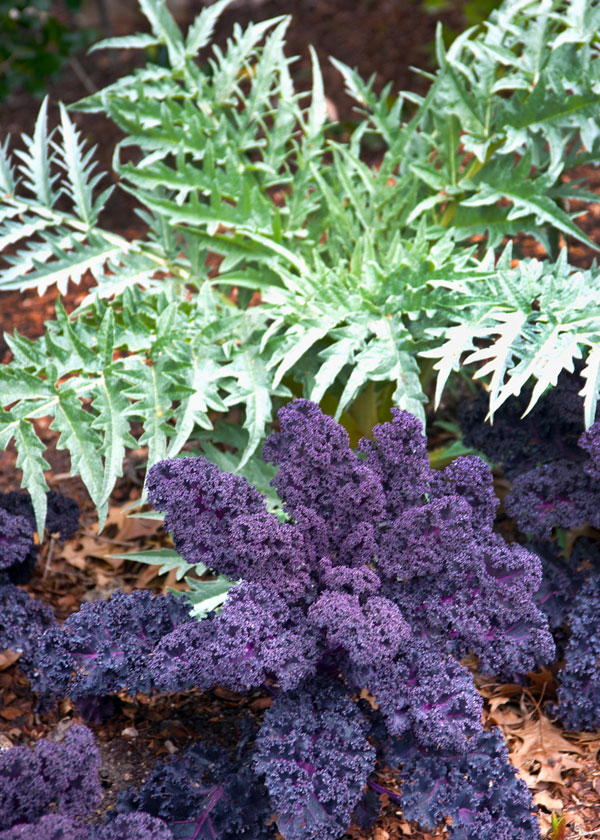
Cardoon This is the tallest and least common of the three plants we’re discussing today. Each clumping plant grows to 4 to 6 ft. tall and wide, and growth culminates in large purple thistle-like flowers resembling those of artichokes. It’s especially showy when used to back Redbor kale (as in photo). Both are tall plants in the landscape, and the color contrast is dramatic.
Cardoon plants are perennials, but they don’t hold up well to Texas summers. The plants tend to “melt” once temperatures climb into the high 90s on a consistent basis by late June or July. But in the meantime, you have a sensational backdrop plant that becomes its own piece of living garden statuary.