
Feeling the chill

When it comes to winter survival with plants, there are several things you’ll need to consider.
All plants have an established “winter hardiness.”
You need to know how winter hardy each plant is for your area. That’s why the USDA publishes their Plant Hardiness Zone Map and updates it every 10 or 15 years. You can find the current map in almost all garden reference books and multiple locations online so I won’t go into it here. But you always want to choose plants that are likely to survive winter cold spells in your part of Texas.
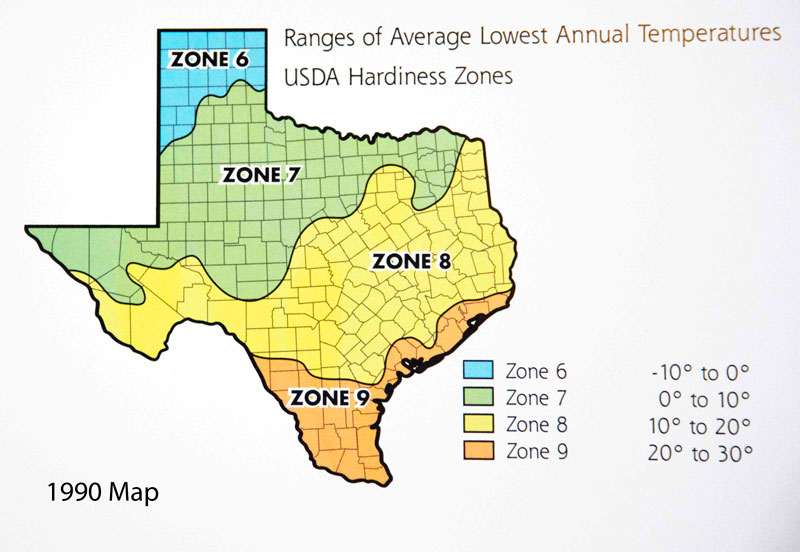
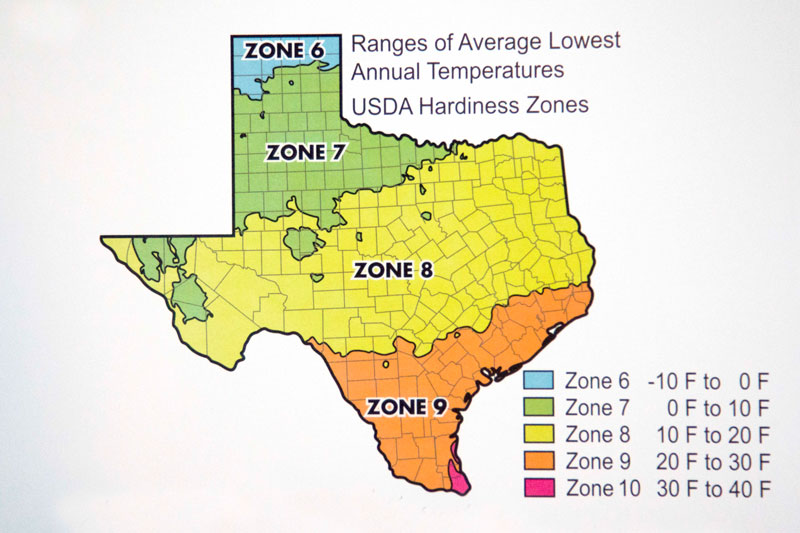
(Note: I personally feel that the USDA’s 1990 map is more accurate for much of Texas than their two successive maps. The later maps, in my opinion, were influenced by warm winters of the early 2000s, and Zones were moved too far north as a result of that bias. People who follow those recommendations are likely to lose plants that are not suited to those locales. I explain that in my latest book, Lone Star Gardening, where I show the 1990 and 2012 maps for comparison.)
What is the other factor that enters the picture re: growing fruit crops?
It’s called the “chilling requirement.” It’s the number of hours a plant is exposed to temperatures between 32F and 45F. It’s the major factor in trigging when any given variety of peach, plum, apricot, nectarine, and many other fruit crops will come into flower.
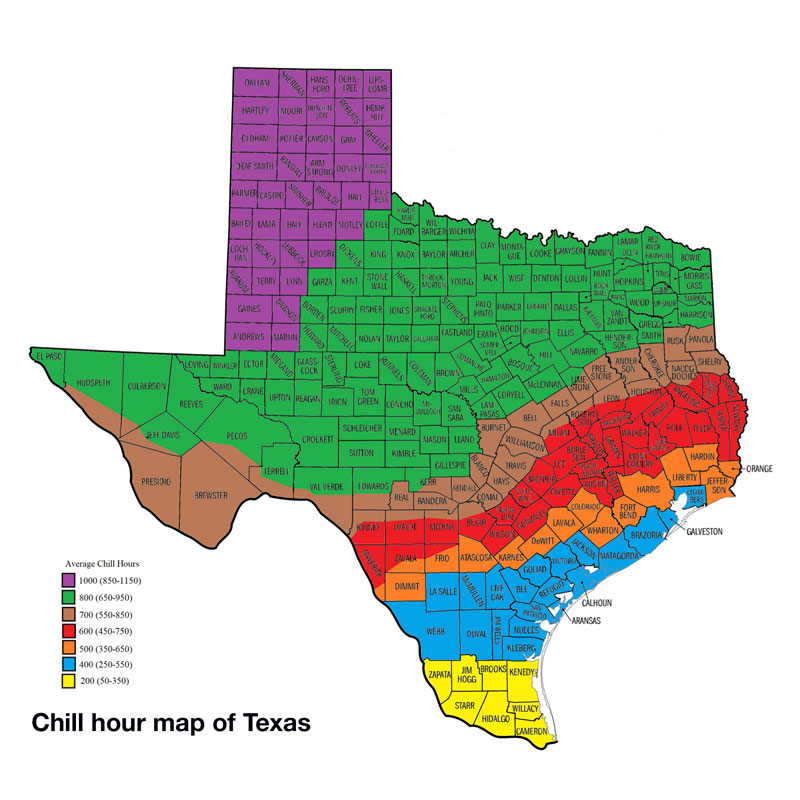
Using peaches as an example, each variety has its own chilling requirement. “Low-chill” varieties have been bred to bloom when they’ve been exposed to as few as 200-300 hours in that temperature range (South Texas, Rio Grande Valley, Gulf Coast). Once that total has been reached, they’ll come into bloom with the next warm spell. They don’t care if it’s still mid-winter. Truth is, however, they almost always get frozen before the crop can mature if a low chill-variety is planted too far to the north.
Other varieties need 500, 800, 1000, and even 1,200 hours of chilling before they will open their flower buds. Some of the high-chill varieties bred for the North may even fail to open their leaf buds at all if they’re in a warmer part of the state. They’re complete duds in those areas.
Look at this map and find your county. Determine the range of hours of chilling it receives on average and buy your fruit trees accordingly.
To carry all this to the ultimate conclusion, here is the full list of Texas A&M fact sheets on fruit varieties and their culture across Texas.
I keep this link from the top TAMU Extension horticulturists on the dock on my iMac. It’s incredibly useful. I hope you agree, and I hope this explanation of “chilling requirement” has brought light to the subject.