
Q&A – Ask Neil: January 22, 2026
(Please read these instructions carefully.)
Before you post your question, please look at recent issues to see if someone else has already asked it. You might find your answer there.
HOW TO SUBMIT YOUR QUESTION…
• Click here to post your question. (Please post your question only one time.)
• Please use this link only for posting questions – not for standard e-mails.
• High-resolution photos (1-2MB – not thumbnails) attached with your question help Neil give you the best possible answer. Please check your photo for clarity and exposure. If you do not see “All images clickable for larger views,” your images’ resolution was not sufficient for enlargement. That might also have made it difficult for Neil to give you an accurate answer.
• Neil chooses questions of greatest reader interest. Plant IDs rarely fit that description.
• Neil requires your first name or initials, also your city or county for an accurate answer. (Texas is a very large state.)
• One question per reader per week, please.
• Watch for Neil’s reply in the next issue of e-gardens.
Note: If you have submitted your question and did not see the pop-up window for attaching your photo, please click here.
QUESTION 1
SHOULD HOLLIES AND ABELIAS BE PRUNED NOW?
Question: You have two pruning recommendations and I need specific advice. Should I trim my evergreen holly bushes now or wait? And I have abelias that also need to be trimmed back. Are these plants both considered to be “shrubs?” Maybe I’m misinterpreting something. Peggy H., West Fort Worth.
Answer: They are definitely shrubs. Prune both now before new growth begins for the spring. Follow-up pruning to touch up irregular growth can be made as needed during the growing season.
QUESTION 2
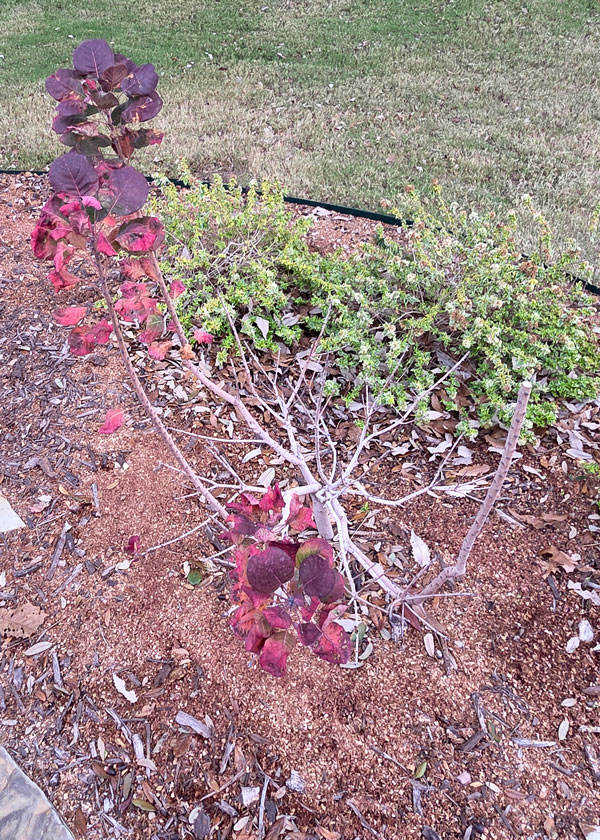
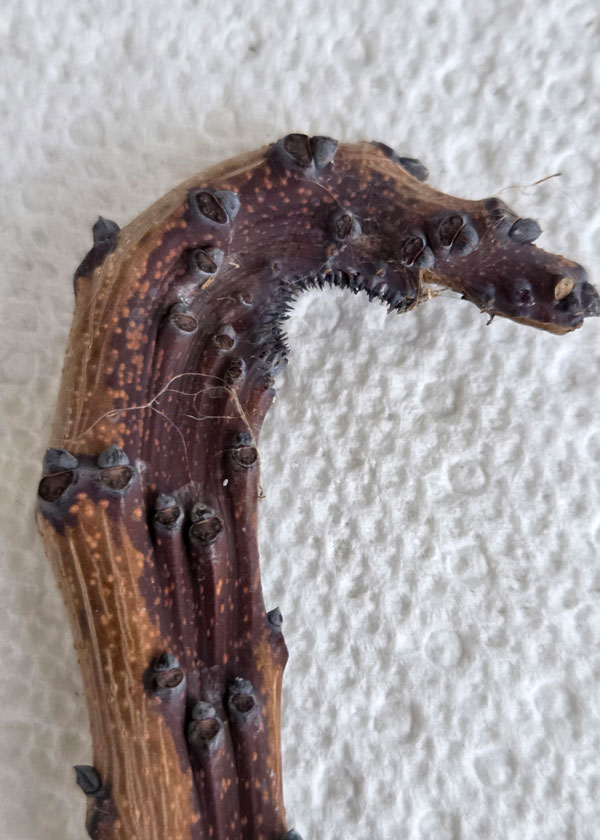
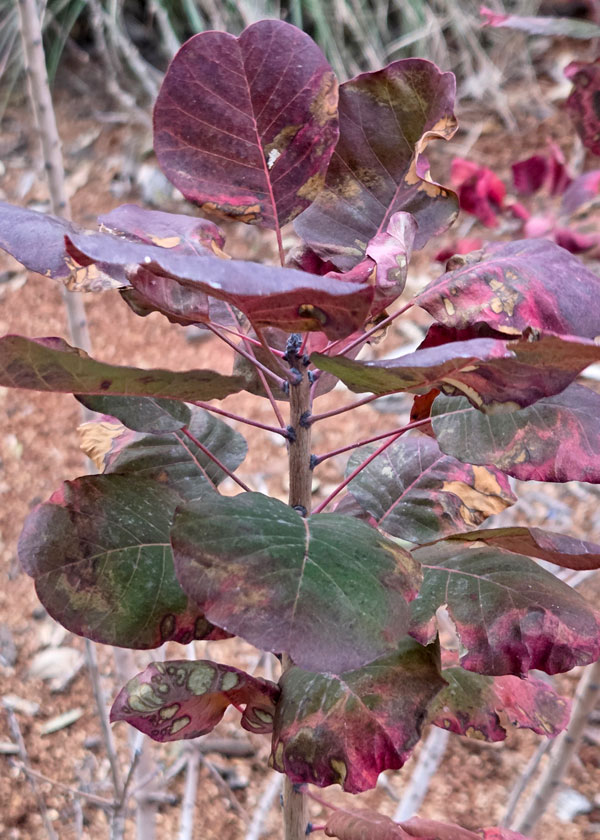
WHAT IS HAPPENING TO MY WINECRAFT BLACK SMOKEBUSH?
Question: I planted a Winecraft Black smokebush last spring. It doesn’t seem to be doing as well as I had hoped. Is this some kind of fungus? Cheryl P., near Eagle Mountain Lake, Tarrant County.
Images clickable for larger views.
Answer: Smokebushes (“smoketrees”) in general are slow to develop in North Texas. That’s why you don’t see more of them. This is not a fungus. Bear in mind that this species is deciduous, so those leaves are eventually going to fall, probably since they have been exposed to last weekend’s hard freeze. That contorted stem is unusual. It looks like fasciation. That’s the mutant growth where development occurs along one plane and not in all directions. You may be familiar with celosias, the popular “cockscomb” annual flower. That’s how their flower heads develop. You’ll see fasciation fairly frequently on Texas mountain laurels and a few other landscape plants. If that’s what it ends up being, trim it out by cutting back into normal growth. Beyond that, let’s just wait to see how the plant leafs out next spring.
QUESTION 3
WHICH ARE BETTER PARKWAY TREES, YAUPONS OR NELLIE R. STEVENS HOLLIES?
Question: Our subdivision is slowly replacing peach trees with yaupon hollies along one of the major streets. Should we be using Nellie R. Stevens hollies instead? Greg P., Dallas.
Answer: Somewhere recently I feel like I have answered this question. I hope this reply agrees with what I said then!
Both are excellent options. Nellie R. Stevens hollies are larger and they’re also more upright, so they would be less likely to get into the street if the parkways are narrow. They could be trained tree-form by removing lower limbs. You can do that trimming and training with yaupons as well, but they will still tend to spread. It really boils down to a matter of personal preference. There’s nothing wrong with having a combination for variety in textures and fruit.
QUESTION 4
IS BONIDE WEED BEATER COMPLETE SAFE AROUND LARGE MAGNOLIAS AND LIVE OAKS?
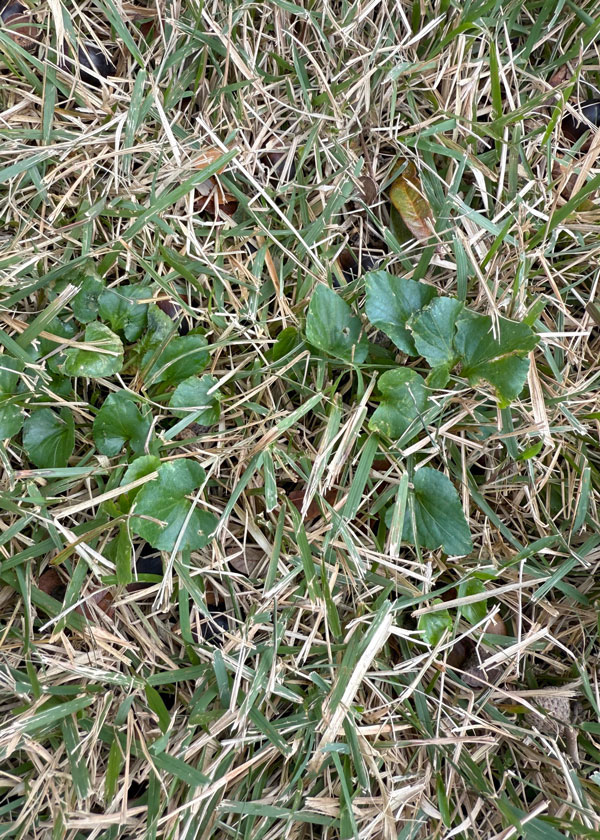
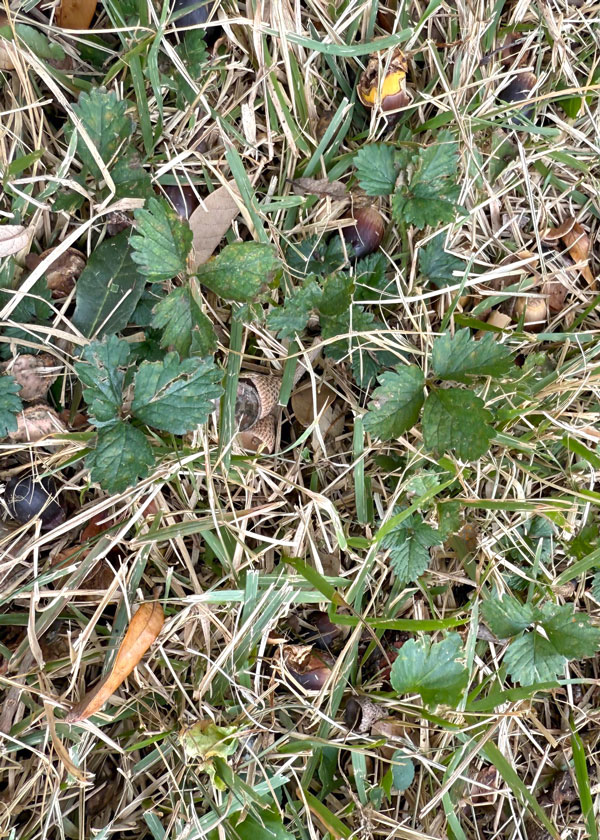
Question: I would like to use Bonide Weed Beater Complete around a 30-year-old southern magnolia in a St. Augustine lawn and a 40-year-old live oak in a zoysia lawn. Both lawns are well established. Would that product be safe for those grasses and those trees? Steve P., University Park.
Images clickable for larger views.
Answer: I’m going to begin my reply with the phone number to Bonide’s national office in Oriskany NY. Call (315) 736-8231 M-F 8AM – 4:30PM and let them have the final decision.
It should not pose a threat to your zoysia or St. Augustine, but I worry more when we start applying post-emergent products inside the drip lines of shade trees. When a southern magnolia is involved, my worries quadruple because for decades the pre-emergent herbicide Atrazine has been included in another company’s weed-and-feed product, and I personally have witnessed major damage, even death it has caused to valuable magnolias in Texas landscapes. Weed Beater Complete does not contain Atrazine, but my nerves are still shaky, and after 30 minutes of searching online for a legible back-of-the-bag label from the Bonide website, I’m just going to have to refer you to them. My 27-in. iMac monitor wasn’t large enough for me to see the print on the back in the upside-down format. I tried zooming, rotating, printing, enlarging. Nothing worked. I’m going to put it back on the Bonide people to help you. I’m sorry to do that to you.
Additional Note: I didn’t realize you had attached photos. You show two broadleafed weeds which could easily be controlled with any of the several broadleafed herbicides containing 2,4-D. While they do instruct that they should not be used beneath trees (inside the drip line), if you were to apply them via a tank sprayer and wand, you would be applying so little of the active ingredients to these weeds that you wouldn’t have to worry about the trees’ roots picking up any of the weedkiller. Crabgrass and grassburs aren’t very likely to pop up in those two turfgrasses if they’re kept dense and vigorous. I’d think there would be a better way than applying pre-emergent herbicides of any kind if these are the sorts of weeds that are causing you concern.
QUESTION 5
IF I PRUNE MY YAUPON HOLLIES BACK TO 5 FT. TALL WILL THAT MAKE THEM DENSE?
Question: I have some very tall and spindly yaupon hollies that I’d like to prune back to about 5 ft. Would that help them regrow to be denser? Susan K., Madison County.
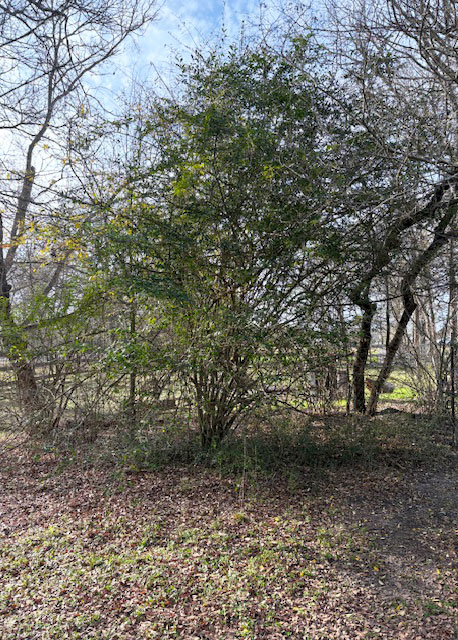
Answer: Looking at your photo, I don’t think it will help. Shade is what caused them to stretch, and as long as the shade remains, they will regrow just as leggy.
QUESTION 6
DO YOU RECOMMEND LIQUID PRE-EMERGENT WEEDKILLERS?
Question: I’ve used granular pre-emergent weedkillers for years. I’m considering switching to a liquid pre-emergent this spring. Do you recommend liquid types? If not, why not? If so, what brands? M A C, Tarrant County.
Answer: Commercial applicators use liquid types very successfully, but my experience has been that homeowners do best with granules. It’s easier for them to make uniform applications – to see where they have been and to avoid missed spaces and overlaps. I’ll turn the tables on you: if you’ve used granules for years, why are you considering changing?
QUESTION 7
IS IT OK TO PRUNE ROSES NOW?
Question: I know the rule of thumb is to prune roses around Valentine’s Day. If we don’t get a hard freeze prior to then, is it still ok to prune? My two Knockouts have put on quite a bit of new growth since the hail hit back in September. Brad S., Sanger.
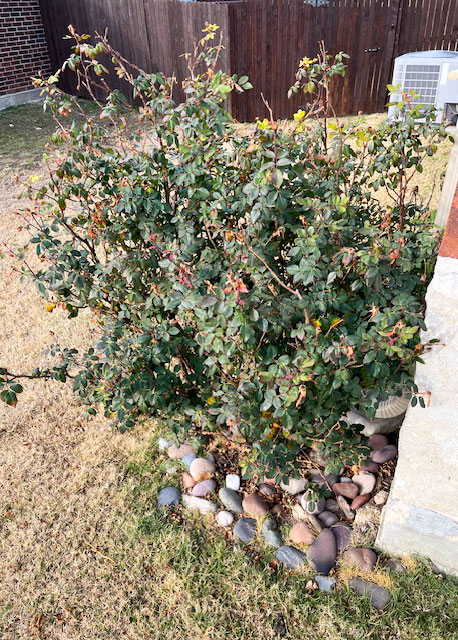
Answer: Just in the few days since you posted your question, your roses have had their hard freeze. Yes, you can prune your roses anytime now. The rule of thumb where you are would be the first couple of weeks of February. That rule remains in place, and after the recent cold it will serve you just fine. Do whatever fits your schedule. Keep your eyes open for the fatal rose rosette virus. It loves Knockouts. I have details on my website.