
A lesson for everyone
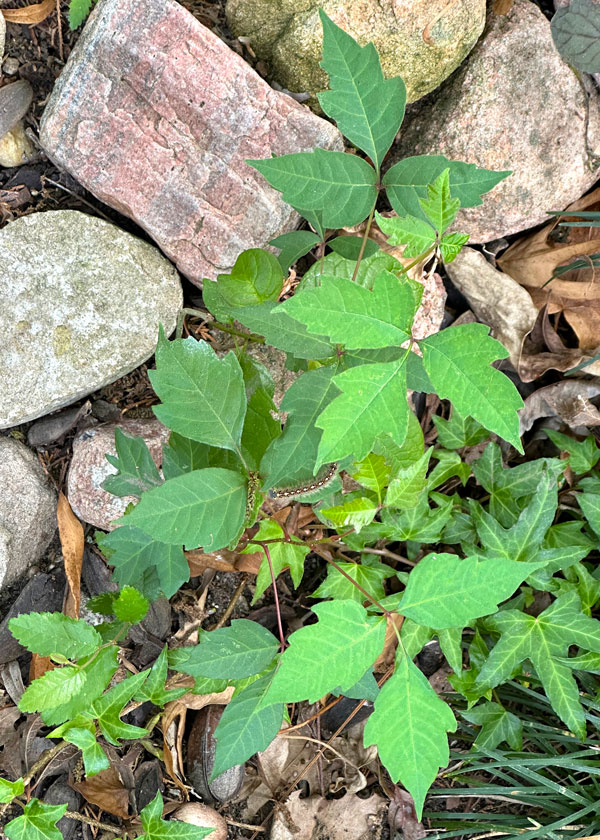
Great-granddaughter Jackie (6) is afraid that all plants in Grandpa Neil’s woods are poison ivy. We were out on the driveway with her last week, and I saw the ideal teaching opportunity. There, growing side by side were the two classic plants that even adults get confused. Each had recently germinated and was proudly growing in a spot where neither is welcomed. It made for a great pop-up classroom for Jackie.
First is a seedling of poison ivy. I showed Jackie right up front what it looks like. We live in a wooded rural area, and as much as I’d like to eliminate it from the property entirely, 55 years and counting haven’t been enough. Birds consume the seeds and “plant” them abundantly.
Every spring at this time I walk all my beds and hoe out the little seedlings before they get a chance to establish deep roots and start climbing.
For those many decades I’ve taught my kids, grandkids, and now Jackie that plants with 3-parted leaves (three leaflets per leaf) must not be touched. Not the leaves. Not the stems. No part of the plants. All parts contain an oil capable of causing a terrible rash. If you so much as brush against the leaves you can develop the itchy irritation. You can even pick up the oils off your clothing.
I will reinforce my lesson a few more times with Jackie before I hoe out that one particular seedling. We see her several times weekly, and she will see how I’ll cut it off with a hoe.
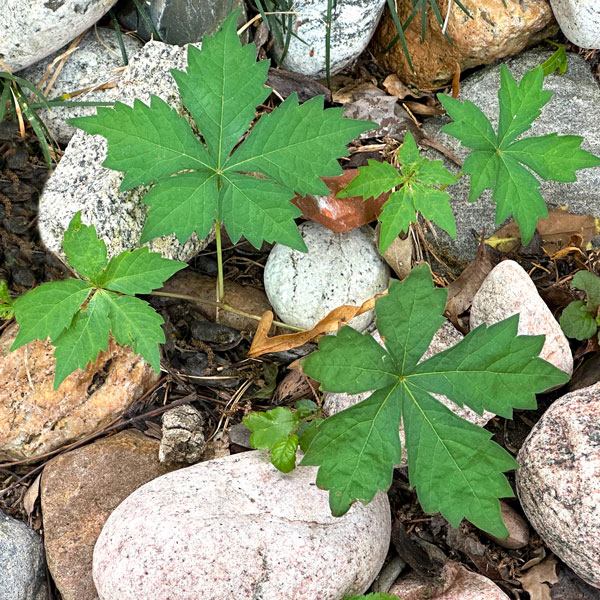
And our other plant is…
Virginia creeper, botanically Parthenocissus quinquefolia. (Sister to Boston ivy, Parthenocissus tricuspidata – see related story this issue.) The species name itself refers to the fact that the leaves have five leaflets. That means it is not poison ivy. Not even related.
Virginia creeper is native to much of the eastern United States. It grows anywhere it can find a place to sprout. It climbs fences. It climbs tree trunks. It climbs walls. It will climb your leg if you stand still for 10 minutes. It’s a big vine.
And Virginia creeper is pretty – dark green in spring, summer, and early fall, then rich red in late fall. (Bare in the winter.) But it’s too rampant for most landscape uses. So, while I’m out hoeing the poison ivy, I’ll be removing the Virginia creeper plants as well.
Jackie is learning Spanish in her classes in school, so these two seedlings gave us chance for another lesson – how to count to 3 and 5 in a second language. No challenge for the Jackie.
And a lesson for you…
That caterpillar you see in the middle of my poison ivy photo is a walnut caterpillar. It’s a leaf eater that has fallen from the tall trees above. We’ve had scores of them littering the driveway over the past 10 days.
The good news is that these larvae don’t create the unsightly webs that webworms and tent caterpillars will make later in the season. These just chew and move on. Their feeding will stop within the next couple of weeks, and the trees will quickly re-leaf and catch up again. No need to worry and no call to action.
There’s the bell. Class is done for the day.