
Q&A – Ask Neil: August 28, 2025
(Please read these instructions carefully.)
Before you post your question, please look at recent issues to see if someone else has already asked it. You might find your answer there.
How to submit your question…
(Note: You may need to allow a pop-up window to come up in order to get the link for sending your photo(s). If you have already submitted your question and didn’t see the pop-up window, please click here.)
• Click the link provided below to post your question. After you submit your question, a new window will pop up giving you the address to which you can e-mail a SHARP, HIGH-RESOLUTION PHOTO to accompany your question. Please DO NOT SEND THUMBNAIL PHOTOS in case I need to zoom in to see things.
• Click here to post your question.
• Please ONLY POST YOUR QUESTION ONE TIME. We can only accept a set number of questions each week, and when we get duplicates it costs other people their chances.
• One question per reader, please.
• Please use this only for posting questions – not for standard emails.
• Watch for your answer in the following week’s e-gardens.
• I choose those of greatest general interest. For example, plant IDs seldom make the cut.
• I must have your first name or initials.
• I must have your city or county. (Texas is a very large state.)
Important favor: I’ve been covered up so far this year with questions about live oaks losing chunks of bark. Rather than continuing to answer the same questions weekly, I’d ask that you look back to previous issues. You’ll find several replies that I’ve posted. Thanks!
QUESTION 1
WHAT’S GOING ON WITH OUR ST. AUGUSTINE?
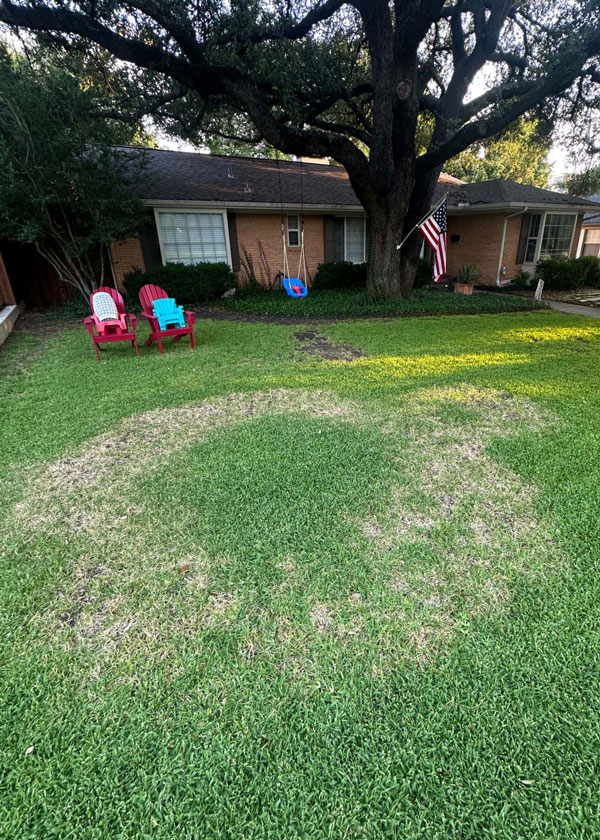
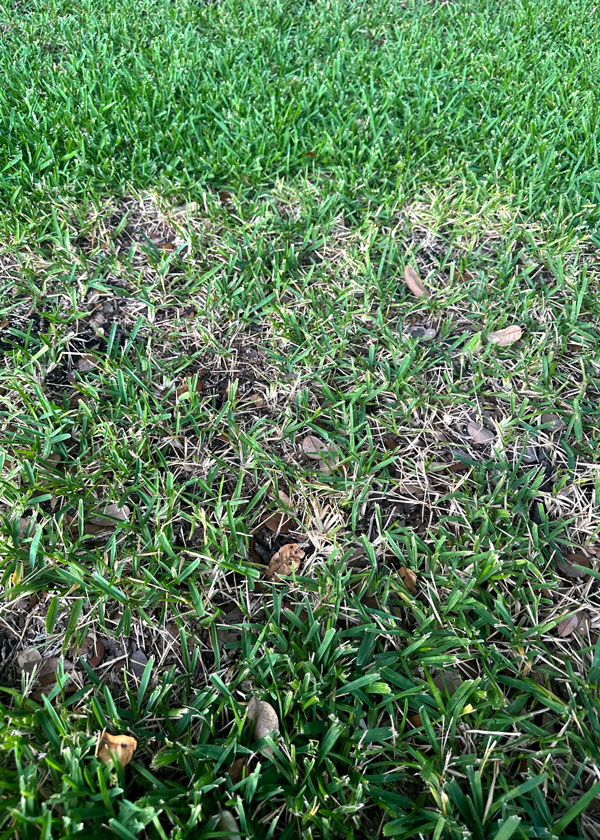
Question: Any idea what is happening with our St. Augustine? It looks like this at the beginning of each summer. I water it early in the mornings, mow it weekly, and fertilize it only in early summer. It has not improved. Chris H., Dallas.
All images clickable for larger views.
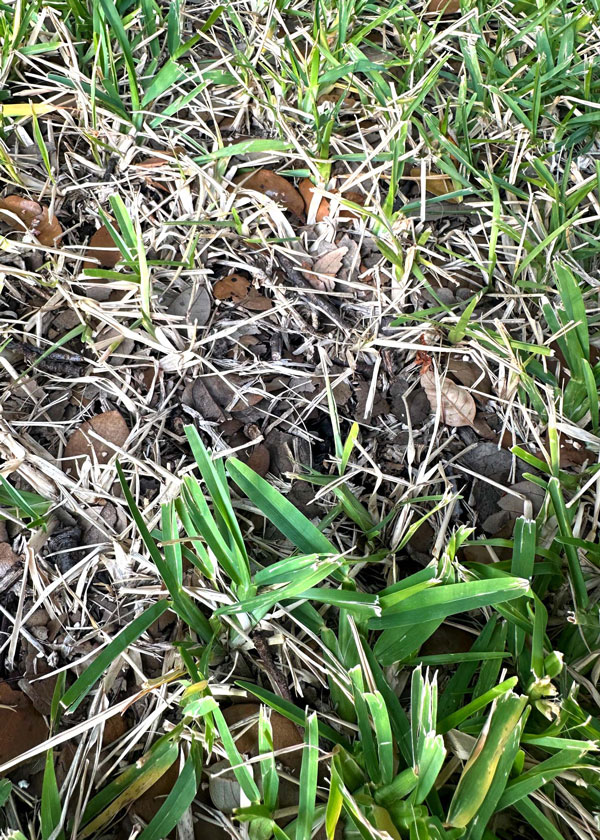
Answer: Your photos are classic examples of the disease we’ve always called brown patch, now being called by university plant pathologists “large patch.” The only problem is that the season you reference is out of cycle. Brown patch is typically a cool-season fungus. We see take-all root rot in April and May, then gray leaf spot in summer, and brown patch once temperatures start to fall and rain kicks in in the autumn.
Brown patch is a fungus affecting the blades of St. Augustine, zoysia, and other turfgrasses. In the case of St. Augustine, it attacks the blades at their bases, right where they attach to the runners. The blades turn yellow, then brown, and they pull loose easily from the runners. You can easily see the areas of deterioration. The runners and roots remain healthy.
The infection begins in much smaller patches, generally 18 to 24 inches across. As the patches enlarge, the centers seem to “heal” and new, green blades are produced, just as you see in the center of your most distant photo.
All the diseases I mentioned can be brought under control with the fungicide Azoxystrobin, but you’ll want to keep up with that morning watering schedule. As much as you can control it, do not let your lawn go into the night wet.
If any of this doesn’t look accurate, you could have samples of the grass examined by the Plant Disease Diagnostic Laboratory at Texas A&M in College Station. However, the symptoms are so typical, I feel comfortable with my diagnosis. Plus, you can easily confirm it by checking the blades.
QUESTION 2
WHAT SHRUB WOULD SHIELD A SMALL STORAGE SHED IN SHADE?
Question: Can you suggest a shrub to shield a small storage shed? It’s in almost total shade. Jack K., Bryan.
Answer: Dimensions or a photo would have been helpful, but I’ll do the best I can. Hollies are always going to be my suggestion for best shade shrubs. I’m assuming you want something that would conceal it completely to its eaves, and if so, then Willowleaf (also known as Needlepoint) hollies would probably be best. Oakland hollies would be more formal. Dwarf Burford hollies would be shorter.
QUESTION 3
CAN IMAGE OR SEDGEHAMMER BE USED AROUND YOUNG TREES?
Question: Can Image or Sedgehammer be used safely around young trees? Karen R., Cooke County.
Answer: Unless you find some odd reason on the label warning you not to do so, yes. I’ve never seen such an alert. They are not approved for use around fruit trees.
QUESTION 4
WHY DOES A SMALL REDBUD TREE KEEP DYING BACK?
Question: I have a small redbud tree that has been in the ground for 5 years. Year 3 it died with the main part of the tree dying first and then branches slowly dying off. It came back, looked great, then started dying again. This has happened twice. What is going on? Marian M., Milam County.
Answer: So, if the planting and two subsequent diebacks have all happened in a 5-year period, that tree is obviously very weak. It may be that the original tree got too dry in its first couple of years, or that it was hit by red-headed wood borers, a small borer that is fairly common in redbuds and other struggling trees. Whatever the cause, it sounds like it’s time to try another tree. I don’t believe your tree has enough built-in reserve energy to keep up this pace.
QUESTION 5
HOW DO I REPAIR MODERATE CHINCH BUG DAMAGE?
Question: I have moderate chinch bug damage in my St. Augustine. When is the best time to begin the repair process, and how best should I do it? Jon M., Dallas.
Answer: If “moderate” means the grass has just thinned out but still has living runners spread throughout, you start with an insecticide to stop any further damage. Then you apply an all-nitrogen lawn food with 30-40 percent of that nitrogen in slow-release form anytime the first two weeks of September. That will encourage one more round of new growth before cold weather arrives.
If you have dead spots in the lawn, on the other hand, you’re going to have to plant plugs into them. You can do that immediately or, to be on the safe side, you can wait until early April. Plugs have deeper roots than pieces of sod so they will establish more rapidly prior to winter. Checkerboard them 15 inches apart across the dead areas.
Chinch bugs will return to those same spots each summer, so have a labeled insecticide ready to go next summer. Apply it the first time you see signs of the dried grass and presence of the small black insects.
QUESTION 6
CAN I CUT OAK ROOTS BEFORE THEY DAMAGE MY FOUNDATION?
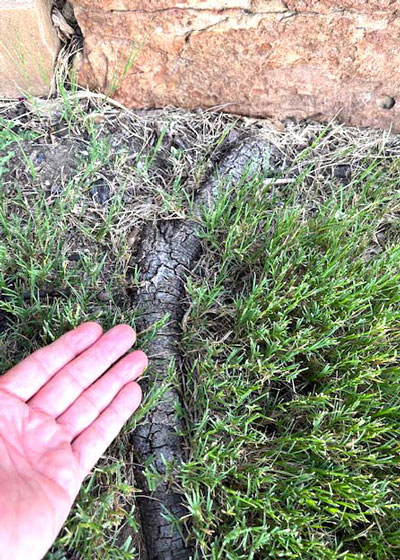
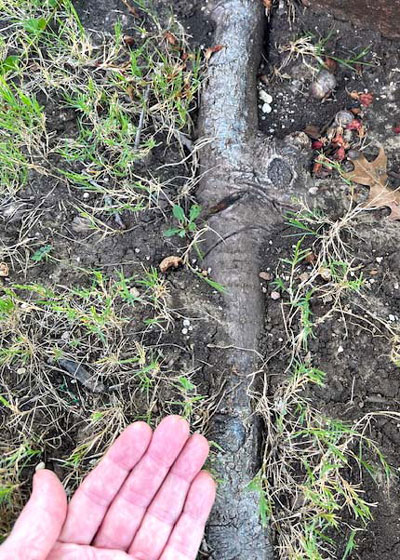
Question: I have a 20-year-old oak tree with several 3- to 5-inch diameter roots protruding up through the bermudagrass. Can I remove them before they do damage to the foundation? Mike S., Collin County.
Images clickable for larger views.
Answer: Yes! If you do not, they will get larger and eventually lift and break your foundation. Roots have incredible strength. If you have several, and if they are larger than these, you probably should have a certified arborist help you with this work. It should be done in October to give the tree maximum time to produce new roots before hot summer weather returns. Consider having them install a 24- or 30-inch root barrier between the trunk and your house to prevent roots from doing this time after time. You may need to stage this over a period of several years if you have very many of these roots of this size. Hopefully your tree is 18 or 20 feet or farther from the house.
QUESTION 7
WHAT IS WRONG WITH MY CRAPE MYRTLE?
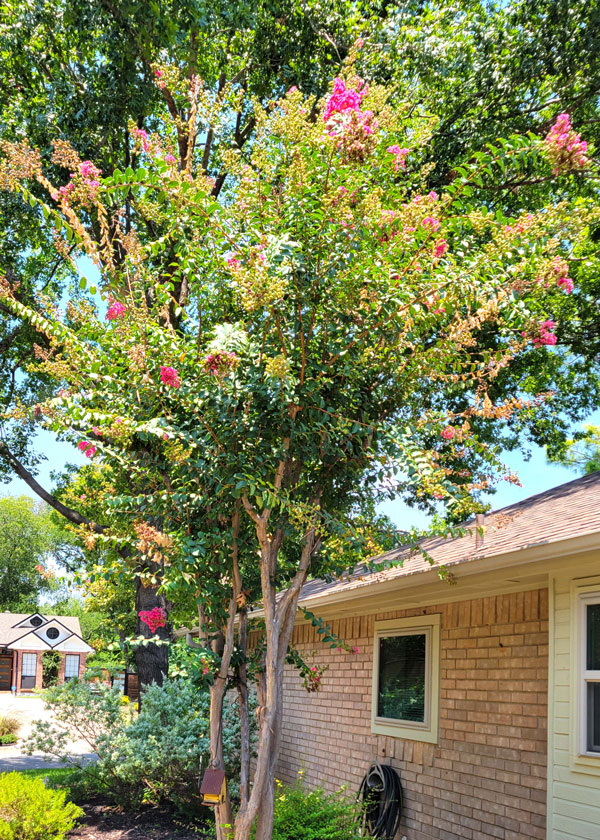
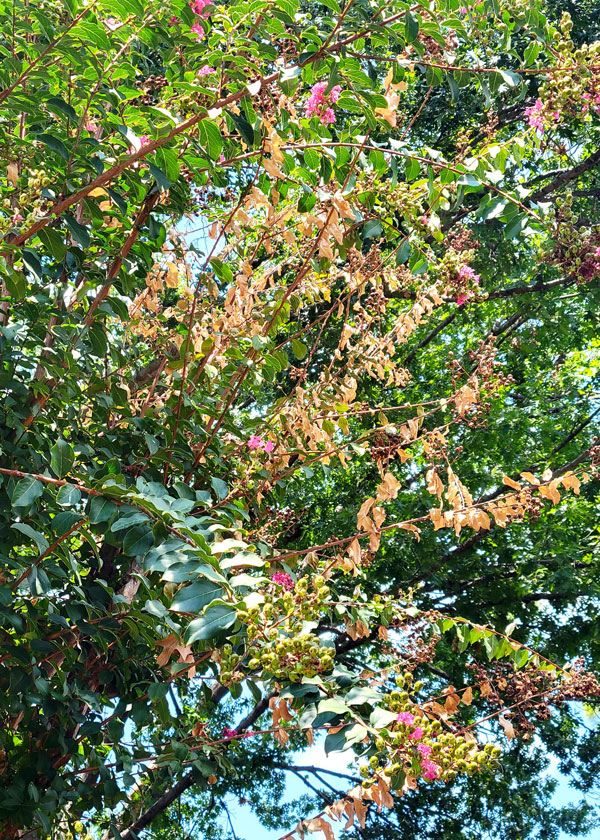
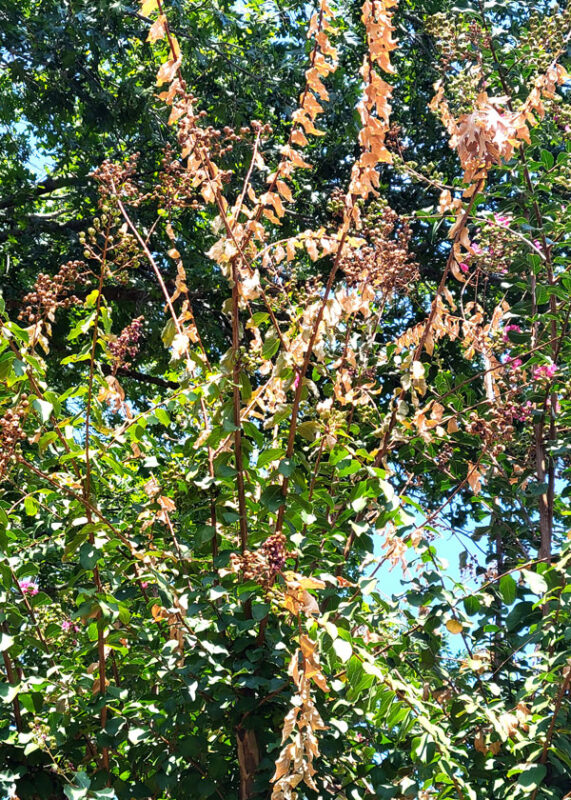
Question: My crape myrtle appears to have a blight. We did the Imidacloprid drench in the spring like we always do for scale and aphids, and it seems to have worked for this plant and three others. This tree, in a different location, is the only one showing the browning leaves. What is going wrong? Kelly S., Arlington.
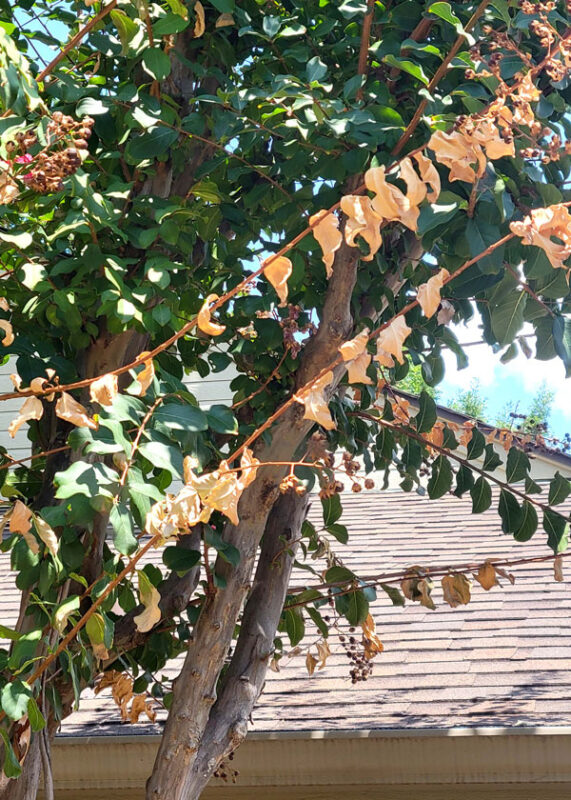
All images clickable for larger views.
Answer: I cannot tell. I scanned up and down through all the photos. I zoomed in tightly on each of them. After 10 minutes of looking, I still saw no clues. The browning leaves seems to be on the back side of the plant, not where you were standing as you took the photos.
It does not look like powdery mildew. I see no signs of scale or aphids (no shiny residue on the foliage). It does not look like leftover freeze damage, although this does look it might be the variety Tuscarora, a popular one in nurseries. Tuscarora is subject to freeze damage, but again, this doesn’t look like a match.
Honestly, this looks more like the plant was sprayed with hot water out of the garden hose. Or, perhaps it was hit by remnant herbicide residue in a spray tank.
As you can tell, I’m clueless without more information. I would suggest you track the brown foliage back to the main trunks to see if you can find any obvious transition where the dieback turns into good bark. That would give us a better idea.
QUESTION 8
CAN I APPLY IMAGE TO ELIMINATE NUTSEDGE IN ASPARAGUS?
Question: I have Image that I would like to use to control nutsedge in a 20-ft. row of asparagus. However, I can’t find any instructions on how much or how to apply it. Can you help me? Is it safe and effective? Glen, Calvert.
Answer: Glen called my statewide Texas Lawn and Garden Hour radio program this past Saturday morning. I told him I did not know the answer, but that I would do the research for him. He referenced e-gardens, so I told him I would answer here.
That turned into a challenge. I finally turned it over to ChatGPT to let their AI computers help me. I watched for 20 minutes as they scanned dozens of websites and PDFs. They kept hitting roadblocks like I’ve never seen.
Finally, it settled on this information which is what I had feared:
“Don’t use ‘Image’ (imazaquin) or “Sedgehammer” (halosulfuron) in asparagus unless the label explicitly lists it. Most formulations are labeled for turf and ornamentals, not for food crops.”
Their “practical working strategy” did not impress me. It consisted only of spot-treatments with products that would suppress growth, not kill it such as a shielded spray of a straight glyphosate herbicide plus a long-term consistent mulching and “clean cultivation” between harvests. I’ve been down that road, and it was a dead-end for me. Maybe they were more diligent than I.
I still like my suggestion of starting a new bed some distance away this fall so you’ll be ready to plant new roots in early January. Harvest all you can out of the old planting for the next couple of springs but plow it under once your new bed starts producing. At that point you would be free to use either of the nutsedge remedies without any restrictions.