
Q&A – Ask Neil: November 6, 2025
(Please read these instructions carefully.)
Before you post your question, please look at recent issues to see if someone else has already asked it. You might find your answer there.
HOW TO SUBMIT YOUR QUESTION…
• Click here to post your question. (Please post your question only one time.)
• Please use this link only for posting questions – not for standard e-mails.
• High-resolution photos (1-2MB – not thumbnails) attached with your question help Neil give you the best possible answer. Please check your photo for clarity and exposure.
• Neil chooses questions of greatest reader interest. Plant IDs rarely fit that description.
• Neil requires your first name or initials, also your city or county for an accurate answer. (Texas is a very large state.)
• One question per reader per week, please.
• Watch for Neil’s reply in the next issue of e-gardens.
Note: If you have submitted your question and did not see the pop-up window for attaching your photo, please click here.
QUESTION 1
HOW MUCH DO YOU KNOW ABOUT BRUGMANSIAS AND EPIPHYLLUMS?
Question: How much do you know about Brugmansias and Epiphyllums? I don’t think I have ever seen you mention either of them. Susan L., Burleson.


Images clickable for larger views.
Answer: That’s a rather open-ended question. I have grown each of them over the years. Epiphyllums are lovely tropical epiphytic cacti. Brugmansias are gloriously beautiful sub-tropical shrubs or tender perennials, sisters to our common native Jimson weed (angel’s trumpet). I’ve been publishing e-gardens for 20 years. Each has been covered. Perhaps it’s time to do so again. Without knowing if you had a more specific question about either, I guess that’s about all I can add.
QUESTION 2
SHOULD I DIVIDE AND REPOT MY NATIVE TEXAS PERENNIALS NOW?
Question: I have many Texas native perennials in pots in my backyard so I can move them around for purposes of insect photography. They include Gregg’s mistflower, fall asters, mealy blue sage, and others. Should I be dividing and repotting them now, or should I wait? Mark L., Bedford.
Answer: Once they’re completely through blooming for the fall season you could divide and repot them. However, I’d be tempted to wait until late winter. Dividing a clump of perennials weakens it just a bit. Doing so right before winter presents an added risk. I would leave them alone until just before they start to send out new shoots in February and do my dividing at that time. Keep them well watered and protected from extreme cold in the meantime.
QUESTION 3
HOW CAN WE STOP SCORES OF CRAPE MYRTLE SPROUTS FROM COMING UP EVERYWHERE?
Question: We had to take down a crape myrtle and now we’re cursed with scores of sprouts coming up from the old plant’s roots. How can we stop these? Gregory H., Grapevine.
Answer: It will involve a bit of digging, but get as much of the old plant’s root system out as you can. If you still have access to its stump, drill into it and pour a broadleafed weedkiller in at full strength to fill the holes your drill has created. Let it soak into the wood, then fill the holes again. Coat the sprouts next spring with a 2,4-D product mixed at the spraying strength. Be diligent and you’ll discourage them. It may take a year or two, but you’ll see progress.
QUESTION 4
WHAT MIGHT HAVE KILLED MY FOREST PANSY REDBUD, AND WHAT REPLACEMENT COULD I USE?
Question: My Forest Pansy redbud died at the end of May in just 7-10 days. Could that have been cotton root rot? I love Forest Pansies. Could I plant another redbud there? If not, what else would be good? I like Nellie R. Stevens hollies, but my kids run barefoot, and I worry about the spines and their feet. Kory H., Grapevine.


Images clickable for larger views.
Answer: Redbuds are highly resistant to cotton root rot. I would suspect red-headed wood borers or some insect pest more than CRR. Your soils in Grapevine are, for the most part, red sandy loams. They are neutral or slightly acidic. That’s not the type of soil that harbors CRR – it is found in alkaline soils.
Note: In cropping your photos after I had written my reply, I noticed the overhead power lines. Little Gem magnolia might grow too large, and it might fill the bed. I’d stick with hollies such as Nellie R. Stevens (maybe trained multi-trunk tree-form) or Warren’s Red possumhaw hollies, or I’d plant a tree-form crape myrtle. I see you already have another crape myrtle farther back in your landscape. Find a compatible color. For what it’s worth, the variety Catawba is compatible with any color (it’s medium purple) and it’s medium height. It’s also my all-time favorite!
I also see a Carolina jessamine vine (I believe) growing on your fence. It appears to be showing iron deficiency, so I now question whether you have acidic soil like most of Grapevine. Nonetheless, redbuds are rarely bothered by cotton root rot.
As for the best replacements if you opt not to use another redbud, Little Gem southern magnolia would be gorgeous. And Nellie R. Stevens holly leaves are not all that spiny. I can’t imagine a child’s foot being harmed by them. I have them all over our landscape. They drop their old leaves in late spring over a 2- or 3-week period. It would make a great small tree. Little Gem would be the next size up the ladder.
QUESTION 5
WHAT IS THIS ON OUR YUCCAS?
Question: Every fall and spring our yuccas put up lovely bloom spikes only to have them decimated in a day or two by hundreds of these insects. We’ve tried an insecticide, but maybe the wrong kind, as it did nothing to stop them. Help. Katie F., Paris, Lamar County.
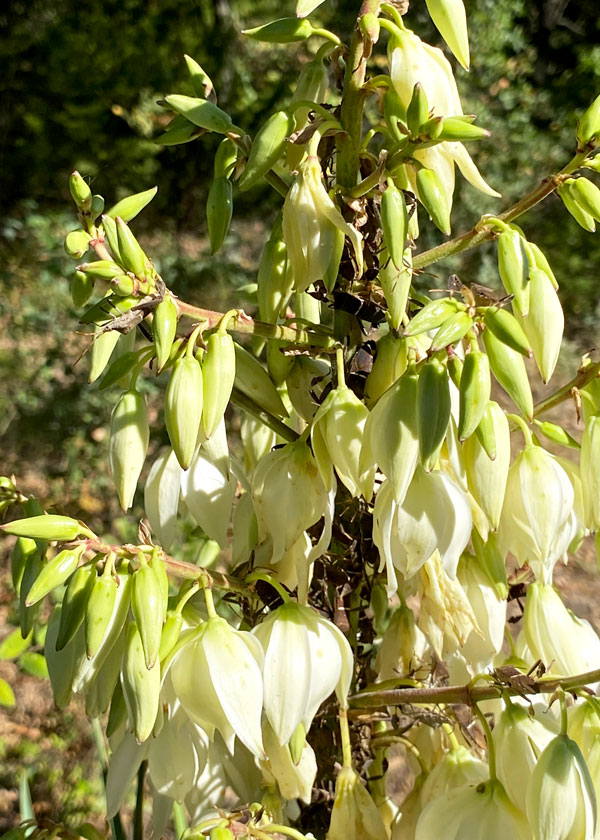

Images clickable for larger views.
Answer: With two degrees and 55 years’ experience in horticulture, I only pretend to be an entomologist. I believe your yuccas are being visited by one of the leaf-footed bugs (insects that are in the category known as “true bugs”).
They’re relatively common visitors to yuccas while the plants are in bloom. They don’t do serious damage to the plants, but their mouthparts can scar and deform buds, blooms, and fruit. They will also damage fruit and vegetables in the garden later in the season.
The entire group of true bugs is difficult to eliminate. It includes squash bugs, box elder bugs, stink bugs, and this one. Conventional insecticides generally don’t do much good, especially with mature individuals of these species.
Try knocking the bugs off the flower stalks into a bucket of soapy water when they’re getting started. As with aphids, you may be able to dislodge many of them with a hard stream of water. When necessary, apply pyrethrum, permethrin, or cyfluthrin products labeled for ornamental use only. Spray late in the day to minimize risk to pollinators. Keep the surrounding habitat free of debris, spent flower stalks, and old foliage to minimize chance of reinfection.
QUESTION 6
SHOULD I CUT MY CRAPE MYRTLES BACK TO THE GROUND?
Question: My crape myrtles need to be trimmed back. My neighbors want them off the property line. They cut down 5 old trees, and now my crape myrtles get full sun. They had grown to be 24 ft. tall. Should I just cut them back to the ground? Margaret, White House (near Tyler).
Answer: I’m answering without being able to see the trees. A photo would really have helped. I can imagine they are lopsided if they were up against large shade trees. I’m unclear, however, if they’re really close to the property line. (Sounds like they might be.) Remember that it’s their genetics that got them to 24 ft. tall, and those genetics will take them back to that same height as they regrow. The only difference is that they will grow out farther in the direction that the old trees used to occupy. Your problem may end up being worse. If they really want none of your crape myrtle limbs hanging over their property, the only way you can assure that would be to take them out entirely. Of course, as you read earlier (Question 2 above), that would precipitate scores of root sprouts for a couple of years, but eventually they would go away.
QUESTION 7
WOULD TREE ROOTS HARM NELLIE R. STEVENS HOLLIES OR WAXLEAF LIGUSTRUMS?
Question: I’d like to plant either Nellie R. Stevens hollies or waxleaf ligustrums along a fence line. It’s in heavy shade close to many cedar elms. Will the tree roots prevent them from thriving? Clay soil. Susy M., College Station.
Answer: Nellie R. Stevens or other hollies would be better adapted to shade than the ligustrums. Ligustrums need full or nearly full sun to stay full, compact, and attractive. As long as you keep them properly watered and nourished, hollies could compete with the cedar elms without any problem at all.