
Q&A – Ask Neil: October 2, 2025
(Please read these instructions carefully.)
Before you post your question, please look at recent issues to see if someone else has already asked it. You might find your answer there.
How to submit your question…
(Note: You may need to allow a pop-up window to come up in order to get the link for sending your photo(s). If you have already submitted your question and didn’t see the pop-up window, please click here.)
• Click the link provided below to post your question. After you submit your question, a new window will pop up giving you the address to which you can e-mail a SHARP, HIGH-RESOLUTION PHOTO to accompany your question. Please DO NOT SEND THUMBNAIL PHOTOS in case I need to zoom in to see things.
• Click here to post your question.
• Please ONLY POST YOUR QUESTION ONE TIME. We can only accept a set number of questions each week, and when we get duplicates it costs other people their chances.
• One question per reader, please.
• Please use this only for posting questions – not for standard emails.
• Watch for your answer in the following week’s e-gardens.
• I choose those of greatest general interest. For example, plant IDs seldom make the cut.
• I must have your first name or initials.
• I must have your city or county. (Texas is a very large state.)
Important favor: I’ve been covered up so far this year with questions about live oaks losing chunks of bark. Rather than continuing to answer the same questions weekly, I’d ask that you look back to previous issues. You’ll find several replies that I’ve posted. Thanks!
QUESTION 1
WHEN SHOULD I PRUNE MY BRIDAL WREATHS AND HOW?
Question: I have two bridal wreaths that are now 20-plus years old. They have never been pruned and now they seem to be getting many dead branches in their centers. When should they be pruned and how? They are approximately 6 ft. tall and 10 ft. wide. Carol M., Fayetteville, Fayette County.
Answer: Normally, the best time to prune spring-flowering shrubs (and vines) is in the spring immediately after their bloom cycle. However, since these have never been pruned, and since this trimming is going to be rather major, I’d probably start it this fall.
Use long-handled lopping shears to reach into the plants to trim away all the dead branches. As spiraeas age, their outer branches shade the older, internal shoots until they die from lack of light. You can always trim dead tissue out of any shrub or tree without fear of doing harm.
Next, I would do any general reshaping as needed to restore good form to your plants. If they then need to be trimmed back considerably to let them fill in as smaller shrubs, that part could be saved for spring after their blooming season.
Don’t be timid about doing this. Just do it with hand shears rather than power equipment. You will be the sculptor, and your plant will have a natural form when you finish.
QUESTION 2
IS IT TOO LATE TO PLANT ZOYSIA PALISADES OR ZOYSIA ZEON SOD?
Question: Is it too late to plant zoysia sod in Allen, Texas? Either variety Palisades or Zeon?
Answer: You’re on a border line of time. Zoysias are more winter hardy than St. Augustine, so from that standpoint, you would likely be ok. However, they’re also the first grasses to turn brown with frost in the fall. I live within 10 miles of you, and we have had our first killing freezes as early as late October in Collin County. That would give the sod only 4 weeks to establish new roots and grow a bit before frost. That wouldn’t be as much as you would want. If you’re talking about a new house and bare ground where you are required to plant sod before occupancy, I guess you could, but you would be assuming that risk. If you could wait until April, that would be even better.
QUESTION 3
HOW DO I GET RID OF ROOT KNOT NEMATODES?
Question: I garden in raised beds. What steps can I take to eliminate root knot nematodes that have caused my tomatoes to be so deformed? Do I treat this fall or next spring? I have limited space to rotate crops. Lisa B., Mansfield.
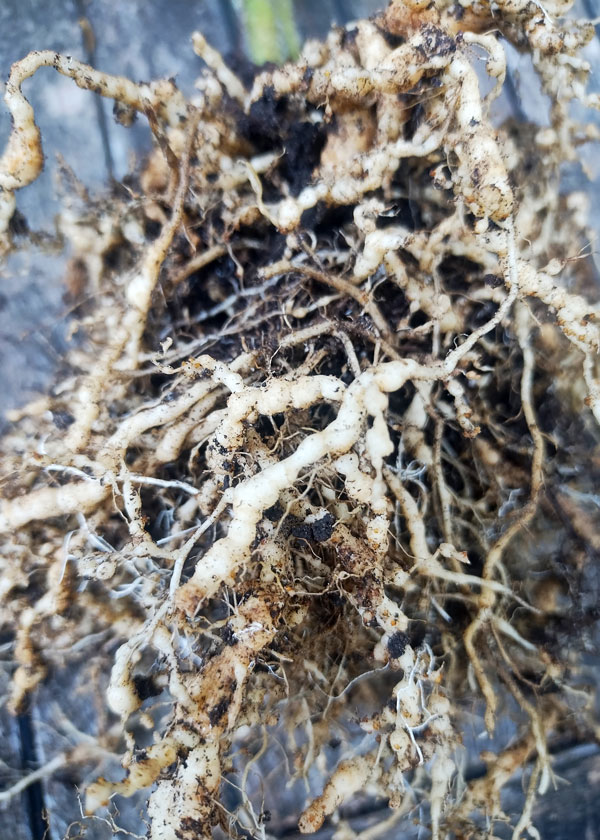
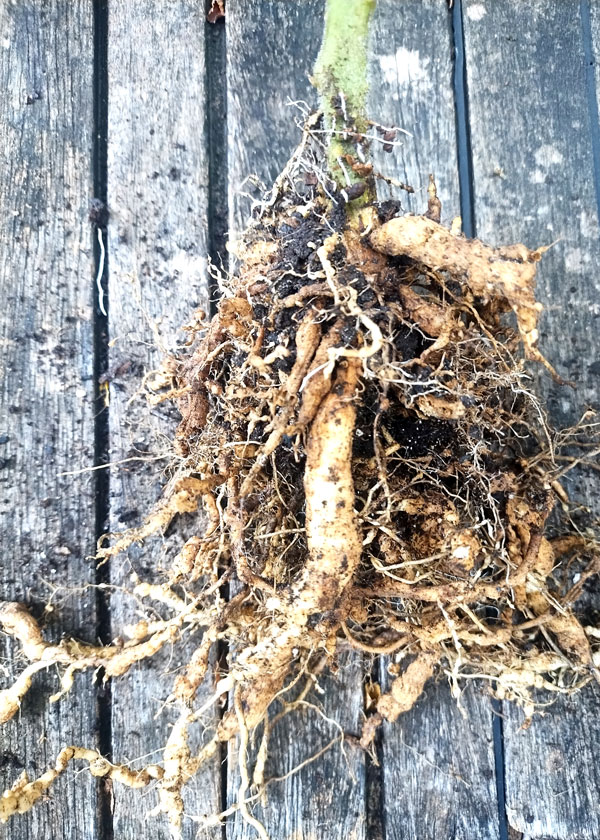
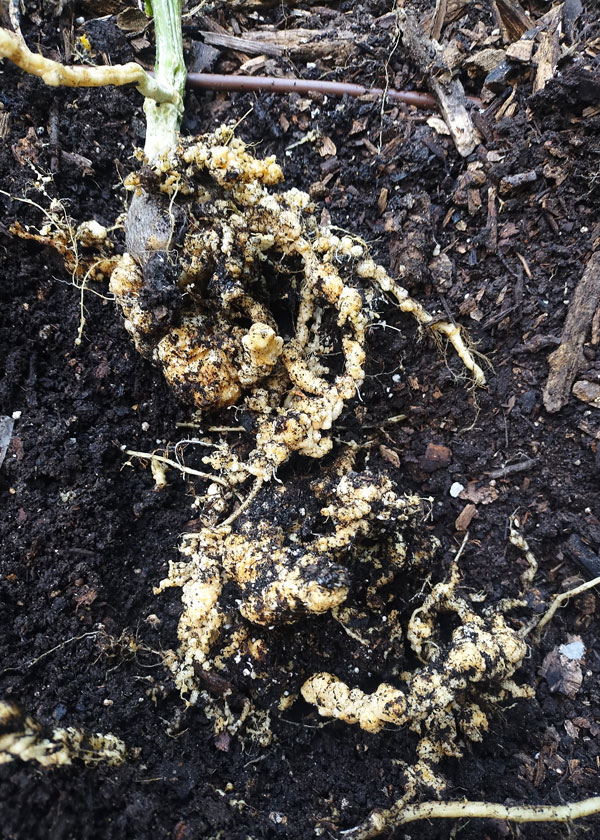
All images are clickable for larger views.
Answer: That’s a challenging problem that’s compounded by the limited space. And, unfortunately, it’s not as easy as pouring or spraying a control product out onto the ground. It’s more involved than that.
For those who are unaware, root knot nematodes are microscopic soil-borne worms that sting plants’ roots, then suck fluids from them. The swollen galls form as a reaction to the injuries. The plants weaken and become very poorly productive.
Your first step would be to use varieties that carry an “N” in their name. You’ll see Celebrity “VFN” and Better Boy “VFN” sold. Those initials following the name of any variety indicate that those varieties are resistant to verticillium and fusarium wilts and nematodes.
Second, remember that nematodes infest warm-season vegetables like tomatoes, peppers, beans, and okra far more aggressively than they do cool-season crops such as leafy vegetables, onions, and garlic. If at all possible at least rotate among those crops so that you can leave the tomato garden empty of warm-season vegetables for 1-2 years.
If that’s not possible, consider growing your tomatoes in large containers. I’ve had good luck using 10-gal. nursery pots filled with a highly organic potting soil and none of the soil from my garden.
Would it be possible to construct one or two new raised beds and devote them to your tomatoes? You could then leave the current beds empty for a couple of years so you could “solarize” them. In the summer, cover the moist soil with clear plastic that you have sealed around the outer edges of the raised beds. Let the sun’s rays heat it, hopefully to 130F. Your goal will be to kill many of the nematodes and weed seeds in the process.
Elbon cereal rye has long been recommended as a fall planting, then removing it in March with nematodes embedded in its root systems. If you did that in combination with the summer solarization for a year or two you would have a good combination approach.
Unfortunately, we do not have a consumer nematicide that can be applied to soil to eliminate nematodes between crops. You’re going to have to resort to this combination effort.
And the final option is complete removal and replacement of the existing soil to a depth of 16 in. That’s a lot of work, but it does give you a second chance at a fresh start. Be careful, if it comes to that, that you check every plant that you buy to be sure it is not bringing new nematode problems into the garden with it.
Want more information? You’ll find oodles by Googling “university plant pathology nematodes.” That will put you in with the accurate and honest information on their identification and control.
QUESTION 4
WHAT CAN BE DONE TO CORRECT MY LEANING TREE?
Question: I have a live oak that was planted in 2021. It’s been leaning more and more ever since. I’ve had it re-staked, but that hasn’t helped. Is it possible to have it dug and replanted? The tree is planted on a slope, down from left to right, so I’m sure that isn’t helping. What can we do? Kevin A., Van Alstyne.
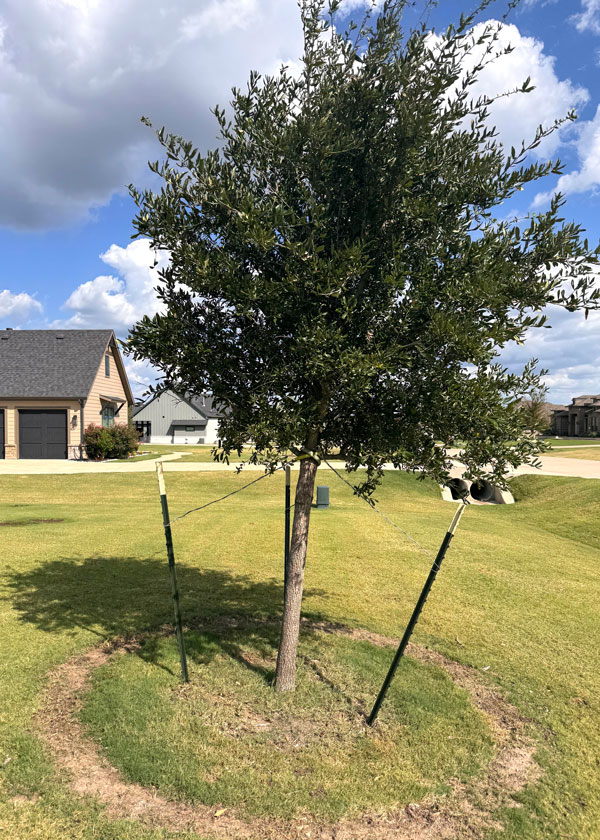
Answer: “Re-staking” isn’t going to help this tree. That just means pulling it up until it looks vertical, but then the tree will pull against the cable until it pulls the uphill stake toward the trunk and the lean redevelops.
Yes, it needs to be dug and reset. That should be a relatively easy project for a professional with the right equipment and experience. It could be done with a tree spade or by a small crew with shovels. Have them replant it at precisely the vertical line, then pack the soil around the soil ball firmly as they water it in place. It will need to be staked once again for a couple of years, but I would suggest larger and stronger stakes positioned outside the soil ball. The way this one looks, the stakes appear to be inside the soil ball. As this tree started to lean, the soil ball leaned with it and the stakes went along for the ride. You need to have them anchored in hard-packed soil of the original grade. Perhaps have the cables a bit farther up on the trunk for better stability.
QUESTION 5
DO YOU RECOMMEND A SPECIFIC BRAND OF ALL-NITROGEN FERTILIZER?
Question: I see and hear you recommend “an all-nitrogen fertilizer with 30 to 40 percent of its nitrogen in slow-release form.” Is there a specific brand? I’ve looked, and all I find is 2 percent slow-release iron. Beppy B., Midland.
Answer: There are many brands, some even private labels for specific independent retail nurseries, that fit that description. When I say “slow-release,” it may be disguised by the words “encapsulated” or “coated.” Those terms refer to nitrogen that has been prepared in a way that slows the rate at which it dissolves and is made “available” for uptake by plants’ roots.
Ask for the help of a Texas Certified Nursery Professional at a local independent retail garden center – a member nursery of the Texas Nursery and Landscape Association. They’ll be able to show you the contents on the label and explain what I’m saying.
QUESTION 6
ARE WINDBREAKS A GOOD IDEA FOR AMARILLO?
Question: I live on rural property in the northern Panhandle, and I’m wondering how I would plant a windbreak. Bo, Amarillo.
Answer: Bo called my statewide radio program last Saturday. I told him it had been probably 25 years since anyone asked this question and I wasn’t sure my “research” was completely current. I said I would do my homework and answer him here.
Indeed, midwestern universities from the Great Plains do still recommend planting of windbreaks. In that regard, Amarillo is a better match for Kansas and Nebraska universities, for example, than it is for Texas A&M in College Station.
What I found had changed in those 25 to 30 years is the nature of the planting recommendations. Foresters and conservationists now suggest planting for greater diversity. Where we used to plant a single species in our windbreaks, we now are advised to plant several types of different heights, growth forms, and leaf retention (evergreen or deciduous).
As might be expected, there are recommendations of planting native species. The only problem there is that there aren’t many species of trees and large shrubs that are native to the Amarillo area, so you really have to resort to types that are best adapted. More on that in a moment.
It’s also now recommended that multiple rows of plants be planted and that several species be planted in each row. This will help protect against losses of individual species to droughts, insects, or diseases.
Rows should be 15 to 25 ft. apart and plants within the rows should be spaced appropriately for the mature sizes of the species.
The tallest trees should be planted at a distance 2 to 5 times their mature height from the house. As example, if you’re planting a tree that could grow to 40 ft. tall, it should be planted 80 to 200 ft. away from the house. It will give wind protection 10 to 15 times its mature height (up to 400 ft., as researched using smoke bombs).
The closer rows should be made up of mixtures of progressively shorter trees and shrubs to help block not only wind, but accumulating snows on those occasions.
Talk to your local nursery professionals for localized advice, but taller plants that would be suitable for your Amarillo-area windbreak would be eastern redcedar juniper, Pinyon pine, bur oak, Shumard red oak, and cedar elm. For smaller plants, here is a very thorough list, although you’ll want to work with a nursery professional to choose from this list. Not all of these are native, but this list is a good starting point.