
Q&A – Ask Neil: September 11, 2025
(Please read these instructions carefully.)
Before you post your question, please look at recent issues to see if someone else has already asked it. You might find your answer there.
How to submit your question…
(Note: You may need to allow a pop-up window to come up in order to get the link for sending your photo(s). If you have already submitted your question and didn’t see the pop-up window, please click here.)
• Click the link provided below to post your question. After you submit your question, a new window will pop up giving you the address to which you can e-mail a SHARP, HIGH-RESOLUTION PHOTO to accompany your question. Please DO NOT SEND THUMBNAIL PHOTOS in case I need to zoom in to see things.
• Click here to post your question.
• Please ONLY POST YOUR QUESTION ONE TIME. We can only accept a set number of questions each week, and when we get duplicates it costs other people their chances.
• One question per reader, please.
• Please use this only for posting questions – not for standard emails.
• Watch for your answer in the following week’s e-gardens.
• I choose those of greatest general interest. For example, plant IDs seldom make the cut.
• I must have your first name or initials.
• I must have your city or county. (Texas is a very large state.)
Important favor: I’ve been covered up so far this year with questions about live oaks losing chunks of bark. Rather than continuing to answer the same questions weekly, I’d ask that you look back to previous issues. You’ll find several replies that I’ve posted. Thanks!
QUESTION 1
HOW CAN I ELIMINATE GOATHEADS BEFORE PLANTING RYEGRASS?
Question: After the July 4 floods here in San Angelo my half-acre of land is now covered in goatheads. I have two pet dogs that roam the territory, and I want to plant ryegrass for winter cover. Should I spray it, or can I till it up and burn them? Jerome P., San Angelo.
Answer: Goatheads are a broadleafed plant (non-grassy weed). I would suggest applying a broadleafed weedkiller spray as soon as possible – over this weekend would be ideal. Give it 10 to 15 days to kill the goatheads, and you should be ready to rototill. Read and follow label directions to avoid doing damage to good trees and shrubs that are nearby. You have plenty of time to get the ryegrass up and growing if you don’t delay.
QUESTION 2
WHAT IS THIS PLANT IN MY POT?
Question: This plant appeared along my drive two months ago. I replanted it into a pot and now it’s covered with big berries. I haven’t a clue if it’s worth saving. Karen W., Mesquite.
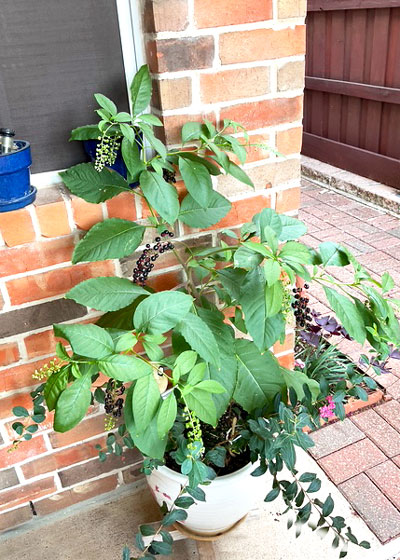
Answer: I normally don’t answer plant IDs here because they are not of general public interest (only to the person with the plant). However, you’ve hit a winner. This is commonly called “pokeweed,” “poke salad,” or “poke salat” (Phytolacca americana), but it goes by many other names, both English and French. It has large, attractive leaves and purple stems. When fall arrives the fruit takes on an intense purple sheen. They’re favorites of birds and other wildlife. The plant is native to big parts of Texas and the Midwest. All parts of the plant are also poisonous. When properly cooked the young leaves can be consumed, but I’m going to leave that information for you to research because of the plant’s toxicity. Here is the complete detail on it from the U.S. Forest Service.
QUESTION 3
TURF-TYPE TALL FESCUE AN OPTION FOR SHADED SPACES?
Question: I have followed you since 1987 and I don’t recall ever seeing you discuss turf-type tall fescue for areas with lots of shade. We are approaching the fall seeding season for established or overseeding existing stands. Any advice? Carl W., Murphy, Collin County.
Answer: Early in those years while you’ve been following me, I was supplied with variety after variety of fescue for trial in a quarter-acre space of our shaded backyard. The sales rep even came to the yard several Septembers to watch it being planted. Some of the varieties did establish and provide modest winter cover over much of area, but none hung around well enough through any first summer to qualify as much of a turfgrass for me. Plus, the water they consumed in the same county in which you live made them prohibitive. Plus, several of them developed serious problems with brown patch and died out by mid-spring. I opted to change that entire part of my own landscape over to shade-tolerant groundcovers, and I’ve never regretted it. Fescues are better adapted, in my opinion, to areas farther north and west than DFW where humidities and temperatures are lower in summer. You’ll see nice fescue lawns in the Metroplex, but the costs of keeping them going far exceed costs of St. Augustine or groundcovers.
QUESTION 4
WHAT IS WRONG WITH OUR NEW SHRUBS? THEY ARE TURNING YELLOW.
Question: We have new shrubs we planted in April. They thrived well until lately, but now some are turning yellow. We treated with iron, but now some leaves are turning white. What to do for that? Karen D., Midland.
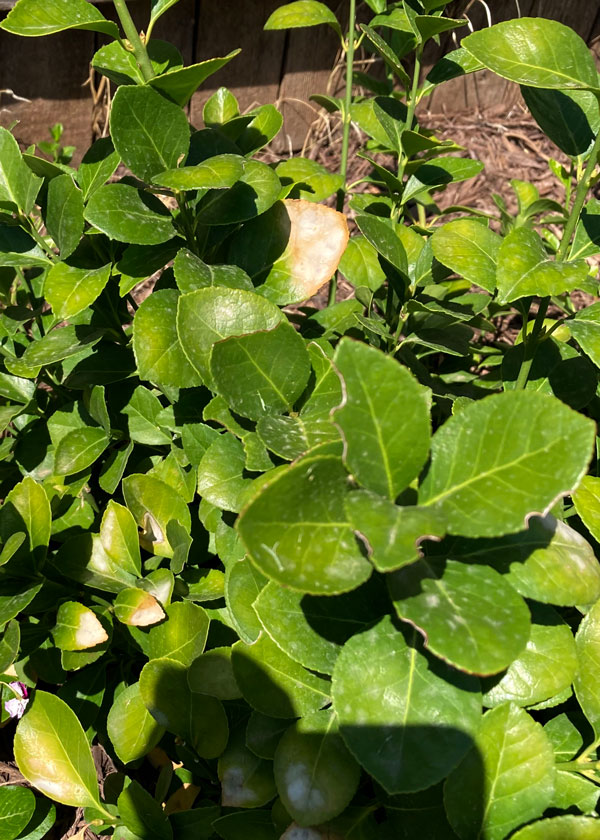
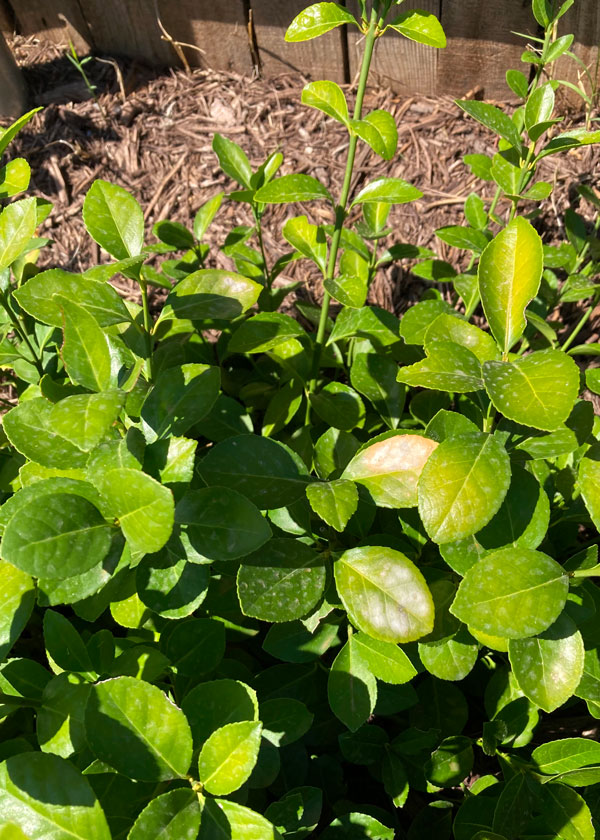
Image clickable for larger view.
Answer: It looks like your Japanese euonymus is suffering from a couple of problems, but iron deficiency is not one of them. I see sunscald on those leaves that look like they’ve been scorched. That may have happened on a really hot day if they got too dry for a few hours.
I’m also seeing a significant start to an outbreak of powdery mildew, a fungus that is common on this plant. You can see it on the tops of the leaves. Given a few more weeks they may look like they’ve been dusted with flour. You’ll need to spray the plants with a labeled fungicide to stop its spread. Keep the foliage as dry as you can.
Third, and most threatening, watch for scale insects. I don’t see any yet, but they may crop up on the backs of the leaves and stems. They’ll look like cigarette ashes plastered together where they will suck the life out of the plants. Systemic insecticides will be your best hope of stopping them before they get out of hand. This plant is problem-prone.
QUESTION 5
WHAT WOULD BE A BETTER CHOICE TO FLANK MY FRONT DOOR?
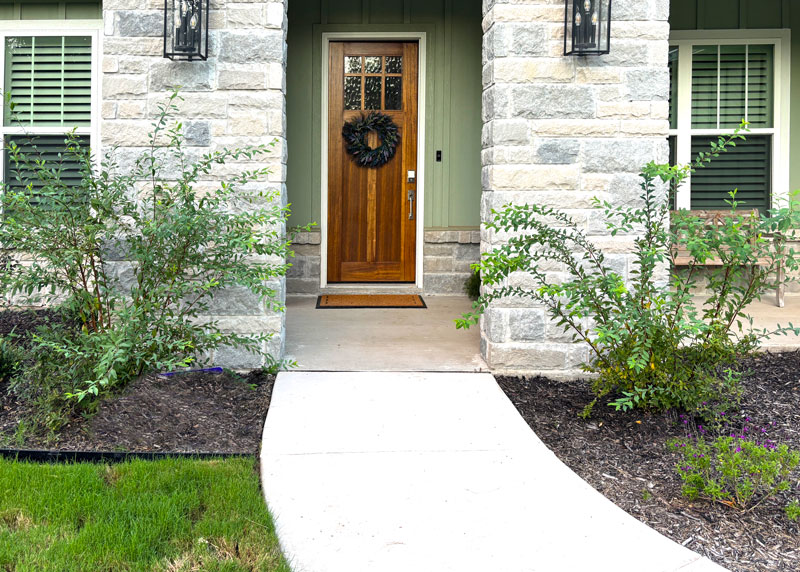
Question: Snowball viburnum was not the best choice for our entry due to its size. Can they be kept trimmed smaller and still bloom? If not, what would you suggest in their place? I’d like something with flowers, even roses. (West-facing, mostly clay.)

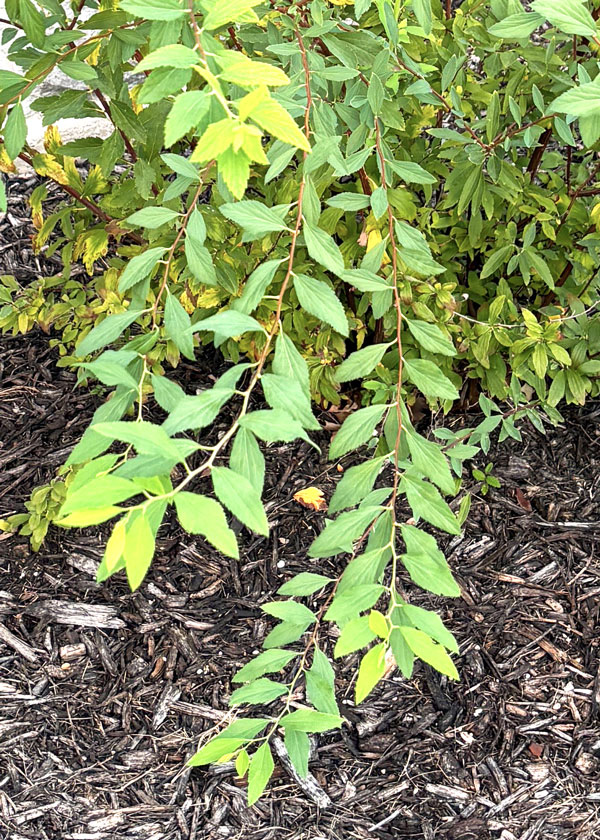
Images clickable for larger views.
Answer: These are bridal wreaths (spiraeas), not snowball viburnums, but either way, they are too large for that setting. You need something with a mature size that is more compact and more upright. I have another suggestion. Almost all flowering shrubs bloom for only 2 or 3 weeks per year, so you’ll have 49 or 50 weeks when they’re not blooming, yet you’ll have to look at them all of that time. Most flowering shrubs, roses included, are deciduous, meaning their stems are bare over the winter. Roses are also thorny, and they are subject to the fatal rose rosette virus for which we have no chemical control. It’s been a real problem in the DFW area and elsewhere for the past 15 years.
A handsome evergreen shrub that looks great 52 weeks a year would be my suggestion. You can surround and attend it with seasonal color, either in beds or pots. If this were my landscape I’d be using dwarf Burford hollies. They’re somewhat oval/upright in habit, they’re gorgeous, and they have large, bright red berries all winter. Yes, they have one spine at the end of each leaf, but I’ve never heard of anyone getting hurt by them. I have them all over my landscape and have for more than 45 years.
You might consider bringing the bed on the left farther out from the house. The two hollies could be set 36 inches away from the stone and trimmed to stay at 42 to 45 inches tall and 40 inches wide. I would trim them “loosely,” not into tight and formal shapes.
QUESTION 6
HOW SHOULD I GO ABOUT MOVING MY DESERT WILLOW?
Question: I bought a Lucretia Hamilton desert willow last year. I’d like to move it (this fall) to a different spot in our yard. What is the best way to go about this? How deep should I go to include the whole taproot? How far from the fence should it be? Danielle K., Little Elm.
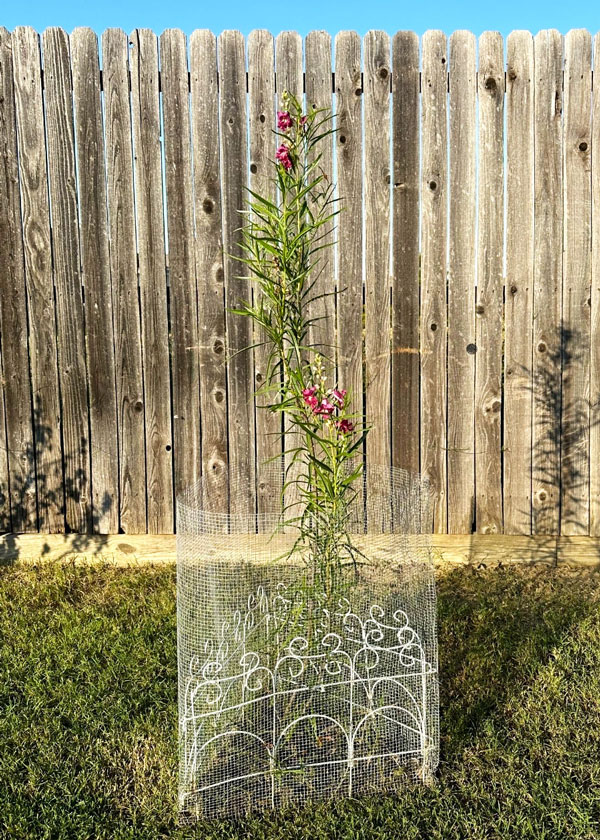
Answer: Lovely color! It looks like it’s been happy in its home, so good work. As desert willows go, it’s listed as a compact selection topping out at 18 ft. tall and wide. Plan for its new location accordingly – probably 8 ft. out from the fence. You don’t want it to crowd into any other plants, fences, walls, roofs, etc. Transplant it in mid-winter (late December through early February) while it’s completely dormant. Use a sharpshooter spade to cut its roots, but don’t worry about getting all its taproot. You wouldn’t be able to hold the ball of soil together if you tried that. Instead, dig a ball of soil the size of a basketball or slightly larger. Do the digging when the soil is moist but not soggy. Carefully cut all lateral roots cleanly, then lift the plant by its soil ball and transport it to its new planting location. Have the new hole dug and ready to receive it. It should be planted at the same depth as it’s been growing this year. Set it in place carefully and fill the loose soil in around it. Tamp it in with the handle end of a hoe, then water slowly and deeply to settle the loose soil and drive air out of the ground. Because roots are damaged when a plant is transplanted, pruning is advised to compensate. I would suggest trimming the main trunk about halfway back.
QUESTION 7
WHAT CAN I DO TO CORRECT “HOT SPOTS” IN MY BERMUDA LAWN THIS TIME OF YEAR?
Question: This time of year, my bermudagrass lawn develops hot spots. Could lack of soil be the problem? During winter, would spreading 2 in. of soil over the grass be helpful? Another factor: this area has been in drought stages 2-4 for the past three years. Mark M., North Bexar County.
Answer: Without a photo I’m just guessing, but I’ll give it a try. Use a root-feeder rod (if you have one) or an iron stake or rod. See if you can push or drive it into wet soil 4 or 5 in. or more. If so, you certainly don’t need to add soil. That is rarely a good idea. Adding 2 in. of soil would set the grass back a good bit.
Be sure you’re not mowing the grass more than 1-1/2 in. tall. Bermuda thins when it’s mowed too high. And be sure these areas are in full sun (required). Unless there’s some unusual source of water there, this probably isn’t Pythium blight of bermuda. Again, a photo would really have been useful. I hope my scatter-shooting was of help.
QUESTION 8
HOW HIGH SHOULD ZEON ZOYSIA BE MOWED?
Question: How high should my Zeon zoysia be mowed? Clay, Weatherford.
Answer: Clay called my statewide radio program this past Saturday. When he asked this question of me, I told him that I had not grown that particular selection of zoysia, so I didn’t have first-hand knowledge of its recommended mowing height. I assured him I would research it and post an answer here. Zeon has become one of the more popular selections of zoysia, so I needed to know anyway.
I looked at 6-8 websites, both commercial and university, and they all agreed that the optimal mowing height for Zeon zoysia, due to its fine blade texture, would be 1-1/2 to 2 in. Most also made a strong point that you should never remove more than 1/3 of the blade length when you mow – in other words, mow frequently enough that you’re not having to do major leaf blade removal.