
Q&A – Ask Neil: September 18, 2025
(Please read these instructions carefully.)
Before you post your question, please look at recent issues to see if someone else has already asked it. You might find your answer there.
How to submit your question…
(Note: You may need to allow a pop-up window to come up in order to get the link for sending your photo(s). If you have already submitted your question and didn’t see the pop-up window, please click here.)
• Click the link provided below to post your question. After you submit your question, a new window will pop up giving you the address to which you can e-mail a SHARP, HIGH-RESOLUTION PHOTO to accompany your question. Please DO NOT SEND THUMBNAIL PHOTOS in case I need to zoom in to see things.
• Click here to post your question.
• Please ONLY POST YOUR QUESTION ONE TIME. We can only accept a set number of questions each week, and when we get duplicates it costs other people their chances.
• One question per reader, please.
• Please use this only for posting questions – not for standard emails.
• Watch for your answer in the following week’s e-gardens.
• I choose those of greatest general interest. For example, plant IDs seldom make the cut.
• I must have your first name or initials.
• I must have your city or county. (Texas is a very large state.)
Important favor: I’ve been covered up so far this year with questions about live oaks losing chunks of bark. Rather than continuing to answer the same questions weekly, I’d ask that you look back to previous issues. You’ll find several replies that I’ve posted. Thanks!
QUESTION 1
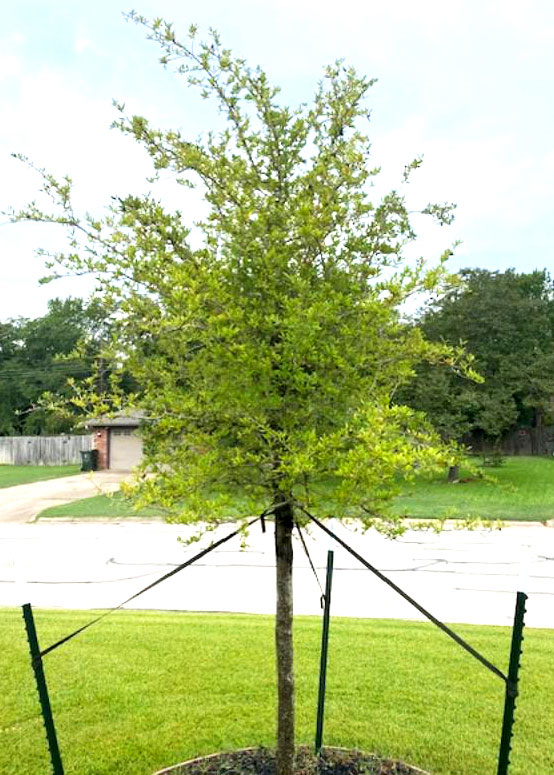
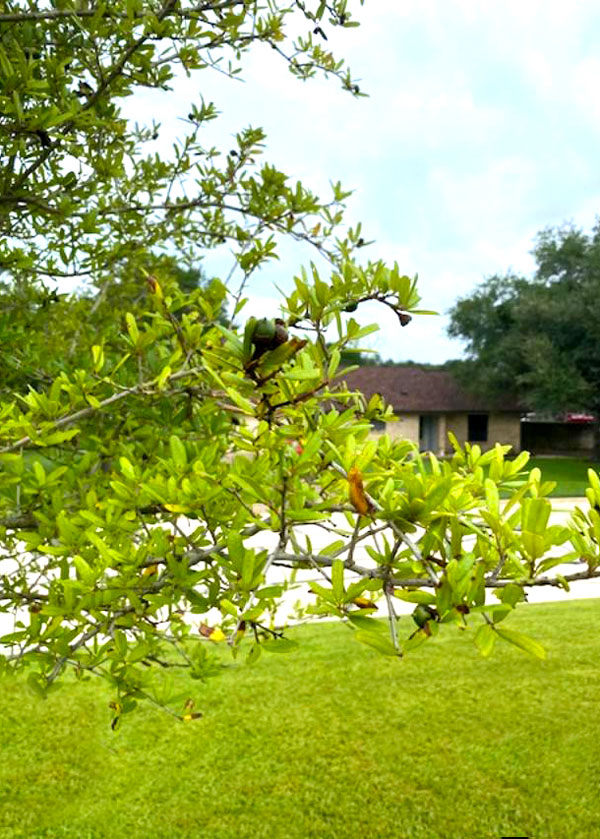
ARE LIGHT GREEN LEAVES ON NEW LIVE OAK ANYTHING TO BE WORRIED ABOUT?
Question: I have three live oaks, all planted at the same time. One tree has very light green leaves. The other two are dark green. Do I need to be concerned, and if so, what should I do? Bobby L., Brazos County.
Images clickable for larger views.
Answer: Light green foliage can be the result of lack of available iron (not with live oaks, and not overall like this) or insufficient nitrogen. For some reason this tree hasn’t taken up enough nitrogen to keep itself deep green and vigorous. When you make the first feeding of your turf late next March, make an extra pass around the tree. See if that helps it green up.
Just as a test, you could try a water-soluble, high-nitrogen plant food similar to what you’d use on house plants. Apply it one time and do it soon so the plant could take it up while it’s still warm. That would let you monitor the impact nitrogen would have on the tree. Don’t make a regular habit of feeding it that way, however. That wouldn’t be enough for a tree as it grows, and it wouldn’t be good for the turfgrass.
Two other quick checks you might make of this tree and its trunk. Look closely at the south and southwest sides to see if there is any cracking or splitting that might indicate sun damage. I can’t tell if you have it wrapped to protect against that. Also, look at the base where it enters the ground. Make sure it’s not planted too deeply. The root flare should be at or very near the soil surface. Again, I can’t tell from the photo. If it’s not, you may have to remove some of the soil to expose the top roots just a bit.
By the way: great job of staking your tree! Perfectly done!
QUESTION 2
DO ORANGE-STRIPED OAK CATERPILLARS EVER DO DAMAGE TO OAKS?
Question: I have had a healthy crop of orange-striped oak worms for 2 years now. I have read that they are essentially harmless to oaks, but they make a big mess. Is there ever a point when they become more of a threat than an eyesore? Nancy L., Friendswood.
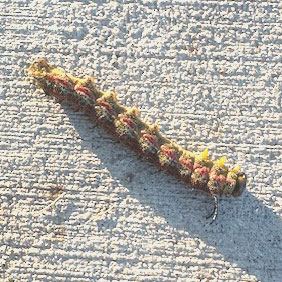
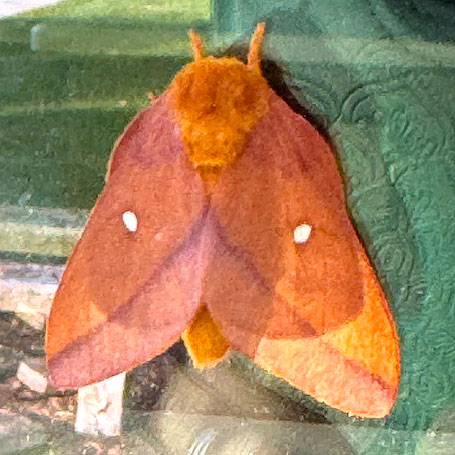
Answer: Probably not. They are devouring foliage primarily in late summer and fall when the trees are preparing to go dormant for an entire winter, so any tiny amount of damage they might do now will be minimal compared to what they could do were they to feed on new leaves in the spring. It’s 99 percent aesthetic.
QUESTION 3
HOW CAN WE STOP THE INVASION OF EVE’S NECKLACE SEEDLINGS?
Question: We have a large Eve’s necklace tree that we love, but there are new trees coming up all over our yard and in our flowerbeds. I read that they are not invasive, but they definitely are in our case. Do you have any advice short of cutting it down? Eunice G., Cleburne.
Answer: If you really like the tree, I would not cut it down. At least, not yet. Apply an inch of mulch to your flowerbeds so that you can run a well-sharpened garden hoe through the mulch to cut the seedlings as they emerge. You won’t have to chop – just glide the hoe through. In the lawn, mowing alone should eliminate young seedlings, but you could also apply a broadleafed weedkiller (containing 2,4-D) with a tank sprayer and a nozzle adjusted to a fairly small droplet size. Keep the pressure down so you don’t blast the spray far and wide.
QUESTION 4
WHEN AND HOW CAN I TRANSPLANT VOLUNTEER PECANS ON MY PROPERTY?
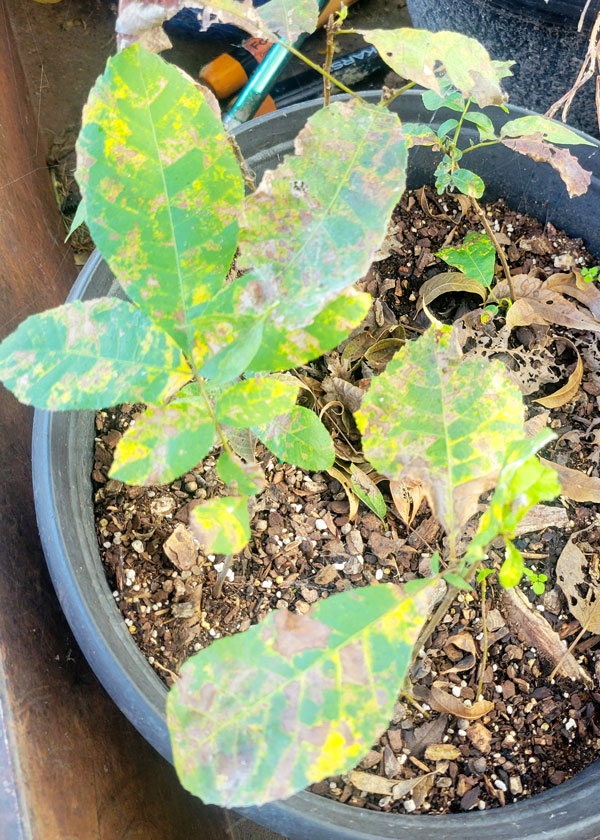
Question: I am in the country and have many pecan trees. Thanks to squirrels I have random plantings in my flowerpots, etc. When and how can I transplant them around in the property? Lon R., Wylie.

Images clickable for larger views.
Answer: Since you would be taking them out of pots you could plant them at any time during the year. Fall would be ideal, because it would give them the balance of fall, all winter, and next spring to establish roots before hot, dry summer weather returns. If their roots are coiled within the pots, you’ll probably want to make a cut through them to break that encircling pattern. Otherwise, they will end up girdling themselves as the trees grow larger. Leave a basin to facilitate watering for the first several summers.
That said, let me also challenge you just a bit. These will all be native pecans since they’re seedlings, not grafted selections. Your odds of getting superior pecans and trees will be very small. This might be a good time to consider planting “improved” pecans that would bring the best crops with outstanding resistance to disease over the ensuing years. Here is a fact sheet from Texas A&M that gives the best choices for each part of Texas. On this map Wylie would be at the west edge of East Texas touching the east edge of Central Texas. Three excellent varieties that appear on each list are Caddo, Desirable, and Pawnee.
QUESTION 5
WHAT IS CAUSING THESE “HOT SPOTS” IN MY BERMUDA LAWN?
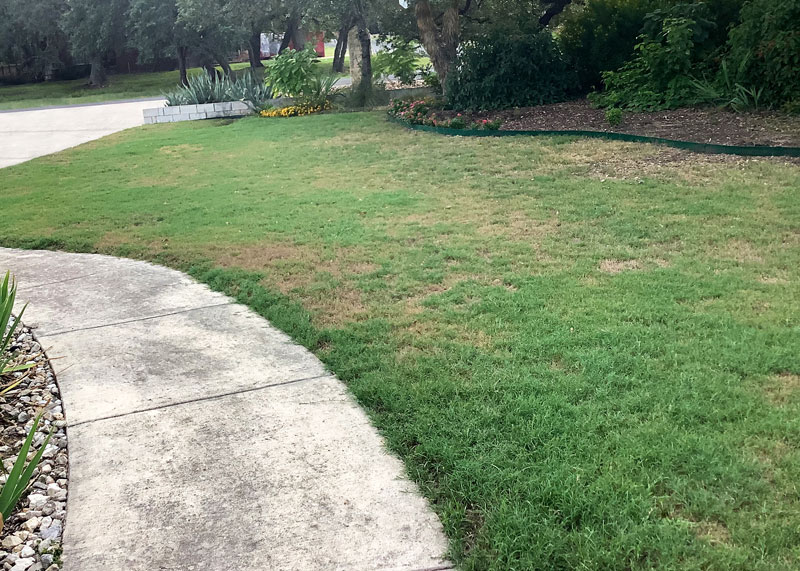
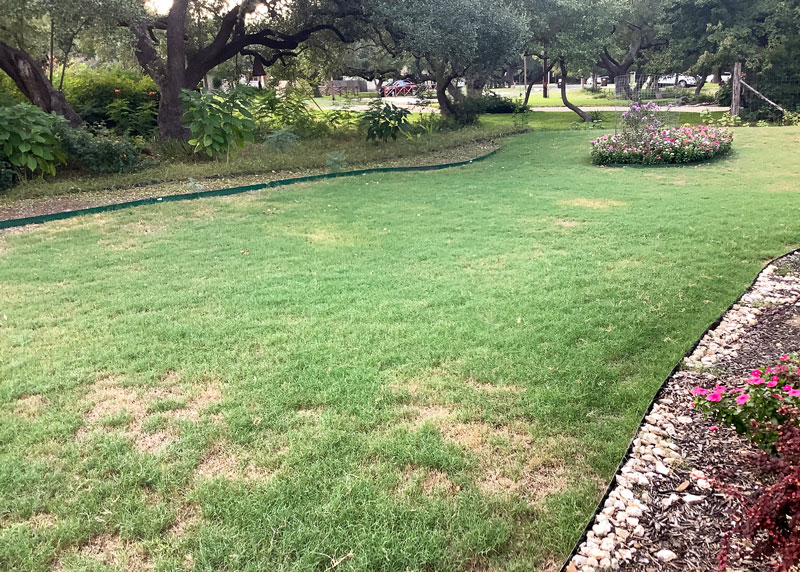
Question: My bermuda lawn has developed “hot spots” for the past several summers. I mow it at 1-1/2 in. It’s full sun. We have been in drought stages 2-4 and the associated watering restrictions for the past several years. Is that the sole cause of the brownings? Mark M., North Bexar County.
Images clickable for larger views.
Answer: Note from Neil: before you think that we’ve slipped a cog and accidentally repeated a question, Mark’s photos did not post as he e-mailed us last week. I told him the question is significant enough (lovely landscape and a lot of effort) that I wanted to repeat it for all to see.
I asked Mark to do one more thing before we published this second pass at his answer, that being to push a dowel stick or metal rod into the soil to see if there might be a rocky outcropping just a couple of inches beneath the dried areas. I asked him as well to send higher resolution photos so I could zoom in for a better view.
He did that, and he said he could push the metal rod in 10 to 12 inches, so the problem is not shallow soil.
The image that shows the browned areas in the foreground gave me the best clues. I do understand the stages of drought that the San Antonio area has encountered, but this still does look like Pythium root rot.
I’m going to give you several links to university websites that discuss this fungus. You will notice that there are several species of Pythium that attack grasses, more commonly cool-season grasses. However, the spots I see in your lawn look very similar to what I see each August and September in well-maintained bermuda across Texas. Look at the photos associated with these links. Look for “Pythium root rot.”
You probably should have the Texas Plant Disease Clinic at Texas A&M culture samples from the edges of some of affected areas. If that is the culprit, perhaps you can do something to lessen the impact of excesses of water on these areas in late summer. You will notice that the turf people say this is seldom permanent. I believe that agrees with one of your comments – that it comes back each year.
University of Florida:
https://sfyl.ifas.ufl.edu/media/sfylifasufledu/baker/docs/pdf/horticulture/TurfgrassDiseaseIdentificationGuide.pdf
University of Arkansas:
https://www.uaex.uada.edu/publications/PDF/fsa-7565.pdf
QUESTION 6
WHY DO MY NEW FRUIT TREES DIE?
Question: I have had trouble getting new pecan, peach, and lemon trees started. They die back to the ground the first year that I have them. I know I don’t want the rootstock. What am I doing wrong? Ron, Corpus Christi.
Answer: To my readers – Ron called my statewide radio program this past Saturday morning. I found out that he had bought these plants more than once at local “big box” stores. I told him I would always recommend buying from independent retail garden centers so he could get localized help from people who know the best varieties to buy for their customers. The big box stores generally buy from centralized offices, often out of state. They do not always sell well-adapted varieties.
That aside, I asked if he had trimmed his peach and pecan tree back by 50 percent at the time of planting. He had not. I told him that was a requirement, both to compensate for roots lost in the digging and to help the trees form scaffold branches.
I told him I would post a link to the Texas A&M directory of all their fruit and pecan fact sheets. This is the page I leave bookmarked on my desktop for quick reference. I hope it will be of help to you all:
https://aggie-horticulture.tamu.edu/fruit-nut/