
Q&A – Ask Neil: September 25, 2025
(Please read these instructions carefully.)
Before you post your question, please look at recent issues to see if someone else has already asked it. You might find your answer there.
How to submit your question…
(Note: You may need to allow a pop-up window to come up in order to get the link for sending your photo(s). If you have already submitted your question and didn’t see the pop-up window, please click here.)
• Click the link provided below to post your question. After you submit your question, a new window will pop up giving you the address to which you can e-mail a SHARP, HIGH-RESOLUTION PHOTO to accompany your question. Please DO NOT SEND THUMBNAIL PHOTOS in case I need to zoom in to see things.
• Click here to post your question.
• Please ONLY POST YOUR QUESTION ONE TIME. We can only accept a set number of questions each week, and when we get duplicates it costs other people their chances.
• One question per reader, please.
• Please use this only for posting questions – not for standard emails.
• Watch for your answer in the following week’s e-gardens.
• I choose those of greatest general interest. For example, plant IDs seldom make the cut.
• I must have your first name or initials.
• I must have your city or county. (Texas is a very large state.)
Important favor: I’ve been covered up so far this year with questions about live oaks losing chunks of bark. Rather than continuing to answer the same questions weekly, I’d ask that you look back to previous issues. You’ll find several replies that I’ve posted. Thanks!
QUESTION 1
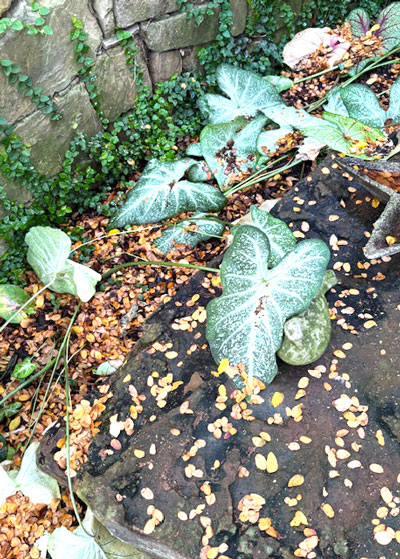
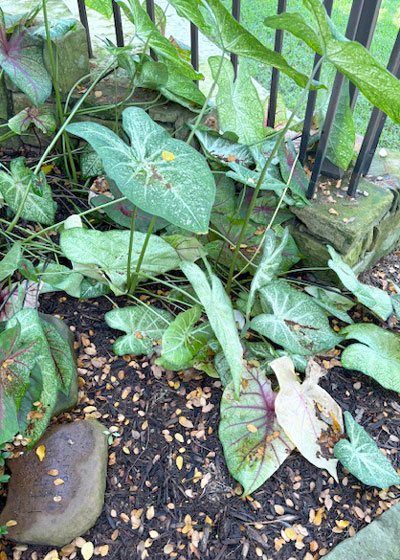
WHY ARE MY CALADIUMS FALLING OVER?
Question: After looking beautiful all summer, my caladiums are falling to the ground. Watering has not helped them. What is the cause? Pam B., Fort Worth.
Images are clickable for larger views.
Answer: My good friend Bob Brackman did research on many different varieties of caladiums while he was at the Dallas Arboretum many years ago. He was comparing planting dates and numbers of weeks that the plants looked good before they started to go dormant – what yours are doing now. Bob found that there was no reason to hurry the plantings in the spring, because each variety had roughly the same number of weeks of peak performance before it would start to go downhill for fall. Most varieties begin to decline by September, especially if they have been planted early (late April or early May in your area). If you let them get dry in late summer or if you let the plants produce flowers you can expect them to decline more rapidly. What you’re seeing is normal behavior.
QUESTION 2
DO YOU STILL RECOMMEND OVERSEEDING LAWNS IN FALL?
Question: Many years ago, I followed your instructions on overseeding my bermuda/St. Augustine lawn with annual rye and fescue. The following spring I noticed hardly any weeds. Do you still recommend rye and fescue or only annual rye?
Answer: I need to fine tune what you remember. I would never have recommended overseeding with fescue. It is a perennial grass. That means that it does not die out in May like annual and perennial ryegrass do. It would stick around and compete with your permanent turf – not good. And I also caution people about overseeding St. Augustine that is growing in shade. The ryegrass dies out more slowly in late spring, and that means the rye would compete longer than you want.
Yes, I do recommend overseeding for anyone who wants a green lawn in winter. Annual ryegrass is less expensive but coarser in its texture. It also grows more rapidly, which means you’ll have to mow it more often. That can be a problem during rainy spells. But perennial rye costs more. It’s finer textured and it germinates more uniformly. If it’s planted later in the fall it will have a better germination rate.
I can make a case for either. I prefer perennial rye if you can find the seed, but where I seed a large area I use only annual rye. If you glance back at “Gardening This Weekend” in prior weeks’ e-gardens you’ll see where I’ve discussed it as recently as the past few weeks.
QUESTION 3
WHAT IS A GOOD PERENNIAL VINE FOR OUR AREA?
Question: We would like suggestions on easy-care perennial vines to add interest to vintage doors in our Dallas yard. Blooming would be nice, but not too sweet-smelling. Lari W., Dallas.
Answer: You have several things to consider. Vines climb by wrapping themselves around their support, with tendrils or holdfasts, or by leaning up against their supports. Without a photo of your doors, I can’t guess which type would work best.
Also, most flowering vines are in bloom for only 2-3 weeks per year, so choose for good looks the other months as well. Carolina jessamine, a twining vine, is the best looking, long-term evergreen vine for Texas landscapes. English ivy would work well, but it makes a heavy vine as it clings to its support. There are several varieties in the market. However, no variety of English ivy has showy flowers. Honeysuckles are semi-evergreen. In South and South Central Texas (and protected spots farther north), fig ivy and star jasmine are both great. Star jasmine’s flowers are spectacular.
Have you considered using heirloom annual vines that would bloom for 2-3 months? Plants like morning glories or moonvine that flower in late summer and fall. Clock vine (black-eyed Susan vine) that blooms in summer. Hyacinth bean that flowers in fall and that has showy maroon foliage from late summer on. And there are others. You could have a different look each year. I’d probably go that way.
QUESTION 4
WHAT HAPPENED TO OUR CRAPE MYRTLES AND WHAT SHOULD WE DO WITH THEM NOW?
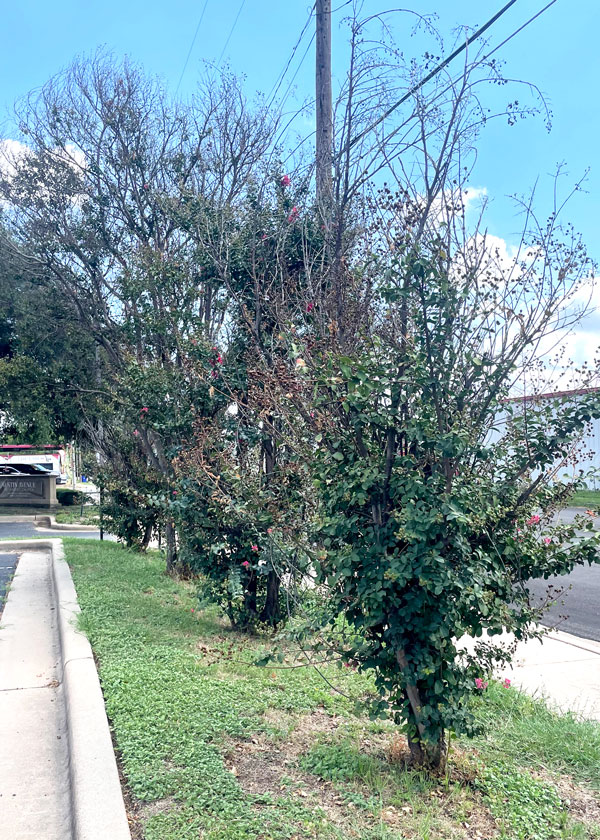
Question: Our church has four crape myrtles with many dead branches. What caused this, and when should they be pruned? How can we avoid it in the future? Lindsey R., Waco.


All images are clickable for larger views.
Answer: The flower head looks like the variety Tuscarora. It, Natchez, and Muskogee are notoriously sensitive to early freezes, extreme winter temperatures, and late freezes just before growth starts in the spring.
This is cold injury. We have seen it on those varieties repeatedly in our Crape Myrtle Trails of McKinney. It’s very difficult to trim the dead trunks out selectively. The remaining trunks are weakened anyway, so the best solution is to cut the plants back completely to the ground over the winter. Let the many new shoots regrow the following spring, then select the 9 to 11 strongest and straightest ones to leave for new trunks by late summer. That’s more than you will ultimately want, but young crape myrtle trunks are brittle and easily snapped. The following May (2027 in this example), remove all but 3 or 5 and train them to be your final new trunks. You may want to put stakes alongside each of them to prevent breakage. You’ll be amazed at how quickly they will become handsome new plants. See photos of this in real life at this page of our Crape Myrtle Trails of McKinney website. (Scroll to the bottom of the page.)
QUESTION 5
ARE OXBLOOD LILIES RELATED TO RAIN LILIES?
Question: Looking at your oxblood lily photos recently, they look to me just like what I call “rain lilies.” Are they different plants, or are oxblood lilies also known by that name? Sandra S., Bell County.
Answer: They are cousins, but their native homes are thousands of miles apart. Many rain lilies (genus Zephyranthus, among others) are native to Texas and elsewhere. Oxblood lilies (Rhodophiala bifida) are native to Argentina. But the two genera are in the Amaryllis plant family.
QUESTION 6
WHAT CAN I PUT ON MY PERIWINKLES TO SAVE THEM?
Question: My periwinkles are slowly dying, one pot at a time – apparently a virus? Is there anything I can put on them to save them? Betty Grace, Glen Rose.
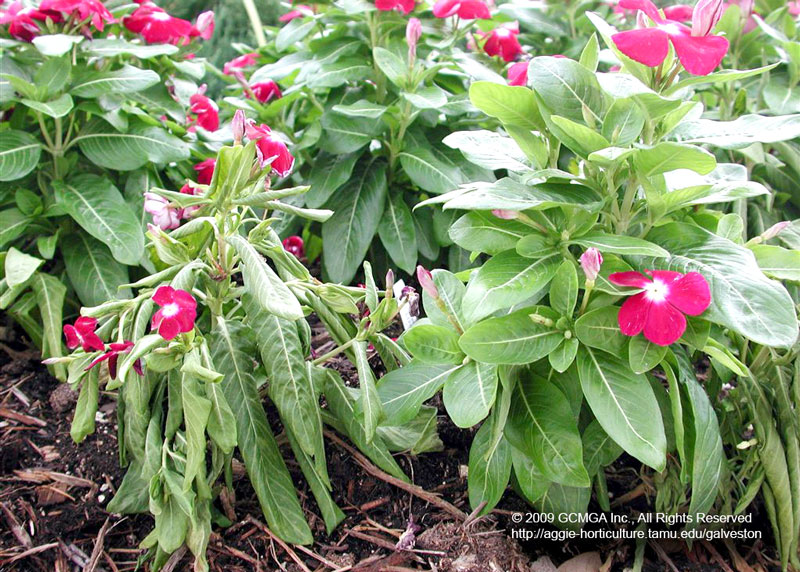
Answer: I wish you had attached a photo. I’ll include one in the absence from the Galveston County Master Gardeners. It’s the disease I see just about 100 percent of the time when periwinkles start to fail. This is aerial Phytophthora, a fungus, not a virus. It has been responsible for landscapers’ avoiding periwinkles for several decades. Then, a selection known as Cora vincas was introduced and declared to be resistant to this disease. After a few years, however, even those began to succumb. A few years later an improved collection was introduced – Cora XDR (“extra disease-resistant”). It has proved to be a distinct improvement.
This disease is one of a category known as “water mold funguses.” It is spread by splashing water. Don’t plant your periwinkles early in the spring – wait until the weather begins to turn warm. Avoid any plants where you can see wilted stems showing signs of the infection. Use clean pots and fresh potting soil each year. Avoid overhead watering whenever possible. There is no consumer product you can spray on infected plants to prevent or cure this disease.
QUESTION 7
WHY ARE MY HOLLIES TURNING YELLOW AND BLACK?
Question: I planted three Burford hollies in March. Recently, the leaves have started turning yellow and some black. I put iron granules on them in late July, and then last week I applied liquid iron. Did I use too much iron? Anita V., Granbury.
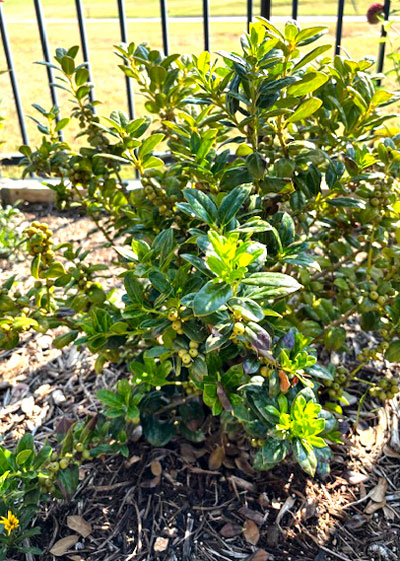
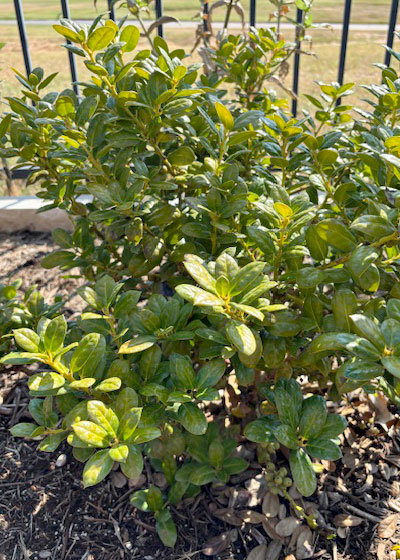
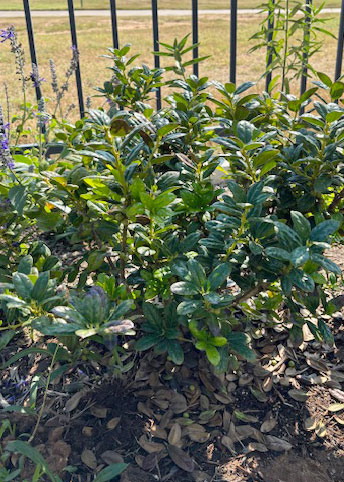
All images clickable for larger views.
Answer: This is not (and was not) iron deficiency. Iron deficiency (“chlorosis”) shows up as yellowed leaves with dark green veins on the newest growth (tops of the plants and ends of the branches).
Your plants got too dry at some point. This is the way hollies behave when that happens. Keep them properly watered through the winter and next year. Apply an all-nitrogen lawn fertilizer to them in March to promote new growth. Repeat in late May or early June. The new growth will have a rich, dark green color. Prune them to restore their good form. They should be fine.