
Q&A – Ask Neil: December 4, 2025
(Please read these instructions carefully.)
Before you post your question, please look at recent issues to see if someone else has already asked it. You might find your answer there.
HOW TO SUBMIT YOUR QUESTION…
• Click here to post your question. (Please post your question only one time.)
• Please use this link only for posting questions – not for standard e-mails.
• High-resolution photos (1-2MB – not thumbnails) attached with your question help Neil give you the best possible answer. Please check your photo for clarity and exposure. If you do not see “All images clickable for larger views,” your images’ resolution was not sufficient for enlargement. That might also have made it difficult for Neil to give you an accurate answer.
• Neil chooses questions of greatest reader interest. Plant IDs rarely fit that description.
• Neil requires your first name or initials, also your city or county for an accurate answer. (Texas is a very large state.)
• One question per reader per week, please.
• Watch for Neil’s reply in the next issue of e-gardens.
Note: If you have submitted your question and did not see the pop-up window for attaching your photo, please click here.
QUESTION 1
WHY IS OUR MAGNOLIA THINNING?
Question: Our magnolia seemed so full in years past, but now you can see through it. What do you think? Cindy M., Harris County.
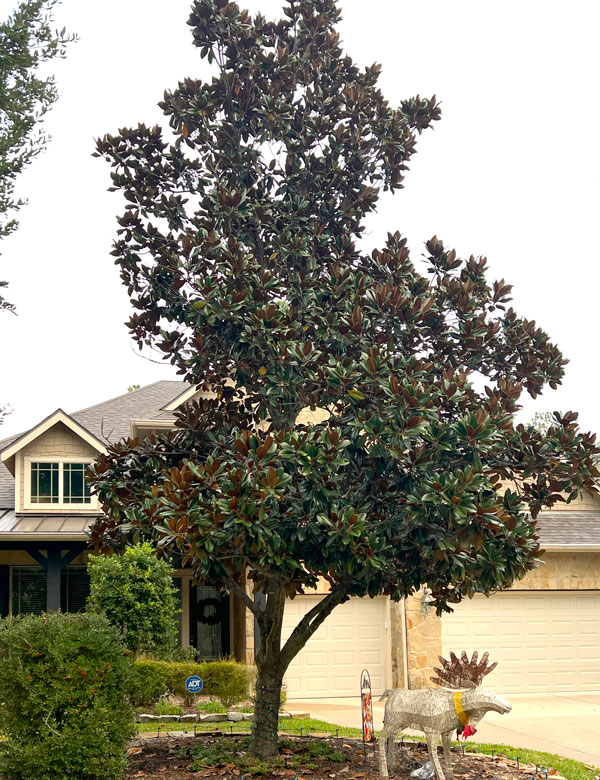
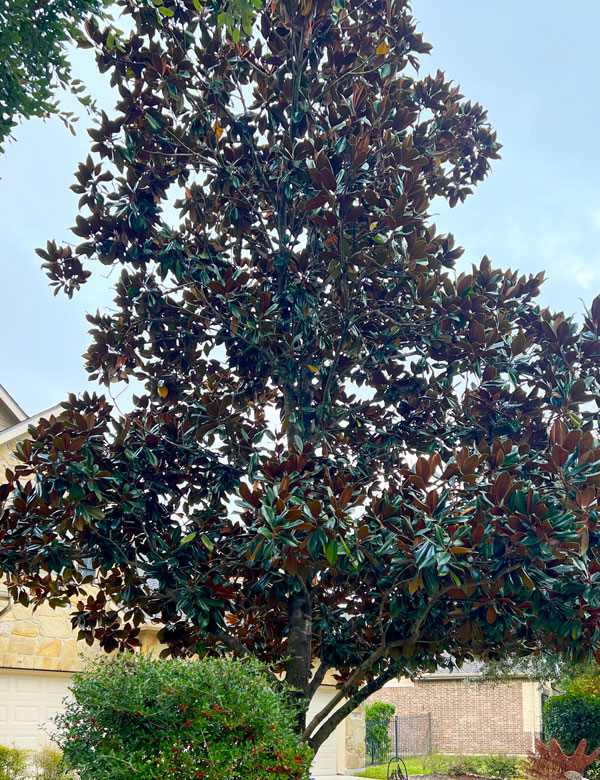
Images clickable for larger views.
Answer: Magnolias do lose leaves toward the end of the growing season, culminating with an almost complete changeover of the prior year’s leaves in mid- to late spring. The Houston area is usually very friendly to magnolias, and your tree, compared to many I see in other parts of Texas farther north and west of you, looks sensational. There are a couple of gaps where there may have been branches originally, and it appears to be lopsided perhaps due to shading on that one side, but otherwise it looks like a tree that will fill in handsomely if you’ll just give it nitrogen and water as needed next growing season. You might want to do a little corrective shaping to balance the sides a bit, but otherwise, I don’t see anything of concern.
QUESTION 2
WHAT IS THE BEST WAY TO STORE IRIS OVER THE WINTER?
Question: I had to dig up an iris bed for water line replacement and will redesign the bed next spring. I have about 15 colors, and I really do not want to lose them. What is the best way to store them over the winter? Denise C., Tarrant County.
Answer: If you’re talking about bearded iris, those are fleshy roots and not bulbs. They need to be replanted as soon as you can. If you try to hold them until spring it will weaken or probably ruin them. At a minimum, “heel them in” by digging a trench in a garden and laying them in shallowly. You could also plant them into 2-gallon pots. They just need to be put into soil.
QUESTION 3
ANY GOOD PUBLICATIONS OR ADVICE ON XERISCAPING?
Question: I am seriously considering going to xeriscaping for most of my lawn. Do you know of any good publication, or do you have any advice on that subject? Rodney R., Greenville.
Answer: I’m going to stick pretty closely to Texas A&M information here, and their publication is “Xeriscape: Landscape Water Conservation.” It’s a free download, but to get the 16-page document you’ll have to register through the TAMU bookstore and set up an account. It’s more cumbersome than other universities, but at least you’ll be getting Texas-driven information.
Before you do that, however, I’m going to present another thought for consideration. I searched Hunt County online, and it appears that you folks average 47 inches of rain per year. Greenville is also in the Blackland Prairie, meaning that you have the same very heavy clay gumbo soil that I’m used to in the county just to your west (Collin County). Xeriscaping, as most people imagine it, features plants that are native to areas that get less than 15-18 inches of rain annually, and the soils are also more porous. That’s why you see so few successful xeriscape landscapes in the Metroplex. Plan carefully, and stick with plants that can handle periods of waterlogged soils. Use berms for drainage, and be sure your plant choices are all winter-hardy to temperatures down to 10F and lower. You asked for my advice, and since we live so close together, my suggestion would be to stick with plants that are drought-tolerant, and use water-conserving planting concepts without going to a truly xeriphytic landscape design.
QUESTION 4
ARE OAK LEAVES BAD FOR ALKALINE SOIL?
Question: Your newsletter mentions composting our tree leaves (red oaks) and then using them in our soil. An individual at our local nursery mentioned that oak leaves add to the alkalinity of the soil, and that that would not be good. I’m confused. Bill B., Fort Worth, near Eagle Mountain Lake.
Answer: As tree leaves, oaks included, decay, they create a valuable source of organic matter that will help loosen clay soils and help sandy soils hold moisture and nutrients.
But that’s not all. Decaying tree leaves, specifically oak leaves, are acidic. They help reduce the pH of alkaline soils. Almost all our cultivated plants in landscapes and gardens grow better in neutral or mildly acidic soils. Some of the best compost I have ever used is from the several dozen red oak trees on my own property. I hope that helps clear up the confusion.
QUESTION 5
HOW CAN I STORE MY POTTED JAPANESE MAPLES OUTSIDE DURING WINTER?
Question: My dad gifted me two Japanese maples two years ago. He kept them on the southwest side of his house. I have them in shade, and they are growing well (6 ft.). Now they are too large to bring into my greenhouse. How can I store them outside during the cold winter? Dawn W., Fort Worth.


Images clickable for larger views.
Answer: You may not be aware that Japanese maples are some of our most cold-hardy trees here in Texas. They can easily survive winter temperatures in pots as long as they have enough “root room.” Your trees look like they are dramatically under-potted. I would suggest that you invest in pots at least 4 to 6 inches larger in diameter and repot them before winter. If there are roots that are encircling the pots, use pruning shears to snip through them to break that potentially girdling growth in one or two places. Then, as long as you are careful not to let them dry out during the winter they should be just fine.
Side note: I couldn’t tell from the one photo, but it appears that you might have wandering Jew growing in the one pot. That, of course, won’t stand freezing temperatures. You may already have lost it earlier this week. If not, take cuttings and carry that through the winter in your greenhouse.
QUESTION 6
HOW LONG DO WE NEED TO LEAVE THE WRAP IN PLACE ON A NEW SHUMARD RED OAK?
Question: We just planted a 15-ft. Shumard red oak. Do we leave the trunk wrapped one or two summers? I want to give it the best possible chance of getting a good start. Cathy O., Springtown.
Answer: For a tree of that size, I would recommend two years. You want it to become established enough that its leaf canopy will be able to start providing shade to protect the trunk from sunscald. The wrap does not harm the tree and is barely noticeable. That assumes you have used paper tree wrap and have not secured it with wire or any other type of binding that could girdle the trunk. Some horticulturists take it off new trees after one year just to be sure all is going well, then reapply fresh wrap for the second year.