
Grape hyacinths could fool you for bluebonnets
But they’re not bluebonnets. They’re not hyacinths. And they’re certainly not grapes. So, what are these pretenders? Where did they come from, and how well do they like it in Texas?
• Grape hyacinths are in the genus Muscari and they’re native to the Mediterranean region, including southeastern Europe, Turkey, and western Asia. So, they’re somebody else’s wildflowers, and that must be a beautiful sight.
• Europeans, long the bulb enthusiasts, specifically Dutch bulb traders, brought them into the United States with their famous tulips and daffodils in the 1700s and 1800s, and by 1900 they were standard fare in American seed catalogs.
• Their popularity quickly spread across the East Coast and along the Gulf Coast. The fact that they establish and spread on their own helped move them along.
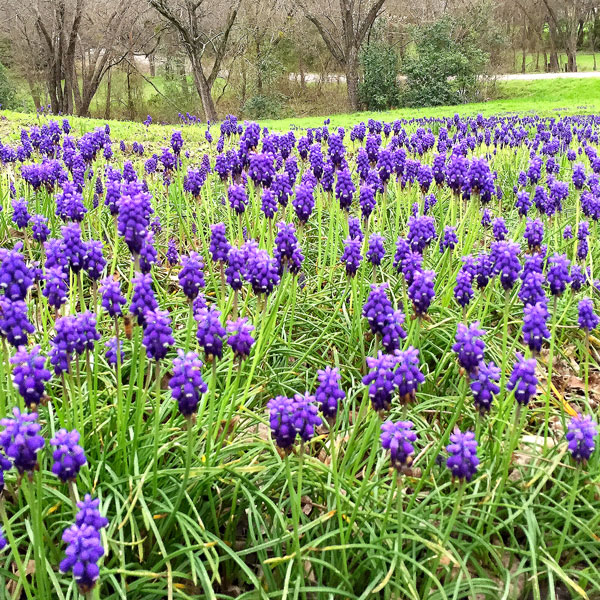
• Only the most assertive invasive plant person would be stern enough to call these little beauties by that word. However, they do establish within a landscape and make themselves right at home. It’s not uncommon for them to spread several feet in all directions from their original planting location, sometimes from seed and other times from bulbs multiplying underground. Usually it’s a bit of both, and generally we’re happy to see it.
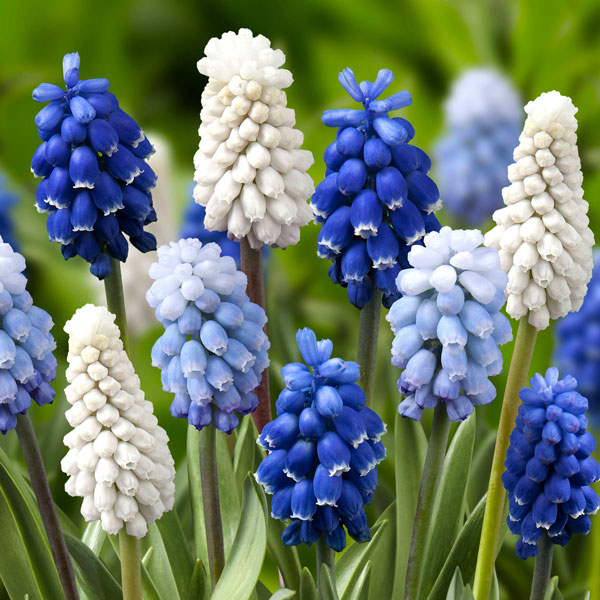
• There is hybridization work being done on grape hyacinths, but it’s nothing comparable to what you’ll find going on with tulips and daffodils. Breeders in the Netherlands and the United Kingdom have introduced several special forms including pure white types, double-flowering varieties, and light blue selections. They’re looking for larger flower spikes with improved color clarity and doubled flowers for the best possible show. Most of the bulbs sold are selections of Muscari armeniacum.
How can you get the best impact with grape hyacinths?
The secret in getting the best visual effects with grape hyacinths comes in numbers. They aren’t expensive, so plant them in masses.
• Use large drifts of 100-250 bulbs planted closely together.
• Plant them where they can remain undisturbed for many years as they fill in and multiply. Always leave their foliage in place after they bloom so it can produce “food” to nourish the bulbs until the next flowering season.
• They’re useful beneath dense shade trees where grass won’t grow, perhaps combined with early daffodils.
• Since they grow only to 6-8 in. tall when blooming they can be used as an edging to an informal garden pathway in spring.
Of worthy note: Blue is never a common color in gardens, especially in spring. It’s nice to have such a vibrant and cheerful plant that’s also eager to grow in any Texas landscape. Everybody comes out a winner with this one!