
Ouch! That’s too tight!
This was a live oak. I emphasize “was” because it is no more. The people who planted it and carefully staked it and supported it with cables never came back to remove them.
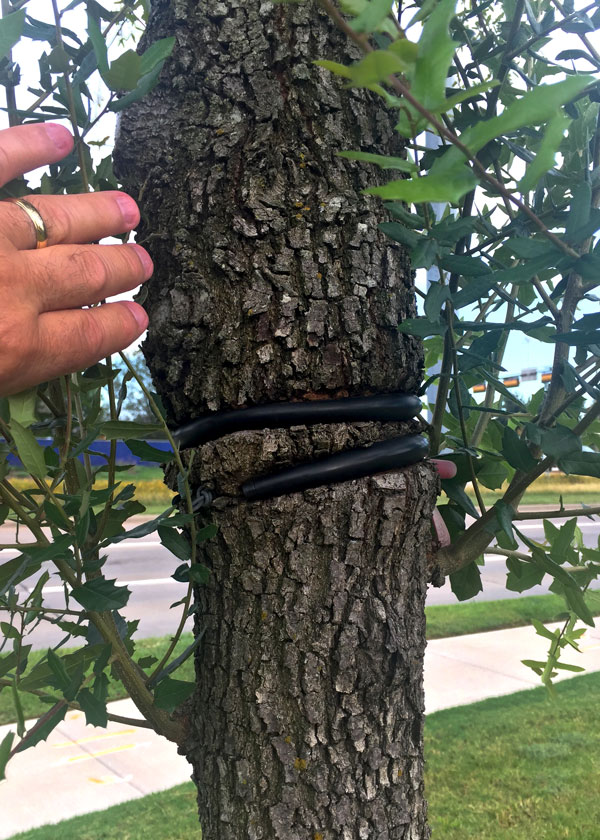
As you can see in the photo, they even took care to run the cables through sections of hose to pad the trunk. Bravo for them, but then the follow-up crew was apparently clueless.
It happens too often, and the trees end up dying.
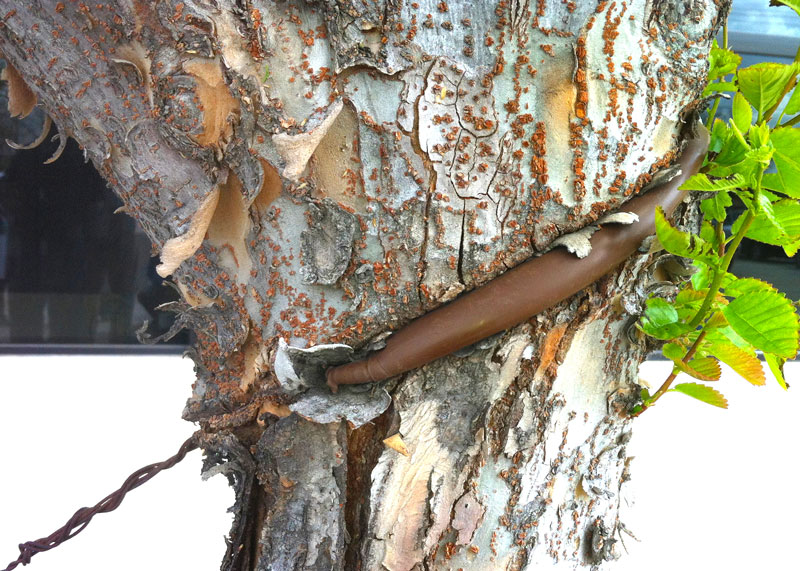
It also happened to the lace bark elm.
Here’s what happens…
To explain it all, let’s look at the structural makeup of a tree’s trunk. We’ll start from the outside and move inward.
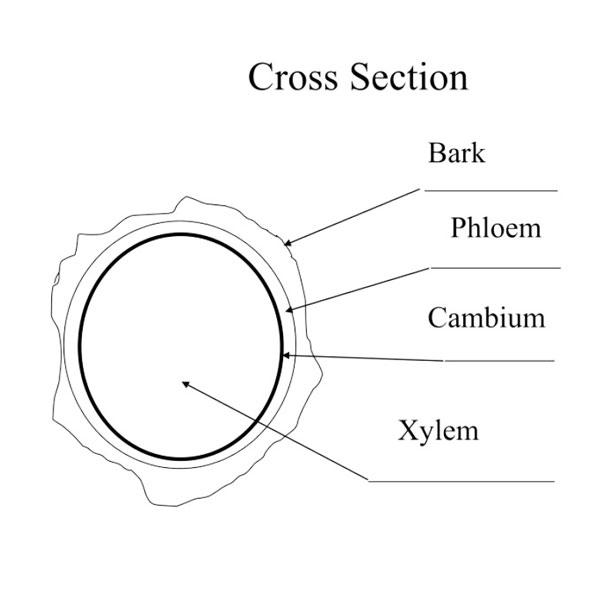
• Bark: The protective covering of dead cells. As the trunk grows larger the old bark cracks and falls off. It’s unable to expand.
• Phloem: Just inside the bark is a cylindrical tissue of living cells that transport sugars from the leaves where they are made during the process of photosynthesis down to the roots where they are used to keep the plant nourished and functioning. Some of these sugars are stored in the roots as well.
• Cambium: Inside the phloem is another cylinder called the cambium. It’s an area of rapidly dividing cells. As they divide and therefore multiply to the outside they form more phloem cells. As they divide and multiply to the inside, they form more of the central portion of the trunk. That is the xylem.
Critical note: If a rigid material completely encircles a trunk, sugars will accumulate above the restriction. The trunk will expand there and grow over the rigid item causing the bind. That restriction will gradually sever the flow of sugars completely – they can no longer be transported down to the roots.
• Xylem: Most of the volume of a tree’s trunk is made up of this tissue of important dead cells. They function much like straws as they transport water and nutrients up through the trunk of the tree from the roots to the leaves.
As a wire or cable is left in place longer than it should be, it causes the sugars to accumulate above the point of girdling of the stem. New growth frequently shoots out from below the wire as the plant struggles to survive, but by then the plant has lost its attractive growth form.
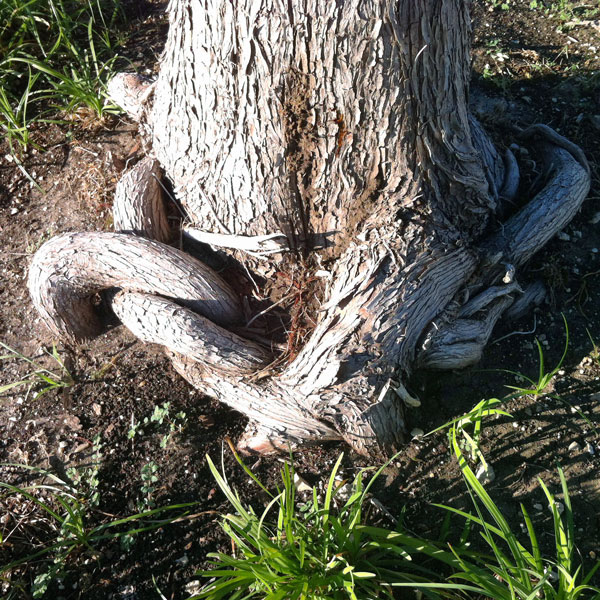
The top growth weakens and eventually breaks. That’s if the plant hasn’t been removed already.
Even simple items can girdle a tree’s trunk. I secured a pinwheel to the trunk of an old cottonwood in our backyard in College Station with a small piece of my dad’s wire from the garage. I was about 10, and by the time I was 14 the trunk had grown enough that the top had died out of our tree.
I bought 5 dogwood trees and planted them into our current-day landscape. Several years later they started to die. I examined them carefully and could find no signs of a problem. As I was removing the first tree, I discovered my error. There had been a second price tag attached to the trees when I bought them. They were lightly attached with thin copper wires, but all the tags had fallen to the ground in the process. Eventually they killed every tree.
Sadly, by the time overgrowth is occurring there is little anyone can do to save the trees. You can’t dig a wire or twine out. It goes back to being vigilant at the time of planting and in the ensuing 3-4 years. We all can do better.