
William C. Welch, Ph.D.

From Neil…
When I asked Greg Grant to write a horticultural remembrance, call it an obituary if you must, of Bill Welch, I knew it would be a masterpiece. But before I turn you over to Greg, I want you to read my thought…
When these two men sat at a table working together you had perhaps 80 percent of the combined horticultural knowledge in Texas. Oh, I know that’s a huge overstatement, but I offer it only to suggest my ultimate respect for each of them. Greg is about to demonstrate how he felt for Bill. Here’s what he sent back late Tuesday night. It brought me to tears. I hope you enjoy it. Thank you, Greg.
(Photos by Greg Grant)
Dr. William C. Welch (1939-2026)
An endless array of accolades could be shared about my late mentor Dr. Bill Welch as a professional garden writer, educator, and horticulturist. He won every award conceivable and left behind an unmatched legacy in both the Southern nursery industry and home landscapes across the South. He was truly a larger-than-life, once-in-a-generation legend. However, his biggest legacy is perhaps his mentorship to me and a number of others including Chris Wiesinger, Jason Powell, Dr. Tim Hartmann, Dr. Andrew King, and most recently soon to be Ph.D. Mason Marshall.
His ability to share, inspire, and motivate was unmatched. I had my first encounter with Dr. Welch when he came to speak about the history of roses to one of my horticulture classes at Texas A&M in the 1980s. I was born in Tyler, Texas, and I thought I knew a few things about roses, but as it turned out I knew almost nothing about roses. I was so enthralled with his lecture that I trotted myself straight to his office to tell him how interested I was, and I made rose rustling my first venture when I went back home to my rural Deep East Texas community. When I came back, I had a stem and bloom of one of my paternal great-grandmother’s old roses in my hand. He didn’t know what cultivar it was, but he assured me it was an old Rosa x odorata (true tea) cultivar and I was immediately hooked. I had always been interested in cemeteries and old homeplaces and had even previously collected one antique rambling rose with my grandmother in addition to numerous heirloom bulbs.
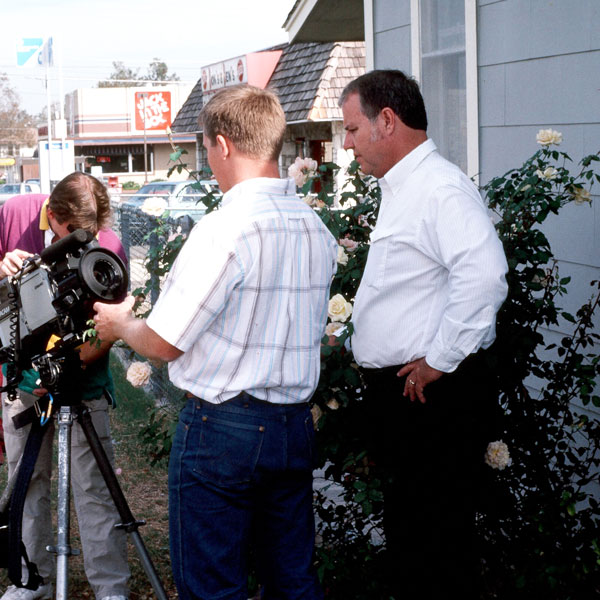
Before long I had received my degree and was headed to graduate school at Stephen F. Austin State University in Nacogdoches the very year Dr. David Creech was to start his famous arboretum there. The day before school started however, Dr. Welch and director of Extension Horticulture Blueford Hancock called me and asked me to take the Horticulture Clerk position, answering hundreds of gardening questions, eight hours a day on three telephone lines, in the Dallas County Extension office, with an annual salary of $13,333.33. They assured me it would be good for my career, so I took their advice and moved to Dallas before heading back to Texas A&M that fall to start my Master’s in Horticulture.
Bill quickly introduced me to Pam Puryear, had me join the Texas Rose Rustlers, and start work with him and Mike Shoup landscaping and opening the one-of-a-kind Antique Rose Emporium. Pam was the first in a very long line of eclectic, influential, and inspiring individuals he would introduce me to in my career. My life and profession would have never been the same had our paths not crossed. Thankfully, the week before he died, I had the chance to sit in front of him and tell him all the ways he changed my life.
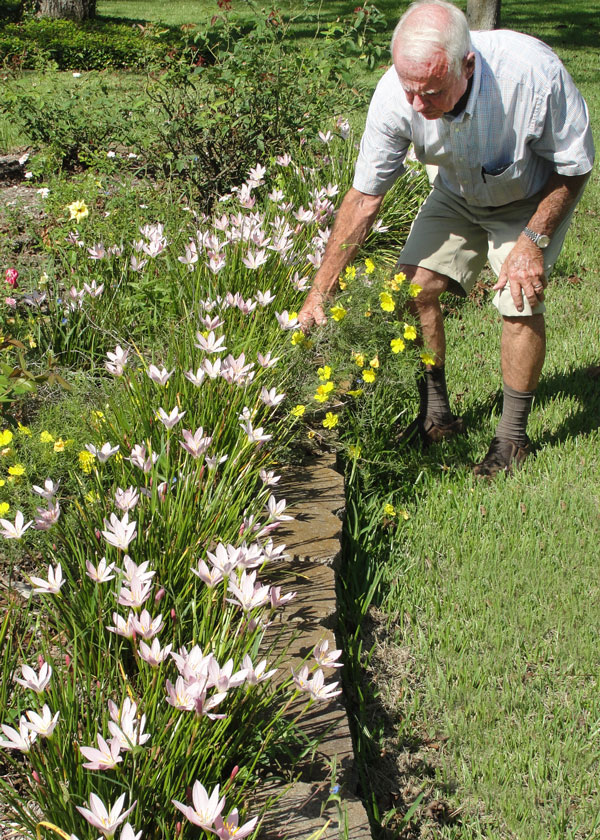
As I’m sure you know, Bill loved perennials (he wrote the book after all), stalwart perennial bulbs in particular. Crinum lilies were a personal favorite and every time I spent the night at his home, he’d have at least one or more in a vase on the dining room table and in the guest room where I stayed. Needless to say, when he passed away, I knew Bill needed crinums at his funeral. So, Chris Wiesinger and I both loaded-up crinum blooms and hauled them to College Station for his service. Years ago, Bill made the now famous statement “No crinum has ever died.” Mike Shoup, Lucille Welch, and Mason Marshall contributed other garden flowers Bill loved. I couldn’t help but think that no great mentor has ever died, because all the goodness and knowledge in them is passed on to others to carry the torch.

My wife asked me if my life would change after the funeral and how long I would grieve. She was surprised when I told her my life wouldn’t change a bit because Bill was my teacher for 40 years so I long since knew how to take the baton and move forward. Granted, I can’t be Bill Welch (no one can), nor can I accomplish his feats, but plant the seed he did. Bill made every place he went prettier and every person he taught inspired. He recruited me to the Texas AgriLife Extension Service, made me a writer, taught me the beauty and functionality of good design, and showed me that every plant has a story, and only special plants are time-tested and truly adapted.
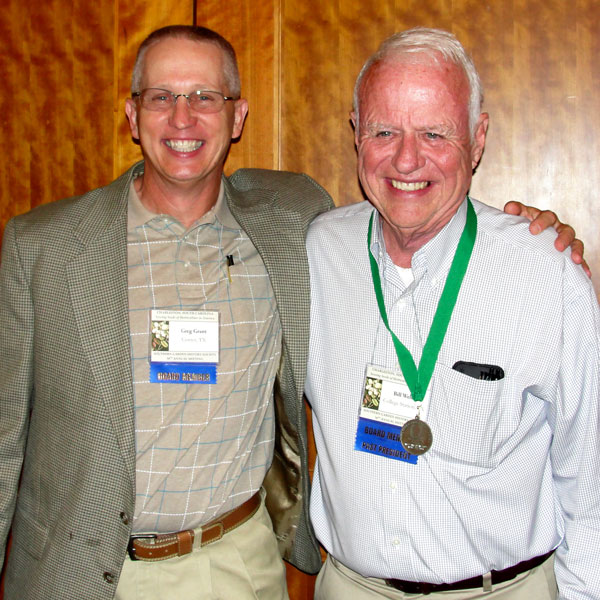
My friend and mentor Dr. Bill Welch will live on in every plant I grow, every word I write, and every lecture I give. Thank you for taking me under your wing and thank you for teaching me how to fly. I may not be as graceful as you, but flap on I will.
-Greg Grant, Ph.D, Tyler, Texas 2026