
Perhaps the hardiest palm
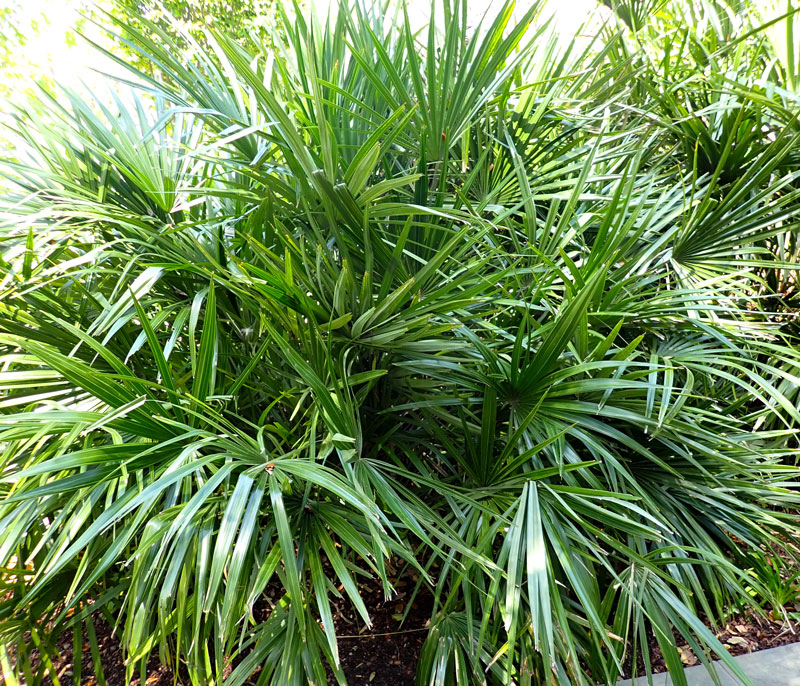
You won’t sit in the shade of a needle palm. For one thing, it won’t grow tall enough. For another, it gets its name from the sharp, black spines where the leaves attach to the trunk. They’re long and they’re painful. This is a plant you enjoy from a distance.
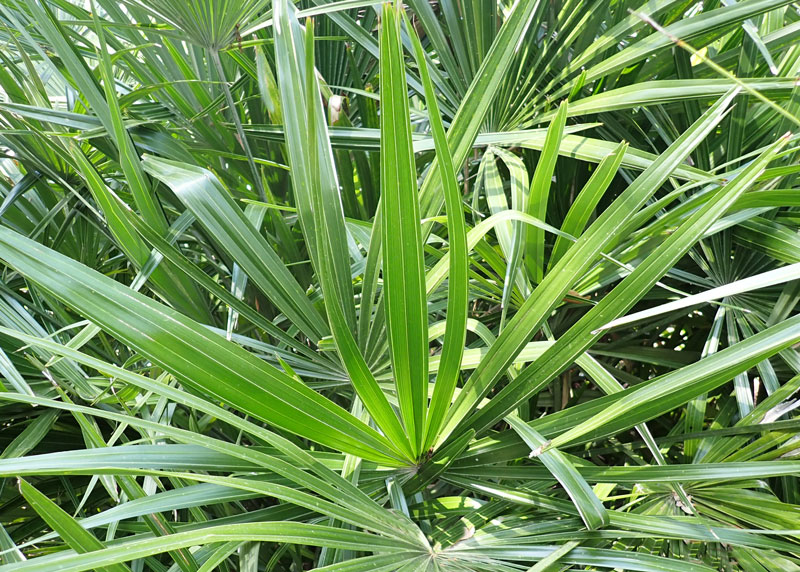
Needle palms are dense, clumping, spreading, evergreen shrubs that grow 3 to 6 ft. tall and 4 to 8 ft. wide. It has large, fan-shaped leaves that are glossy green on the upper surface and dull green beneath. They grow to be up to 30 in. across, and they consist of 8 to 16 narrow and stiff leaflets that are each 15 to 20 in. long and 1 to 2 in. wide. The handsome leaves give the plants a beautiful, coarse texture. The plants’ trunks are short and thick, reddish-brown in color.
Needle palms bloom in the summer with panicles of yellowish-brown, 3-petaled flowers emerging within the leaf sheaths. The flowers are not especially showy, and they are usually hidden within the foliage anyway.
The flowers are followed by small, fuzzy, reddish-brown fruit that ripen in fall. The fruit are foul-smelling, but various mammals still like to eat them. The plants can be spread by seed from those fruit, but it does take them up to 6 to 12 months to germinate. In theory the plants can also be propagated from offsets they send up from their roots, but the spines make that task virtually impossible.
Needle palms are tolerant of dry soils once established, but they do best in rich, moist, well-draining soils. Although they will tolerate full sun, they do best with partial shade (especially from the afternoon sun in the summer). When planting them in colder parts of the state, use them where cold winter winds won’t hit them directly. Mulch their root systems for added protection.
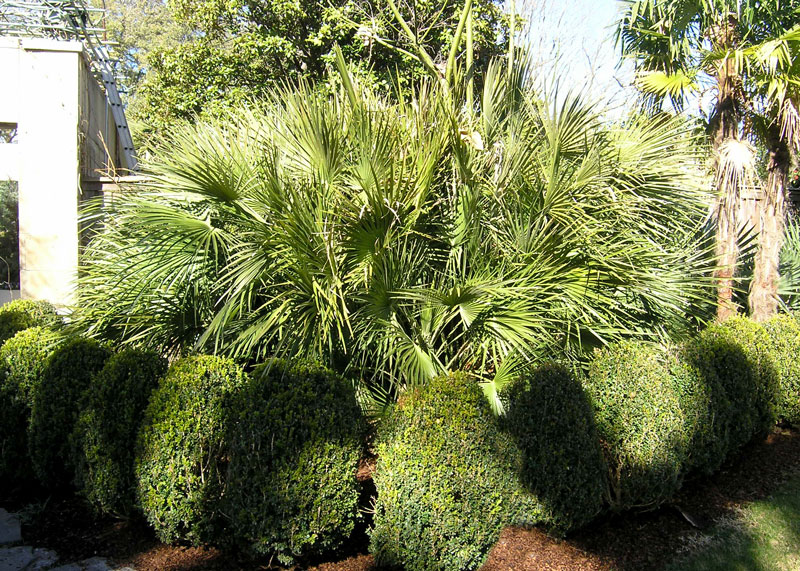
Needle palms work best in small groupings around the patio, pool, or even in a woodland setting as understory shrubs. Because of their spines they make outstanding security plants. Allow your plants ample space to grow thick and wide so you won’t have to contend with the spines as you maintain them. It probably belongs in the back of mixed shrub beds. Companion plants might include holly fern, Farfugium japonicum var. giganteum, plum yew, Turk’s cap, and Carex ‘Feather Falls.’
Here are facts to remember…
Common name: Needle palm
Scientific name: Rhapidophyllum hystrix. The species name is Greek for “porcupine” (for the spines on the stems).
Plant Family: Arecacea, the Palm Family
Native home: Mississippi, Alabama, Georgia, South Carolina, and Florida
U.S.D.A. Hardiness Zones: Zones 6b-10b (the zones that cover Texas)
Pests: No serious insect or disease problems and seldom damaged by deer.
Wildlife: Attracts pollinators and mammals. Serves as wildlife habitat.