
Purple fountaingrass is a longtime staple

Its actual place of origin isn’t known, but it’s somewhere in Africa, the Middle East or tropical Asia or Malesia. That narrows things down to about half the world!
And its exact lineage isn’t much more certain, either. We’ve called it a hybrid of a Pennisetum species for a long time, but taxonomists now think it’s a sterile hybrid between Cenchrus setaceus and C. elegans. In other words, this thing may be a mongrel.

To a gardener, however, it’s a delight. It showed up in American gardens in 1916. It’s been with us ever since, but it’s only been really popular in the past 30 or 35 years.
What about its winter hardiness?
• In USDA Hardiness Zones, 9-11 (South Texas) it will be perennial, returning each spring.
• In Zone 8b it may return in the spring if it’s grown in a protected, well-draining location.
• In Zones 8a and colder you’re going to want to consider it to be an annual that will have to be replanted each spring.

The cultivar ‘Rubrum’ is most common, growing to 4-5 ft. tall (including floral plumes) under ideal conditions of moisture and fertility. There are several shorter named selections from ‘Rubrum,’ less common in the nursery trade, but equally attractive.

You will occasionally see dramatically tall purple cultivars, often in commercial landscapes. They’re not selections from ‘Rubrum,’ but from another ornamental purple-leafed grass of similar appearance – called purple elephantgrass. ‘First Knight’ grows to 4 to 6 ft. tall or taller. ‘Prince’ and ‘Princess Caroline’ grow to 5 to 6 ft. tall or taller. These types are grown for their foliage, as most do not produce floral plumes.
All these types of fountaingrass grow best in full or nearly full sun. That’s especially true if you’re looking for rich purple color and production of floral plumes. Set out potted transplants once the soil has warmed in late March (South Texas) or April. Keep them well fertilized and watered and they’ll soon take command of their settings.
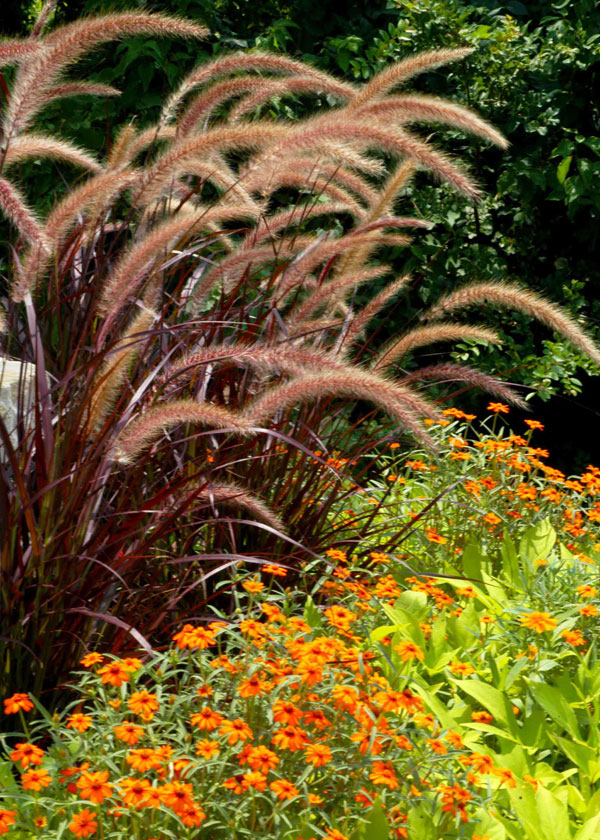
Feature purple fountaingrass plantings where you need the contrast of colors they provide against bright yellows, oranges, pinks, or blues. They make the ideal backdrop for almost any of your flowerbed all stars.