
Ferns of fun and fantasy
It’s hard to believe these are really plants. They look some kind of laboratory experiment run wild where genes of a wild beast were stirred in with some kind of jungle vine.
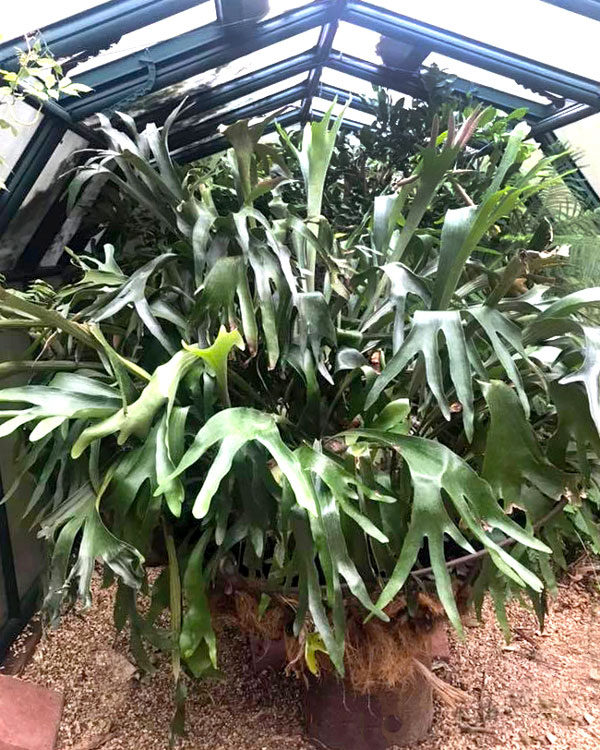
But staghorn ferns are the real deal. They’re true ferns from the genus Platycerium, from the Greek meaning “broad horn.” Those Greeks had it right.
And it’s not like they’re native to some little tucked-away spot. They come from far away regions of tropical and subtropical Africa and Madagascar (lots of odd plants come from Madagascar), Southeast Asia, Australia, and parts of the Pacific. It sounds like they’re fond of the Southern Hemisphere.
These are some of the best examples we can find of true epiphytes. Those are plants that grow attached to trees. They’re amazing in that respect, because if you’ve ever carried a big staghorn fern, those babies get heavy. It must take a lot of suction for them to hang onto trees.
You’re probably familiar with regular ferns – let’s say a Boston fern. It has one type of fronds (leaves). They all look pretty much the same as each other.
Well, that’s not the case with our staghorn ferns. They produce the “fertile” fronds. Those are the “antlers,” and they’re the parts of the plants that give rise to the reproductive spores.

But, unlike most other ferns, staghorns have “shield” fronds. They’re the rounded fronds at the bases of the plants. They gradually turn brown as they age, but they are highly important. They protect the plants’ roots, and they also collect and store moisture and organic matter that will decay and supply nutrients as the plant grows. They must not be removed.
How to grow staghorns…
Like most ferns indoors, staghorn ferns are going to need very bright light. A west bay window, a sunroom, or a greenhouse/garden room would be ideal. While they shouldn’t have direct sunlight in the summer, winters indoors can be exceedingly dark. Artificial lighting won’t be enough.
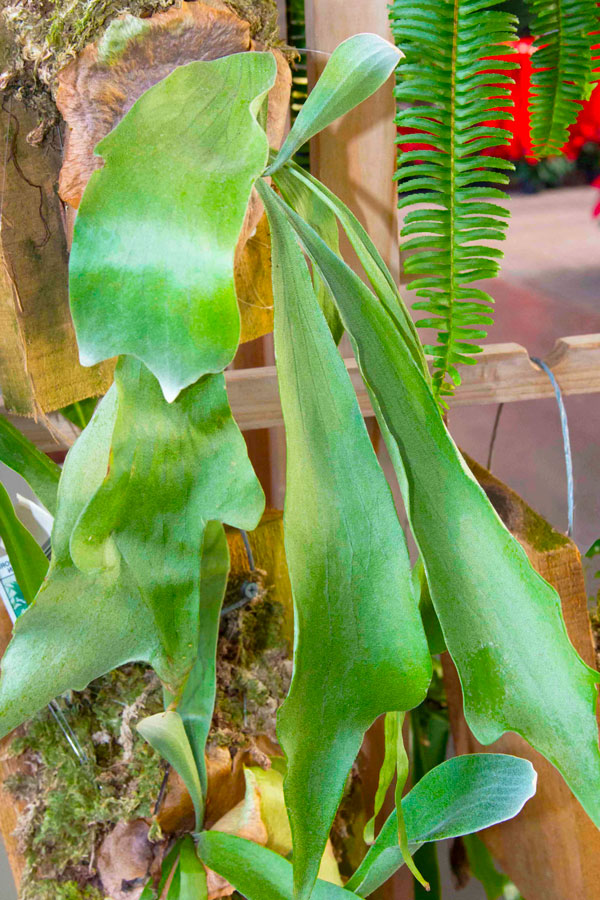
They’re usually sold on bark slabs in nurseries, and those will be sufficient for some time. However, most types of staghorns get large as they get older, so you’ll want to have a larger piece of wood that you can affix to the back of the original plaque. Use a piece of galvanized wire to secure it.
I have found it easiest to keep my staghorn ferns moist when I covered their shield fronds with a piece of dry cleaner’s plastic carefully concealed so it isn’t unsightly. I soak their moss or soil between waterings, and I use a diluted, complete and balanced, water-soluble plant food every couple of weeks.
The only pests I’ve ever encountered on my staghorns were fire ants in the potting soil, and they were not pleasant. There are, however, houseplant insecticides that can be used as a drench through the potting soil to eliminate them. Obviously, that’s a job that must be done outdoors.
Staghorn ferns tolerate temperatures into the 50s, but they cannot be allowed to freeze. For best growth, keep them in the 70s and warmer.
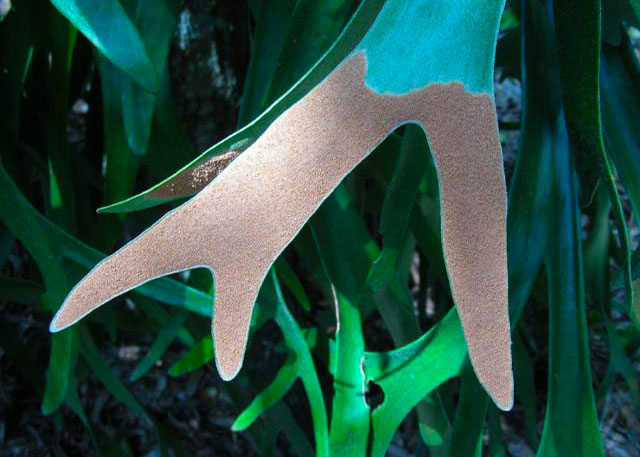
Nature, obviously, propagates staghorn ferns by spores. However, that’s very slow and painstaking. It’s easier and quicker to divide offshoots that form in the shields. Do so carefully using a sharp knife to minimize damage done to both plants. Better yet, just buy yourself a new plant.
Staghorn ferns are actually quite easy to grow. Keep up with their needs and you’ll have a plant pal for many years.