
Q&A – Ask Neil: October 8, 2026
(Please read these instructions carefully.)
Before you post your question, please look at recent issues to see if someone else has already asked it. You might find your answer there.
HOW TO SUBMIT YOUR QUESTION…
• Click here to post your question. (Please post your question only one time.)
• Please use this link only for posting questions – not for standard e-mails.
• High-resolution photos (1-2MB – not thumbnails) attached with your question help Neil give you the best possible answer. Please check your photo for clarity and exposure. If you do not see “All images clickable for larger views,” your images’ resolution was not sufficient for enlargement. That might also have made it difficult for Neil to give you an accurate answer.
• Neil chooses questions of greatest reader interest. Plant IDs rarely fit that description.
• Neil requires your first name or initials, also your city or county for an accurate answer. (Texas is a very large state.)
• One question per reader per week, please.
• Watch for Neil’s reply in the next issue of e-gardens.
Note: If you have submitted your question and did not see the pop-up window for attaching your photo, please click here.
QUESTION 1
HOW SHOULD I TRAIN MY PEGGY MARTIN ROSE?
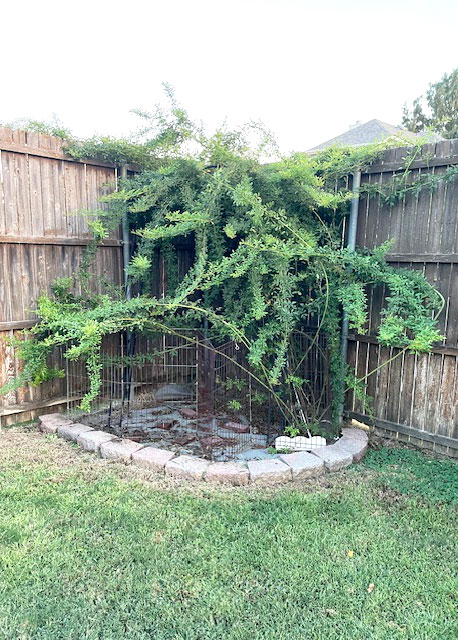
Question: My Peggy Martin rose has become unruly and overgrown. This is my first experience with this plant. I don’t know when to prune it nor how much to remove. What needs to happen to train it over the arbor? Connie P., Allen.
Images clickable for larger views.
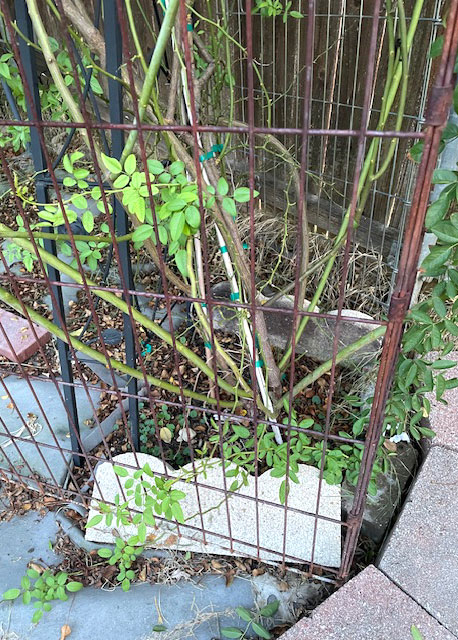
Answer: Peggy Martin is a very large and strong-growing variety (see examples online) that will need a heavier support than you currently have in place. Its weight could pull or push the fence over in a few years, and the trellis isn’t stout enough to support it. I would suggest you build a much stronger frame independent of the fence and all other supports so that you can remove them as the rose transitions over to your new heavier trellis.
You’ll need to tie and train each shoot as it develops rather than trying to pull them onto the frame later. With that said, you probably should remove the two large stems coming off at low angles at the bottom, left of the plant. The comparable stems on the right should be removed as well. The plant will look best if it cascades down over your support.
My other overriding worry is that it can stay free of rose rosette virus. As durable as Peggy Martin rose is, even it is susceptible to that fatal disease. I hope there isn’t any in the neighborhood to spread to your plant. My wife and I are in Allen frequently, and I know it caused the city to take out all the roses in many of the medians along Stacy and Anderson 8-12 years ago. If you can avoid RRV your Peggy Martin will be beautiful.
QUESTION 2
DO NEIGHBORHOOD RABBITS BRING WEEDS IN THEIR DROPPINGS?
Question: Would weeds in my lawn possibly have come from the droppings of neighborhood rabbits that have stopped by to visit? Teresa W., Argyle.
Answer: Yes, they can. They eat, digest, sow, and fertilize. They’re a package deal.
QUESTION 3
WHY DOES MY ST. AUGUSTINE LOOK SO BAD?
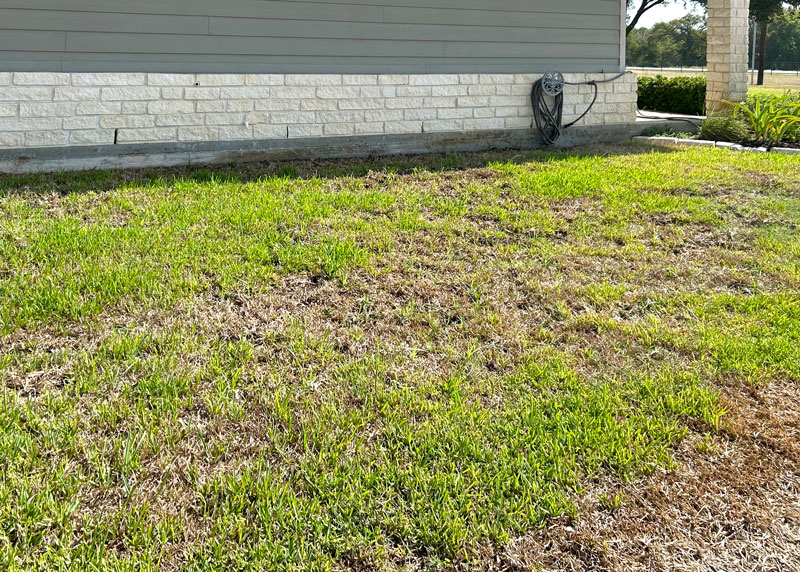
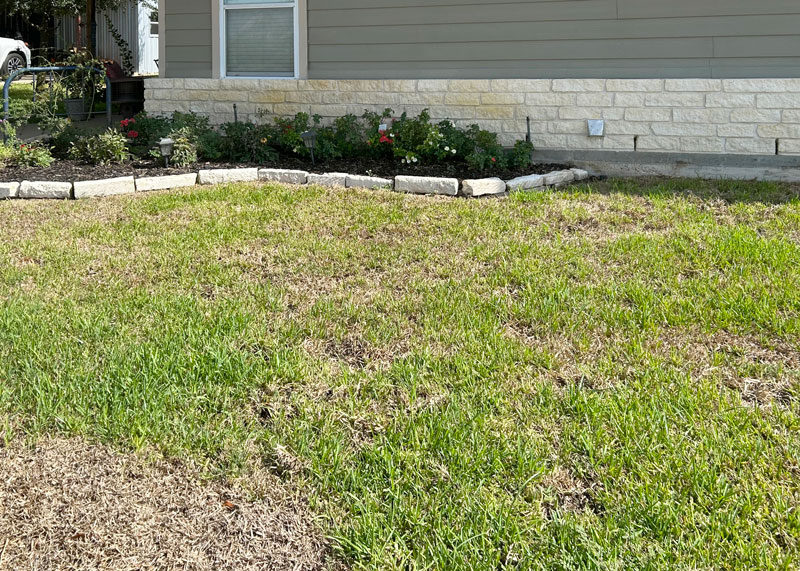
Question: My St. Augustine looks terrible this year. The front yard looks great, but the side and backyard look awful. We have been invaded by armadillos, and some of the grass is turning yellow. I have fertilized and put out fungicide and iron. Ava W., Robertson County.
Images clickable for larger views.
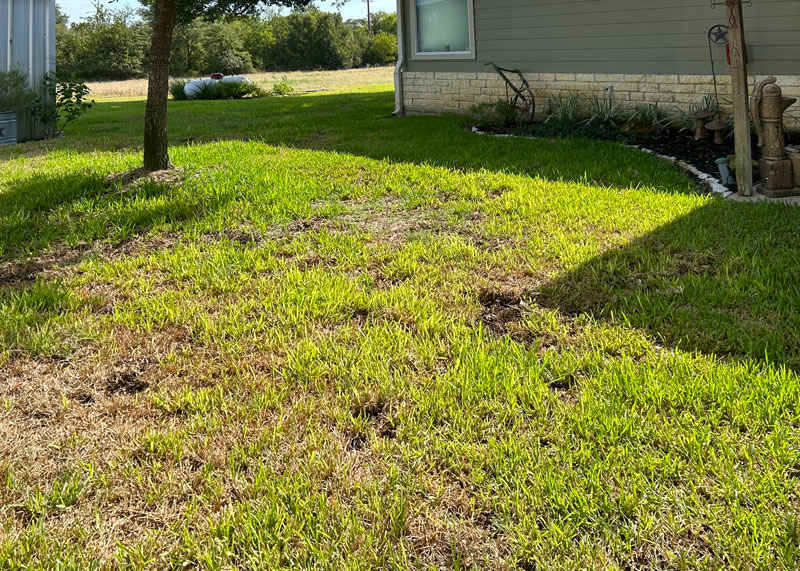
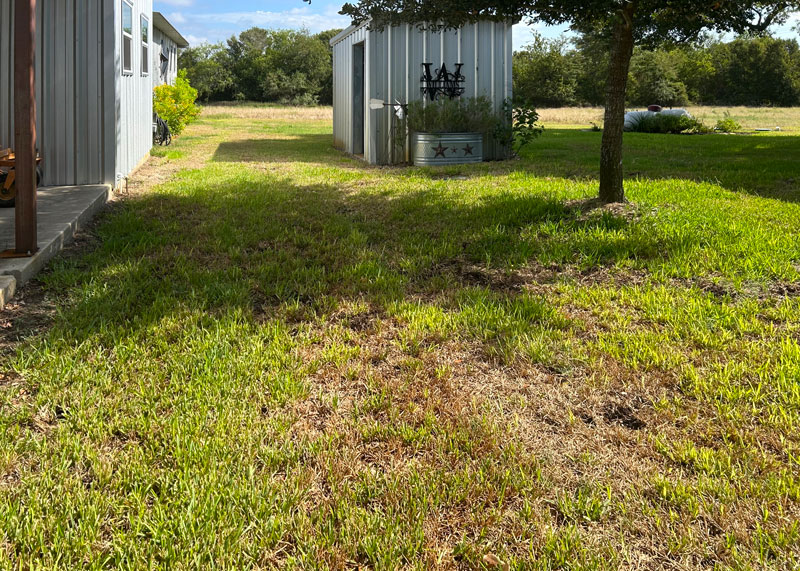
Answer: I saw the scratching around the armadillos had done. They came to your lawn back when you had the only moist soil anywhere around back during the hot, dry weather. I have information on how to catch them in a humane trap in the FAQ pages of my website. Here is a link.
As for the yellowing and thinning, that’s similar to questions that have been asked here in the past month or so. Chinch bugs certainly could have been involved in the hot, sunny locations. They’re probably not out there any longer, but learn how to check for them and watch for them next year starting mid-summer.
I really suspect, however, that your lawn has been hit by gray leaf spot this summer. It’s a fungal leaf disease that runs rampant when it’s really hot. It causes BB-sized, diamond-shaped and gray-brown lesions on the blades. Affected areas take on an anemic yellow look leading gardeners to haul out the fertilizer. Unfortunately, nitrogen causes the disease to get even worse – in a hurry.
The best thing you can do if you see the spots on your St. Augustine blades now and next summer is to avoid applying nitrogen between early June and early September. The grass will survive just fine. We overfeed our lawns anyway. And, for short-term relief of any current problems, we can apply a turf fungicide such as Azoxystrobin – one that is labeled for patch type diseases.
QUESTION 4
WILL THESE POMEGRANATE PLANTS COME BACK?
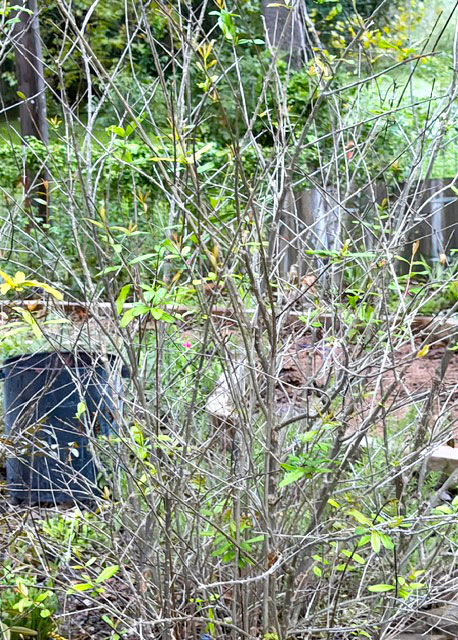
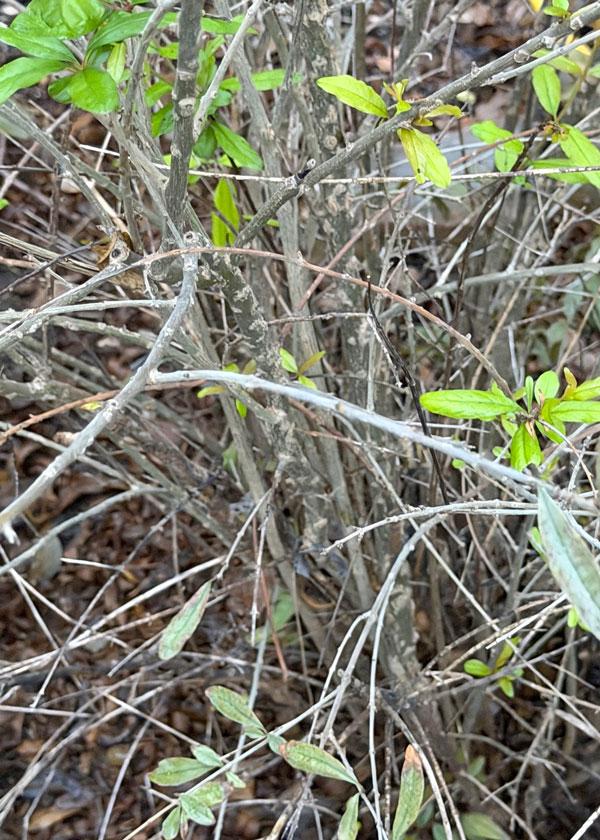
Question: The hot, dry weather has not been easy on these pomegranate bushes. They have lost most of their leaves. Do you have any recommendation? They’ve been in this spot for more than 60 years. Carolyn M., San Saba.
Images clickable for larger views.
Answer: I’m going to have to rely on your intuition a lot in developing our answer here. Pomegranates were hurt badly by the extreme cold of February 2021. Many of those that survived have been lethargic ever since. If your plants looked weak before this summer, I’d be concerned that they’ll come back. They certainly look frail in your photos.
If, on the other hand, they have just lost their leaves a few weeks early following this beastly summer, it would be worth giving them one more winter to bounce back and leaf out next spring before you make your decision. I don’t want to be the executioner all by myself, but if I had to guess, I’d say they’re going to have a real struggle pulling through. You’ll probably be better off starting with new and vigorous plants in 2027.
QUESTION 5
WHEN SHOULD I REMOVE THE PLANT TIES FROM LIVE OAKS PLANTED 22 MONTHS AGO?
Question: I planted live oaks from containers in December 2024. I left their lower branches on the trees, and I secured the trunks against stakes. When should I remove the stakes and plant ties? When should I prune and remove the lower branches? Jerry S., Colleyville.
Answer: You are probably there now. Judge from the amount of new top growth they have produced, also if the trunks have grown thicker. If they’re more stout, less likely to tip over in a windstorm, it’s time. Prune those side shoots off flush with the trunk.
QUESTION 6
CAN YOU RECOMMEND A LANDSCAPE COMPANY FOR A TOTAL RE-DO?
Question: We live in Frisco and want a total re-do of our landscape in our backyard. Can you suggest companies that could do that? Mary C., Frisco.
Answer: Almost any landscape company could do that for you. It depends on the style you’re seeking and how involved you want the garden to be. If you’ve been in landscapes that really appealed to you, ask the homeowner who did their designing and planting. They’ll be happy to share that information. Local independent retail nurseries (as opposed to “big box” stores) either do landscape designs or they know people who do them. Our advertisers (Calloway’s) have a division within their company that will work with you. If you have a favorite nursery you like, and if that nursery also sells wholesale they will know some of the best design/plant companies that buy from them. Don’t be afraid to ask around. Soon you may find that the same names will keep popping up.
QUESTION 7
WHAT WOULD BE A GOOD REPLACEMENT FOR OUR TEXAS MOUNTAIN LAUREL?
Question: Whatever killed half of our Texas mountain laurel last year got the other half this year. What would be a good alternative to plant in place of it? 8-plus hours of sunlight. Like height and width. Max B., Dallas.
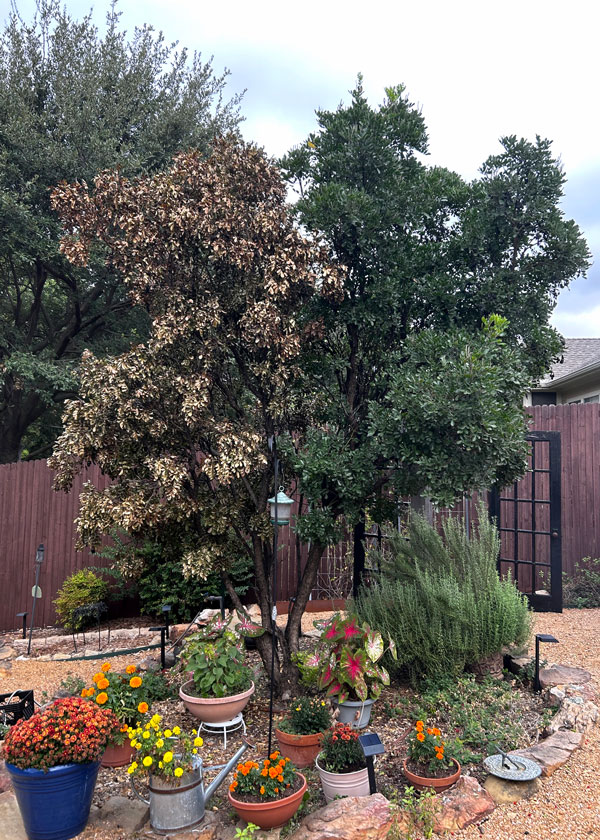
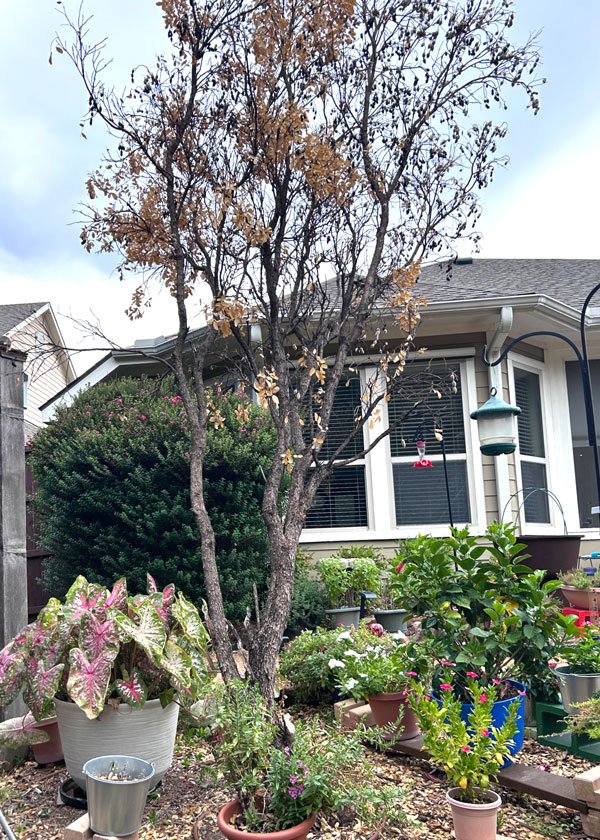
Images clickable for larger views.
Answer: That stinks. Mountain laurels are so pretty, but I lost mine in the same way. It had a stem canker fungus that gradually took one stem at a time.
I’d always lean toward one of the hollies. Sometimes you can find them already trained tree-form, but even if you can’t, it’s not a difficult task. You simply buy a large enough plant where you can see the general directions in which the lower branches are growing. That will let you know if they could be trained to be trunks. I’ve trained Willowleaf, dwarf Burford, Nellie R. Stevens, and Oakland hollies into small trees that would fit your space.