
Q&A – Ask Neil: October 1, 2026
(Please read these instructions carefully.)
Before you post your question, please look at recent issues to see if someone else has already asked it. You might find your answer there.
HOW TO SUBMIT YOUR QUESTION…
• Click here to post your question. (Please post your question only one time.)
• Please use this link only for posting questions – not for standard e-mails.
• High-resolution photos (1-2MB – not thumbnails) attached with your question help Neil give you the best possible answer. Please check your photo for clarity and exposure. If you do not see “All images clickable for larger views,” your images’ resolution was not sufficient for enlargement. That might also have made it difficult for Neil to give you an accurate answer.
• Neil chooses questions of greatest reader interest. Plant IDs rarely fit that description.
• Neil requires your first name or initials, also your city or county for an accurate answer. (Texas is a very large state.)
• One question per reader per week, please.
• Watch for Neil’s reply in the next issue of e-gardens.
Note: If you have submitted your question and did not see the pop-up window for attaching your photo, please click here.
QUESTION 1
HOW CAN I PREPARE MY TREES AGAINST LOSS TO FREEZE?
Question: How can I prepare mature trees for a severe freeze like we had in 2021? Water? Mulch? I purchased a home with a magnificent red oak in the garden. I thought it was gone after that freeze, but it has slowly come back. How can I avoid having that happen again? Ann M., Tarrant County.
Answer: Keeping it properly watered and nourished (nothing out of the ordinary) would be the main things. Mulching it won’t help, because its roots go out as far as the drip line, and the damage that freeze did to most species was to the woody top growth anyway, not to the roots.
I’ve been in Texas all my life and in your area for the past 56 years. I have never seen a cold spell do the kind of damage that one did to red oaks and live oaks, among many other plant species. The damage was even done much farther south than you are. I would not expect to see it again in the foreseeable future. I certainly hope not.
Oh, and it’s always a good idea to have a certified arborist looking after your important trees once or twice each year.
QUESTION 2
IS RABBIT MANURE GOOD FOR THE LANDSCAPE AND GARDEN?
Question: What is your opinion of rabbit manure? Is it free fertilizer or a noxious weed spreader? Teresa W., Argyle, Denton County.
Answer: It is definitely an organic fertilizer, although like other manures it will have a low nutrient content and the solubility of nitrogen, phosphorus, and potassium will be slow. Over a period of time, it could cause a build-up of mineral salts in the soil, so it’s best to use it in moderation and to keep blending it into the soil. Don’t just pack it up around your plants’ stems. I don’t think it’s going to be a big contributor of weeds to the garden. Any that do germinate should be easy to remove by cultivation.
QUESTION 3
SHOULD I LEAVE THESE SPROUTS ON MY LIVE OAK?
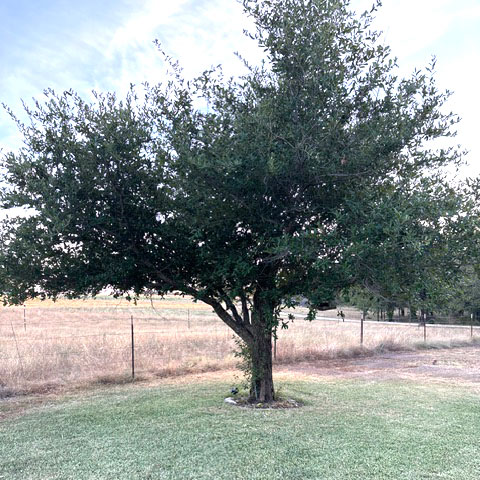
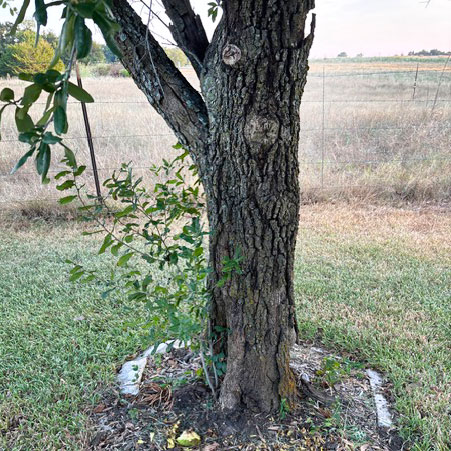
Question: My live oak barely survived the big freeze 6 years ago. Now it has some shoots coming out of its base. Do I just cut them off or wait in case the tree doesn’t make it? The bark seems to be growing back OK. Pam H., Grayson County.
Images clickable for larger views.
Answer: Your tree looks like it’s doing handsomely. Even if it were to die back from leftover damage from the freeze (which it doesn’t appear to be doing at all), you really wouldn’t want a 1-in. diameter trunk coming out of a stump 8-10 in. in diameter. Go ahead and cut them back flush with the trunk.
QUESTION 4
SHOULD WE WORRY ABOUT THESE TREES?
Question: The neighbors behind us are in an unincorporated area. Should we be concerned about these trees? We have enjoyed them for 9 years, but now we are seeing broken limbs, and the trees seem to be leaning toward us. Karen F., Denton County.
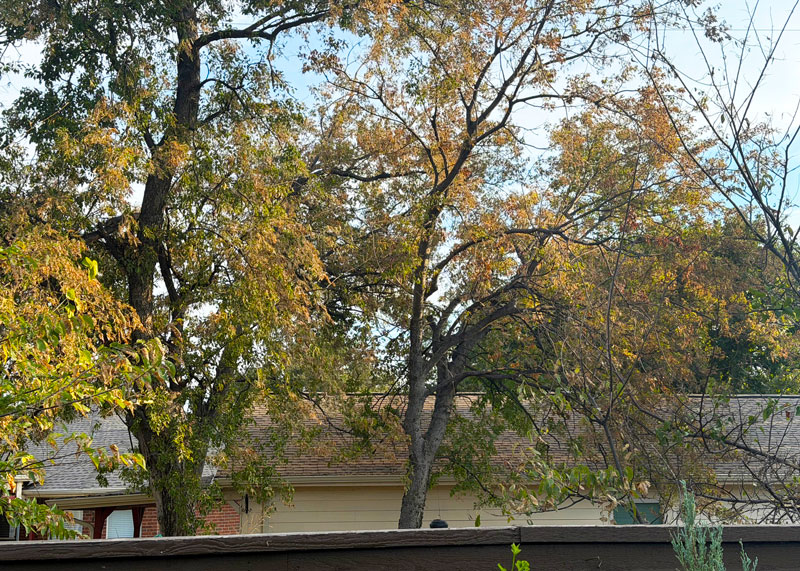
Answer: Best I can tell those are hackberries (sugarberries). They get very large as they mature, and they are notoriously weak wooded. They’re fairly attractive while they’re young, but they’re subject to limb breakage as they age. They’re also highly susceptible to mistletoe. If they’re on your property, you might consider having them removed. If they belong to a neighbor, put them on alert to your concerns. Perhaps they would consider having a few limbs removed to balance their weight as they mature.
QUESTION 5
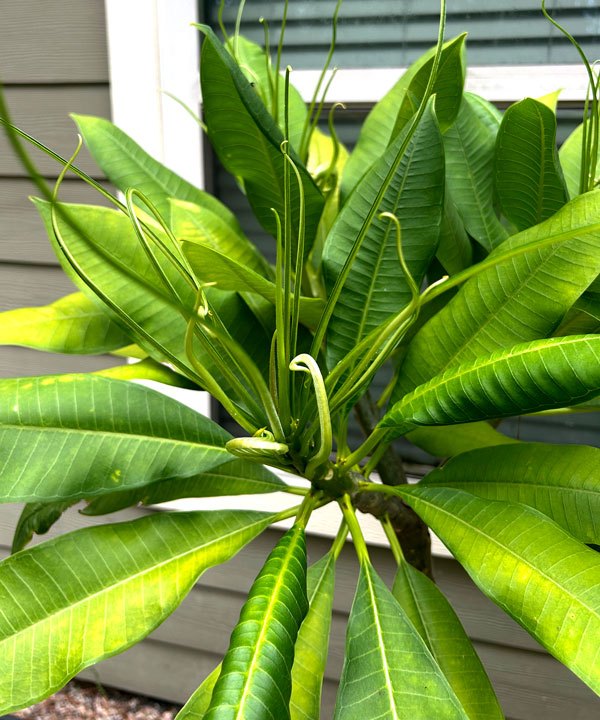
WHY DOES MY PLUMERIA PUT OUT THESE SPIKES?
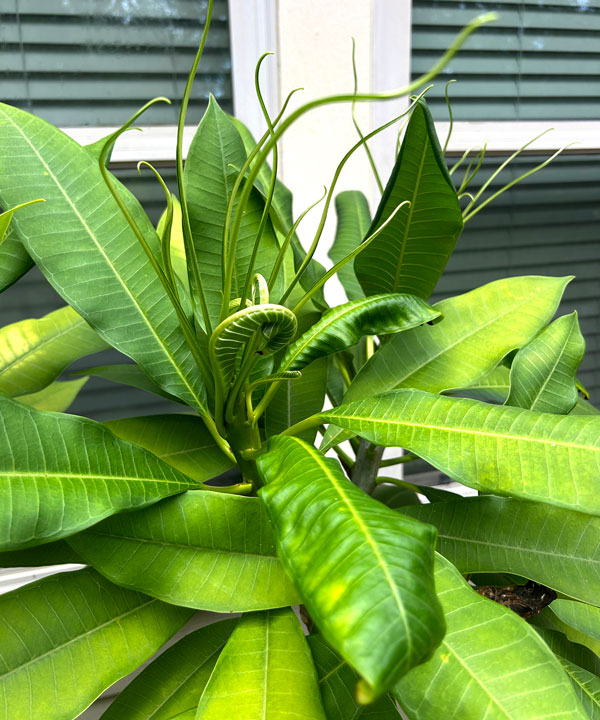
Question: Why does my plumeria put out these spikes among the leaves? They don’t open or grow into leaves. JoAnne L., Spring.
Images clickable for larger views.
Answer: Those are badly disfigured leaves. Notice how this is a somewhat gradual transition at the top of the plant. You have several leaves that are cupped, then these that are tightly rolled.
The only thing that I have ever seen cause this reaction among plants is from exposure to a broadleafed weedkiller such as 2,4-D or dicamba. When one of them is used on a lawn, you’ll see the weeds curling their leaf blades in this same way.
This could happen from drift from a nearby application or from contamination from spraying with a tank sprayer that had remains of the herbicide in it. Sit tight and see how the plant responds over the next few weeks. Hopefully it will self-resolve before winter and the plant will grow out of it.
QUESTION 6
WHAT CAN I DO TO HELP MY ST. AUGUSTINE?
Question: I’m having issues with my St. Augustine. I fertilize. I’ve debugged. I’ve used Grub-X and Disease-X, both as preventives and right on schedule. I see no signs of chinch bugs or grub worms. The rest of the yard looks great. Roger P., DeSoto.
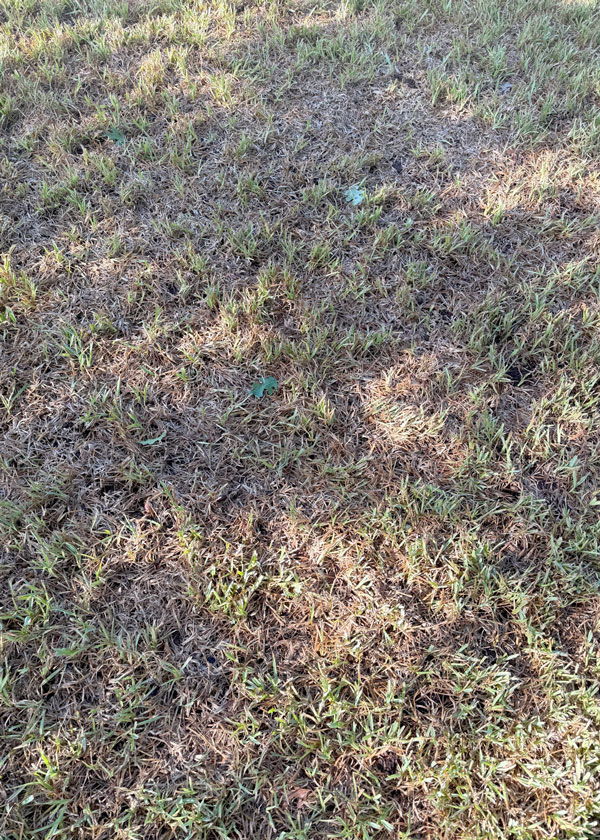
Answer: You won’t see insects since you have used an insecticide. I’m looking at the top of your photo. Is that bermudagrass there? Is it also struggling? If so, that would rule out any insect or disease. White grub worms are the only insect that would bother both grasses, and this doesn’t look like grub damage. Please look closely at the blades of your St. Augustine for diamond-shaped lesions that would tell us that gray leaf spot might be present. That’s what this really looks like. I know you used a fungicide, but if you fertilized in the summer, you could easily have made the problem worse in a hurry.
Am I seeing holes in the ground every few inches? That might be from emergence of cicadas or cicada killer wasps, but neither should have set your lawn back this much. That’s the best I can do with just the one photo. I hope it helps.
QUESTION 7
MY ROSE OF SHARON HAS ONE BRANCH THAT HAS SPLIT. WHAT SHOULD I DO?
Question: My 6-trunk rose-of-Sharon has one trunk that split about 3 ft. from the ground. The leaves have fallen off that branch. Is it dead? The other 5 branches all look fine with leaves and blooms. What should I do? Mary D., Dallas.
Answer: Without a photo, it sounds like it’s done. I would trim it off and let the plant fill back in. I have a dwarf Chinese holly that lost a major branch when a tree branch fell into it. We’ve done a little cosmetic pruning, and the rest will be up to my little holly.