
Q&A – Ask Neil: September 10, 2026
(Please read these instructions carefully.)
Before you post your question, please look at recent issues to see if someone else has already asked it. You might find your answer there.
HOW TO SUBMIT YOUR QUESTION…
• Click here to post your question. (Please post your question only one time.)
• Please use this link only for posting questions – not for standard e-mails.
• High-resolution photos (1-2MB – not thumbnails) attached with your question help Neil give you the best possible answer. Please check your photo for clarity and exposure. If you do not see “All images clickable for larger views,” your images’ resolution was not sufficient for enlargement. That might also have made it difficult for Neil to give you an accurate answer.
• Neil chooses questions of greatest reader interest. Plant IDs rarely fit that description.
• Neil requires your first name or initials, also your city or county for an accurate answer. (Texas is a very large state.)
• One question per reader per week, please.
• Watch for Neil’s reply in the next issue of e-gardens.
Note: If you have submitted your question and did not see the pop-up window for attaching your photo, please click here.
QUESTION 1
SHOULD WE USE WATER BAGS AND PERFORATED PIPES FOR NEWLY PLANTED TREES?
Question: I know you’re not a marriage counselor, but please settle a difference. My husband says we should use water bags and/or PVC pipes with perforations pounded into the hard clay soil near our newly planted trees. I disagree. Who is correct? Brenda E., Mansfield.
Answer: I am absolutely not a fan of the water bags around tree trunks as a means of watering them. First, they don’t hold enough water. Second, it would be easier just to water them the right way in the first place. And people are going to have an almost impossible time getting perforated pipe into the ground. That’s an even worse idea.
I cast all my votes in this election year to building a low berm of soil around each new tree. I use the soil I’ve just removed in the process of planting the tree. I want that berm to extend out to the edge of the new tree’s soil ball.
That will allow me to use a water wand and a water bubbler or water breaker to give each new tree a deep soaking every 2 days at the 100-degree temperatures we’ve been having recently. You probably have seen the several stories I have had here in e-gardens over the past several months with that suggestion.
Each tree should be given an amount of water equal to the size of the pot from which it was planted. A 10-gal. tree would get 10 gallons of water every two days. A 20-gal. tree would get 20 gallons, and so forth. As it cools down, frequency can drop.
That is the non-negotiable suggestion I propose for watering newly planted shrubs and trees, and it holds for their first two years.
Sorry if I came across as stern, but those water bags are a joke. Look at how seldom you see landscaping professionals use them. Look at how often they mark the locations of dead trees that have dried up and died.
QUESTION 2
WHAT ARE THE SMALL CREAM-COLORED MOTHS IN MY LAWN?
Question: The past week, while walking through the yard, hundreds of what appeared to be small, cream-colored moths were flying out of the grass as I walked. They are about ½-in. long. What might they be? Anita M., Hico, Hamilton County.
Answer: Without a photo I can only speculate. If you have bermudagrass you should be on the lookout for armyworm larvae that may develop very soon. Or, you could have sod webworms. Both these turf pests have cream-colored adult moths in their life cycle. Both can be controlled easily with a general purpose organic or inorganic insecticide should you begin to see damage. This is a typical time of year for them, more notably armyworms.
QUESTION 3
HOW CAN I KILL VINCA MAJOR BENEATH SHADE TREES?
Question: I’m trying to kill Vinca major that has gone wild beneath my bald cypress and Chinese pistachio trees. Both are mature trees. Will black plastic covered with cedar mulch smother the roots of the trees? Suzie B., Jackson, OK.
Answer: I would probably not have mentioned that as my first choice, although it certainly could be done. It wouldn’t take very long to kill the groundcover – probably only 5 or 6 months when it was actively trying to grow. You really should not have to do much digging. The plants’ roots will be very shallow and could easily be scraped out with a sharpened hoe or a flat-bladed nursery spade if the soil were moist.
However, by far the easiest way to eliminate it would be to spray it with a broadleafed herbicide containing 2,4-D during its time of most active growth. That’s going to be in March or April. Cut off all the old stubble now and mow the new growth it will put out this fall. If there’s much of it, you could actually jump ahead and begin the herbicide treatment I’ll describe next.
You’d want to use a 2-gal. tank sprayer that you dedicate to weedkillers thereafter. Mix the weedkiller per label directions and include one drop of liquid dishwashing detergent per gallon of spray mix. That will help hold the herbicide on the glossy new foliage. Apply the weedkiller in a spray of fine droplets and coat the leaves but do not soak the soil. That will avoid any possible damage to the large trees. Then make your first application in the spring as new growth begins. If any follow-up spraying is needed, you could do that 3 or 4 weeks later.
QUESTION 4
WHY DON’T YOU SUGGEST PRODIAMINE AS A GRASSY WEED PRE-EMERGENT?
Question: Why don’t you suggest prodiamine as a grassy weed pre-emergent. I’ve seen better results in my yard (bermudagrass) with it than with Dimension. Brian W., Fort Worth.
Answer: If you’ve found a product that works for you on your lawn, in your soils and climate and with your application techniques, stick with it. I’m merely recommending products that have been recommended by turf authorities at Texas A&M and that can usually be found at independent retail garden centers where Texas Certified Nursery Professionals work. I feel that my readers and listeners can get the best help in those settings. I’m going to stick with where I am, but I do appreciate your comments very much.
QUESTION 5
WOULD EXPANDING THESE BEDS HELP MY CRAPE MYRTLES?
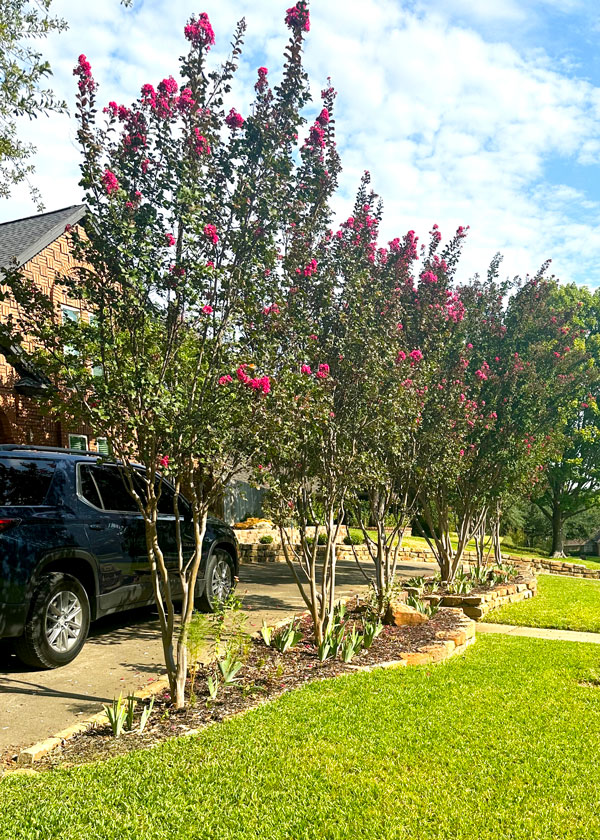
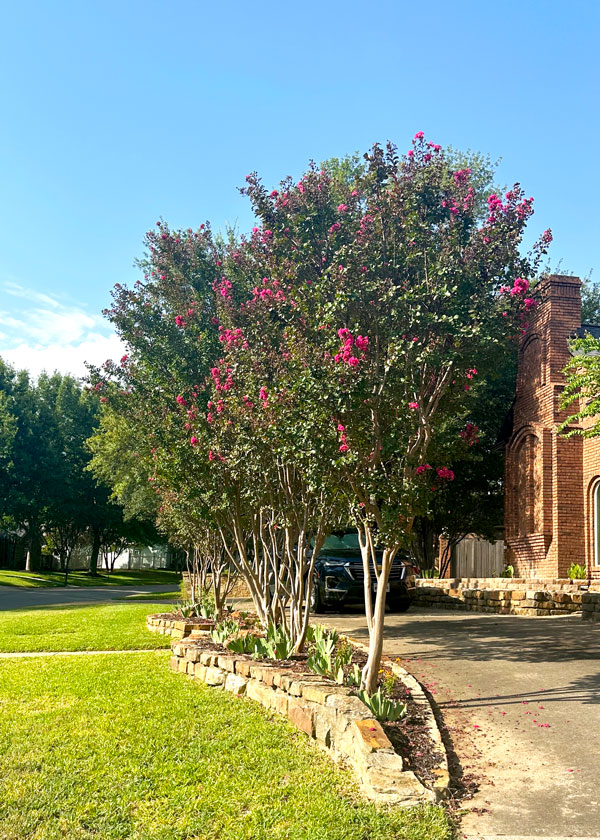
Question: These planting beds are more than 40 years old. I’m wondering if my crape myrtles would grow better if I made the bed wider? I’m planning on putting a perennial flowerbed in front of one of the sections and eventually in front of the second, but for now I’m just wondering if there would be any benefit to expanding the bed? Catherine A., Colleyville.
Images clickable for larger views.
Answer: If you’re doing it primarily to help the crape myrtles, there would be easier ways. They need nitrogen and water to get maximum growth and bloom. Both can easily enough be added in the space you already have. Of course, if you’re doing it mainly to make room for perennials, that’s another story and yes, you could do it, but don’t count on it making much difference in the crape myrtles.
I have a couple of thoughts about your crape myrtles. They don’t look like they’re a full 40 years old. If they are anywhere near that old, are they some of the original purple-leafed types? Those were chosen for their dark foliage, but what we discovered after we grew them for 6 or 8 years was that they really don’t grow very large. They’re mid-sized at best (12-14 ft. tall). They also don’t bloom as heavily in many parts of Texas. So, if that’s what you have, their failure to grow as large as you expected could be more related to the variety you chose than to the conditions under which you grew them.
My other thought was that you may want to remove one or two of the lower branches from a couple of the trees to even them up. They don’t seem to match in their appearance. I can’t tell for certain, so that may not be the case.
QUESTION 6
WHEN SHOULD I PLANT SEEDS FROM MY PRIDE OF BARBADOS AND ESPERANZA PLANTS?
Question: I have gotten brown seeds from Pride of Barbados and Esperanza plants and have dried them. When should I plant them? Cindy P., San Antonio.
Answer: I’m going to start with the Esperanza. I’m hoping you’ve had Gold Star Esperanza, the variety selected by our friend Dr. Greg Grant because it blooms from spring until frost. That’s really the only one we should plant in our gardens. It’s sensational. However, its seeds do not reproduce true to its type. Gold Star is started asexually (cuttings), and rights to that are protected. Buy new plants as you need them each year. The plant you have should survive most winters for you in San Antonio.
As for the Pride of Barbados, let me back up one step. The pods mature quickly and can actually pop and shoot their contents far and wide. Put a paper bag or small mesh bag over the pods as they begin to rattle to let them dry and open on their own. I hope you didn’t harvest them prematurely.
After you bag them, leave the pods in the bags for a week to let the seeds dry, then put them into an air-tight jar in the fridge until you’re ready to plant them into deep pots 8-10 weeks prior to your last killing freeze.
It helps if you scarify their hard seed coats against sandpaper, then soak them overnight prior to planting. Sow them into loose, highly organic potting soil on a warm, sunny windowsill or in a greenhouse. Plant the young plants into the ground once the soil has warmed considerably, probably no sooner than early May.
QUESTION 7
IS THIS LIGHTNING DAMAGE LIKELY TO BE FATAL TO OUR POST OAK?
Question: We had a welcome thunderstorm last week here, but the lightning that did this damage to our post oak was certainly not welcome. Is it likely to be fatal to the tree? Mike S., College Station.
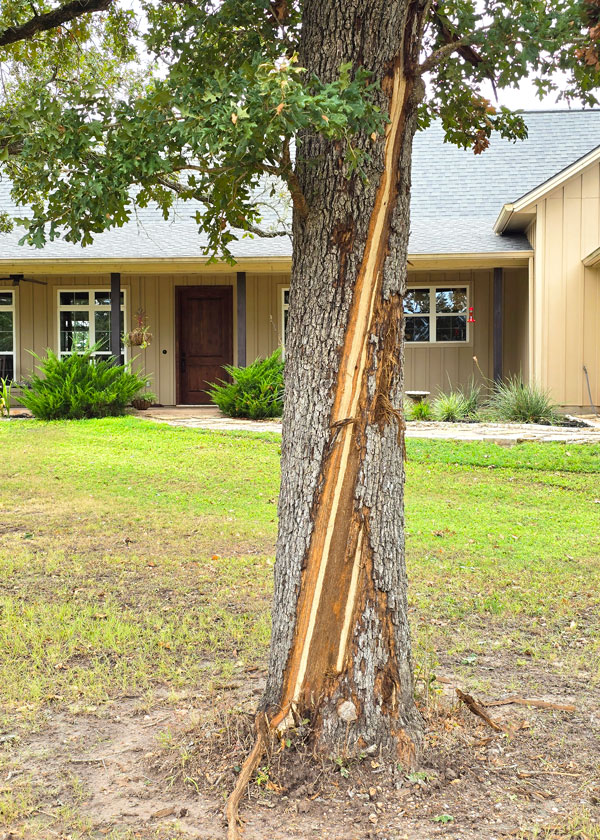
Answer: I can’t tell you. Probably no one can yet. The fact that it happened to a post oak doesn’t help, because they’re easy to upset, whether by humans or by nature. But I’ve seen them survive lightning strikes and heal themselves quite well. I’ve watched a 60-ft. pecan tree down the road from our house survive a similar lightning strike from 32 years ago and that tree is still alive and kicking. You’ll have a better idea by spring when the branches leaf out. Hopefully the ones on this side of the trunk will be fully leafed and new bark will be starting to form across the wound. Watch for decay to set in within the trunk. Hopefully it will not. That would be your biggest concern.
I would strongly suggest you get a certified arborist on site immediately and have them watch the tree’s progress every few months. Take photos of the damage now, again before it loses leaves in 6 weeks, and again every 6 weeks in spring and summer. That will help you monitor its progress. Good luck!