
Q&A – Ask Neil: September 3, 2026
(Please read these instructions carefully.)
Before you post your question, please look at recent issues to see if someone else has already asked it. You might find your answer there.
HOW TO SUBMIT YOUR QUESTION…
• Click here to post your question. (Please post your question only one time.)
• Please use this link only for posting questions – not for standard e-mails.
• High-resolution photos (1-2MB – not thumbnails) attached with your question help Neil give you the best possible answer. Please check your photo for clarity and exposure. If you do not see “All images clickable for larger views,” your images’ resolution was not sufficient for enlargement. That might also have made it difficult for Neil to give you an accurate answer.
• Neil chooses questions of greatest reader interest. Plant IDs rarely fit that description.
• Neil requires your first name or initials, also your city or county for an accurate answer. (Texas is a very large state.)
• One question per reader per week, please.
• Watch for Neil’s reply in the next issue of e-gardens.
Note: If you have submitted your question and did not see the pop-up window for attaching your photo, please click here.
QUESTION 1
SHOULD I SAVE THIS PLANT?
Question: We’ve had what appears to be a crape myrtle pop up. It is growing quickly. There is no other crape myrtle within 100 yards. Will it mature and flower, or should I dig it up? Robert L., McKinney.
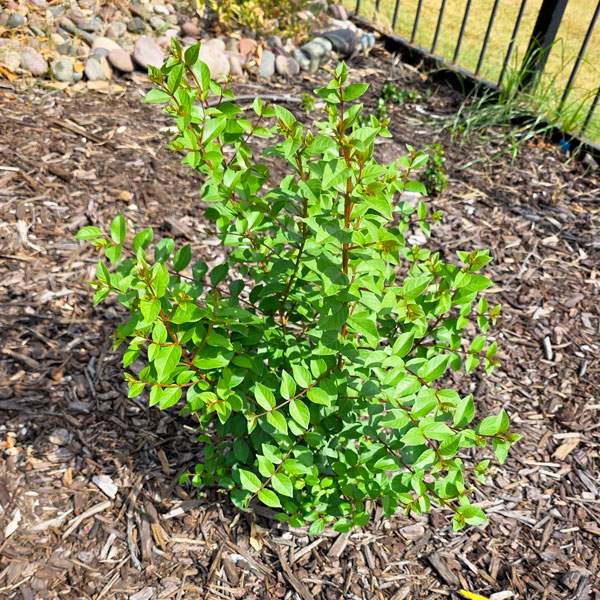
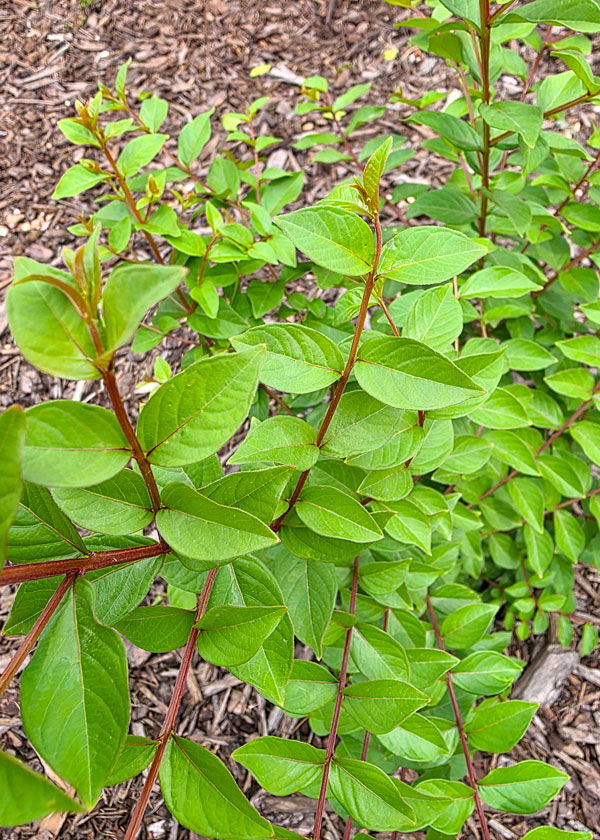
Answer: I normally don’t ID chance seedlings here because we all get them and they’re generally of interest only to the one sender, but this one is so unusual that I decided to make an exception.
Indeed, this is a crape myrtle. If it were mine, and if I had room to let it grow, I would leave it (or move it to an appropriate location). Almost all our crape myrtles you see around Texas originated as seedlings in breeding beds, so they certainly do produce viable seeds. You just don’t see them coming up in landscapes as often as you do other plants. Remember that you know nothing of this plant’s mature size, color, flower head size, disease resistance, bark characteristics, or any other genetic feature. But it will still be fun to see what you get.
Note: In cropping your photos after composing my reply I think I’m seeing several small sprouts behind the larger plant – toward the wrought iron fence. Those look like root sprouts of a crape myrtle. Is it possible there might have been a crape myrtle in this general area several years ago? This looks like a typical pattern in which sprouts would come up from old roots if a mother plant were cut out or transplanted and moved. Just a thought.
QUESTION 2
WHY ARE MY CELEBRITY TOMATO PLANTS NOT SETTING FRUIT?
Question: I planted two Celebrity tomato plants in pots in mid-July. They have produced blooms, but they have not set fruit. I keep the potting soil moist and they get full sun. Any idea on why they are not setting fruit? J.P., Sadler, Grayson County.
Answer: Yes, I do. It’s been more than 100F daily for a month since you planted them. That’s way too hot for almost any tomato variety to be setting fruit. Plus, I certainly hope you planted normally sized transplants in mid-July, not some lanky leftovers from springtime. Those should still be relatively small plants. Don’t expect them to be able to bear fruit at such a young age. You’ll get ample fruit set starting when daytime temperatures drop down to the 70s, 80s, and very low 90s.
QUESTION 3
WHAT CAN I DO TO GET RID OF SPURGE EVERYWHERE?
Question: Help! I have spurge and more spurge everywhere. I like to think my lawn is healthy. I apply pre-emergent weedkiller granules, but I am still infested with spurge. In this really hot weather is there anything I can do now? David M., Celina.
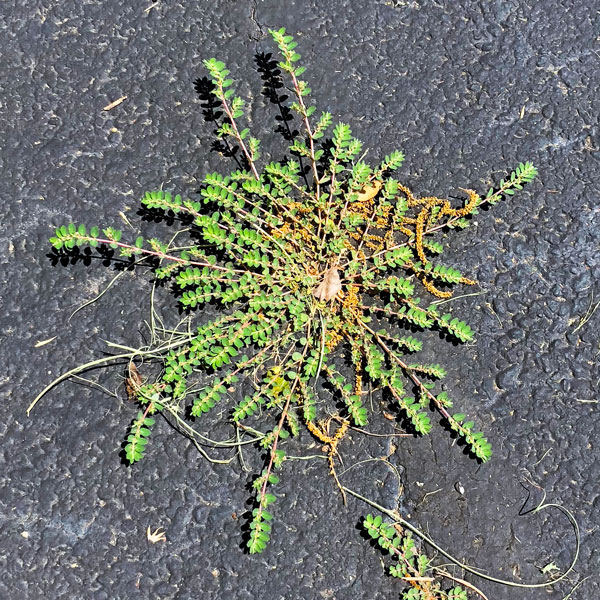
Answer: I do understand. Spurge is capable of growing anywhere, even in black asphalt parking lots in full sun.
You can use a 2-gal. tank sprayer with a broadleafed weedkiller spray containing 2,4-D to spot treat the clumps of spurge. It’s somewhat boring to lug it around the yard, but it allows you to apply it right in the middle of each clump so that you’re missing almost all your turfgrass. The herbicide wouldn’t damage bermudagrass, but St. Augustine would be at risk at high temperatures. If you keep after it for a couple of years, you’ll reduce the population dramatically.
The other option is to sharpen a small hoe so that it has fairly square corners. It’s easy to sever each tap root of the spurge. You can leave the disk of each clump laying on top of the lawn and then mow them up a few hours later after they have wilted and dried. It’s actually a lot easier than you might think.
QUESTION 4
WHAT IS THE MOST ATTRACTIVE SHORT NANDINA?
Question: What is the most attractive short nandina? The setting is part sun, part shade. Red color is a bonus, but not absolute. Marianne H., Dallas.
Answer: Ah, my friend. It’s not often I get to answer knowing the lovely gardens in which a plant will be used. Marianne and I worked together in radio for many years. Those of you who have just enjoyed ‘Restaurant Week’ in DFW need to know that Marianne was one of the chief initiators of that great idea.
My favorite short nandinas are the ones that look like real nandinas (Harbour Dwarf, Harbor Belle, and Flirt – listed in the chronological order in which they were introduced, Flirt being the newest) and not the ones with the crinkled leaves and the more intense red color year ‘round.
Those three I named establish themselves in slowly spreading clumps that develop into lovely tall (15- to 18-in.) groundcovers. The others are used as individual rounded plants, but they thin and die out after a few years.
The first Harbour Dwarf planting I ever saw was at Callaway Gardens in Pine Mountain, Georgia, in 1978. I was there on a photographic assignment shooting their incredible azalea collection with the help of Fred Galle – one of the world’s kindest people ever. And ChatGPT just helped me learn that Mr. Galle discovered and introduced Harbour Dwarf himself! I wouldn’t have learned that if you hadn’t put me on this assignment. He certainly didn’t bother to brag about having discovered it.
Harbor Belle came into the market around 2003.
Flirt was found as a mutation of Harbour Dwarf and was first marketed by Southern Living Plant Collections in 2010.
I’ve had Harbour Dwarf outside our living room windows for 35 years. I keep the tallest canes cut out to keep it at 16 in. tall. I have a smaller grouping of Flirt on our hillside. Both have nice maroon-red winter color. Flirt has the more intense colors in our landscape. Both plantings get morning sun, afternoon shade.
QUESTION 5
SHOULD I KEEP MY TOMATO AND CUCUMBER PLANTS INSIDE UNTIL OCTOBER?
Question: I have bought tomato and cucumber plants and moved them to larger pots for transplanting to the garden when a little cooler. I’ve kept them in partial shade, yet they wither and die within two days. Do I need to keep them indoors until October? Jack K., Bryan.
Answer: I’m not sure I can help with those plants.
Here is the sequence and pointers I would use in Brazos County (where I grew up) in future years:
Buy tomato transplants in early July. Stick with small- or mid-sized fruiting types (not the big types like Big Boy and Beefsteak, since they won’t set fruit well in Texas).
Buy transplants that are growing in the same kind of sun exposure (hopefully full sun) that you will be providing for them. Do not buy transplants that are in a shaded nursery setting.
Plant them directly into the garden. If temperatures are dramatically above normal highs, wait a day or two, but no longer.
Provide some type of temporary half-day shade over the plants. I used to recommend wooden roofing shakes, but since those aren’t used much anymore, find some equivalent material. Perhaps pieces of stiff cardboard or foamboard. Make “A-frames” that will provide shade each afternoon for the first 2-3 days. Gradually adjust them so the plants get an hour more sun each day. After 7-10 days the plants should be in full sun.
If your local sources don’t plan on having transplants at that time you can grow your own from cuttings from your best spring plants. You could also start transplants from seeds sown in pots in mid-June. Grow them in sun so they’ll be acclimated.
Your cucumbers should be planted around August 1 from seed. Use your hoe at a 45-degree angle to cut a shallow trench into recently rototilled soil. Fill the trench with potting soil and plant the seeds in the potting soil. Keep the soil watered deeply to get the seeds sprouted and growing actively. They will adjust to full sun without problems.
To think ahead, potted transplants would also work well for peppers and Cole crops (broccoli, cabbage, cauliflower, and Brussels sprouts).
QUESTION 6
WOULD IT BE DANGEROUS TO BRING THESE MUSHROOMS INDOORS?
Question: I found a beautiful cluster of mushrooms growing in my daylily bed. They were so attractive that I dug them up with the thought of displaying them indoors. Is it risky bringing them into the house? Harmless or poisonous? They were soft in the bed, but they have hardened since they’ve been dug. Andrew B., Highland Village.
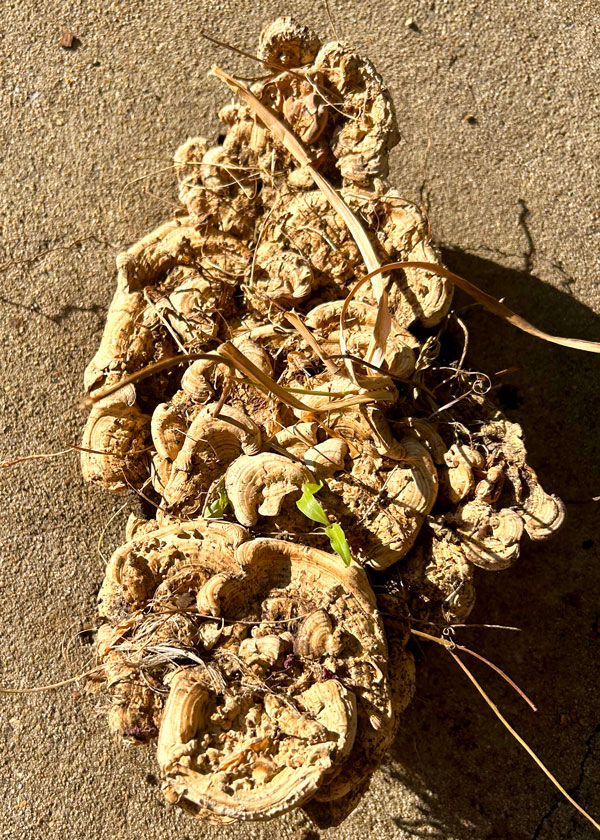
Answer: I doubt that there would be any risk in having them indoors, although I don’t know what will become of them after a few months. You would need a mycologist to identify this type and what happens to it after it completes this phase of its life cycle. Just don’t try to consume it without professional identification. It didn’t sound like that was in your plans, however.
QUESTION 7
HOW DO I KNOW IF MY LAWN REALLY NEEDS AERATION?
Question: How do I know if my lawn really needs aeration? My lawn service offers (1) plug aeration, which I have read leaves messy dirt plugs all over; (2) spike aeration; or (3) liquid aeration (cheapest and, I’ve read, ineffective). Dale W., Fort Worth.
Answer: I’ve had lawns here in Texas for more than 6 decades, all of them in heavy clay soils similar to what you have in Tarrant County. I have never felt the need to aerate my lawn.
Times when I feel aeration could be needed:
• Extreme compaction following heavy pedestrian traffic. For example, if you had kids playing football on your front yard every evening for 4 months, or the grounds of the State Fair of Texas once the last visitor leaves at the end of the run. Or maybe alongside a driveway if someone has repeatedly parked on the grass.
• If a layer of true thatch has formed. Thatch is undecomposed organic matter that accumulates between the runners and the surface of the soil. It compresses together until water and nutrients can’t penetrate it. They run off and down the street. Aeration breaks through the thatch so oxygen can start the decomposition process in the layer of organic matter.
• Commercial lawn care companies, golf course superintendents, etc. sometimes aerate soils on slopes so nutrients and seed will stay in place without being washed away by heavy rains or irrigation.
Core aeration is best because it actually pulls small plugs of compacted soil and thatch up and out of the ground. That allows air, nutrients, and water to penetrate the ground. The plugs are pulverized by the mower the first time it runs across the lawn. However, before I hired anyone to aerate my lawn or before I rented equipment to do it myself, I would want to know exactly why it was being done. It definitely is not something that needs to be done on a routine basis.