
Q&A – Ask Neil: August 13, 2026
(Please read these instructions carefully.)
Before you post your question, please look at recent issues to see if someone else has already asked it. You might find your answer there.
HOW TO SUBMIT YOUR QUESTION…
• Click here to post your question. (Please post your question only one time.)
• Please use this link only for posting questions – not for standard e-mails.
• High-resolution photos (1-2MB – not thumbnails) attached with your question help Neil give you the best possible answer. Please check your photo for clarity and exposure. If you do not see “All images clickable for larger views,” your images’ resolution was not sufficient for enlargement. That might also have made it difficult for Neil to give you an accurate answer.
• Neil chooses questions of greatest reader interest. Plant IDs rarely fit that description.
• Neil requires your first name or initials, also your city or county for an accurate answer. (Texas is a very large state.)
• One question per reader per week, please.
• Watch for Neil’s reply in the next issue of e-gardens.
Note: If you have submitted your question and did not see the pop-up window for attaching your photo, please click here.
QUESTION 1
WHAT HERBICIDE CAN I USE ON MY GARDEN NOW AND STILL HAVE IT BE SAFE FOR PLANTING COME SPRING?
Question: What kind of weedkiller can I use on my garden that will leave it safe to plant in the spring? Clifford M., Pottsboro.
Answer: I would suggest spraying with a glyphosate. That is the herbicide that has given outstanding control of grasses such as Johnsongrass and bermudagrass for decades. It does not go into the soil, so there is no contamination – no herbicide residue. I will note, however, that it is most effective when it is applied to vigorous growth. At this point in the summer your weeds are likely to be browned and woody. In that case I would still go ahead and spray, but I would expect to have to come back in late September or early October with a follow-up treatment to any new growth that has popped up following fall rains. This same practice helps those who are wanting to prepare fall groundcover or shrub beds.
QUESTION 2
WHAT WILL KILL ANTS IN A VERY OLD PLUMERIA’S POTTING SOIL?
Question: My 35-year-old plumeria is in a huge concrete pot. It has ants in the soil and on the trunk. What can I use to send the ants packing? Melinda A., Frisco.
Answer: Congratulations on keeping a plumeria that long. That’s quite an accomplishment. Probably the best product to use on the soil surface and top ½-in. would be bifenthrin. You’ll find it in several different brands. Before you treat, however, look closely at the ants on the trunk. Are they in a trail up to some type of insects that are secreting a sugary honeydew? Scale insects and mealybugs both do that. Look for them, and if you see them you may want to deal with them separately with cotton swabs dipped in rubbing alcohol. Daub the insects off the trunk. If you can eliminate them, you may not need to spray the plumeria itself. I would be careful not to apply any insecticide to a plant of that age and value indiscriminantly.
QUESTION 3
WHAT AM I DOING WRONG WITH MY RED OAK?
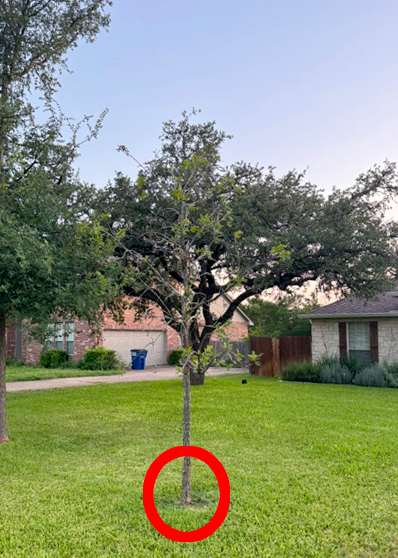
Question: This is a red oak that was planted 2 years ago. The yard has a sprinkler system. It gets morning sun and afternoon shade. Can you tell me what I’m doing wrong? Nancy B., Cedar Park.
Answer: I’ll do the best I can, but there will be some elements of guessing on my part.
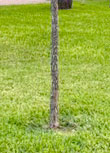
I see no wrap on the trunk to protect it from sunscald. You may have seen the several stories and answers I’ve had here over the years warning of the dangers of damage to the lower trunks of red oaks, red maples, and Chinese pistachios (and other thin-barked trees) when they’re put out in the sun from nursery settings. I’ve tried to crop in on the one photo that shows the base of the trunk, but the resolution is poor so it shows it in pixels. If you see vertically cracked bark in that area, that would be sunscald.
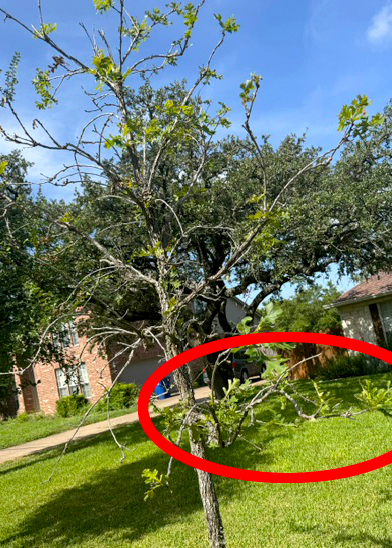
In the Austin area hopefully you would have been specifying Shumard red oak. It’s the one that’s best adapted for your region. But best I can see the leaves, this doesn’t look like a Shumard red oak. From the one photo and the leaves and bark I can see in it, it looks more like some other species, very likely one from an area with acidic soils (as opposed to what you have). That could explain the yellowed, iron-deficient leaves I believe I can see.
Third, going back to the photo that shows it planted in your yard, it looks like this tree was planted too deeply. It looks like the root flare may be at or below grade. It needs to be higher, best I can tell from the one photo. There’s no way to correct that at this point.
If you had this tree planted for you, and if any of those three things is correct, the nursery where you bought the tree is at least partly responsible, best I can tell from your photos. But, as I said, those are all just my best guesses.
QUESTION 4
WHAT HAPPENED TO THIS NELLIE R. STEVENS HOLLY, AND CAN IT BE SAVED?
Question: I have a row of 6 Nellie R. Stevens hollies. All have received the same water and fertilizer. This one is stunted and pale, and it’s losing leaves. Can it be saved? What might have caused this? Jack K., Brazos County.
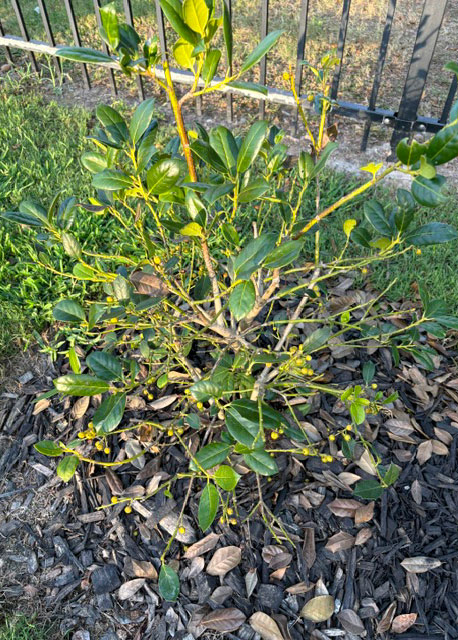
Answer: This plant got too dry at one point late spring or early summer. All it takes is one time. Look at all the fallen leaves on the ground beneath the plant. Sadly, I’ve even messed up myself and let this happen to a couple of hollies in my own landscape over the 49 years that I’ve been planting them, and I’ve seen this happen probably a thousand times over my career in others’ landscapes. The thing is that hollies don’t wilt, so people don’t realize that they’ve gotten as dry as they are. They can drift past what is called “the permanent wilting point” before we ever realize it. Keep this plant properly watered (with a hose and a water breaker, not with a sprinkler system and not with a sprinkler on the end of a hose). Fertilize it mid-September to promote some new growth this fall. It looks like it’s capable of staging a comeback.
QUESTION 5
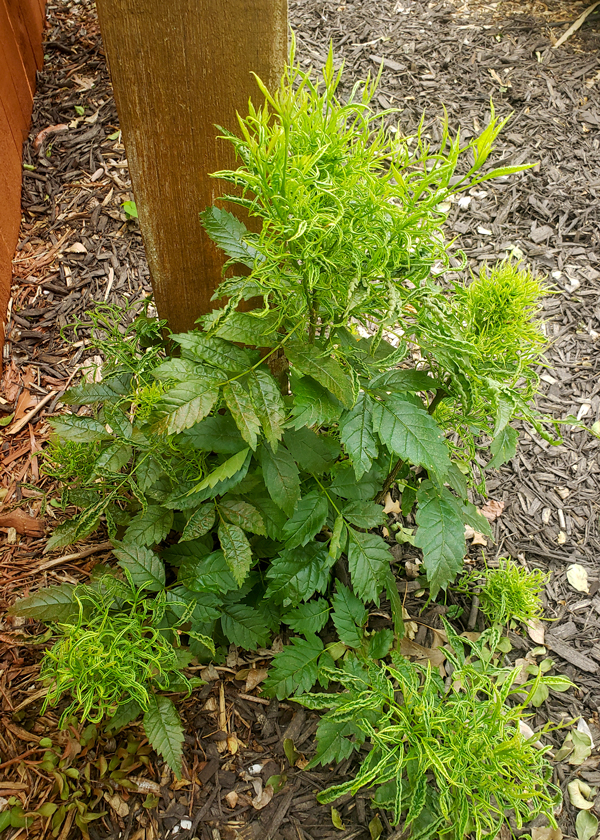
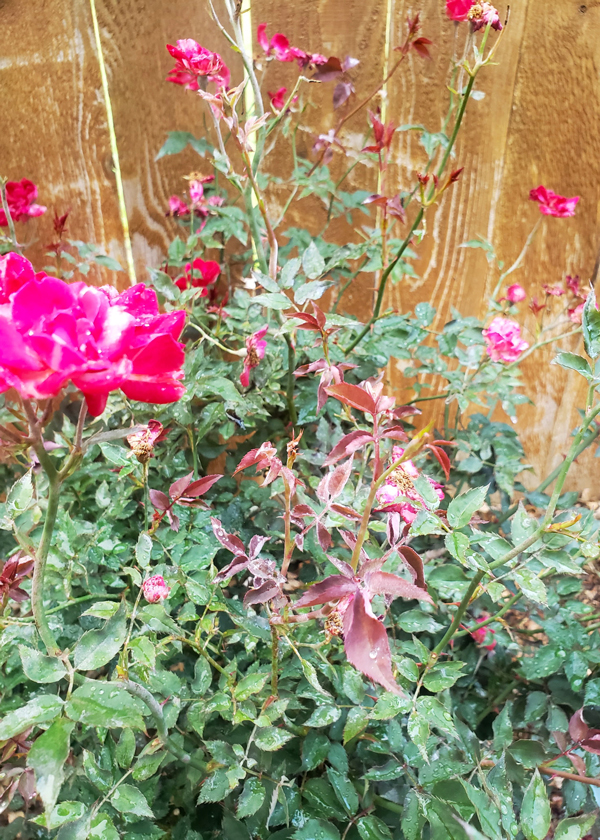
WHAT IS WRONG WITH MY ESPERANZA AND KNOCKOUT ROSES?
Question: What is wrong with my Esperanza and Knockout roses? They have weird growth this year and are struggling to bloom. Tamela J., Harker Heights.
Images clickable for larger views.
Answer: The Espernaza plant has been hit by a broadleafed weedkiller containing 2,4-D. Either it accidentally got sprayed directly, or it suffered a major drift. It’s also possible there was residue left over in the tank or that your sprayer wasn’t washed out carefully. I don’t know why you would have been spraying Esperanza, so the concept of unwanted drift moves to the top of the possibilities. That’s pretty bad damage. I don’t know if it will come back from it in time to bloom this fall.
Side note: have you recently had your fence sprayed with any kind of stain or preservative? Did the Esperanza damage show up shortly after that was done? I thought I saw some discoloration on the mulch on the ground at the base of the fence.
As for the roses, the photos aren’t as sharp so I can’t tell as easily. If they, too, were near any drift or if they, too, were sprayed, that could also be herbicide damage. I don’t see direct evidence of rose rosette virus unless that one crooked stem I see on the left side of the one photo I’ve chosen to include is evidence. I don’t think it is. Here is information I have archived on my website about that deadly virus. I hope it’s not the source of your problem. Please read what I’ve written. I’ll have to leave the rest of that diagnosis up to you. If the plants have had a glancing blow from a herbicide, they should grow out of it. If it’s rose rosette, they must be removed roots and all.
QUESTION 6
HOW CAN I CONTROL WEBWORMS IN MY PECAN TREES?
Question: How can I control webworms in my pecan trees? In the past I have simply cut the affected branches out and burned the webs. This year, however, they’ve been too high in the trees for me to reach with my pole saw or penetrate with my hose-end sprayer. Frank G., Shady Shores.
Answer: Your options quickly become limited. You can use a longer piece of PVC pipe and attach a coat hanger to it with duct tape. Use that apparatus to pull the webs open, but be aware of power lines nearby and be careful to avoid them entirely.
You can also invest in power spray equipment. I’ve had the same decision at our home, but I’ve opted not to go that route. I just figure that people don’t have a right to look up that high into my trees. They’ll just have to understand. The webworms do very little permanent harm. It’s all about the aesthetics.
QUESTION 7
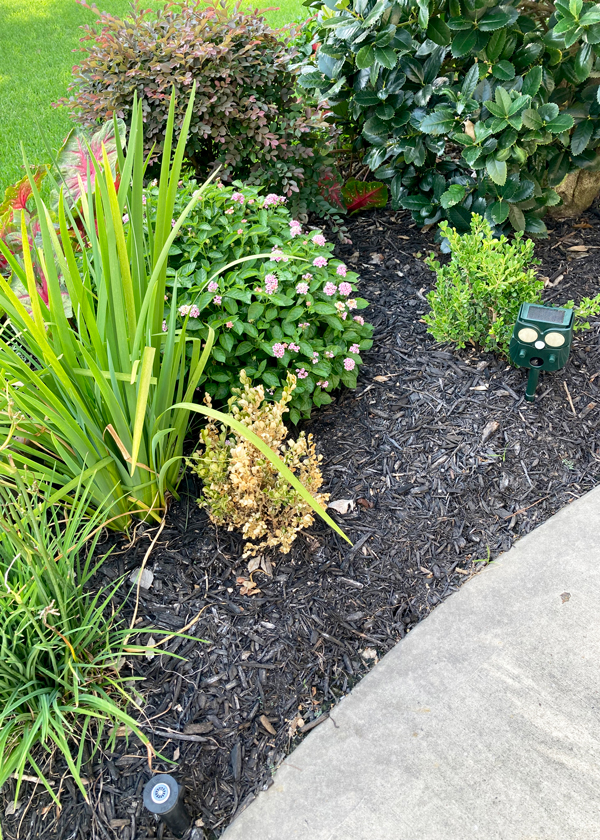
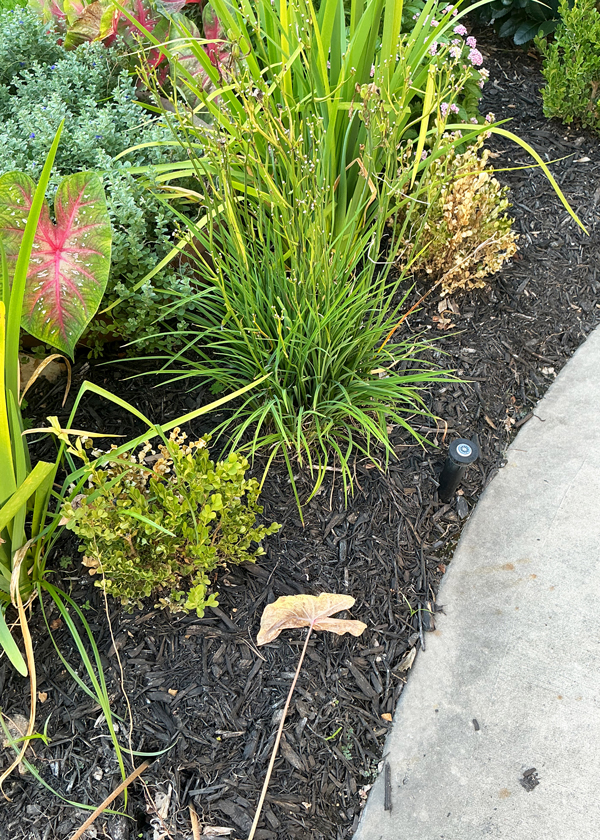
WHAT IS WRONG WITH 2 OF MY BOXWOODS?
Question: I planted boxwoods last spring. Two of them are not doing well. What is wrong? The bed faces west. It receives shade in the morning and sun in the afternoon. Ann H., Kingwood, Harris County.
Images clickable for larger views.
Answer: As with Jack’s Nellie R. Stevens holly in Q.4 above, your boxwood plants have gotten too dry one or more times earlier this summer. Their soil balls were comparatively small when they were planted. That meant that they didn’t hold a lot of water when they were irrigated and they subsequently dried out more quickly than the surrounding soil. All it takes is one time in that condition. The one plant has a lot of competition from plants immediately adjacent to it. It probably won’t come back. The other one might if you give it ample water the rest of the season. Note how moist the mulch looks farther back in the bed compared to around the worse of the two boxwoods. You might even turn your system on to see if it’s spraying up and over the front of the bed where the boxwoods are planted. If they survive, they’re eventually going to block its spray pattern for sure.