
Q&A – Ask Neil: July 23, 2026
(Please read these instructions carefully.)
Before you post your question, please look at recent issues to see if someone else has already asked it. You might find your answer there.
HOW TO SUBMIT YOUR QUESTION…
• Click here to post your question. (Please post your question only one time.)
• Please use this link only for posting questions – not for standard e-mails.
• High-resolution photos (1-2MB – not thumbnails) attached with your question help Neil give you the best possible answer. Please check your photo for clarity and exposure. If you do not see “All images clickable for larger views,” your images’ resolution was not sufficient for enlargement. That might also have made it difficult for Neil to give you an accurate answer.
• Neil chooses questions of greatest reader interest. Plant IDs rarely fit that description.
• Neil requires your first name or initials, also your city or county for an accurate answer. (Texas is a very large state.)
• One question per reader per week, please.
• Watch for Neil’s reply in the next issue of e-gardens.
Note: If you have submitted your question and did not see the pop-up window for attaching your photo, please click here.
QUESTION 1
PLEASE TELL ME ABOUT HAMMERHEAD EARTHWORMS.
Question: Why is my Facebook loaded with questions and pictures of the dangerous Hammerhead earthworms, yet Neil Sperry has nothing about them on the website? Michael F., Hurst.
Answer: Thanks for your inquiry, Michael. I’ve posted it verbatim. The place on my website where I would have discussed them is my MAQ pages. You’ll notice on the Index/Search page that I explain it contains the 1,000 questions I’ve been asked over my 49-year career in radio and writing. I spent a year compiling that information for a book and then put it all onto my website. They really don’t come close to rising to that level. I’ve had your question and one other question about them in all the time I can remember. That’s out of 450,000 telephone calls on the air and questions via letters and emails. I keep a log of them all. You asked why it is that they’re not mentioned, and so that’s my reply.
They are also not true earthworms, but indeed predatory land planarians known as flatworms. I’ve had a couple show up in our landscape over the past 49 years and I know they look a bit ominous – longer than most earthworms and with spade-shaped heads. They feed on earthworms, so they are definitely harmful to our gardens.
They secrete a toxin so that you don’t want to handle them with your bare hands. Adding to the fun of it all, if you try to kill them by chopping them up, the pieces will regenerate into numerous new worms. We are advised to pick them up with disposable gloves or with a stick and drop them into plastic bags, then cover them with salt, seal the bag and put it in the trash.
Personal opinion: I would not elevate them to the level of “dangerous.” I’d say they are quite “undesirable.”
I hope that helps.
QUESTION 2
WHAT IS THE CORRECT HEIGHT TO MOW ST. AUGUSTINE?
Question: In last week’s newsletter you said “Mow turf at the recommended height. Tall grass quickly becomes weak grass. ‘Mowing high’ does not improve summer hardiness or drought tolerance. How do you know what the correct height for St Augustine grass is?
Answer: Sorry. That’s a very legitimate question. The reason I didn’t get into specific mowing heights for the various grasses was because of all the different heights that would have to be covered for the many types of bermuda.
The simple answer for St. Augustine is that it does best when maintained at 3 in. As one who mowed a ton of St. Augustine lawns as a teen and young adult and then as a homeowner, I can say from my own experience that when mowers were set higher the grass tended to grow more upright. It thinned out and that let weeds get a start. Lawns look better when they’re kept at that 3-in. level to encourage runner development.
Frequency of mowing is equally important. You want to mow often enough that you’re never removing more than one-third of the blade length with each cut. And keep your mower’s blade sharp. The ends should be cut cleanly, not frayed.
QUESTION 3
IS THERE A REASON YOU DO NOT RECOMMEND PRODIAMINE FOR PRE-EMERGENT APPLICATION?
Question: Is there a reason you do not recommend Prodiamine for pre-emergent application for prevention of weeds? Joe B., Horseshoe Bay.
Answer: Not at all. If you have a source and if you have been happy with its results, go with it. I have stayed with products that are commonly sold in independent garden centers and feed stores where you can get expert localized advice, but Prodiamine is an excellent pre-emergent.
QUESTION 4
WHAT CAN I DO TO AVOID HONEYDEW FROM MY BUR OAKS?
Question: It will soon be time for the honeydew from aphids on my bur oaks coating our driveway and leaving it sticky for our cars and feet. It becomes almost impossible to see out the windshield. What can I do to prevent the problem this year or next? Andrew B., Highland Village, Denton County.
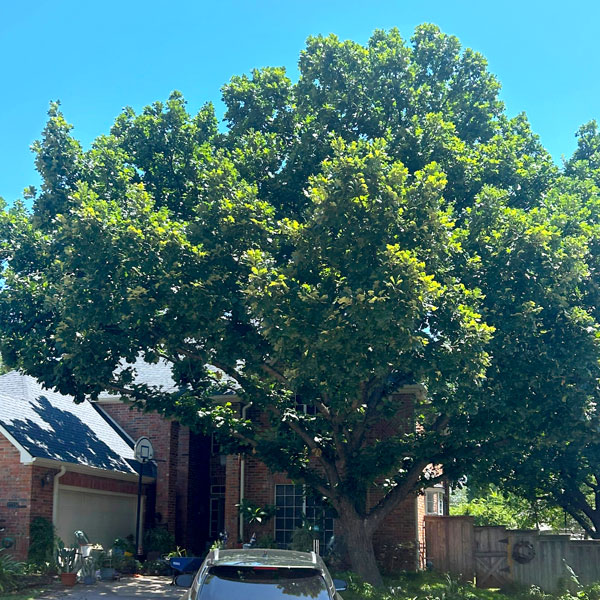
Answer: The honeydew could be from aphids, or it could be from lacebugs. Both process the sap through their bodies and excrete the sticky mess. My wife and I live in a pecan forest, so we understand all too well.
You could invest in a power sprayer and use a general-purpose insecticide. Most will eliminate both insects if you care to go to that expense and trouble. Or you could hire a pest control person to do the spraying for you. You might get relief from a systemic insecticide applied 4-6 weeks ahead of the time that the honeydew normally begins. Of you could do as we do – park elsewhere for a few weeks until they run their course and then power wash the drive before the black sooty mold starts to develop.
I’m sorry I don’t have a more innovative reply, but at least you know I’m living your bad dream with you.
QUESTION 5
WHY ARE BRANCHES OF MY TEXAS SAGE DYING?
Question: Why are branches of my Texas sage dying? They’re in their third summer, so they’re well established. I don’t water them much. I noticed this two weeks ago before the rain. I don’t see any damage to the branches or any pests. Ashley K., Granbury.
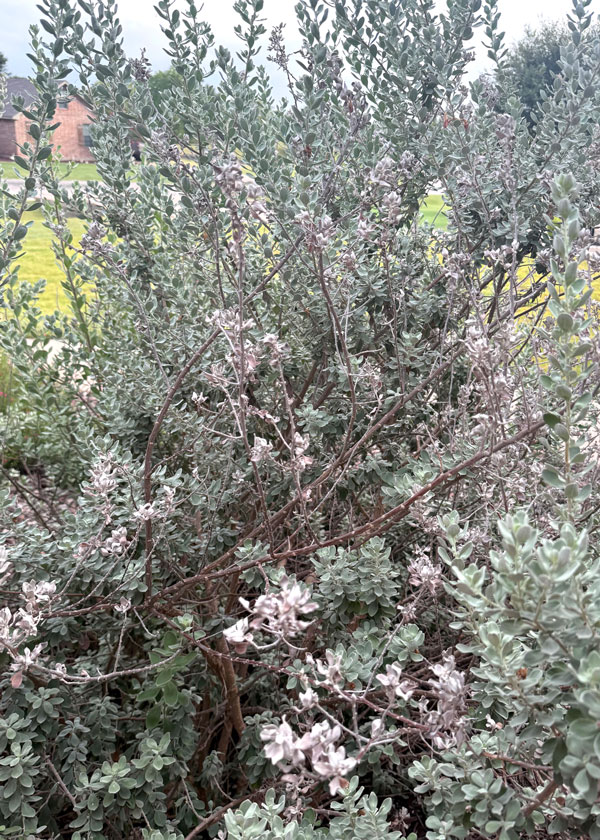
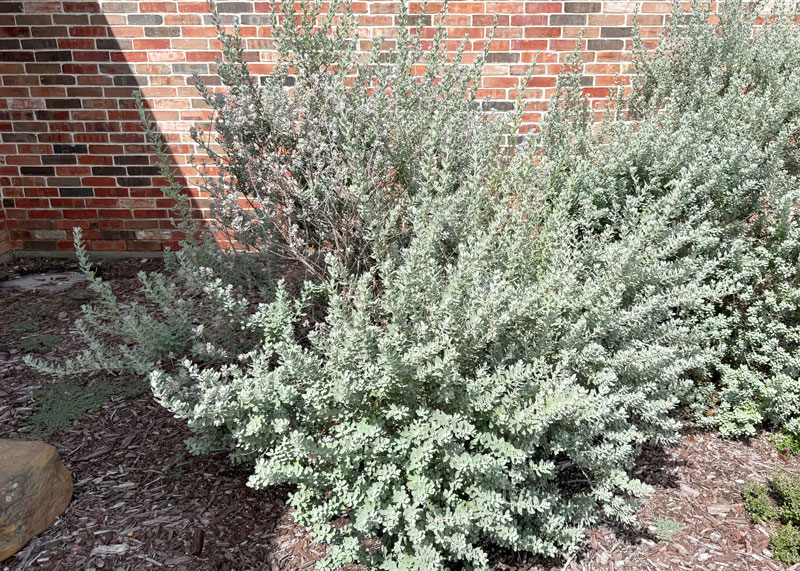
Answer: I’m going to start my reply by saying “I don’t know.” Then I’ll set out to prove it.
I was going to suggest that you look very closely at one of the dead branches – at the interface of dead and healthy tissues. Use very sharp shears to cut it into clean sections so you can examine the stem. See if you observe any kind of internal damage – cracking, decay, etc.
As long as the dead branches are randomly scattered across the plant it’s probably not an issue with the main trunk or the roots. If it were, the entire plant would be impacted. It’s something more localized, perhaps something as unusual as hailstones having hit the branches that are dying.
It’s not water-related. They can handle drought, and we certainly haven’t had dry weather for long enough in your part of Texas for that to be a concern anyway. And hopefully you don’t have it planted in a sinkhole where water accumulates and can’t get away.
Without additional clues I’m stuck.
QUESTION 6
WHAT ABOUT THE PRODUCT CERTAINTY FOR WEED CONTROL?
Question: I purchased a product Certainty that claimed to kill annual bluegrass, rescuegrass and nutsedge but not harm turfgrass. I am not associated with the company, so disregard if my comment is inappropriate. You might want your readers to know there is an alternative to pre-emergent weed control. Mark M., Bexar County.
Answer: Thank you. And it’s worthy of mentioning. I have not used it, and I must admit I’m timid to recommend it because of the tiny amount that is used. I worry that readers might not be careful. It also is expensive, but it does appear to do everything you said. It’s a very accepted professional-grade product. I appreciate your helping my readers know.
QUESTION 7
DOES THIS LOOK LIKE CHINCH BUG DAMAGE?
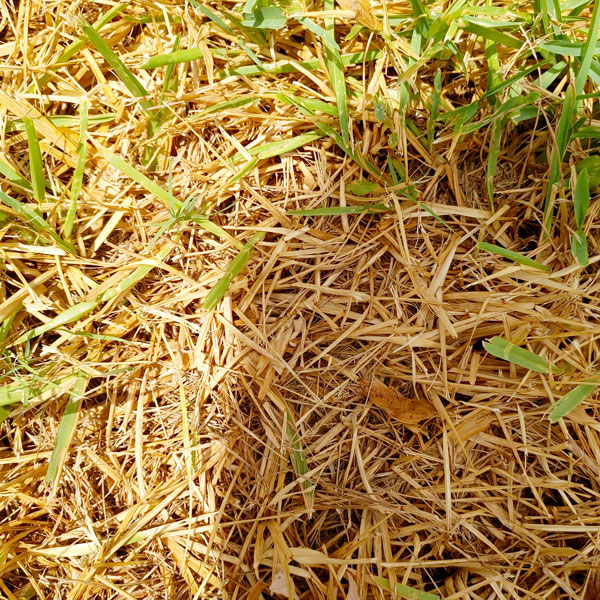
Question: I know you’ve had many questions about them, but does this look like chinch bug damage? I couldn’t see any bugs, but I went ahead and sprayed the area. Danny S., Tarrant County.
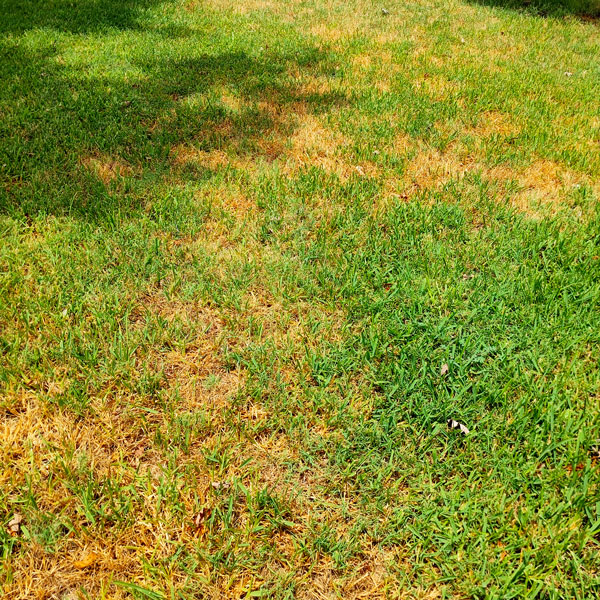
Click images for larger views.
Answer: The first time I looked at your photos I thought it definitely did look like damage of chinch bugs. However, it’s unusual for it to be so spotty. Since you’ve already applied an insecticide, we have no way to go back and confirm their presence. I’d suggest keeping it watered properly to see if those areas start to get green growth back across them. They’re not very wide, so they should cover over again fairly soon.