
Q&A – Ask Neil: July 2, 2026
(Please read these instructions carefully.)
Before you post your question, please look at recent issues to see if someone else has already asked it. You might find your answer there.
HOW TO SUBMIT YOUR QUESTION…
-• Click here to post your question. (Please post your question only one time.)
-• Please use this link only for posting questions – not for standard e-mails.
-• High-resolution photos (1-2MB – not thumbnails) attached with your question help Neil give you the best possible answer. Please check your photo for clarity and exposure. If you do not see “All images clickable for larger views,” your images’ resolution was not sufficient for enlargement. That might also have made it difficult for Neil to give you an accurate answer.
-• Neil chooses questions of greatest reader interest. Plant IDs rarely fit that description.
-• Neil requires your first name or initials, also your city or county for an accurate answer. (Texas is a very large state.)
-• One question per reader per week, please.
-• Watch for Neil’s reply in the next issue of e-gardens.
Note: If you have submitted your question and did not see the pop-up window for attaching your photo, please click here.
QUESTION 1
WHAT IS WRONG WITH MY HYDRANGEA?
Question: What is wrong with my hydrangea? It was blooming when I received it in 2024, but it hasn’t bloomed since. It receives sun 11-2 daily, shade the rest of the day. Margaret P., Livingston.
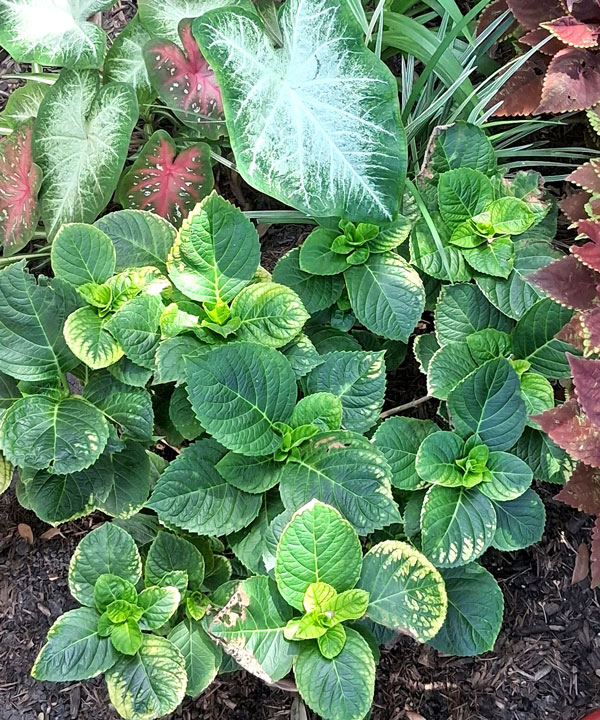
Answer: You’re in a part of Texas where hydrangeas typically thrive. I’m sure you knew that, which doesn’t help you feel any better about your plant. Those of us farther west (toward I-45 and to its west) have to worry about alkaline soils and the resulting iron deficiency, but that’s not the issue here. Your plant’s discoloration is showing on older leaves. New growth looks better.
My guess would be that the plant got too dry at some point a couple of months ago. I would suggest watering it very carefully the balance of this growing season. Take care never to let it dry out to the point of wilting. Don’t prune it until after its bloom time next spring. Hopefully you’ll see good flowering next season.
QUESTION 2
WHAT CAN I DO WITH FLOPPY CRAPE MYRTLES?
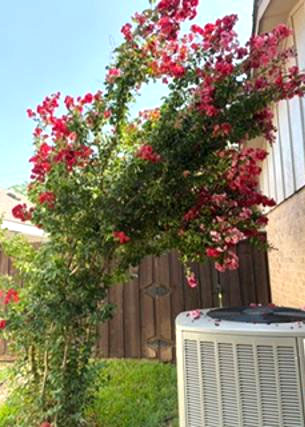
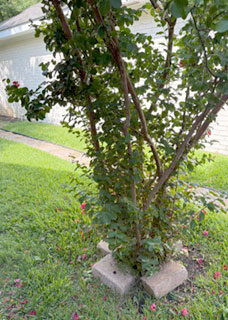
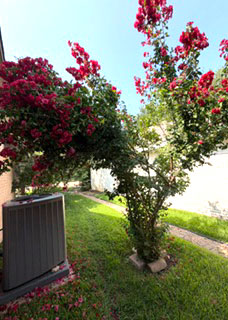
Question: We had 4 in. of rain in 2 hours. Our young Dynamite crape myrtles bent over, and after several days of drying, the multiple trunks still don’t seem to be able to support the leaves and flowers. What can we do? Bill H., Farmers Branch.
Answer: Great to hear from you, Bill!
The problem comes from the weight of the flower heads on fairly new, soft growth of late spring. Then they got loaded down with all that moisture.
So, here’s our game plan. As the petals fall and seed heads are left behind, trim the heads off one cluster at a time. (They weigh more than the flower heads.) Normally that’s not needed, but in this case, it will remove the weight and allow the stems to resume their vertical habits. You might even need to trim a few inches farther down. That’s in no way similar to topping, however, because you’ll be removing stems smaller than pencils. Make the several removal cuts at varying heights so the plants won’t look like they’re had haircuts. At the same time, remove the unwanted shoots from around the bases of the plants to let the trunks begin to develop. Make one pruning cut at a time so you can see the impact of each cut before you make the next.
Fertilize the plants with an all-nitrogen lawn food immediately after you prune them and water deeply to get the nutrients down to the root zone. You’ll get a flush of new growth and another sequence of blooms.
Having said all that, I have one additional comment/question. It appears that at least one of your plants, perhaps a couple are in a good bit of shade. That will add to any spindly, weak growth. I hope that’s not the case, but if it is, you might have to resort to transplanting it/them out into full sun this winter. It’s just a thought.
QUESTION 3
WHY WOULD LEAVES ON MY ‘WHITE CHIFFON’ ALTHAEA BE SOLID WHITE?
Question: The leaves on my White Chiffon althaea are turning white as well as the stem. I’ve tried researching it, but all references describe yellowing, not solid white. Elizabeth K., Plano.
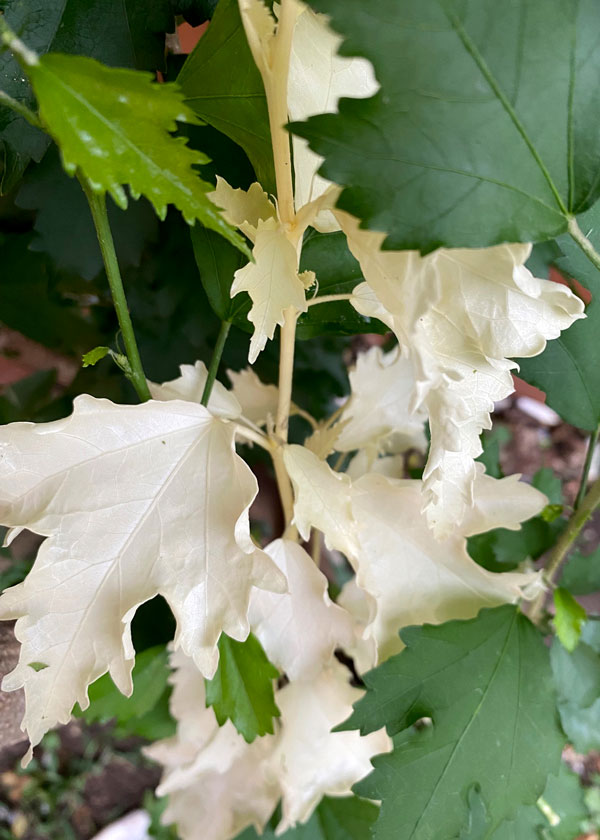
Answer: Wow! When you said “white,” you meant really white!
This is a mutation that occurred at the base of that stem where it attaches to the main stem. A cell lacking chlorophyll developed and started to grow. Its stem and all the leaves that sprouted from it have no chlorophyll. Over time they will turn brown, wither, and die. Enjoy it as long as it lasts. It does not harm the mother plant.
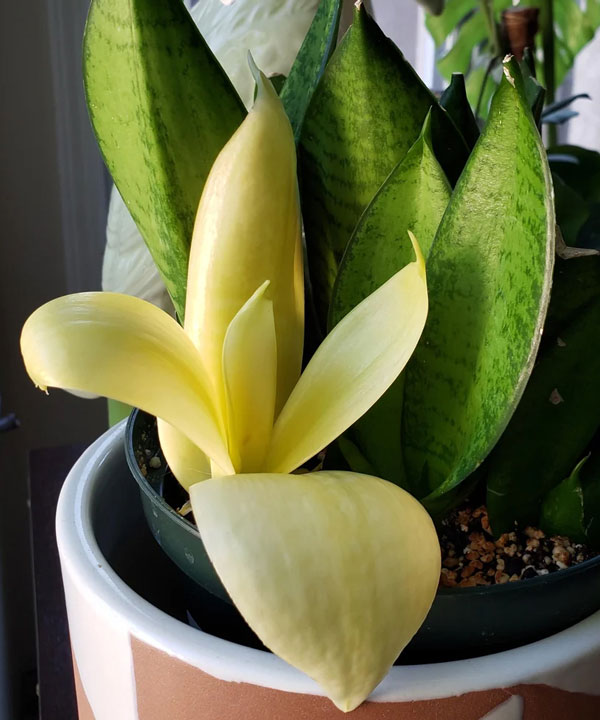
I used to see that in my daylily seedlings. A tiny percentage would germinate pure white or striped with white. Haworthias, sansevierias, and other plants grown for their colorful variegation will sometimes develop solid white sections. I’ve posted an example of a sansevieria that has developed a pure white section. But I’ve never seen one as striking as your althaea.
QUESTION 4
IS THIS A MORNING GLORY, OR BINDWEED? WHAT CAN I DO?
Question: I’ve had my daylily patch for a long time. Many years ago, I planted morning glories, but subsequently this weed started taking over. It looks like a morning glory, but I believe it’s called bindweed. How can I eliminate it? Andrew B., Highland Village, Denton County.
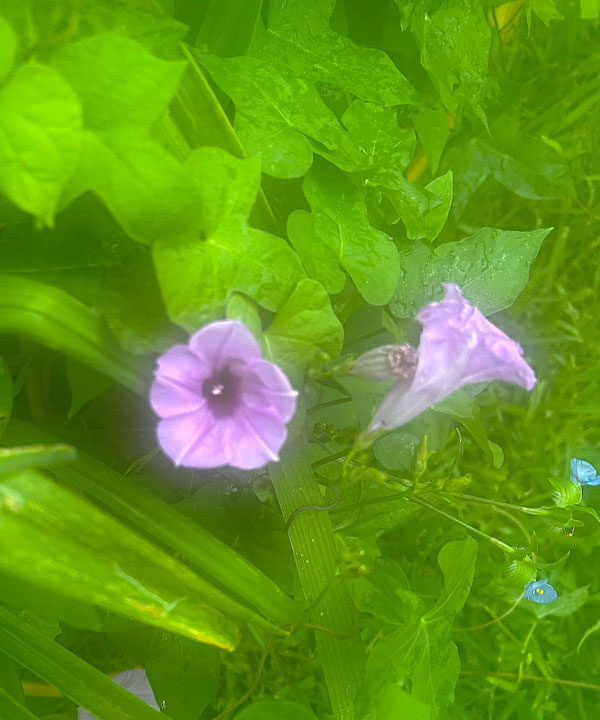
Answer: Bindweed is a perennial form of morning glories, and it’s notoriously one of the most difficult of all Texas weeds to eliminate. If this is a year that you’ll be digging and dividing your daylilies, I’d suggest reworking their soil and removing as much of the bindweed as you can in the process. Then, as you replant, put weed-blocking landscape fabric right up alongside the rows of daylilies so that only the 3-4 inches of the plants is exposed. That will make it much easier to eliminate the few bindweeds that try to come up within that space.
If that’s not possible, once the area has died back to the ground following the first freeze this fall, install the weed-blocking fabric then. Mow or rototill between the rows of daylilies to get rid of as much stubble as possible prior to rolling out the mulch. Weight the mulch down with compost and leave it in place for a couple of years. Eventually the weeds’ roots will give up.
Note: Your photo also shows another tenacious perennial weed, dayflower with the blue blooms, in the background. It’s a relative of wandering Jew, and its stems break into hundreds of pieces when you try to pull it out. Good luck with it, too.
QUESTION 5
WHY DO MY HIBISCUS BUDS FALL OFF WITHOUT OPENING?
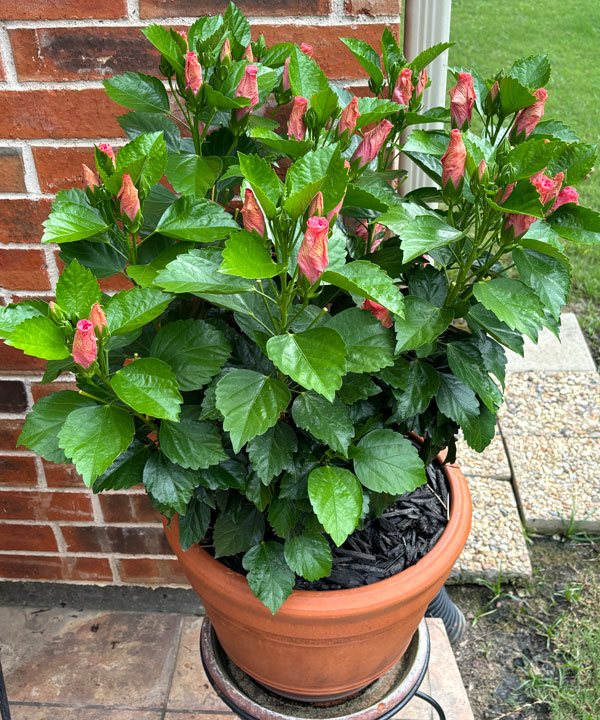
Question: My hibiscus plants are beautiful and they’re full of buds. However, the buds never open. They fall off after a few days. I find no insects, and I water them religiously on schedule. Are they getting too much sun, or is it too hot? Michael G., Mansfield.
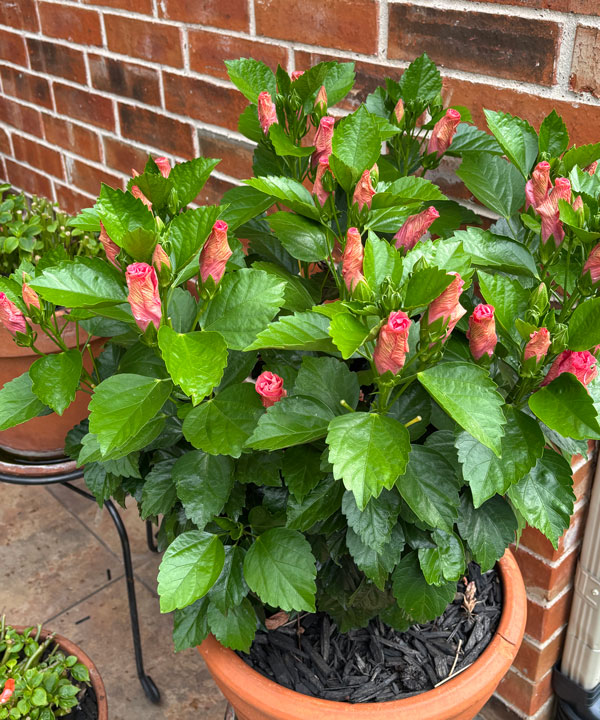
Images clickable for larger views.
Answer: That hurts! It’s common for hibiscus relatives to abort buds when moist spring weather melds into hot, dry summertime. That’s what’s been happening to your plants. Hibiscus bloom best in full sun, but a little shade from noon until 3 would be welcomed. And you might try watering them morning and evening for a little while to help them adjust to these rising temperatures and lower humidities. Soak them until water comes out the drain holes. They dry out surprisingly fast when grown in pots.
QUESTION 6
WHAT IS THIS WHITE STUFF THAT IS ALL OVER OUR SHRUBS?
Question: What is this white stuff that is all over our shrubs? It appears to be killing them. What can we do to save the plants? Jan W., Benbrook, Tarrant County.
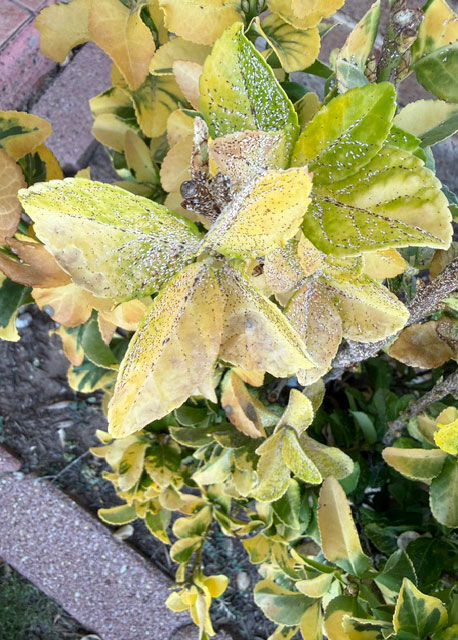
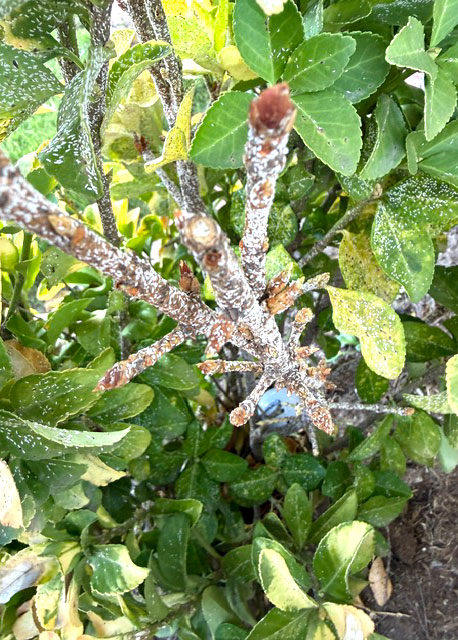
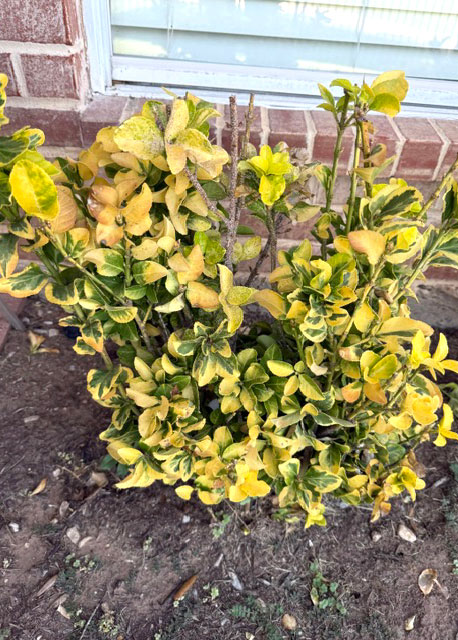
Images clickable for larger views.
Answer: Your euonymus plants are horribly infested with euonymus scale insects. And you’re right. They will suck the life right out of your plants.
If you get to them early enough, the systemic insecticide Imidacloprid will kill them, but it needs to be applied earlier in the growing season. Use it as a soil drench and apply it to the soil around each plant according to label directions. The insects won’t fall off, but they will not be pink and mushy when pressed once they’re dead.
In all honesty, these plants are not worth saving. It would take many treatments over several years to see positive results. Your money would be better spent buying some other species with far fewer problems. I know it’s not the answer you wanted, but it’s the only honest answer. Notice how few healthy plantings of euonymus shrubs you see 5 years after they’re set out.
QUESTION 7
WILL Poa annua BUILD UP RESISTANCE TO SPECTICLE?
Question: Since Poa annua built up resistance to the pre-emergent weedkiller I had been using, I switched over to Specticle pre-emergent with much better results. Over time, will the annual bluegrass develop resistance to it as well? Keith C., Prosper, Collin County.
Answer: It’s quite possible. I wouldn’t have expected it to develop resistance to the ones we were using before, but it did. Turf researchers are working actively to stay ahead of the game. Annual bluegrass is a serious weed in professional turf plantings.
What I was amazed to learn years ago was that many high-end golf courses in cooler climates such as Pebble Beach in California and Shinnecock Hills on Long Island (U.S. Open Championship two weeks ago) have Poa annua greens. One man’s trash is another man’s treasure. Go figure!