
Q&A – Ask Neil: May 21, 2026
(Please read these instructions carefully.)
Before you post your question, please look at recent issues to see if someone else has already asked it. You might find your answer there.
HOW TO SUBMIT YOUR QUESTION…
• Click here to post your question. (Please post your question only one time.)
• Please use this link only for posting questions – not for standard e-mails.
• High-resolution photos (1-2MB – not thumbnails) attached with your question help Neil give you the best possible answer. Please check your photo for clarity and exposure. If you do not see “All images clickable for larger views,” your images’ resolution was not sufficient for enlargement. That might also have made it difficult for Neil to give you an accurate answer.
• Neil chooses questions of greatest reader interest. Plant IDs rarely fit that description.
• Neil requires your first name or initials, also your city or county for an accurate answer. (Texas is a very large state.)
• One question per reader per week, please.
• Watch for Neil’s reply in the next issue of e-gardens.
Note: If you have submitted your question and did not see the pop-up window for attaching your photo, please click here.
QUESTION 1
WHY DOES MY BLEEDING HEART PLANT NEVER BLOOM?
Question: My bleeding heart plant has never bloomed. It is in full sun, and it continues to put out runners. It seems to be thriving, but even with weekly feedings I never get any flowers. Why would that be? Melissa B., San Antonio.
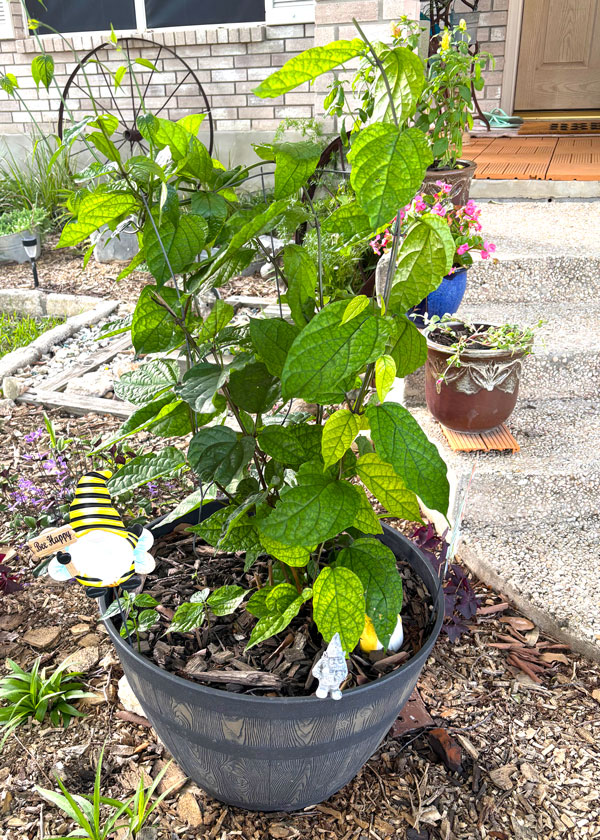
Answer: Your sub-tropical vine is botanically Clerodendrum thomsoniae if you care to look it up in any of the university or botanic garden websites. It’s not to be confused with northern shade-loving perennial bleeding hearts (Dicentra sp.).
Those leaves ought to be rich, dark green overall. There is a nutrient deficiency going on. It appears to be iron, but other minor elements may be involved as well. I’d suggest you try a different plant food, perhaps a water-soluble 20-20-20 with trace elements included applied weekly at the rate recommended on the package. It’s going to outgrow its trellis pretty quickly, so you might want to trim it back some before you undertake this feeding program. Morning sun with shade during the hottest part of the afternoons during the summer should work well.
I have grown this plant a couple of times, but it’s been a while. It’s strong growing, so plan on its getting 5-8 ft. tall. Once you get the nutrition issues figured out it should bloom for you.
QUESTION 2
HOW CAN I KEEP MY HIBISCUS PLANTS FROM BEING SO LEGGY?
Question: How can I get my hibiscus plants to be less leggy? They have so many buds on their ends. I hate to cut them off. Cindy P., San Antonio.
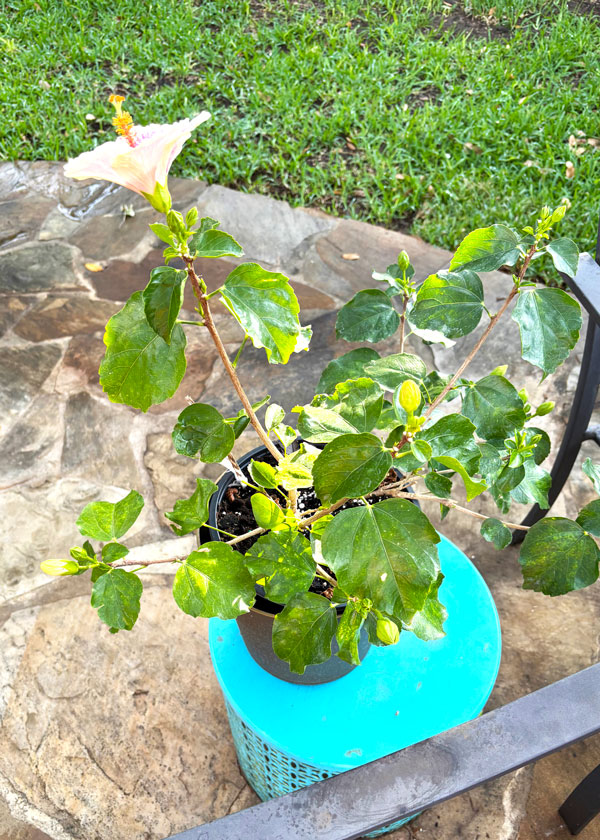
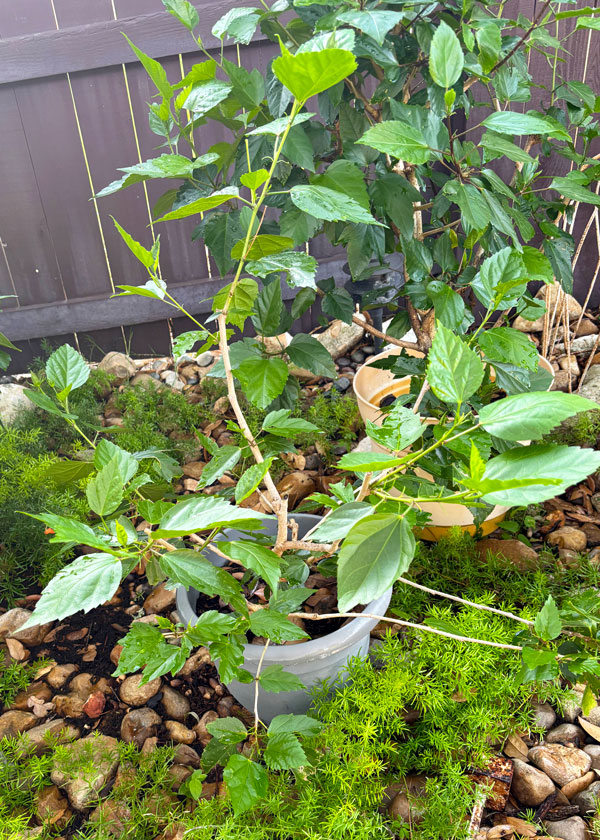
Images clickable for larger views.
Answer: Hibiscus plants bloom on new growth. They need a high-nitrogen fertilizer applied on a regular basis (probably weekly). They’re also going to need “root room” to accommodate all that growth. They could easily be 4-6 ft. tall and wide by the end of the summer if you take good care of them. That’s going to require larger pots.
All of that said, pruning them back a bit to give them room to grow normally would probably be a good idea now. Then start the feeding and watering and be sure they’re in full sun all day. If they get any shade at all, it shouldn’t be more than a couple of hours mid-afternoon during the summer.
QUESTION 3
IS A CHERRYBARK OAK OK FOR HOUSTON?
Question: We recently lost a large cherrybark oak. It was the focal point of our backyard. Nurseries here do not seem to carry it. Is there a reason I should not plant another one? Thomas K., Houston.
Answer: I have not grown cherrybark oak (Quercus pagoda) so I do not have first-hand experience with it. For the longest time it was classed as a variant of southern red oak (Quercus falcata), but they are now recognized as distinct species one from the other. Like southern red oaks, cherrybark oaks are found in the southeastern United States. Houston should have been fine, but not much farther west.
Before I planted another one, I would want to know why your old tree died. There are many other fine choices for the Houston area. I would encourage you to shop a little farther. Look at independent retail garden centers. There are many fine ones in your area. You should be able to find a great substitute if it comes to that.
QUESTION 4
WILL I HAVE TO TRIM MY CRAPE MYRTLE TO THE GROUND?
Question: One of my young crape myrtles was caught leafing out by our last light freeze. Its neighbor was barely starting, but it seems to be growing well currently. Now the first tree is struggling. I hate to cut it off and start over as it does have leaves. What is your opinion? Renvy S., Rising Star.
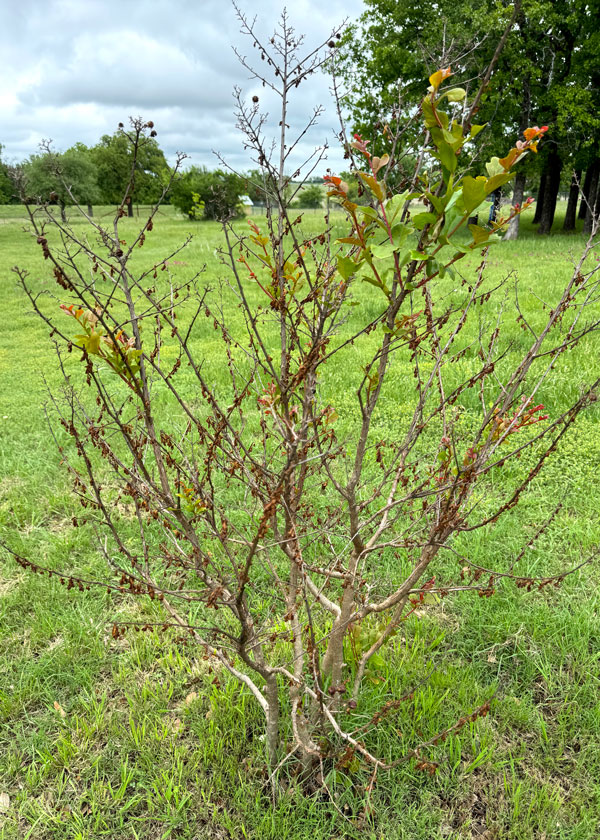
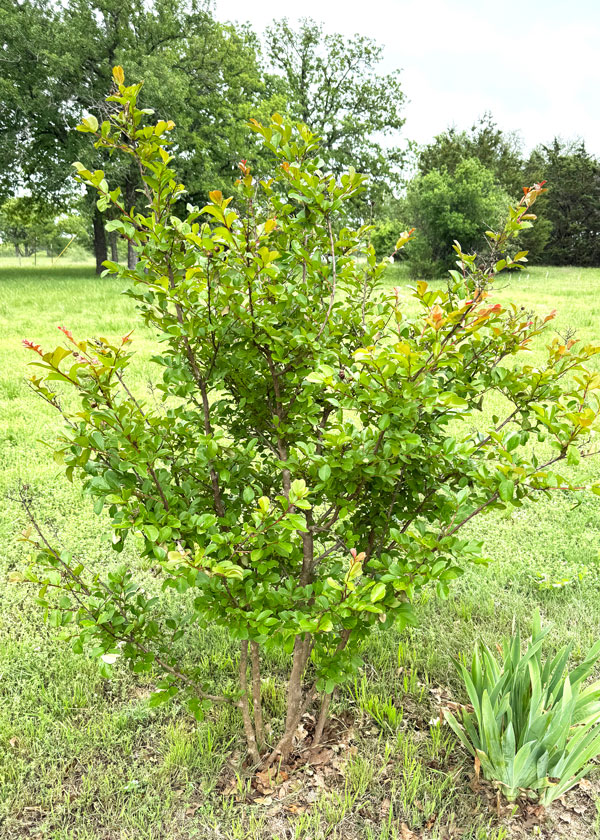
Images clickable for larger views.
Answer: There are three times that a crape myrtle is especially vulnerable to damage by cold. One is with a very early first freeze. One is with a late last frost or freeze (like yours faced). And, of course, extremely cold winter spells can hurt some varieties.
I would wait two more weeks. I see what appear to be buds breaking that might be your salvation. Or, they may be frozen leaves from several weeks back. If it sends out new shoots in erratic spots up and down the branches, you’ll probably be much happier if you do cut it back near the ground and let it regrow. I know it sounds harsh, but you’ll be amazed at how rapidly it will fill back in (usually just 18 months). Otherwise, it’s likely to languish for years. Let’s see what happens between now and the first week of June.
QUESTION 5
COULD I CUT A ROOT FROM MY LIVE OAK?
Question: My live oak has a ground-level root that is cracking and raising our concrete driveway. Would it be safe to use a chainsaw to cut the root? Dale H., Lewisville.
Answer: You’ll have to do it to save your driveway. I can’t tell you about the impact it would have on the tree, because I don’t know the trunk size or the root size. We’re about to head into the hottest part of the year. That’s when your tree will need its roots the most. This type of root removal is always better done in October. But if the driveway will be ruined if you wait, you’ll have to do what you’ll have to do.
Caution: Do not let your saw’s chain touch the soil. It will dull the blade instantly. You’re going to need to dig around the root and expose it completely. Get all the soil out of the way before you start cutting.
Another caution: If you do decide to remove the root now, plan to soak the ground around the tree on a regular basis this summer. Deep soakings weekly will help it recover.
QUESTION 6
WHAT ABOUT THIS ORGANIC FERTILIZER?
Question: In last week’s e-gardens you cautioned about “miracle soil additives,” etc. I recently discovered Microlife organic fertilizer. What is your opinion of their products? Russell B., Frisco.
Answer: That would have been the May 7 edition of e-gardens, and here is the exact wording I used in my story on “Easier Landscapes.”
• Avoid quack products. Texas is full of them. Miracle soil additives that will stimulate microbes or activate enzymes. Our state has no “proof of claim” laws on these things as long as they don’t claim to add nutrients.
I believe those four sentences express my opinion well enough that I can let you look through any website and draw your own conclusion.
Of course, from the standpoint of products that say they are “organic fertilizers,” the state does require proof of accuracy of those claims.
QUESTION 7
WHAT GARDENIA VARIETY WOULD BE BEST FOR A CONTAINER?
Question: I think I’d have the best success growing a gardenia in a pot on the patio. Is there a variety that you would recommend over others? How should I prepare the pot for best results? Margaret H., Plano.
Answer: Before I go too far, a warning. You will have to protect your plant anytime temperatures are going to drop into the mid-20s or colder. You lose a lot of winter hardiness when root systems are exposed to freezing weather, so be prepared to put it in a greenhouse or to shuttle it in and out like you would a citrus tree or any other large tropical plant.
That said, I’d probably go with the old standard August Beauty. It is long proven for vigor and large, fragrant flowers. It will need a large container (16-in. or larger) filled with highly organic potting soil containing 50 percent sphagnum peat moss and no native soil from the Collin County area (far too alkaline). Grow it in morning sun and give it shade from late morning through most of the afternoon (11-7, for example, during the summer). Fertilize it with an azalea-gardenia specialty food. Be on the lookout for whiteflies – notorious visitors to gardenias.
I’m going to have to tell you that in 60 years of advising Texans about their outdoor plants (and part-time winter houseplants), I can’t remember a case where someone has been successful bringing a gardenia indoors for a prolonged period of time. I’m sure there have been a few, but I’ve just never crossed paths with them. Even though they require a great deal of babying when planted outdoors in your area, you would probably have better luck with a gardenia in the ground in a very protected location with morning sun and afternoon shade, shelter from winter cold, and a totally artificial, low pH growing medium.