
Q&A – Ask Neil: April 23, 2026
(Please read these instructions carefully.)
Before you post your question, please look at recent issues to see if someone else has already asked it. You might find your answer there.
HOW TO SUBMIT YOUR QUESTION…
• Click here to post your question. (Please post your question only one time.)
• Please use this link only for posting questions – not for standard e-mails.
• High-resolution photos (1-2MB – not thumbnails) attached with your question help Neil give you the best possible answer. Please check your photo for clarity and exposure. If you do not see “All images clickable for larger views,” your images’ resolution was not sufficient for enlargement. That might also have made it difficult for Neil to give you an accurate answer.
• Neil chooses questions of greatest reader interest. Plant IDs rarely fit that description.
• Neil requires your first name or initials, also your city or county for an accurate answer. (Texas is a very large state.)
• One question per reader per week, please.
• Watch for Neil’s reply in the next issue of e-gardens.
Note: If you have submitted your question and did not see the pop-up window for attaching your photo, please click here.
QUESTION 1
SHOULD I TRY TO SAVE MY REDBUD?
Question: My Forest Pansy redbud is 17 years old. It has developed a 10-in. gap in its main branches of the trunk. Should I cable the branches or bite the bullet and replace the tree? It’s 5 ft. from the 8-ft. fence. Any species recommendations? David S., Allen.
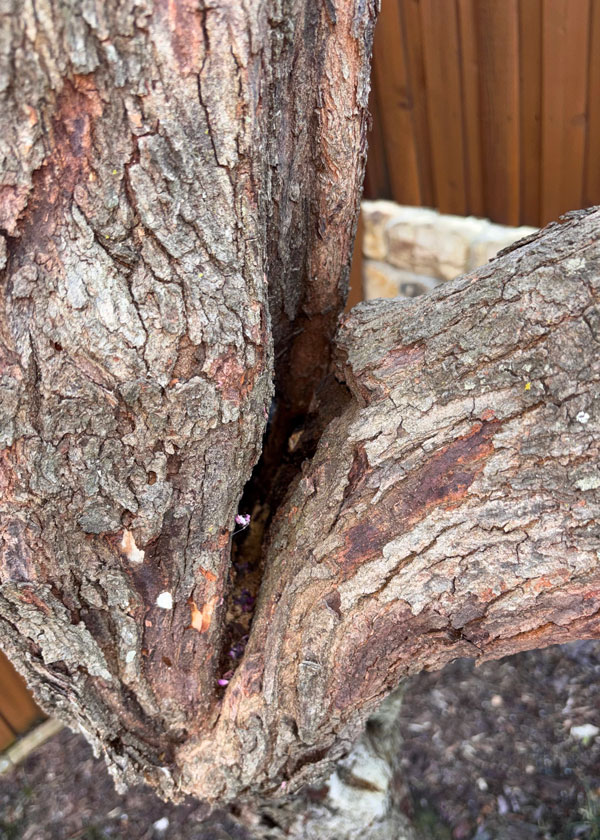
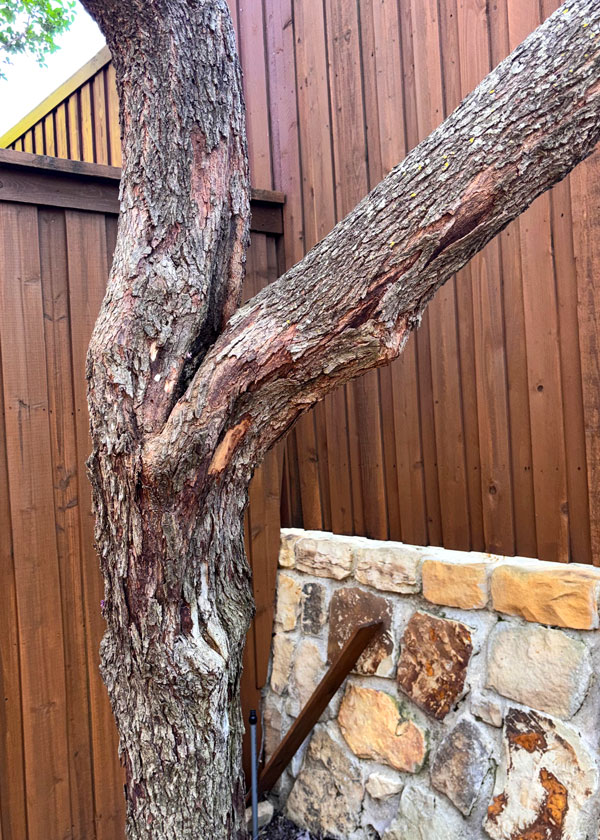
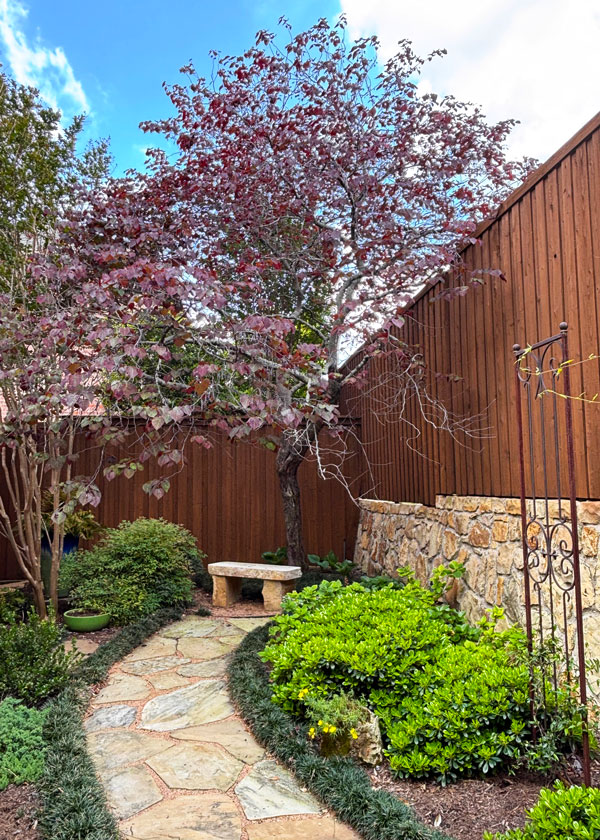
Images clickable for larger views.
Answer: Sadly, cabling would not help. If you look at the right-hand branch, it’s losing its bark. It also has about half as many leaves as it should have, so it’s on its way out, and the trunk is showing signs of following closely behind. I see that you already have one nice crape myrtle growing there. You don’t have a lot of room for a standard tree in that corner, so I might be tempted, if I could match that crape myrtle variety, to buy another large one (must be the same variety!) and create a sort of grove with them. If you really want a tree, the best options would probably be a Teddy Bear dwarf southern magnolia or a tree-form Nellie R. Stevens holly if you could find one already grown to a nice size. That’s a really pretty setting you’ve created. I believe any of those three options would work well.
QUESTION 2
WHAT IS THE TERM “LAQ” THAT YOU USED TWICE IN LAST WEEK’S e-gardens?
Question: You used the term “LAQ” twice in your 4/16 newsletter. What does it mean? And no, Google didn’t have an answer that fits. Neil P., Austin.
Answer: OK. I’ll show you where I hid it. I had written about the FAQ – Frequently Asked Question. Most people are familiar with that term. I used it for the question I’ve been asked most often about shade trees.
Then I turned to the LAQ. Here’s what I wrote:
And then, moving on…
That’s when I come up with my second question – the one I’ve never been asked in 48 years. The least-asked question from gardeners.
The LAQ about shade trees…
“What are the best long-lived shade trees?”
I guess I could have made it more obvious. Sorry ‘bout that.
QUESTION 3
HOW CAN I ELIMINATE THIS PESKY WEED IN MY ASIAN JASMINE?
Question: I have Asian jasmine groundcover where the shade became too heavy for St. Augustine. Now I have this pesky weed growing in it. I don’t think I can use a broadleafed weedkiller on it because of the jasmine. What can I do? Bill L., Dallas.
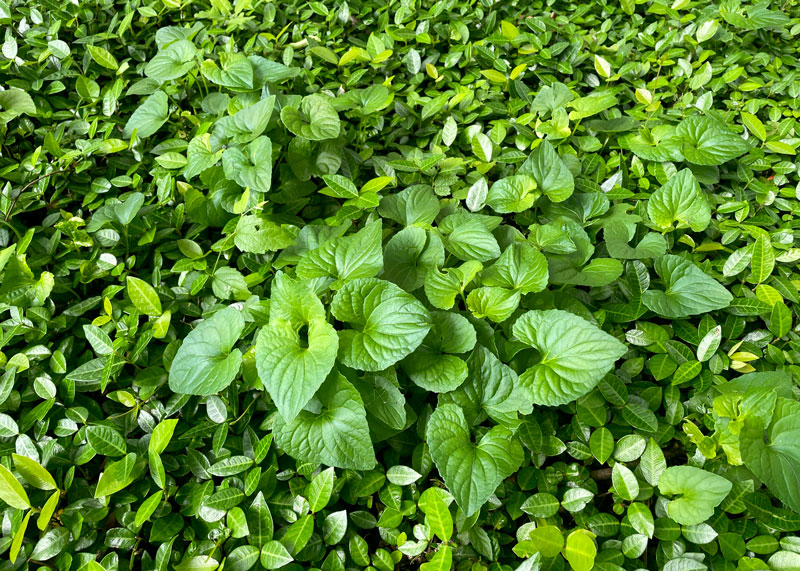
Answer: You have wild violets. There are two options. One would be to use a broadleafed weedkiller with a sponge and rubber gloves. Carefully soak the sponge in the mixed herbicide, wring it to where it won’t drip freely, then wipe it across the leaves of the violets. They are taller than the jasmine, so you should be able to coat them without getting the weedkiller onto your groundcover. You might have to repeat the treatment in 10-15 days.
It’s also a known fact that glyphosate herbicides such as the original Roundup do not kill Asian jasmine, but they will kill grassy invaders like bermuda grass. However, three notes must be made. One would have to wait until the soft spring growth of the jasmine has become leathery. Also, violets are some of the more difficult weeds to eliminate, so I’m not sure whether the glyphosate will work very well on them. You must also be certain that you have a glyphosate-only product, not a combination with other herbicides mixed in with it.
I must inform you that the glyphosate comments are merely that. They are not a recommendation. Asian jasmine has never been on that product’s label, so I can’t recommend it. I’m just telling you that thousands of landscape contractors have used it on Asian jasmine beds, and I personally have not seen it do damage when those precautions are followed. Still, I would suggest if you try it, that you experiment on a small spot to see if you’re satisfied.
Personally, I’d spot-apply the broadleafed weedkiller with a sponge if I were in your shoes.
QUESTION 4
WHY ARE MY HIBISCUS BUDS DROPPING BEFORE OPENING?
Question: I just bought two new hibiscus plants. They had huge blooms on them when I bought them, but now their buds are dropping off without opening. I repotted them and have not overwatered them. They are in full sun. What could the problem be? Cindy P., Bexar County.
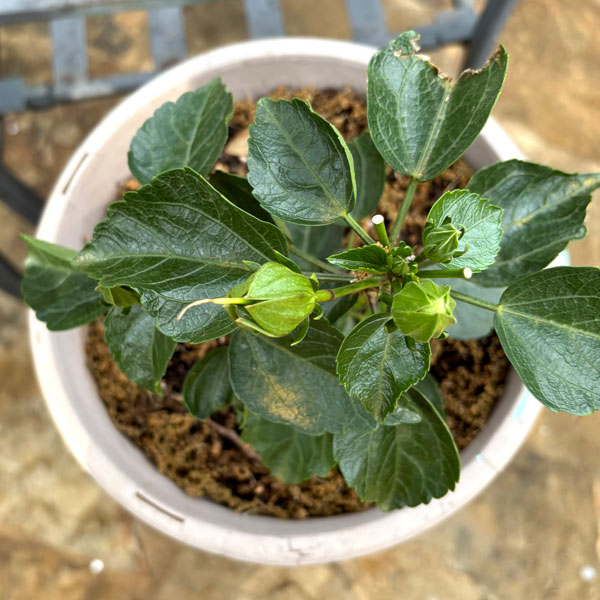
Answer: It sounds like you’ve done everything correctly. They like really warm weather and they need full sun. If anything, you might have over-potted them. Hibiscus plants tend to bloom best if they’re slightly pot bound. They produce their buds on new growth, so use a high-nitrogen, water-soluble plant food to keep them growing actively. Feeding them every 10-14 days should be adequate for now, switching over to weekly when they get larger and start drying out more quickly.
QUESTION 5
WHAT HAS HAPPENED TO MY MAGNOLIA?
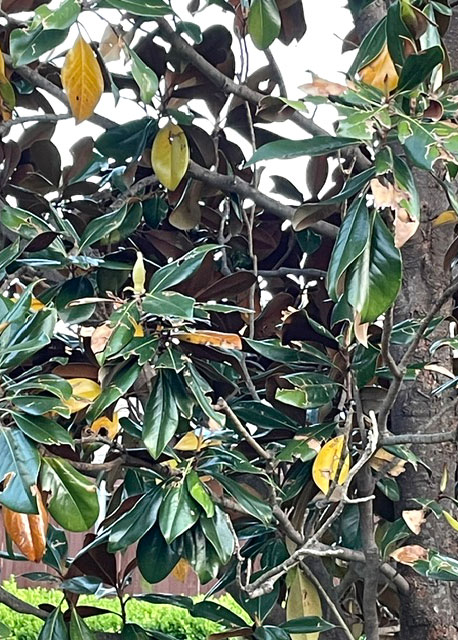
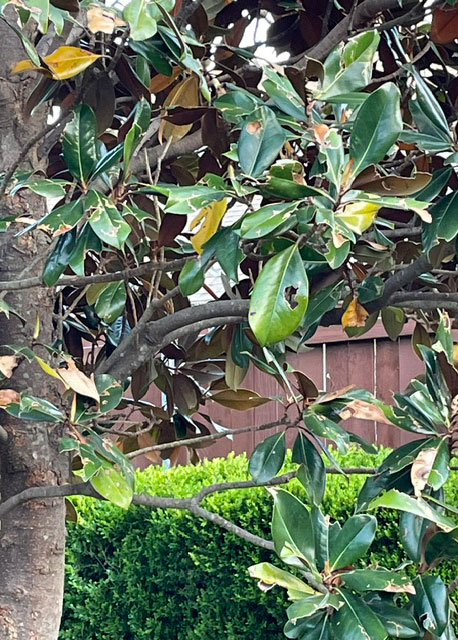
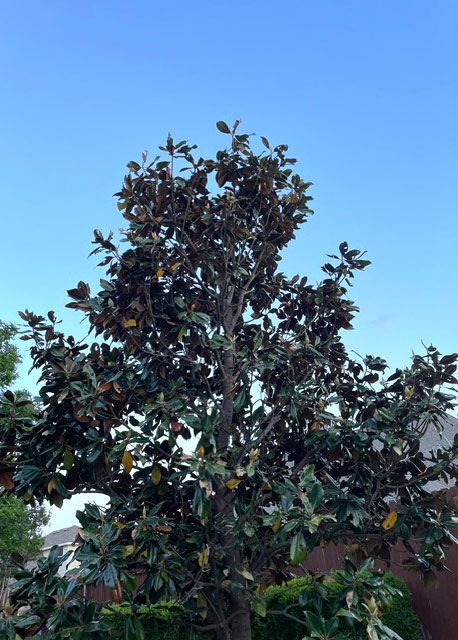
Question: What has happened to my magnolia? Its leaves looked chewed, but I don’t see any signs of insects. Laura H., McKinney.
Images clickable for larger views.
Answer: It looks absolutely normal to my eyes. Those are last year’s leaves starting to shed. They are just tattered from being out in the weather for all those many months. My magnolias are doing the very same thing. You’ll see other magnolias around McKinney (where my wife and I live, too) doing the same thing. Those leaves will be replaced in a few weeks with fresh, new growth. Nothing to worry about.
QUESTION 6
HOW CAN I GET AHEAD OF CHINCH BUGS THIS YEAR?
Question: My beautiful St. Augustine yard was devastated last year. I’d like to get ahead of the nasty chinch bugs this year instead of waiting to see damage in my new sod. What will control them, and when can I put it out? Jon M., Dallas.
Answer: I’ve been dealing with chinch bugs personally for 56 years. Obviously, I’ve been advising folks concurrent with my own issues for those same years – since I began my work with the Extension Service.
I’ve never recommended applying insecticides preventively for them. I’ve always coached people on learning the early warning signs and then checking immediately upon seeing them. Here’s what I look for:
• Chinch bugs come back to the same spots in my lawn, so that’s where I watch.
• I watch for grass that looks dry even after I water it deeply.
• I get down on my hands and knees on a sunny, hot afternoon. I part the grass with my hands. I look for insect activity. Chinch bugs will be near the outer edge of an infestation, and they’ll be BB-sized black insects with irregular white diamonds on their wings.
• I look, also, for the small red nymphs moving about freely.
• There are many insecticides labeled for control of chinch bugs in home lawns. Sprays are more effective than granules, but only if you water deeply after you apply them to soak them through the thatch layer.
• Check a few days later to monitor the populations. Repeat as needed.
Just to have given you some type of timetable, I have had chinch bugs in my own turf as early as late June, but that’s not happened more than once or twice. They usually show up in mid-July, and one year they were much later (August into September).