
Q&A – Ask Neil: April 2, 2026
(Please read these instructions carefully.)
Before you post your question, please look at recent issues to see if someone else has already asked it. You might find your answer there.
HOW TO SUBMIT YOUR QUESTION…
• Click here to post your question. (Please post your question only one time.)
• Please use this link only for posting questions – not for standard e-mails.
• High-resolution photos (1-2MB – not thumbnails) attached with your question help Neil give you the best possible answer. Please check your photo for clarity and exposure. If you do not see “All images clickable for larger views,” your images’ resolution was not sufficient for enlargement. That might also have made it difficult for Neil to give you an accurate answer.
• Neil chooses questions of greatest reader interest. Plant IDs rarely fit that description.
• Neil requires your first name or initials, also your city or county for an accurate answer. (Texas is a very large state.)
• One question per reader per week, please.
• Watch for Neil’s reply in the next issue of e-gardens.
Note: If you have submitted your question and did not see the pop-up window for attaching your photo, please click here.
QUESTION 1
WHY WERE MY REDBUDS’ FLOWERS PITIFUL THIS YEAR?
Question: My redbuds (an eastern and an ‘Oklahoma’) had pitiful buds but are leafing out nicely. Was this the freeze? Are they going to be OK? Carol V., Collin.
Answer: It was probably a combination of atmospheric situations. It has been very dry over the past 6 months. That hurt many of our flowering trees. And the late cold spells also cost us a lot of buds on the early-flowering types. If it’s any consolation, I mentioned to my wife that this was one of the poorest years I’ve observed overall for redbuds (her favorite trees). I took only a few photos compared to normal springs.
QUESTION 2
WHAT ARE THE RECOMMENDATIONS FOR FERTILIZING NEWLY PLANTED TREES?
Question: I planted two red oaks in October and have read you should not fertilize newly planted trees for at least two years. What is the reasoning for that? Reggie T., Hewitt, McLennan County.
Answer: I have no idea. You didn’t read it here, so I’ll have to refer you back to the person who wrote it to defend.
It seems rather open-ended to me. In my opinion it varies by how the trees are dug and sold.
• Balled-and-burlapped trees would benefit from a monthly feeding of a liquid, high-phosphate root-stimulator fertilizer for the first year or two to help them re-establish roots to make up for those lost in the digging. That’s been standard procedure for as long as I’ve been a horticulturist.
• Container-grown specimens have all their roots intact, so they can be fed lightly with a high-nitrogen fertilizer to encourage normal stem and leaf, also root growth.
• In all cases, water becomes an even more critical issue than whether you fertilize the new tree or not. Newly planted trees have limited amounts of soil from which to get their water. They must be watered by hand using a hose with a water breaker or bubbler, not drip or sprinkler irrigation. If you miss one watering at a critical time you will lose the tree.
QUESTION 3
WHY DID MY OLD WISTERIA NOT BLOOM?
Question: I have a 22-year-old wisteria that is about 16 feet in circumference. I trim it to grow like a tree-like shrub, not a vine. For the past 2 years it has not bloomed. I do trim quite a bit throughout the year to keep it under control. What can be done to get it blooming once again? Angie K., Grayson County.
Answer: You are probably trimming off the primordial flower bud clusters as they are trying to form, especially if any of your pruning is done later in the growing season, say in August through October. We normally try to do almost all pruning to wisterias immediately after they finish blooming to avoid that problem. I hear what you’re saying about keeping a wisteria in bounds, but that comes with the risk of cutting off the flower buds. They are set in the fall and early winter.
There are, however, other reasons for wisterias not to bloom. If shade has become greater, for example, from a large tree growing even larger overhead, that will cost flowers. Or, if you have the wisteria growing in a turf area where it gets a high-nitrogen feeding in the fall when it should be setting buds, that might keep it vegetative. So will keeping the plant very moist all fall, since that stimulates leaf growth right up until frost.
You might try root-pruning it early this September. When the soil is wet following a rain, use a sharpshooter spade to cut a slit down through the roots at a distance 18 or 20 in. out from the trunk and 8-10 in. deep. You’re not trying to dig the plant. You’re just severing the lateral roots. That will “shock” the plant, and it may stimulate formation of flower buds in a “survival of the species” mode by the plant to become reproductive. It sounds hocus-pocus, but it often works.
QUESTION 4
PLEASE DISCUSS THE ISSUE OF “TROPICAL” MILKWEED VS. “NATIVE” MILKWEED.
Question: I enjoyed the story on butterfly weed milkweed last week. When I go online there are several kinds of milkweed. Please discuss the issue of “tropical” milkweed versus “native” milkweed. Bob T., College Station.
Answer: I’m glad you enjoyed the story. Butterfly weed is a wonderful native milkweed, and I hope you’ll give it a try.
All milkweeds are in the genus Asclepias. They’re noted for their fruit having pods with only one opening (suture). When they’re mature, they split along that opening and expose feathery seeds that disperse easily in the wind.
Most gardeners by now are aware that milkweeds are the critical food source of monarch butterflies. That food becomes critical as the butterflies migrate from eastern North America to their winter home in a tiny section of Mexico.
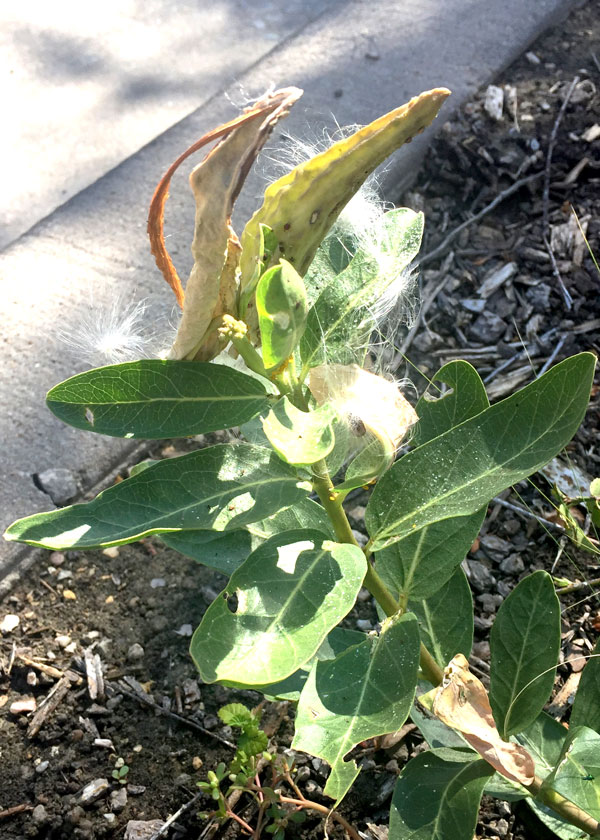
The best food source is native milkweed that goes dormant in fall. That aids the monarchs’ knowing when it’s time to head south. Our most common Texas species is Asclepias asperula. Unfortunately, it’s not especially handsome in our landscapes, at least to our eyes. But monarchs love it and lay their eggs all over it.
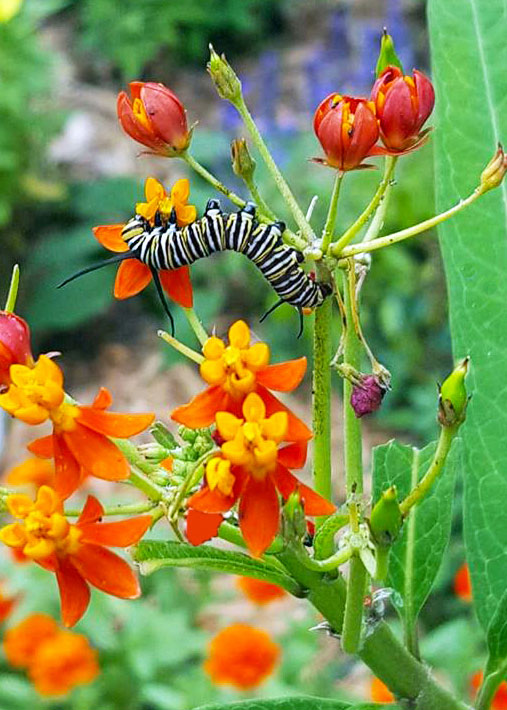
The tropical species Asclepias curassavica has been planted widely because it is easily grown and its red/orange flowers are very showy. However, it does not go dormant in fall, so the monarchs can’t use it as a signal of when to migrate. It disrupts their natural cycle. It’s not a bad plan to plant it, but you should commit to cutting it back to the ground by late September so it won’t be a draw to the migrating butterflies.
QUESTION 5
WHAT IS GOING ON WITH MY TEXAS MOUNTAIN LAUREL?
Question: I planted my Texas mountain laurel from a 10-gal. pot 10 or more years ago. It bloomed beautifully this year, but there are a few branches that seem to be dying suddenly. What might be going on? Denise C., Tarrant County.
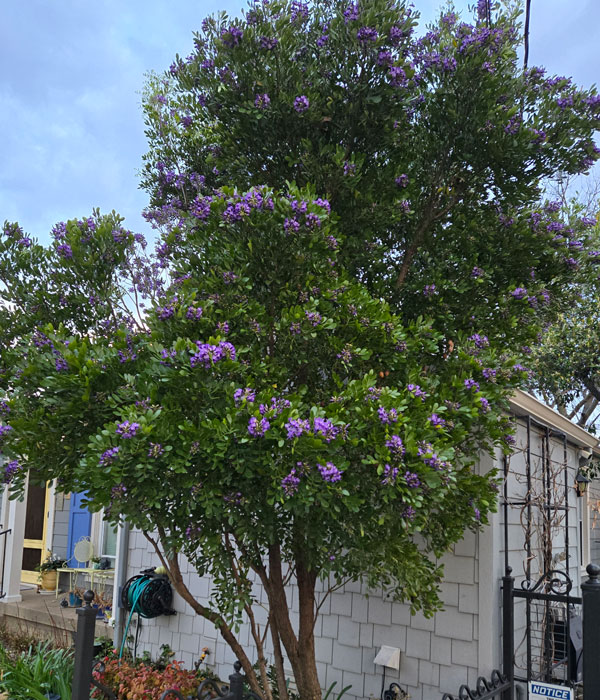
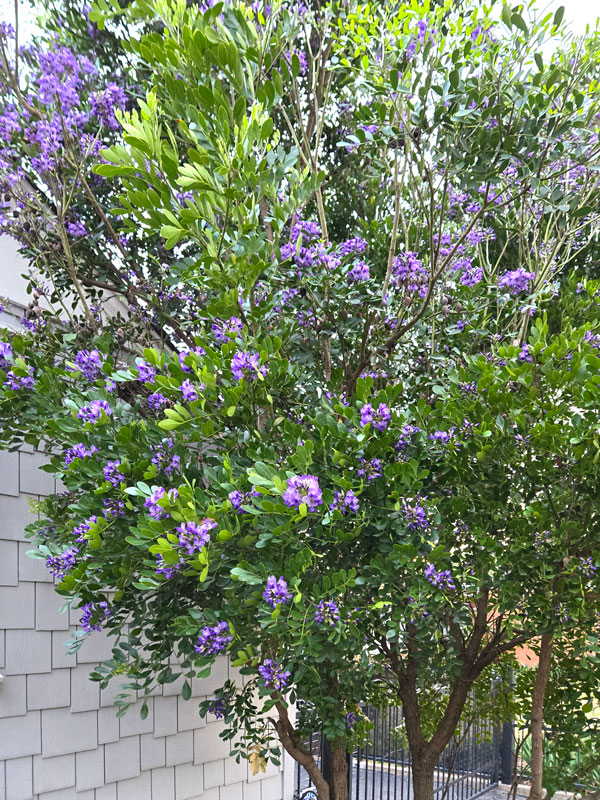
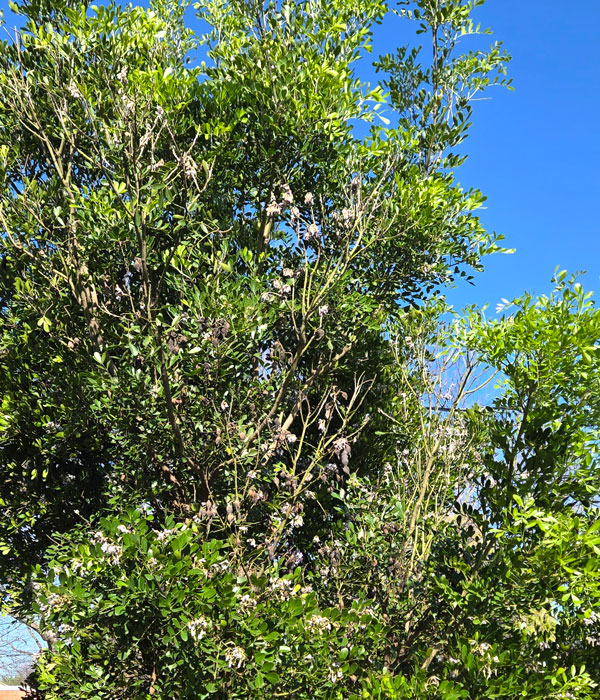
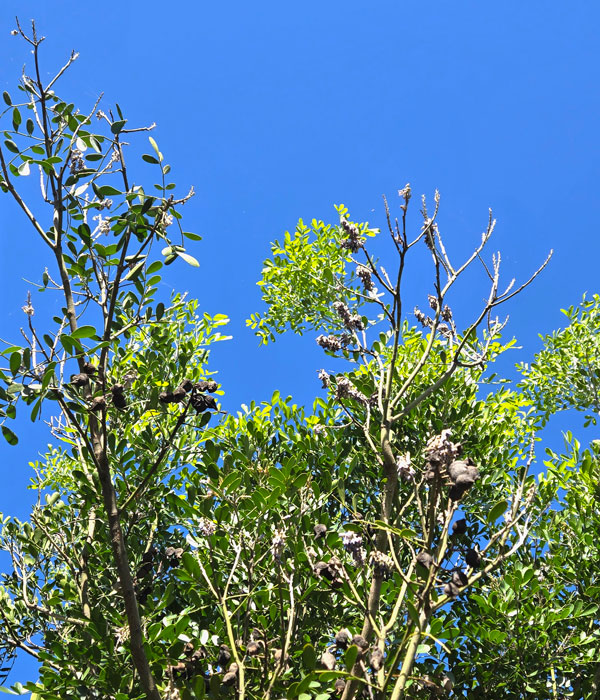
Images clickable for larger views.
Answer: Perhaps nothing. It could be freeze damage. It might be leftover damage from the Genista moth larvae that devour foliage during the growing season (last year). Or trace the dieback on each stem closely to see if you can find anything specific where it begins. I had some type of fungal canker hit one trunk of my mountain laurel. I regret not having sent a sample to the Texas A&M Plant Disease Diagnostic Laboratory in College Station. I could have known what caused that one trunk to die. I ended up losing my plant to extreme cold a year later. If you find anything out of the ordinary in the branches where the dieback is happening, you might send samples to the lab at A&M. There will be a charge for their diagnosis, but it’s a sure way to know what’s happening.