
Q&A – Ask Neil: March 5, 2026
(Please read these instructions carefully.)
Before you post your question, please look at recent issues to see if someone else has already asked it. You might find your answer there.
HOW TO SUBMIT YOUR QUESTION…
-• Click here to post your question. (Please post your question only one time.)
-• Please use this link only for posting questions – not for standard e-mails.
-• High-resolution photos (1-2MB – not thumbnails) attached with your question help Neil give you the best possible answer. Please check your photo for clarity and exposure. If you do not see “All images clickable for larger views,” your images’ resolution was not sufficient for enlargement. That might also have made it difficult for Neil to give you an accurate answer.
-• Neil chooses questions of greatest reader interest. Plant IDs rarely fit that description.
-• Neil requires your first name or initials, also your city or county for an accurate answer. (Texas is a very large state.)
-• One question per reader per week, please.
-• Watch for Neil’s reply in the next issue of e-gardens.
Note: If you have submitted your question and did not see the pop-up window for attaching your photo, please click here.
QUESTION 1
HOW WELL WILL GROW BAGS DO FOR SWEET POTATOES, AND WHAT GUIDELINES CAN YOU GIVE ME?
Question: I plan to plant sweet potatoes (specifically Murasaki and Okinawan Purple) in 10-gal. Grow Bags sometime this spring. Do you have any recommendations on growing in bags, when to plant the slips, and the best soil composition? Kent V., Fort Worth.
Answer: The short answer is that they should do well, although larger bags (15-gal.) might give better yields. Plant in late April or early May. Full sun. They will benefit greatly from getting out of the Blackland Prairie heavy clay soil. You’ll want to prepare a loose, highly organic but well-draining potting soil with 10-15 percent sand and expanded shale to keep it open and airy. That will give their tubers the ability to grow and expand.
Fertilize with a complete and balanced, water-soluble plant food, but be prepared to cut back on the amount of nitrogen they receive if they start to produce excessive leaf and vine growth.
I am not the world authority on growing sweet potatoes this (or any) way, but the variety Beauregard is considered to be most dependable and productive. Okinawan Purple requires a longer season, so don’t delay in starting it. It also will have a slightly lesser yield, especially compared to Beauregard. (I do understand that you’re probably trying to grow the less common types with unusual colors and flavors.) Murasaki might be the better choice of your two. People who have grown it do warn about not over-feeding it for fear of smaller tubers and excessive foliage.
QUESTION 2
WHAT HAPPENED TO SHADES OF GREEN IN FRISCO? THEY WERE THE BEST.
Question: What happened to Shades of Green Nursery in Frisco? We were surprised to see a new owner. They were the best. Jackson R., Frisco.
Answer: The Shades of Green folks have been friends for many years. This isn’t the first time they have moved. This time they have consolidated all their efforts into their new Celina store, so if you want their same quality and service, it may be a bit farther up Preston Road for you, but it’s definitely still available. The old location has sold to another operator based out of state.
QUESTION 3
I CAN’T GET RID OF CLOVER. HELP!
Question: I cannot get rid of clover in my bermuda front yard. I’ve put nitrogen on the yard two times and poisoned it multiple times. How do I get rid of it? Dee D., McKinney.
Answer: There are several plants that are mistaken by gardeners for clover, notably oxalis. Without seeing your weed, I can’t be definitive, but I’ll try.
Your fertilizer comment makes me wonder if you might have read about putting one particular high-nitrogen fertilizer on bur clover to cause it to die. My dad, the weed control specialist for Texas A&M years ago, demonstrated that when I was a kid, but it was a fertilizer I would never recommend for home lawn use. It messed with the physiology and effectiveness of the nitrogen-fixing bacteria in the root nodules on bur clover and other legumes at the same time that it was encouraging vigorous growth of the turf. The result was that the bur clover was crowded out – it died. But don’t go there. It’s a fertilizer I will not recommend for several reasons, not the least of which is that it leads to formation of thatch in bermuda turf.
The weedkiller that works on clovers of all kinds, even oxalis, would be one containing 2,4-D. It will be labeled as a “broadleafed” herbicide. If you read and follow label directions carefully it should do a good job in eliminating them.
The rules: Do not mow for several days before or after spraying. Use a tank sprayer with the nozzle set to a fine droplet size for best coverage. Include one drop of liquid dishwashing detergent per gallon of spray to help hold the spray on the leaves of the weeds. Do not water for 48 hours after spraying.
QUESTION 4
WHAT DO I NEED TO AMEND THIS GARDEN SOIL?
Question: I have amended the soil in my garden patch with various things: wood chip mulch, purchased garden soil, and kitchen refuse. Is this enough, or does it need amendments each year afterwards? Shan W., Amarillo.
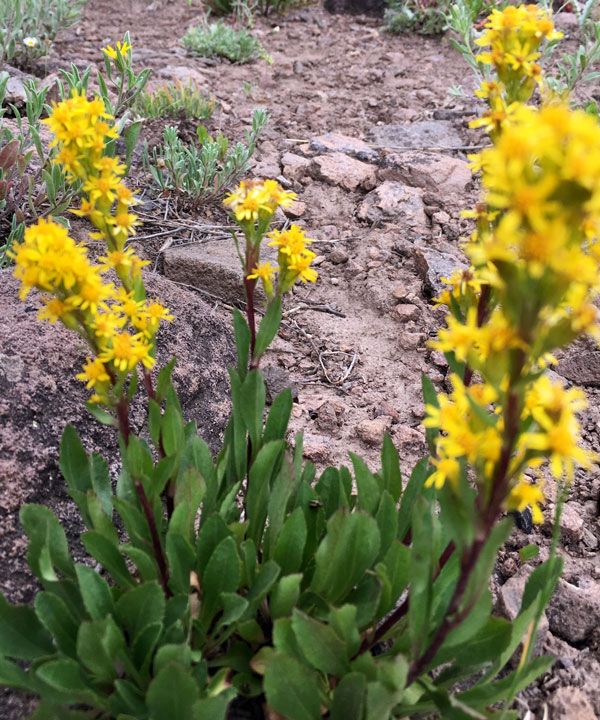
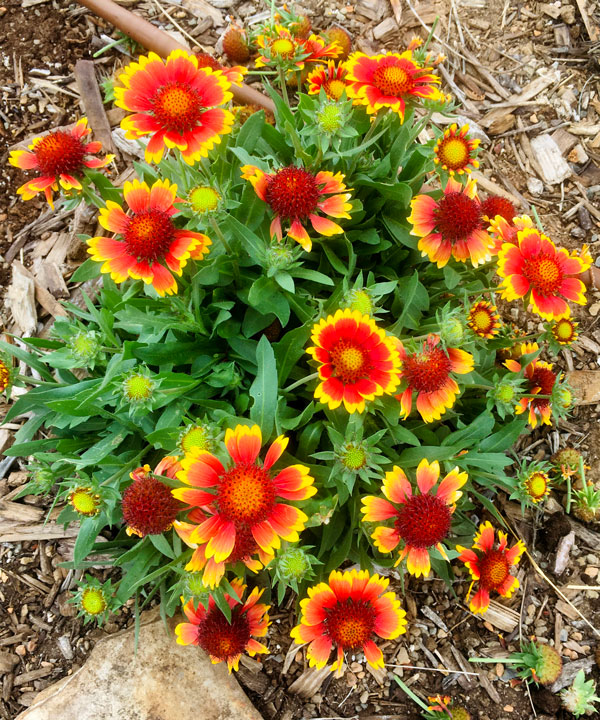
Images clickable for larger views.
Answer: Let me take a different direction in developing my answer. Here is how I prepare soil for a flower garden at my house.
I have a native clay loam soil. I begin by removing all existing vegetation, either with an herbicide or physically with a shovel.
Before I do anything else, I use a rear-tine rototiller to till the soil to a depth of 10-12 in.
I add 4-5 in. of a combination of organic matter. 2 in. of sphagnum peat moss, 1 in. of finely ground bark mulch, 1 in. of well-rotted compost, and 1 in. of well-rotted manure.
Since I am amending a clay soil, I also add 1 in. of expanded shale (could substitute 1 in. of washed brick sand).
I rototill again, back to the same depth as before, mixing all these ingredients together until they form almost a potting-soil consistency.
Thereafter, I add organic matter at half those amounts every year to replace all that has decayed and disappeared.
QUESTION 5
WHAT SHOULD I DO TO KEEP MY BEGONIA BASKET VIGOROUS FOR ANOTHER YEAR?
Question: I bought this begonia basket on clearance last summer and it was still going strong and looking beautiful when the cold weather hit. I moved it in and out of the garage to protect it from the freezes. The base of the plant looks full and even has new shoots. The top is leggy and sparse. Should I trim it? Can I use the trimmings for cuttings? Do I need to repot it? Lisa B., Mansfield.
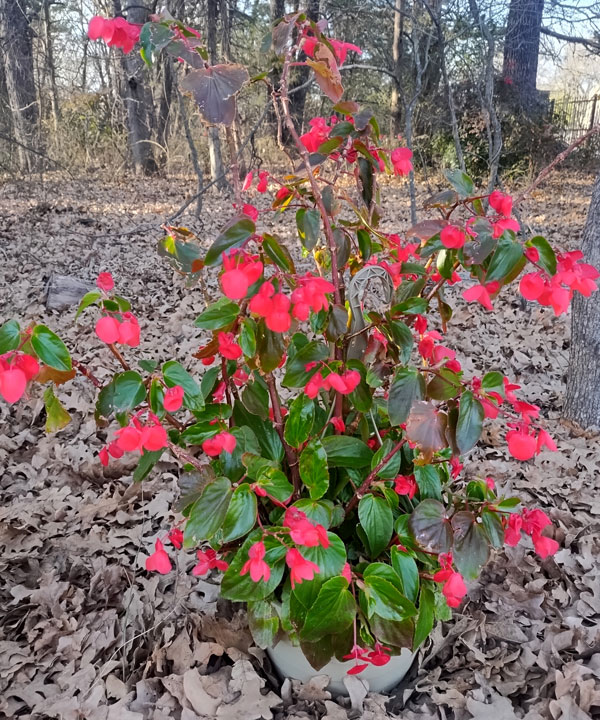
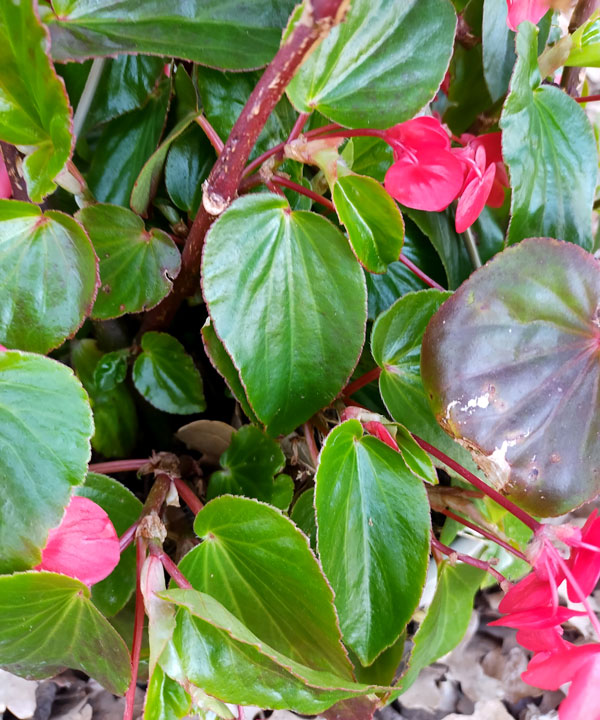
Images clickable for larger views.
Answer: Nice work. You can certainly save it to be beautiful again this year. Trim off all the leggy growth. I would not try to root those trimmings as cuttings. They lack the vigor you would want. Repot it into a larger pot with fresh, highly organic potting soil. Apply a high-nitrogen, water-soluble plant food each time that you water it and keep it in bright light outdoors except when temperatures drop below 40F. It will start growing vigorously in April and May and you’ll be able to root cuttings from those new shoots much more successfully than from the old, weathered shoots.
QUESTION 6
WHAT PLANTS WOULD GIVE PRIVACY AND NOISE REDUCTION FROM A NEW ROAD?
Question: A nearby city is going to put a roadway in near our house. What might we plant in the Blackland soil that would give us privacy and noise suppression? It will be in a pasture, so the only irrigation will be rainfall. John S., Temple.
Answer: Your last sentence is the killer. So, I’ll ask you in return: How much is it going to rain? Will it be a record-setter with lots of rain, or are you going to be in a drought? If you make no provision for some level of irrigation my answer will be limited to eastern redcedar juniper, Juniperus virginiana. It’s an excellent tall privacy screen that also deadens road noise very well. It grows to 35 ft. tall and 25 ft. wide. Just so it doesn’t look like some kind of tall, green border wall, I’d suggest you plant it on an irregular pattern zig-zag style every 18-20 ft. apart. Start with small plants 15-18 in. tall, not with large plants. There’s a much higher loss rate when we dig and move larger redcedars. The smaller ones establish and take off much faster.
However, let the record show that I said this: You still need to carry water to them every 5-7 days April-early October for their first summer or two. Once they get established where you are they’ll be able to hold their own, but without that help at the start you’ll probably lose many.
They’re hard to find in area nurseries. Call around to ask for that species in smaller sizes. See if it can be brought in from a wholesale grower for you.
If you can figure a way to supply irrigation on a permanent basis, Nellie R. Stevens hollies would be my next suggestion. I have actually used a combination of the two species for this purpose in our rural landscape. Since you have ample room, you could even blend in a live oak or three for a really natural look to your part of Texas. Space them 30 ft. from the redcedars or hollies. Again, water will be the key to quick growth. Start with a larger plant for quickest results.
QUESTION 7
PLEASE CLARIFY TIMING OF SHRUB FEEDINGS.
Question: Please clarify the timings of feedings for shrubs as stated…
March 30, 2023, in e-gardens “Planning for Feedings”
and
February 26, 2026, in e-gardens “Gardening This Weekend.”
Jon R., Richardson.
Answer:
For others, I’ll copy and paste what I wrote.
For March 30, 2023:
• Shrubs, vines and groundcovers: Every two months beginning early April. If you are feeding new plants or plants that were damaged by cold be careful that you do not overdo things. Be patient as they gear up to start growing.
And for February 26, 2026:
• Shrub and groundcover beds with all-nitrogen lawn fertilizer. They typically green up earlier than turfgrass. Follow feedings with deep watering.
Goodness! Either you have a photographic memory or you’re cataloging what I’ve said and written.
It’s easy to explain. They’re two different columns with two different purposes.
Remember that my promise with my “Gardening This Weekend” column here in e-gardens is that it will always be directed at things that I feel are most timely to be accomplished over the ensuing 3-4 days.
As you may have heard Pete Delkus on WFAA Channel 8 tell us several times in the past couple of weeks, the Winter of 2025-26 has been the 5th warmest on record. I have seen many shrubs in North Central Texas (where you and I both live and garden) leafing out already. That’s why I wrote what I did for that column last weekend.
I can’t speak to what kind of weather had been happening 3 years ago, but that was a general story meant to be printed and saved for permanent reference. That’s why I titled it “Planning for Feedings.” I was using the mind set of averages across the entire state and not for one specific weekend.
I am completely comfortable with both statements. They are not comparable.