
Q&A – Ask Neil: February 12, 2026
(Please read these instructions carefully.)
Before you post your question, please look at recent issues to see if someone else has already asked it. You might find your answer there.
HOW TO SUBMIT YOUR QUESTION…
• Click here to post your question. (Please post your question only one time.)
• Please use this link only for posting questions – not for standard e-mails.
• High-resolution photos (1-2MB – not thumbnails) attached with your question help Neil give you the best possible answer. Please check your photo for clarity and exposure. If you do not see “All images clickable for larger views,” your images’ resolution was not sufficient for enlargement. That might also have made it difficult for Neil to give you an accurate answer.
• Neil chooses questions of greatest reader interest. Plant IDs rarely fit that description.
• Neil requires your first name or initials, also your city or county for an accurate answer. (Texas is a very large state.)
• One question per reader per week, please.
• Watch for Neil’s reply in the next issue of e-gardens.
Note: If you have submitted your question and did not see the pop-up window for attaching your photo, please click here.
QUESTION 1
HOW CAN I PREVENT SQUASH VINE BORERS?
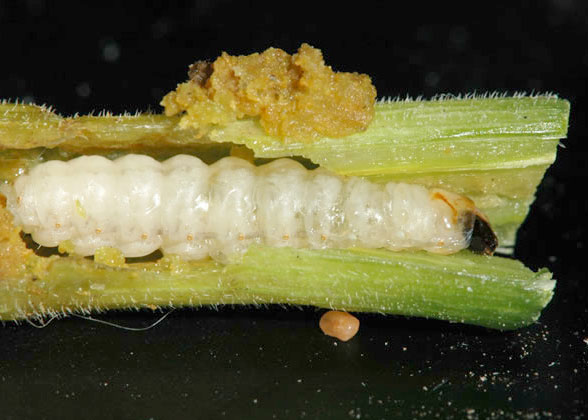
Question: I have raised both summer and winter squash for many years, but for the past several years the vines have gradually died. I later find the outer shell of a worm inside the stalks. What can I do to prevent this? Elise D., Cooper, Delta County.
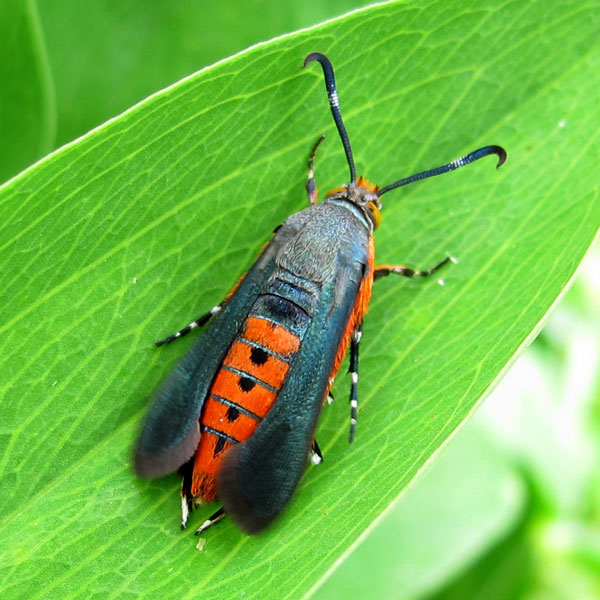
Answer: Squash vine borers can be devastating to summer squash varieties, notably yellow crooknecks, zucchinis, and Patty pans. The adult clearwing moths (resemble wasps) fly and mate in May and June and lay their eggs soon thereafter. Larval tunneling happens in June and July, and once the larvae are burrowing insecticidal sprays are ineffective.
A second partial generation will sometimes fly later in the summer. You want to time plantings to fall out of the active larval development. (Keep reading.)
• Very early planting time will allow harvest before the peak borer flight. That would mean soon after the average date of the last killing freeze for your area.
• A late planting date after that first generation declines – probably in late July – would allow a fall crop when the borers would be less active.
• Some serious home gardeners put floating row cover over their squash plantings after they germinate, removing it only at the time of blooming to allow pollination. That’s primarily for the spring garden.
• Others will wrap the lower stems with a couple of inches of aluminum foil to make it difficult for the larvae to penetrate into the stems.
• Bury the nodes of running vines every foot or so to give them additional places at which they can form support roots if their crowns should be invaded by borers.
• Watch for early signs of borer invasion: wilted leaves at midday even though soil remains moist. Plants initially rebound by morning.
• Look closely for frass coming out of holes in the stem. Check a couple of times weekly. It will resemble sawdust, and it will be your call to ramp up your measures.
• As preventive, spray lower stems with Bacillus thuringiensis kurstaki biological worm spray weekly. If necessary, use a hypodermic syringe to inject it directly into the stems to kill the larvae inside.
• Synthetic pyrethroids permethrin or bifenthrin can be applied to the
stem bases weekly while adults are flying. It must come into contract with the larvae before they start boring.
• In severe outbreaks and only as a last-ditch effort, use a single-edge razor blade to slit the stem lengthwise. Remove the larvae (usually a small number per vine), then bury the vine in garden soil and water deeply. Hopefully the plants will recover from that injury and resume normal growth. It’s better not to let it get this far, however.
• Finally, dig and destroy all canes and remains of old squash and cucurbit plants as they die. Next year’s population will come from those remains.
QUESTION 2
IS THIS A GOOD TIME TO PLANT BLUEBERRY BUSHES?
Question: Is this a good time to plant blueberry bushes, or should I wait? Brenda G., Van Zandt County.
Answer: You can plant blueberries anytime late winter through mid-spring equally successfully. This would be an ideal time. Additionally, Van Zandt County is in the acidic soils of the Piney Woods – they will do very well for you. That’s not the case for folks starting a couple of counties farther west of you.
Here is the informational fact sheet from Texas A&M horticulturists on growing blueberries, both in the home garden and commercially. Let me know when the pie will be ready!
QUESTION 3
DO YOU HAVE ANY TIPS ON USE OF PRODIAMINE FOR WEED CONTROL?
Question: I’m considering switching to Prodiamine granules this year for weed control. I hear it’s effective for both broadleafed and grassy weeds. I’m familiar with the products you normally recommend. Since Prodiamine is different, do you have any tips for me?
Answer: I just spent an hour updating my knowledge for 2026 to answer your question. Prodiamine is a pre-emergent that is effective in preventing grassy weeds like crabgrass and some of the unsightly winter grasses. It also offers limited control of some broadleafed weeds. There are products containing Prodiamine that offer more control of broadleafed weeds because of addition of other herbicides, but you didn’t specify anything further. In my opinion, there are post-emergent sprays that can be applied to young broadleafed weed seedlings for more effective and safer control.
Just to have entered one more aspect into the discussion, I’m not a supporter of “weed-and-feed” products because of the magnitude of damage I’ve seen them do to innocent shade trees growing in the turf areas that have been treated with the wrong products. But the Prodiamine itself is not going to do damage.
All of which is to say, you asked for my tip. My suggestion always has been that you buy from a local independent retail garden center where you can discuss your needs and the products that best meet those needs and how you should use them with an expert. The best place to get that kind of help is from a Texas Certified Nursery Professional at a member nursery of the Texas Nursery and Landscape Association.
QUESTION 4
HOW CAN I GET RID OF ANTS IN MY RAISED BED GARDENS?
Question: How can I get rid of ants in my raised garden beds, and how can I keep them out? They ate my blueberries last year. I’ve tried cornmeal and grits on top of the soil and they haven’t worked. Jennifer D., Temple.
Answer: I’m going to assume those to be fire ants. They will build their mounds in improved garden soils, even in bags of potting soil stacked on top of the ground. They can be annoying and painful. Use an area-wide bait applied around the perimeter of the garden. In fact, Fertilome’s Come and Get It Fire Ant Killer even advertises that it can be used within a vegetable garden space. Home remedies like the ones you have tried just won’t get it with these aggressive pests.
To answer many unasked questions, the A&M publication I referenced in Answer 2 above might offer you other good suggestions on your cultivation of blueberries in your area.
QUESTION 5
WILL A PRE-EMERGENT HERBICIDE WORK ON BEGGAR’S LICE IF APPLIED NOW?
Question: I live on 2.5 acres of semi-rural land. I have a total infestation of beggar’s lice (hedge parsley). I have used a broadleafed herbicide and Roundup with limited results. Can I control this weed with pre-emergent applied now? Robert H., Midlothian.
Answer: Not at this time. It is about to be fully engulfed in seed, so this is the exact opposite for timing. Most of its germination in the DFW Metroplex where you live will be in October and November. If you want to apply a pre-emergent, I suggest Gallery applied in late September. However, you could also use a post-emergent broadleafed weedkiller spray containing 2,4-D applied as you see the small seedlings in early December or in late winter, just before they bolt into flower. Use a pump sprayer and include one drop of liquid dishwashing detergent per gallon of spray to help hold the spray on the weeds’ leaves.
QUESTION 6
WHEN SHOULD I APPLY PRE-EMERGENT GRANULES FOR ROADSIDE ASTERS IN MY BERMUDA LAWN?
Question: I want to prevent roadside asters in my bermuda lawn this year. When should I apply broadleafed weedkiller granules? Jack K., College Station.
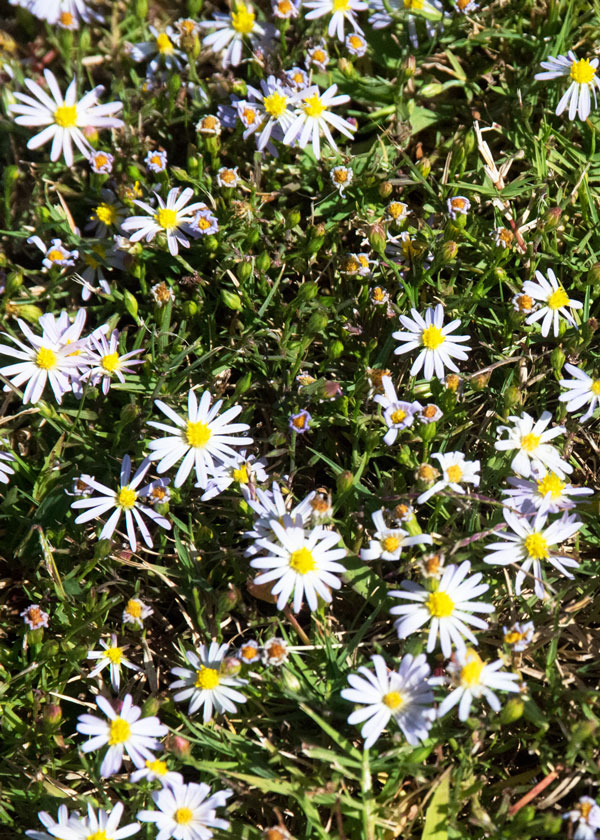
Answer: Roadside asters germinate in the spring as soils begin to warm. In Brazos County that would be mid-March and Gallery would be the product you would use. However, I may have two alternatives that could prove better. As with one of my earlier replies above, you could wait until the tiny seedlings start to grow and then address them with a broadleafed weedkiller containing 2,4-D. It would be just as certain (if not more so) and much less expensive.
My other suggestion is that roadside asters are “weeds of neglect.” That is to say, they show up where we have fallen down on our lawn maintenance. Usually, it’s out back by the alley, out front by the walk or up against the curb – places where it’s difficult to feed and water properly. They are among the most easily controlled weeds if we simply ramp up our lawn management program – water and fertilize more regularly, and mow on a routine schedule. Keep the grass cut at the recommended height so it will grow short and dense, better able to crowd out roadside asters and other obnoxious weeds.

QUESTION 7
WHY DO SOME HOLLIES HAVE DIFFERENT LEAVES?
Question: I have several holly bushes that were here when we moved in. Some now have very spikey leaves coming out from their bases as you can see from the photos. Is this growth from a different root system? Bob T., College Station.
Answer: We did not receive Bob’s photos, but I’ve had this question often enough that I can guess an answer. Many of our most popular hollies are selections from Chinese holly (Ilex cornuta rotunda). Dwarf Burford is one that occasionally will send up one of these rogue basal sprouts.
However, the one that does so most often is Carissa holly. Carissas are one of our best dwarf plants. But it does revert to its parent, dwarf Chinese holly fairly often. The solution: prune out the spiney shoots, cutting back into normal growth.