
Q&A – Ask Neil: February 5, 2026
(Please read these instructions carefully.)
Before you post your question, please look at recent issues to see if someone else has already asked it. You might find your answer there.
HOW TO SUBMIT YOUR QUESTION…
• Click here to post your question. (Please post your question only one time.)
• Please use this link only for posting questions – not for standard e-mails.
• High-resolution photos (1-2MB – not thumbnails) attached with your question help Neil give you the best possible answer. Please check your photo for clarity and exposure. If you do not see “All images clickable for larger views,” your images’ resolution was not sufficient for enlargement. That might also have made it difficult for Neil to give you an accurate answer.
• Neil chooses questions of greatest reader interest. Plant IDs rarely fit that description.
• Neil requires your first name or initials, also your city or county for an accurate answer. (Texas is a very large state.)
• One question per reader per week, please.
• Watch for Neil’s reply in the next issue of e-gardens.
Note: If you have submitted your question and did not see the pop-up window for attaching your photo, please click here.
QUESTION 1
HOW FAR BACK CAN I CUT MY COTONEASTERS?
Question: I have several of these rather large cotoneasters. A week ago, they were green, but the cold certainly turned them brown. I have no doubt they will revive in the spring, but I’d like to reduce them in size for the season. How far back can I cut them in the next couple of weeks? Steve C., Granbury.
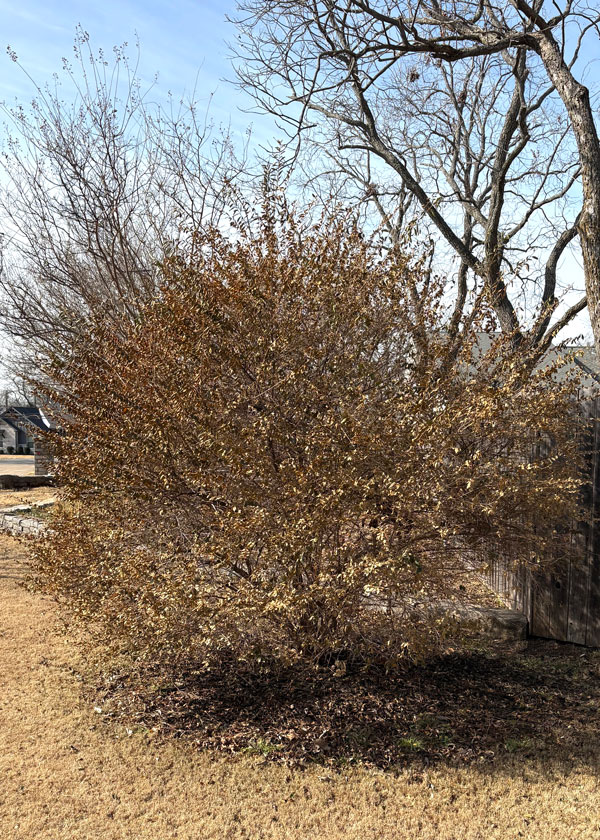
Answer: The cold really did take care of the green foliage, didn’t it! You should be able to reduce their overall size by 30 to 40 percent, but do so with lopping shears rather than hedge trimmers. You want to remove one branch at a time so that you can tailor them back to a natural shape and form. You’ll be able to do this a couple of times over the years, but eventually they’ll develop very large trunks disproportionate to the sizes of their tops. At that point you’ll want to consider replacing them with a more compact species.
QUESTION 2
WHAT COULD SUPPLEMENT MY PAPERWHITES ONCE THEY FINISH BLOOMING?
Question: My paperwhites are beautiful when they’re in full bloom, but then I’m left with a bare flower bed the rest of the year. What would you recommend planting to fill in the bed the remainder of the year? Libby B., Irving.
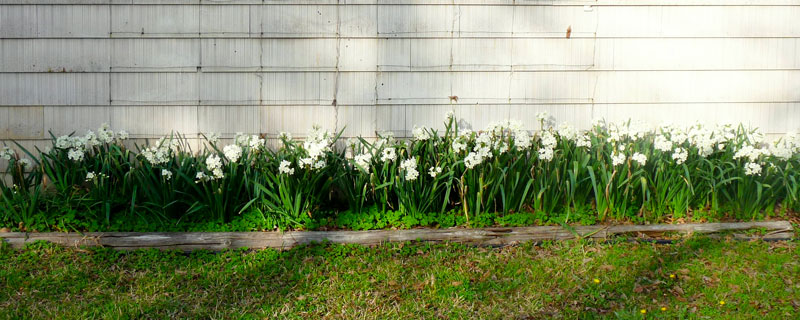
Answer: This is always the problem when we dedicate a bed entirely to one type of perennial plant. Iris enthusiasts, also daylily gardeners are famous for doing this, and when their plants have finished for the season their gardens can look really bleak. It’s always best to have a bed that’s wide enough to allow groupings and clusters of several different types of perennials mixed in with smaller types of evergreen shrubs so that flowering can be staggered over the entire growing season. In your case you’ll probably be best served by waiting until the paperwhites’ foliage dies to the ground, then to plant some type of low-growing annual to take over the balance of the season. I’m assuming this to be a part-sun setting, so you might consider pots of bronze wax begonias or sun-tolerant coleus for fall.
QUESTION 3
WHAT ABOUT WOUNDS WHERE COMPANIES REMOVE BRANCHES HIGH IN TREES AND DON’T SEAL THE WOUNDS?
Question: You highly recommend sealing the area from where branches are removed, but what about when the electric company or hired tree trimmers cut the branches high up in trees? I’m concerned because I know they don’t seal the branches they remove. Pam K., Wise County.
Answer: Be careful how you quote me. The only time pruning sealant is needed on trees is with oaks. That’s especially true when oaks are pruned in areas where oak wilt is known to be active. Or when oaks are pruned during seasons of active wilt transmission (mid-February through mid-July). If you still have concerns after you read that, I’d recommend talking to the people doing the actual pruning. Hopefully they are certified arborists. Do remember that a utility company’s responsibility is not for the perfect and proper pruning of our trees, especially those we have carelessly allowed to germinate and grow beneath power lines (hackberries, mulberries, etc.). Their responsibility is to do the best job possible of keeping power available to all of us who contract with them to do so. Conversely, we don’t expect certified arborists to keep our power on.
QUESTION 4
WOULD FERTILIZER HELP MY LITTLE GEM MAGNOLIAS THICKEN UP?
Question: We planted a row of Little Gem magnolias several years ago. They grew quickly (one to the point that the top 2 ft. fell over). Now they are sparse. Should I be fertilizing them? If so, what type of fertilizer and how often? Sandy T., Tyler.

Answer: This kind of thinning looks more like shade was the culprit more than a shortage of nutrients. To answer your question, however, I would suggest a high-nitrogen fertilizer similar to what you would use on your turfgrass. Be sure it has no weedkiller included in it. Feed them as new growth begins in March/April, and again in early June, probably again as rains return in September.
I’m more concerned, however, about the impact of the shading from the large pines overhead and maybe those trees behind the magnolias. I can’t judge how far back they are. You might be well off to do a little careful pruning to even up the heights and shapes of the magnolias. Remove the growth around their bases, whether that’s their own low branching or perhaps unwanted grasses, and then start your feeding program. Be mindful of watering them during prolonged summer dry spells as well. I hope they’re getting enough sunlight to fill in for you.