
Hide-and-seek succulents
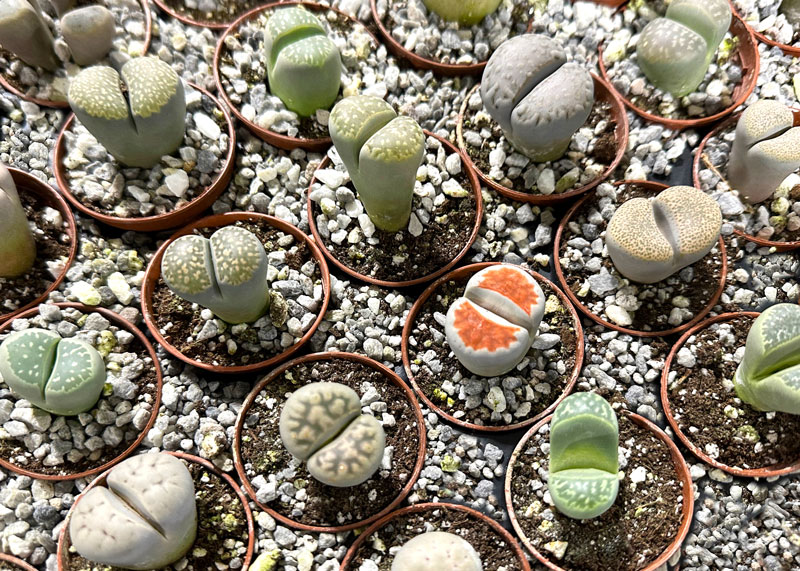
I’m going to tell you everything I know about growing Lithops and their sister succulents in the next several paragraphs. It won’t take me long.
I’ll begin with a tip of my old baseball cap back to sculptor-turned-grower the late Ed Storms of Fort Worth. I’d gone out to his greenhouse in the early 1970s with my photographer from the Dallas Morning News as I wrote a story on him and his plants. He had been commissioned to sculpt these “living stones” into a piece of art some years earlier and he fell in love with them.
Soon he found himself growing and selling them. He became a regional authority as it were. His self-published book on their culture Growing the Mesembs (a shorthanded name for this whole category of plants) is still out there on the resale market occasionally.
There in Mr. Storms’ collection I saw more living stones than I’d seen in all my life. Hundreds. Maybe thousands. Fact is, I’m not sure I’d ever seen any in real life at that point. I was smitten.
I bought a few and I tried growing them like I’d grow any other plant. That didn’t go well. These plants grow in rocky soils where mists off nearby waters are sometimes their only means of “irrigation.” These babies don’t like wet bottoms. Mine lasted a couple of weeks. (I never told Mr. Storms.)
The fact is, these plants only have one pair of thick, fleshy leaves at a time. Those leaves last them a year. There’s a slit between the two leaves, and it’s through that slit (we’ll call it a “split” in the rocks) that new leaves form and flowers are produced.
The tops of the leaves are translucent, like a foggy window. Light enters the tops of the leaves and is transmitted to tissues within which photosynthesis occurs.
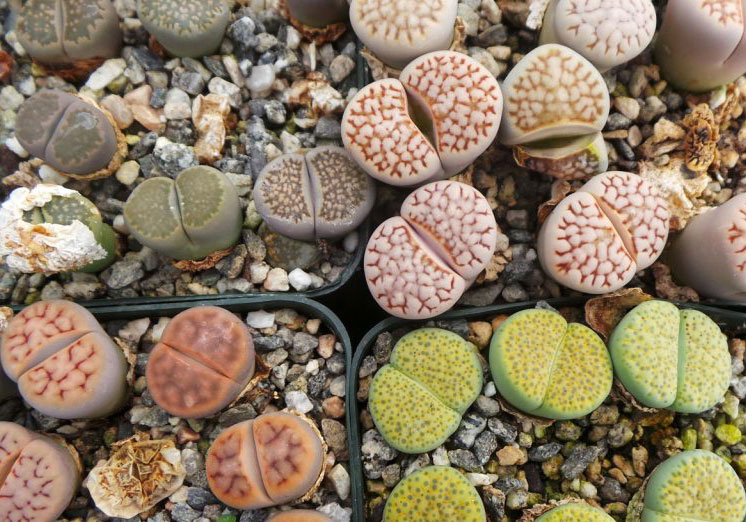
The tops of the leaves are marked with various colors and shadings, almost like a precursor to AI imagery. In reality, those markings are the plants’ camouflage in their own local environments. They mimic the stones among which the plants grow. Hence the reference to these plants as being “mimicry” plants.
The flowers are rather showy, loosely resembling daisies. They require cross-pollination from other Lithops nearby. The fruit is a dry capsule that opens and distributes its seeds onto the ground over a period of time. Seed propagation is the most common way new plants are started. Seed is available from specialists online.
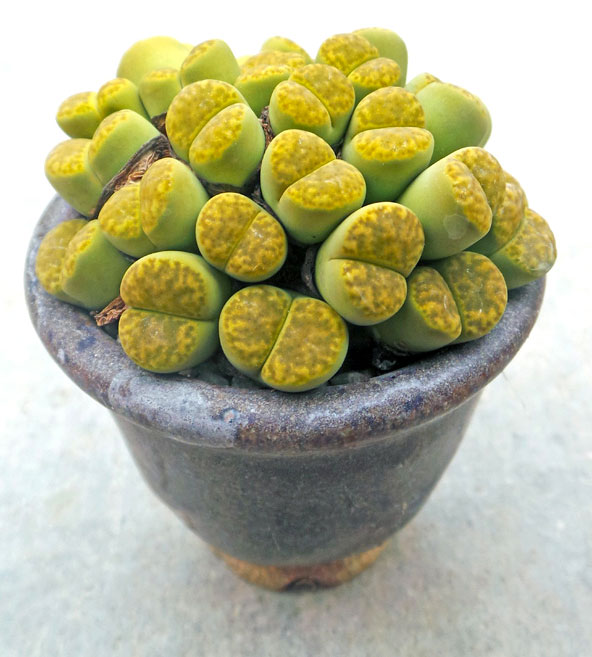
Now to my care tips on growing Lithops…
I said I’d be quick.
• Grow them in pots.
• Fill the pots with a cactus planting mix, but modify it with additional expanded shale or small aquarium gravel to ensure very rapid drainage.
• Put a layer of fine gravel on top of the planting mix so the tops of the plants will not be in contact with moist soil.
• Give them bright light, but no direct sun in the summer.
• Let them have a dry rest in the winter. The new leaves will draw moisture from the old leaves. During that time water ¼-in. deep into the soil – just enough to keep the root hairs alive.
• As the old leaves dry up in the spring, water slightly more, but do not get the root ball soaking wet.
• Over the summer the plants will stop growing. Go back to watering only ¼-in. deep.
• As flower buds appear later in summer and fall, begin the process again.
It’s been my observation and personal experience that 95 percent of the losses of Lithops come from improper (and excessive) watering.
And a personal suggestion would be that you find a few plants at one of the better local nurseries in your town to see how you and they match up. You’ll find them all over the Internet, but at least for starters, I’d let the learning curve start with plants you buy down the street.
These are fun plants with a great story to tell, but like so many of our best friends, they bring a lot of issues to the party.
Good luck, and happy gardening!
Want to learn more? See this informative piece from the Extension Horticulturists at the University of Wisconsin, where knowledge of tropical plants apparently abounds!