
Q&A – Ask Neil: February 19, 2026
(Please read these instructions carefully.)
Before you post your question, please look at recent issues to see if someone else has already asked it. You might find your answer there.
HOW TO SUBMIT YOUR QUESTION…
-• Click here to post your question. (Please post your question only one time.)
-• Please use this link only for posting questions – not for standard e-mails.
-• High-resolution photos (1-2MB – not thumbnails) attached with your question help Neil give you the best possible answer. Please check your photo for clarity and exposure. If you do not see “All images clickable for larger views,” your images’ resolution was not sufficient for enlargement. That might also have made it difficult for Neil to give you an accurate answer.
-• Neil chooses questions of greatest reader interest. Plant IDs rarely fit that description.
-• Neil requires your first name or initials, also your city or county for an accurate answer. (Texas is a very large state.)
-• One question per reader per week, please.
-• Watch for Neil’s reply in the next issue of e-gardens.
Note: If you have submitted your question and did not see the pop-up window for attaching your photo, please click here.
QUESTION 1
WHERE CAN I FIND UNUSUAL PLANTS?
Question: Where can I find unusual plants in a large urban area? Most nurseries around here sell the same 8 or 10 plants, and I don’t want my landscape to look identical to all the neighbors. James H., Plano.
Answer: You have the advantage of living in one of the largest metropolitan areas in America. Shop at local, independent retail garden centers where you can talk to the owners, managers, and buyers. You’ll find specialty shops that offer native plants, perennials, water garden plants, shade-loving plants, xeriphytic plants (be careful with this one, because there are times that your area is very wet), and other plants that would fall far outside the limited range of your “8 or 10 plants.”
Remember, too, that a big part of setting your landscape apart is in creative landscape design. However, you also want to blend in so you can be a team player in your neighborhood. Elevate what others do by staying within the overall feeling of what the community has adopted as its personality. Just do it much better.
QUESTION 2
HOW DO I PRUNE THIS UNKNOWN PLANT?
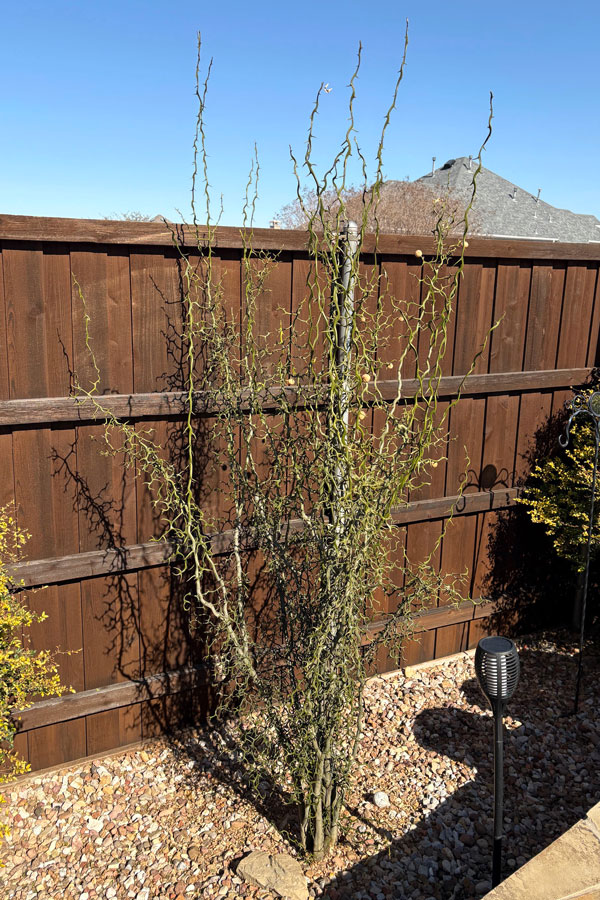
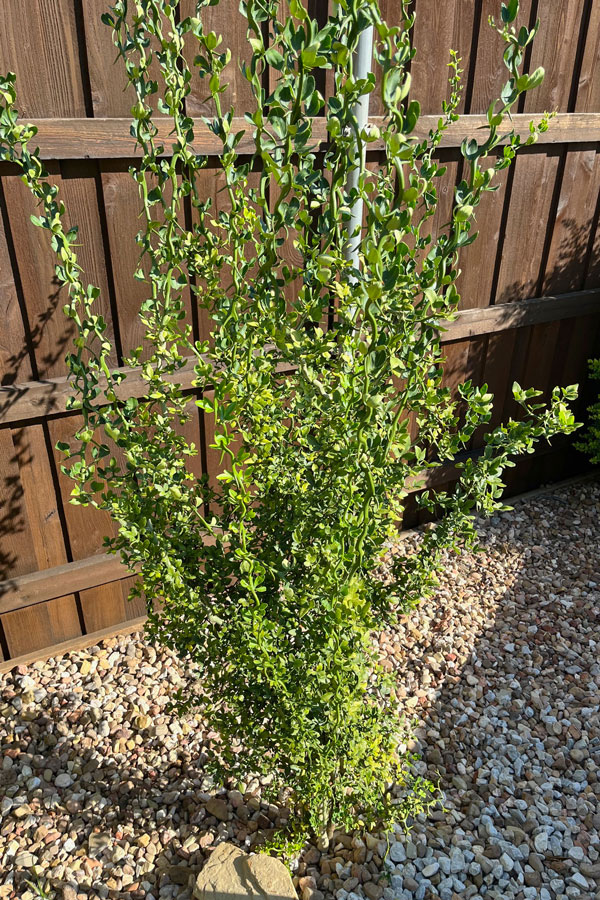
Question: I have been unable to identify this shrub/tree that was planted before I moved into my house two years ago. It has grown more than 6 ft. and has huge thorns and fruit pods on it. I’d like to prune it, but I’m struggling to determine what shape. Lisa I., Lewisville.
Images clickable for larger views.
Answer: You have trifoliate orange, also called Japanese bitter orange (Citrus trifoliata or Poncirus trifoliata). In fact, you might have the ‘Flying Dragon’ cultivar because of its contorted stems.
This is one of the most cold-hardy types of citrus we have. I once saw a planting of it in Quanah, Texas. It’s hardy to -10F.
It is one of the most important rootstocks onto which edible citrus is grafted, notably Meyer lemons, Satsuma mandarins, and kumquats, among others. My bet is that someone planted one of those into the ground without realizing that it would not survive winters in your part of Texas. The edible variety, in my theory, froze to the ground, and this rootstock happily grew back from its roots. If it were mine, I’d leave it in place and enjoy its interesting look in my garden. You can use long-handled loppers to prune it back to a manageable size and shape. It should stay with you for a long while.
QUESTION 3
ARE THESE DUE TO OAK LEAF ITCH MITES?
Question: I was covered in extremely itchy bites after raking oak leaves. The bites itched for days and felt a lot like chiggers (which I’ve never had in my yard). AI says they are Oak Leaf Itch Mites. Do we have those in the Metroplex? Help me get rid of them. Michael J., McKinney.

Answer: AI helped us both get to a quicker answer. I tried Chat GPT and it took me down the same path you had traveled with this as the outcome. I had never heard of this pest even though I also live in Collin County – and in a Shumard red oak forest! I had wondered if you hadn’t been stung and bitten by fire ants, but AI explained why you would have experienced much more immediate pain when they attacked. Like chiggers, the Oak Leaf Itch Mites’ itches show up sometime later.
So, I went to the Internet and searched the TAMU website. They’ve been asked about them, too. Here is a short essay they put online a decade ago. All of its information is still completely useful.
QUESTION 4
DO BIRDS OF PARADISE REQUIRE PRUNING?
Question: Do birds of paradise require pruning? I have two that have grown into large shrubs, but they have very few blooms. When we lived in Franklin County they died back to the ground every year, but they had a lot more blooms. Jim I., Chandler, Henderson County.
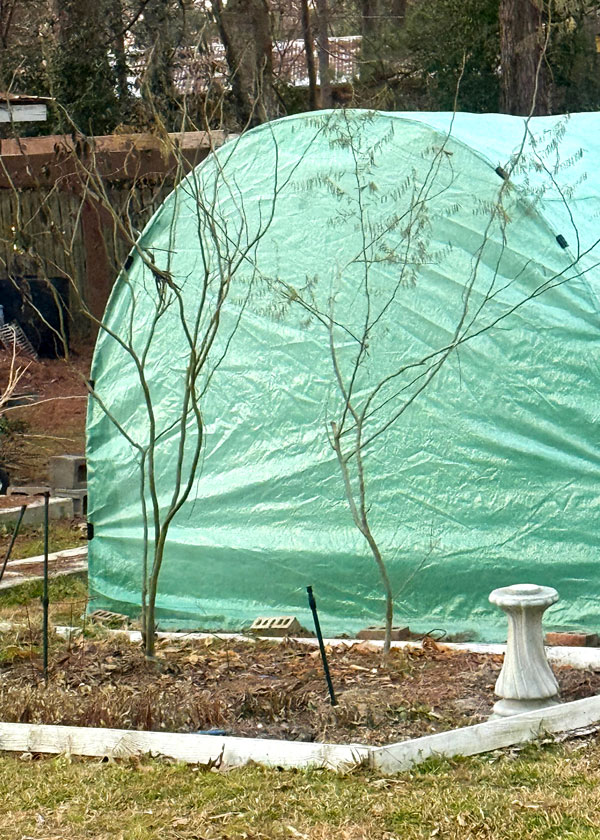
Answer: It looks like your plants probably will need to be cut back to the ground after this winter’s cold spell of 3-4 weeks ago. However, I would suspect there could be a difference in the amount of sunlight these plants get from where your plants in Franklin County (a bit farther north) were getting. That could result in plants that grew taller and lankier with far fewer flowers. These plants do best in full, hot summer sun. With your tall pines it appears that they might not be getting that.
QUESTION 5
HOW CAN I HAVE COLORFUL ANNUALS AND DISCOURAGE THE SQUIRRELS?
Question: I love colorful annuals in my window boxes, but I can’t seem to keep the squirrels out. I surround the boxes with chicken wire, but I have even seen squirrels enter from above by falling from the roof. I’ve tried coffee grounds with no luck. Any ideas? Carol W., McKinney.
Answer: They are probably digging in the window boxes’ planting soil to hide acorns and pecans, so consider covering it with landscape fabric drawn taut to the corners. It might discourage their pawing around.
I actually think chicken wire would be better, but you would have to be careful not to scratch yourself with the ends of the rusting wire. Cut holes in the chicken wire just large enough that you could plant the annuals through them. After that you would be able to water and fertilize the plants for the entire growing season until it became time to replace them.
Carrying that one step farther, maybe you could plant your annuals in pots that would barely fit within the size of the window boxes. Then fit the chicken wire over the pots as you set the pots within the boxes. Fill the gaps between the pots with bark mulch to conceal it all. Water and feed the pots individually. The squirrels wouldn’t be able to dig into the pots, and they wouldn’t have much reason to dig in the mulch, so in my perfect world they would become discouraged and move on.
That’s the best I can do in outthinking the squirrels.
A note regarding why we have fewer questions this week…
Please don’t use this as a means of sending me general e-mails. Because of the volume of questions that come into this part of e-gardens, I had to resort to a counter of sorts to limit the numbers. When that total is reached, it shuts things down for others with regular gardening questions. Thanks!