
Q&A – Ask Neil: February 26, 2026
(Please read these instructions carefully.)
Before you post your question, please look at recent issues to see if someone else has already asked it. You might find your answer there.
HOW TO SUBMIT YOUR QUESTION…
• Click here to post your question. (Please post your question only one time.)
• Please use this link only for posting questions – not for standard e-mails.
• High-resolution photos (1-2MB – not thumbnails) attached with your question help Neil give you the best possible answer. Please check your photo for clarity and exposure. If you do not see “All images clickable for larger views,” your images’ resolution was not sufficient for enlargement. That might also have made it difficult for Neil to give you an accurate answer.
• Neil chooses questions of greatest reader interest. Plant IDs rarely fit that description.
• Neil requires your first name or initials, also your city or county for an accurate answer. (Texas is a very large state.)
• One question per reader per week, please.
• Watch for Neil’s reply in the next issue of e-gardens.
Note: If you have submitted your question and did not see the pop-up window for attaching your photo, please click here.
QUESTION 1
SO, SHOULD I PRUNE NEWLY TRANSPLANTED TREES AND SHRUBS, OR NOT?
Question: I’m confused. My Master Gardener friends say when transplanting not to prune for a full year so as not to double stress the plant. You say to prune to compensate for root loss during transplanting. Help! Teresa W., Argyle.
Answer: I’ve contemplated how I want to reply. I’ll keep it very brief. Master Gardeners come from all fields. They may be CPAs, sales reps, teachers, or government employees. They can be anything. They love gardening, and they have a desire to share that love with fellow Texans. They agree to take 70 hours of classroom instruction to qualify to be Master Gardeners, plus volunteer hours, plus a certain number of continuing education hours (for example, 10 per year) to maintain their MG status. My opinions, right or wrong, are based on two college degrees in horticulture and 60 years of full-time employment in horticulture plus a lifetime of personal experiences.
It’s my feeling in this specific case that you can’t ask a bare-rooted or balled-and-burlapped tree or large shrub to endure the torture of its first Texas summer operating on, let’s say, 40 or 50 percent of the roots it had before it was dug unless you remove some of the top growth that cries out for water. That might work with a few species and in some parts of America where summer weather is more forgiving, but I couldn’t sleep with a clear conscience if I recommended that here in Texas.
I do not want that to come off sounding like a know-it-all. There are much smarter horticulturists in this world than I, but in this case, I feel quite strongly about this opinion.
However, give it a try both ways. I’d be anxious to know how it works.
QUESTION 2
IS A PRODUCT CONTAINING 2,4-D SAFE ON ST. AUGUSTINE?
Question: Is a broadleafed weedkiller (containing 2,4-D) safe to use on St. Augustine? I get mixed answers when I Google the question, ranging from “safe” to “no.” Does it come down to the individual product? Greg C., Fort Worth.
Answer: With any weedkiller you must read and follow each product’s label directions. Some will even say, “Safe on St. Augustine.” Of course, “safe” is a relative term. You must still use them with caution. I have used many brands of 2,4-D products on my own St. Augustine turf without ever causing problems. Here are my specific suggestions:
Use only during cooler months (March and April, certainly not after mid-May and through the summer and early fall). Damage is much more likely when daytime temperatures exceed 85F. The labels will tell you that.
Apply with a tank sprayer, not a hose-end sprayer. You can be much more precise with the tank sprayer, plus you can adjust the nozzle to a finer mist. In both cases you will be applying far less of the actual herbicide.
Spot-treat whenever possible. There is no point in broadcasting the weedkiller over the entire lawn if your weeds are more localized.
Apply only to actively growing weeds. Do not mow for several days before or after you treat. That will allow the herbicide to be taken into the leaves. Do not apply prior to rains.
Keep your St. Augustine healthy and vigorous. It will crowd out most weeds if given good care.
QUESTION 3
HOW CAN I DISCOURAGE SQUIRRELS FROM RUINING MY PEACHES?
Question: I have a mature peach tree adjacent to my house. Last year the squirrels discovered it, and over a period of a couple of months literally devoured every single peach on the tree. What will discourage the squirrels from eating all my peaches? Maurice C., Arlington.
Answer: Few questions could be any more difficult. You must determine how the squirrels are getting onto and into your tree and you must cut off the route(s). If the tree is adjacent to the house, it may be touching the house (or close enough that a squirrel could jump). Selective pruning could help. You might be able to put a sheet metal collar around the trunk during the time that you have fruit on the tree. You’d want to have it in place loosely so that it didn’t bind the growth of the trunk. It must never be wired in place. If there are any utility wires that go through the tree, they’ll be avenues of transit so you’ll need to deal with them, and if any adjacent trees are close enough that the squirrels could jump, that could be the way they’re getting in. I’m sorry I don’t have a magic spray that would help you. Plus, it’s illegal to do anything that would hurt them.
QUESTION 4
WHERE CAN I FIND DIMENSION, HALTS, OR BALAN PRE-EMERGENT WEEDKILLERS?
Question: This should be a simple question. Each year I see your posts about pre-emergent weedkillers, but when I go to stores to find them (numerous places) I never find the names Dimension, Halts, or Balan. I feel like I may be buying knockoffs. Where do I go? Jana M., Chandler.
Answer: In a broad sweep reply, Dimension is available most widely in independent retail garden centers and hardware stores. We have an advertiser here in e-gardens that sells it all across Texas. Halts is at the national chain stores, and Balan is often found in farm supply stores. Ask for a Texas Certified Nursery Professional or use the “find a dealer” link in our sponsor’s ad.
QUESTION 5
HOW CAN I ELIMINATE THIS MOLD?
Question: My flowerbed on the west side of my house is covered with mold of some sort. It is covering all the plants and any yard art in the bed, along with wind chimes hanging from a large oak tree above the bed. What advice can you give me? Margaret P., Livingston.
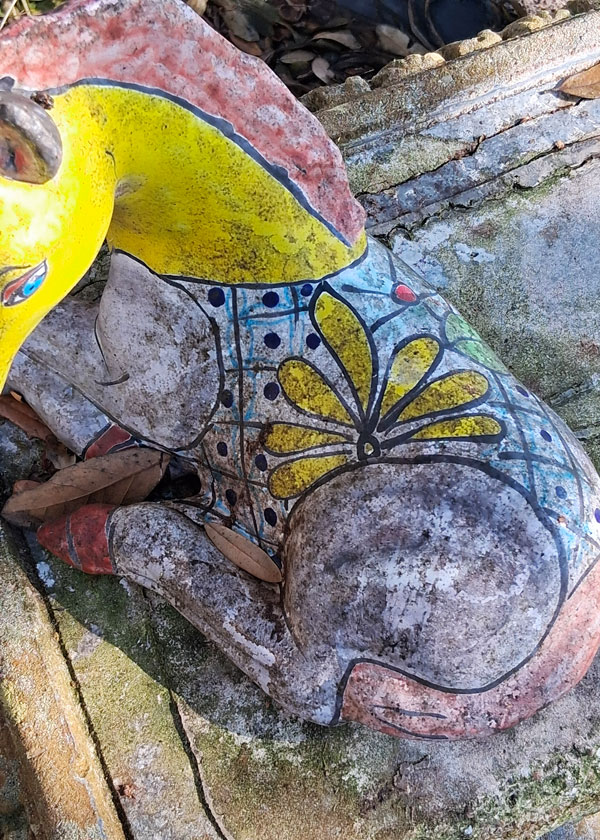
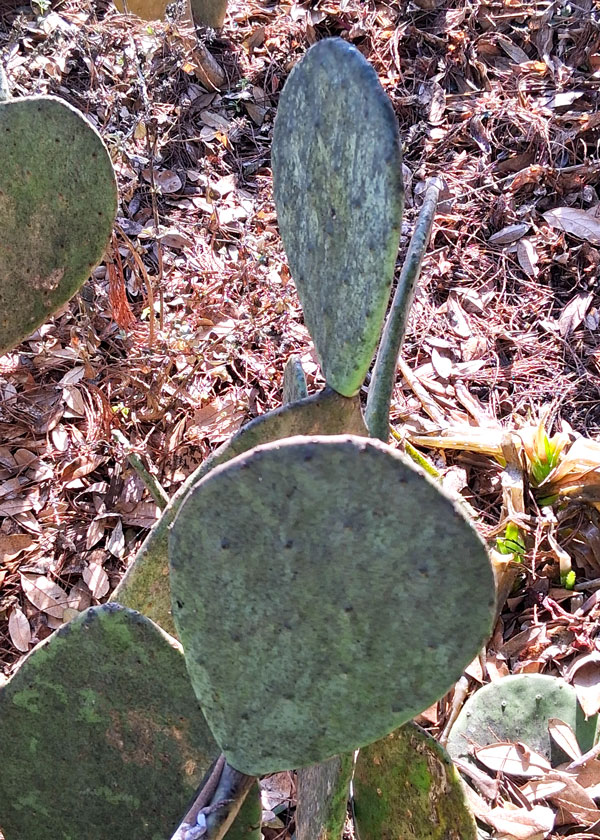
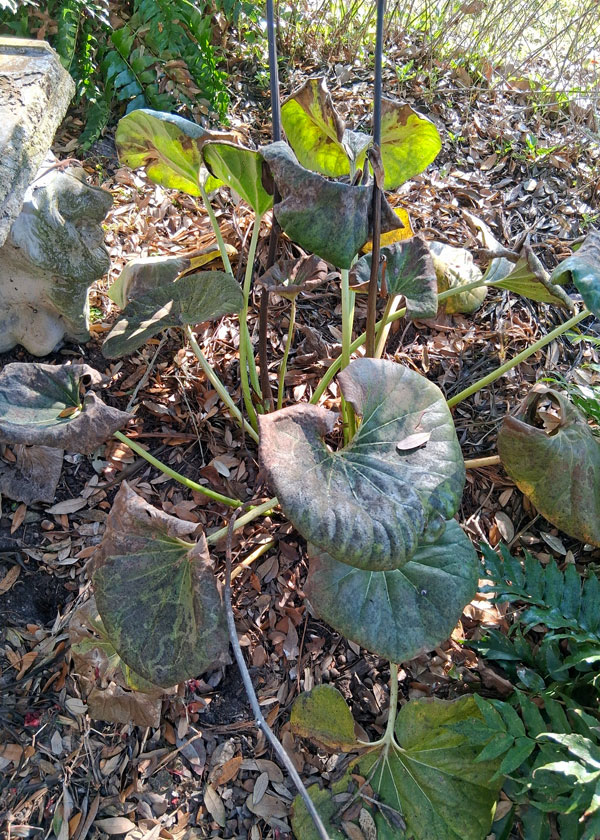
Images clickable for larger view.
Answer: This black mold is left over from last summer and fall. It’s called sooty mold, and it grows in the sticky honeydew excrement of aphids in the oak tree. You may recall seeing tiny mist-like droplets falling from the tree against the early or late day sun. That would be the honeydew, and it will accumulate on all surfaces below. Pecan aphids also bless us with it, and a large pecan over our driveway yields so much honeydew that we park our car up the hill for a couple of months late each summer to avoid it.
As for eliminating the aphids, you would either have to use a systemic insecticide in late spring or have the tree sprayed with a power sprayer able to reach clear to the top of it. Either would come at a good bit of expense. Some years will be worse than others. You can wash it off hard surfaces with a power washer and soap, and new growth will replace the “moldy” leaves on your plants. It’s mostly annoying and not especially damaging, but it certainly does ruin the looks of the landscape. I wish there were a simpler answer for both of us.
QUESTION 6
WHAT DO I NEED TO DO TO HELP MY CAST IRON PLANTS?
Question: My cast iron plants took a hit in the recent freeze. Is there anything I should do to make sure they continue to grow? Susie S., Abilene.
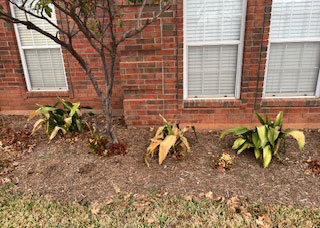
Answer: Trim off all the damaged leaves. They will put out new leaves this spring and summer, but they will be painfully slow. In future winters, have frost cloth on hand so you can cover them completely when temperatures are expected to drop below 22-24F. I have a lot of cast iron plants myself, and I’m speaking as the voice of experience. I learned the hard way 30 years ago. I lost all the top growth on mine that first winter and have not lost them since.
QUESTION 7
WHAT WOULD LOOK GOOD IN THE CORNERS?
Question: A landscaper installed our new landscape a couple of years ago. The picture is facing west, so it gets full sun in the winter while the oak is bare, but it’s total shade during the summer. He planted hydrangeas, but during the winter they haven’t done well and it’s so bare looking. What would you suggest so we can have something evergreen about the height of the fence?
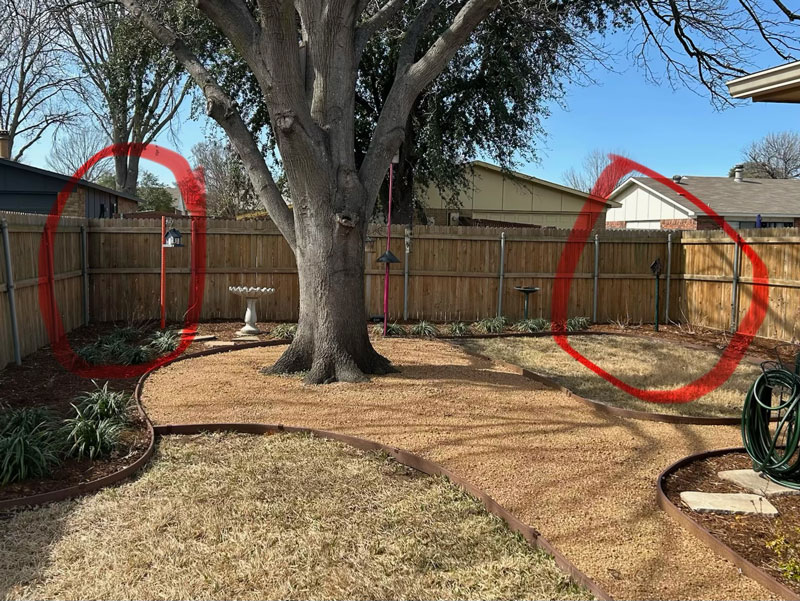
Answer: Hollies are, hands down, your ideal solution. They do well in both sun and heavy shade. My own personal choice would be Willowleaf holly. It grows to 8-9 ft. tall, but it can be kept at 7-8 ft. with infrequent training (not shearing). If that’s too tall you could use dwarf Burford holly, but it would be slow to grow to 6 ft. tall. You would want to spring for large specimens (20- or 40-gal. size) for their immediate impact. Nellie R. Stevens hollies would grow too large. Tree-form yaupon holly would make a nice specimen plant in one corner or the other for variety. If he didn’t use oakleaf hydrangea, that would be a nice choice, although it is deciduous. It blooms white in mid- to late spring. It has huge leaves that are attractive. Leatherleaf mahonias would be pretty if you want something different but stay with that species and not any of the other mahonias. Leatherleafs are great in the shade and winter sun won’t hurt them.
QUESTION 8
WHY WOULD MY MAYPOP PASSIONVINES BLOOM WELL BUT NOT SET FRUIT?
Question: I have a big planting of passionvines in the sandy soil. They flower well, but I don’t get any of the fruit. What can I do to improve my success? Scott, North Padre Island near Corpus Christi.
Scott called my statewide radio program last Saturday. I told him I needed to do more homework in order to give him a better answer. I told him his answer would be waiting here. This also allows anyone who was listening a chance to see what I have found.
Answer: Maypops are Passiflora incarnata, and they are native to Texas. In most cases they are self-fertile meaning they do not require a second plant to ensure good pollination.
I did a good bit of research on why you might not be getting that good fruit set on the island, and all my sources came back with similar suggestions.
• Although they are self-fertile, passionvine flowers require rather large bees to transport the pollen. Carpenter bees and bumblebees are most commonly the heroes. You need to watch for strong bee activity when the flowers are open and the pollen is exposed.
• High humidity can damage the quality of the pollen.
• Strong Gulf breezes can make it even more difficult for the bees to transport the pollen.
• Because of the high temperatures from mid-spring into the fall, flowers may open and close in relatively short order.
• Look closely to see if there is pollen on the stigmas (female parts of the flowers.) That would indicate that the bees have done their jobs.
• If the pollen has not be transferred successfully, you can try hand pollination with a small brush in early morning as soon as the pollen is exposed.
• Planting a second plant nearby might also help if there is any chance of poor cross pollination.