
Q&A – Ask Neil: March 12, 2026
(Please read these instructions carefully.)
Before you post your question, please look at recent issues to see if someone else has already asked it. You might find your answer there.
HOW TO SUBMIT YOUR QUESTION…
• Click here to post your question. (Please post your question only one time.)
• Please use this link only for posting questions – not for standard e-mails.
• High-resolution photos (1-2MB – not thumbnails) attached with your question help Neil give you the best possible answer. Please check your photo for clarity and exposure. If you do not see “All images clickable for larger views,” your images’ resolution was not sufficient for enlargement. That might also have made it difficult for Neil to give you an accurate answer.
• Neil chooses questions of greatest reader interest. Plant IDs rarely fit that description.
• Neil requires your first name or initials, also your city or county for an accurate answer. (Texas is a very large state.)
• One question per reader per week, please.
• Watch for Neil’s reply in the next issue of e-gardens.
Note: If you have submitted your question and did not see the pop-up window for attaching your photo, please click here.
QUESTION 1
WHAT IS CAUSING THE BROWN SPOTS ON THE LEAVES OF MY NELLIE R. STEVENS HOLLY?
Question: Here are the front and back of a leaf from my male Nellie R. Stevens holly planted in July 2025. I have looked at the top and bottom leaf surfaces and I see no creatures. Is this need for fertilizer or stress from the planting? Jim P., Fort Worth.
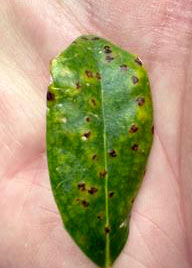
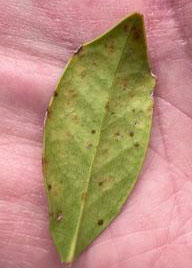
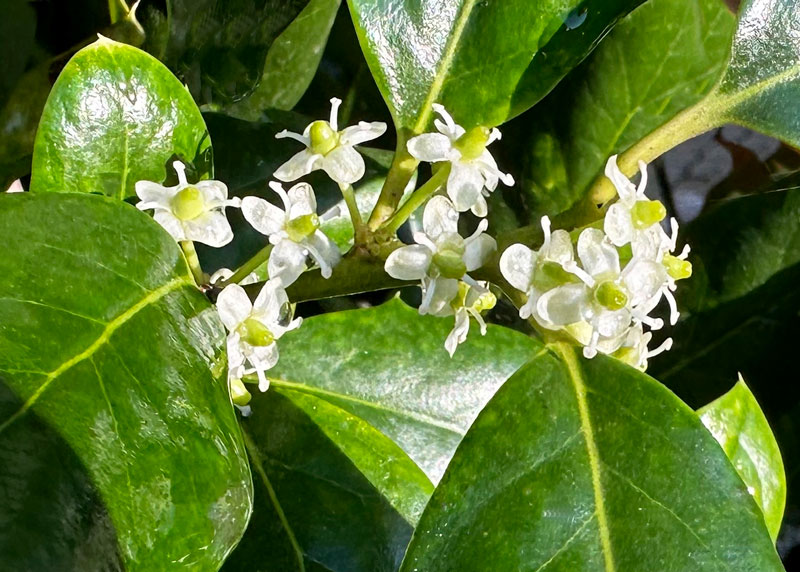
Answer: First, all Nellie R. Stevens hollies have both male and female flower parts in the same flowers, so every plant will be able to produce fruit if there are bees available to do the pollinating. I took a close-up photo of one of my plant’s clusters of blooms earlier this week. You can see both the male and female flower parts in each small blossom.
My bet would be that these are prickle marks caused by the points on the leaves punching against the leaves. It doesn’t matter much because the new growth that replaces these leaves will be free of this problem. These old leaves will start falling within 2-4 weeks. You have no call to action other than normal feeding with a high-nitrogen, lawn-style food and regular deep waterings. It will look fine in a couple of months. Just keep watering it by hand all this growing season until it develops a root system well into the surrounding soils.
QUESTION 2
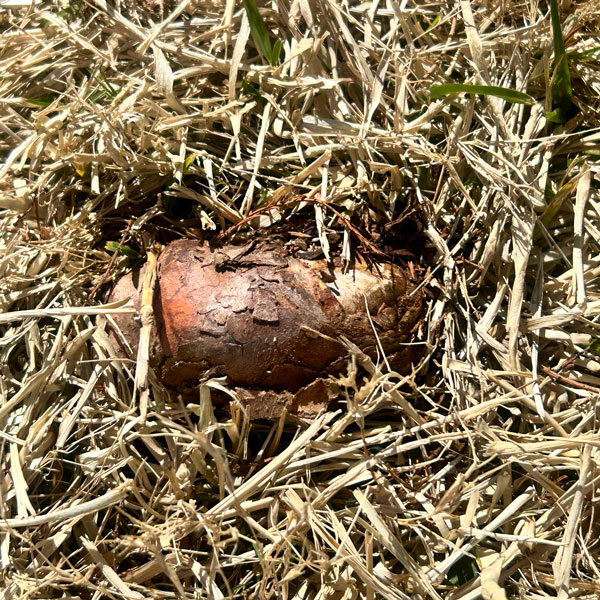
HOW CAN I REMOVE THESE DEVELOPING “KNEES” ON MY CYPRESS TREES?
Question: I have two bald cypress trees that have a few root knees coming up out of the ground. I trip on them, and I fear that they will damage my mower. Is there a way to shave them down so they won’t be a further issue without hurting the tree?
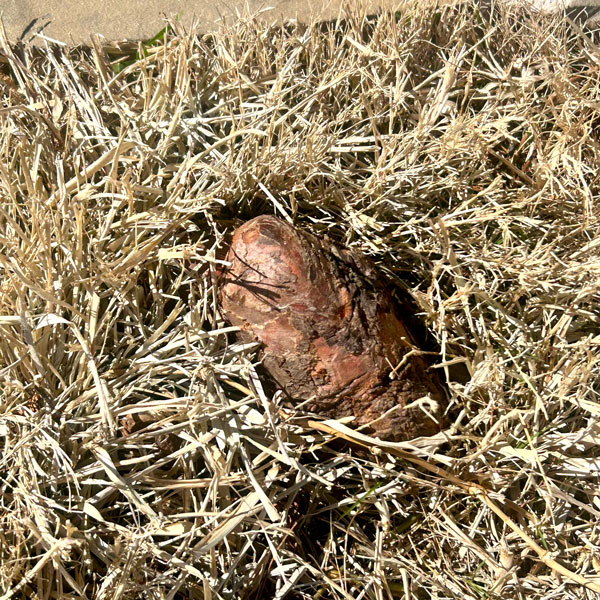
Images clickable for larger views.
Answer: Use a long-handled axe to chop them out. You’ll probably need a sharpshooter spade to expose them fully before you go after them with the axe. Do not put a chainsaw into the soil. Soil particles and small pebbles would dull its blade instantly.
QUESTION 3
WHAT SHRUB OR VINE COULD I PLANT IN FRONT OF THIS RETAINING WALL?
Question: I bought a house with a front yard that slopes down to the house. In front of the house, they built a 3-ft.-high concrete bag retaining wall running the length of the house. What would be a good vine or shrub to plant in front of the wall? It is very shady. Jimmy F., Burleson.
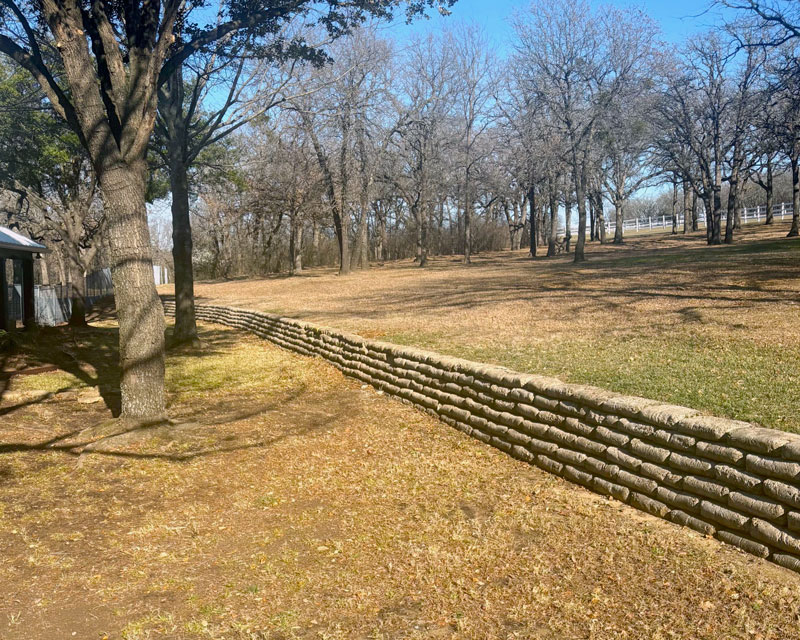
Answer: They did a nice job of lining it all up. However, it also looks like there isn’t much lawngrass toward the bottom of your photo, so you might also want to consider developing a patio in the lower left area if that would be appropriate. My goal would be to break up the long, linear nature of the wall, the fence up the hill, the house, etc.
As for the best low shrubs for shade, they’re definitely going to be the dwarf hollies such as dwarf yaupon, Carissa, dwarf Chinese, and dwarf Burford. All are evergreen. The last three have larger leaves that would show up well against the concrete and the large hillside. Dwarf yaupons have no spines, but they have tiny leaves that might be too fine textured to use near the wall. I would definitely develop a long, curved bed of liriope. Choose a green variety (not variegated), and go for one with large and wide leaves for the boldest look. English ivy is a popular groundcover in shaded beds such as you have up under the trees. I’ve used a lot of purple wintercreeper euonymus in beds that are in both sun and shade.
I would encourage you to choose four or five types of plants that you like and then work with a landscape designer to plan a simple and tasteful project for this lower area. It could be really pretty.
QUESTION 4
WHEN DO LANTANAS SEND UP NEW SPROUTS?
Question: When do perennial lantanas begin to green up in spring? Mine looks pretty dead now, but I don’t want to give up on it too soon. Debra B., Cleburne.
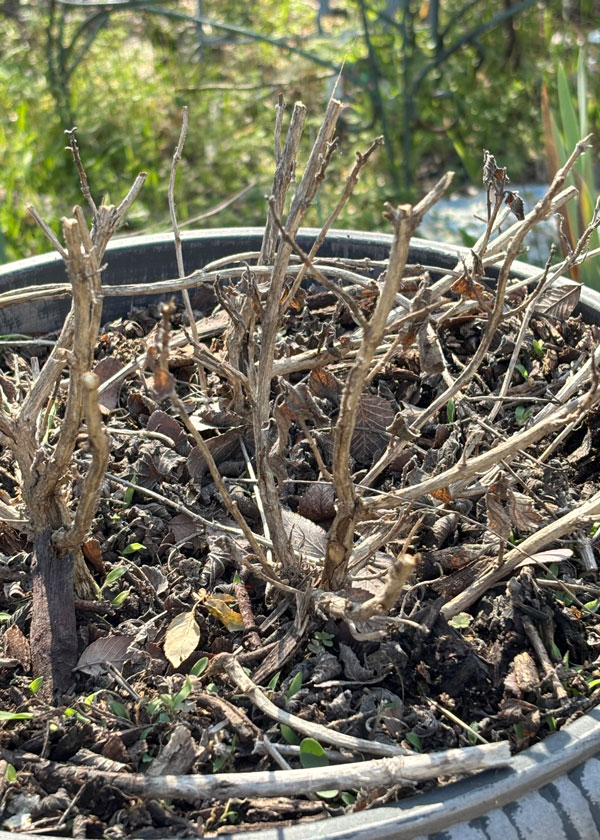
Answer: Lantanas are some of the last perennials to send out their new shoots in the spring. You will know by the end of this month in Cleburne. I will warn you that chances are much lower when we have them in pots. Their root systems are exposed to freezing temperatures and that’s not good. They’re more likely to survive when planted into the ground. Shrubby types are more durable to cold than the trailing types. Least winter-hardy are the trailing lavender and its white counterpart. Be patient and you’ll know pretty soon. (Hopefully you cut the stalks back soon after the first freeze last fall. It may just be my long-held assumption, but it seems like doing that and covering the clumps of stumps with compost improves odds of their survival.
QUESTION 5
IS THERE ANY WAY TO PREVENT OR ELIMINATE THE SEED PODS ON REDBUDS?
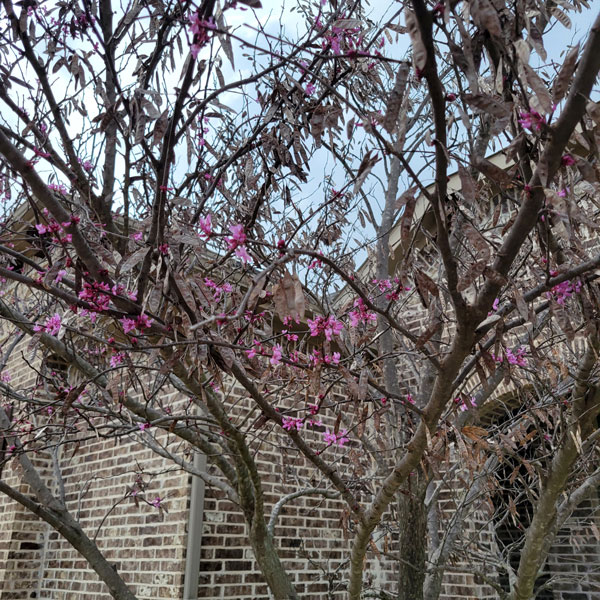
Question: I’m not loving these pods on my redbud tree. Do you have an easy way for removing them or do I just have to learn to live with them? Also, what are those hanging “cones?” Marylu L., Midlothian.
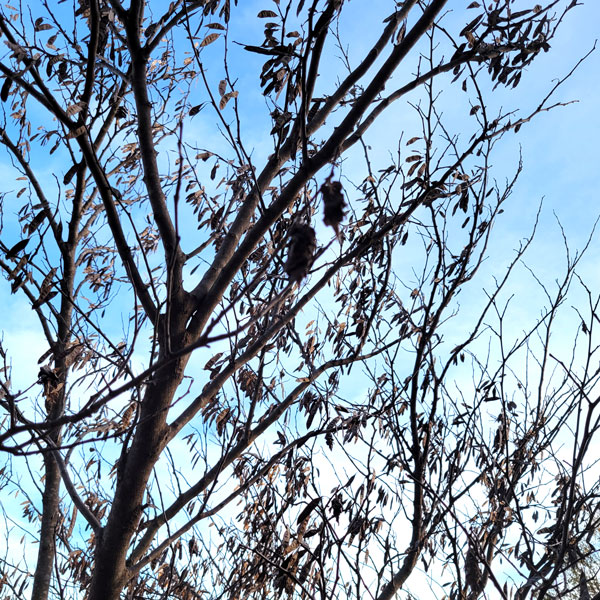
Images clickable for larger views.
Answer: I guess the seed pods would be the downside of having beautiful redbuds in your landscape. They’re just the reproductive benefit of having a legume in your life. Unfortunately, short of plucking them off or scraping them down with a stick there is no way of getting them down without just waiting. I’m not sure that either of those physical ways would work anyway, or that you might not be damaging your tree in the process.
The insect “cones” appear to be bags from wayward bagworms, much more commonly found on conifers such as junipers and cypresses. No big issue there. They could be nipped off with pruning tools. (As my final addition to this week’s e-gardens I will say that I certainly hope those aren’t some kind of hornet nests. Yikes! I just can’t see them very well. Just be careful.)