
I came across a couple of old friends
Too often we move away from old, time-proven plants to shiny, new types that really haven’t been put under the stresses of Texas conditions. It’s nice to see our old friends pop back up once in a while.
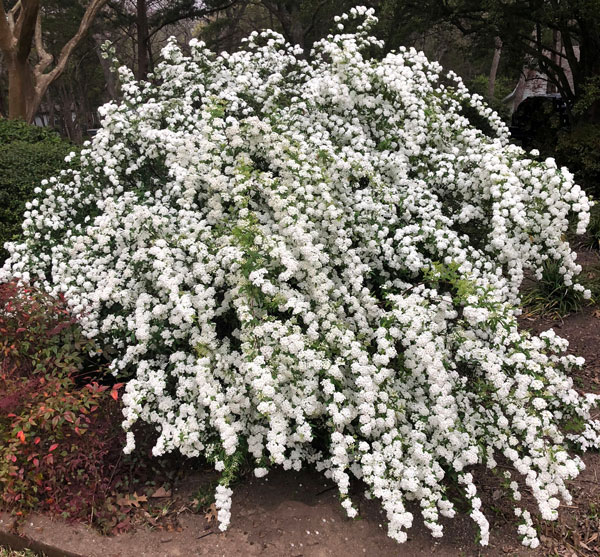
Reeve’s bridal wreath…
It’s hard to imagine a spring-flowering shrub any more pristine than a happy, vigorous bridal wreath. Actually, that’s a name given to cultivars from several different species. This particular one is Spiraea cantoniensis, Reeve’s bridal wreath.
The plant is growing in our landscape, but it’s a bit out of the way and hard for me to access. I caught a glimpse and walked on down to it yesterday afternoon after the rain had passed and the sun was beaming brightly.
It does best in morning sun and afternoon shade, but it can tolerate full sun if it’s not backed up against a hot, reflective wall. It tolerates alkaline soils better than some of the other spiraeas, but like all of them, it will grow best in highly organic soils that are kept uniformly moist.
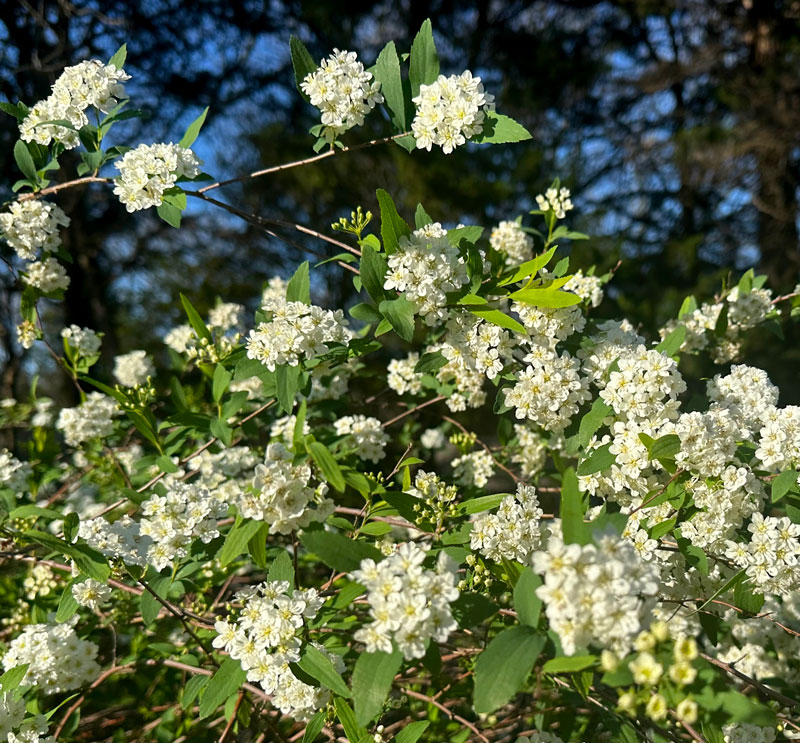
It is deciduous, blooming a week or two before the average date of the last killing freeze. Any pruning you do should be done immediately after it finishes flowering. It’s best to thin out the weak, stubbly growth and not to use hedge trimmers to cut it to one uniform height.
Right after pruning, apply an all-nitrogen fertilizer to it if you have a heavy clay soil or a high-nitrogen food if it’s growing in a sandy loam. In either case, 30 to 40 percent of the nitrogen should be in slow-release form.
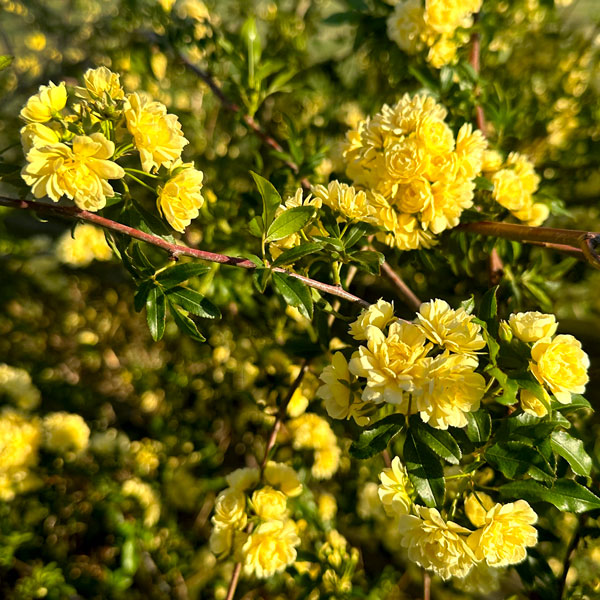
Lady Banksia rose…
Oh, I love this old beauty. However, you don’t see it nearly as often as you did 30 or 40 years ago. A big reason is the fear gardeners have of the terrible rose rosette disease (RRD), a fatal virus for which we still have no prevention or cure.
RRD impacts almost all species and cultivars of roses, and gardeners across Texas and the world have been horrified to watch it attack their prized plantings. Making matters worse, it is spread by a microscopic mite that is carried on the wind. And, once any part of the plant is infected, the entire plant is doomed. You can’t prune it out. The entire plant must be carefully dug and destroyed. You just can’t buy a break with this disease.
Massive amounts of research have been going on to find ways to cope with RRD, from cures to prevention to breeding resistant cultivars. In the process, several thousand different rose types have been tested and evaluated as to their resistance/susceptibility.
In doing my research for this little story I was pleased to see that Lady Banksia scored as “not immune, but highly resistant” to RRD.
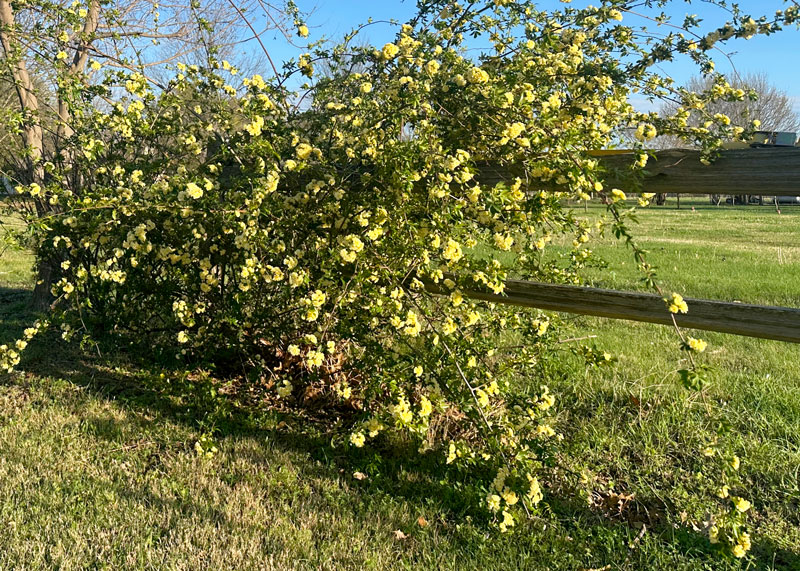
The plant I spotted as Lynn and I headed toward home yesterday was in a rather remote setting. It was clambering across a section of old split rail fencing that was just about on its last post. I noticed an old, weathered strap and buckle. I’m not sure whether the rose is holding the fence up or if the fence is still trying to keep the rose from laying over. They seem to have become best buddies.
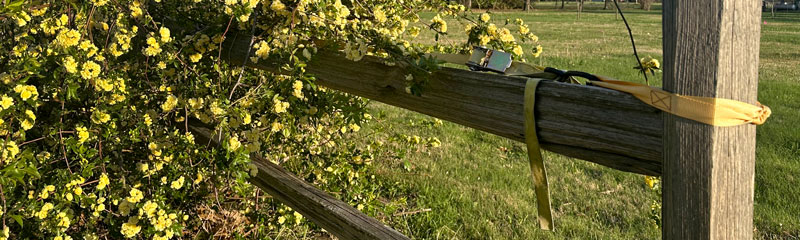
Speaking of “a while,” Lady Banksia was brought to the Western World from China by William Kerr in 1807. He was working for The Royal Botanic Gardens in England, and he shipped living plants back to Kew Gardens. The species was named for Dorothea Lady Banks, wife of famous botanist Joseph Banks.
It made its way to America and became a favored plant of the South. Old specimens reached giant sizes – 15 or 20 ft. tall and 50 ft. wide.
The bonuses with Lady Banksia rose: It’s thornless and it almost never gets black spot or powdery mildew. Plus, that resistance to RRD. That’s huge. It does well in our heat, and it’s tolerant of a wide range of soils.
The down sides with this variety: It only blooms one time in the spring. It is not fragrant in its yellow form, although I’ve loved the sweet fragrance of the less common white type. (Not as winter hardy as the yellow version.)
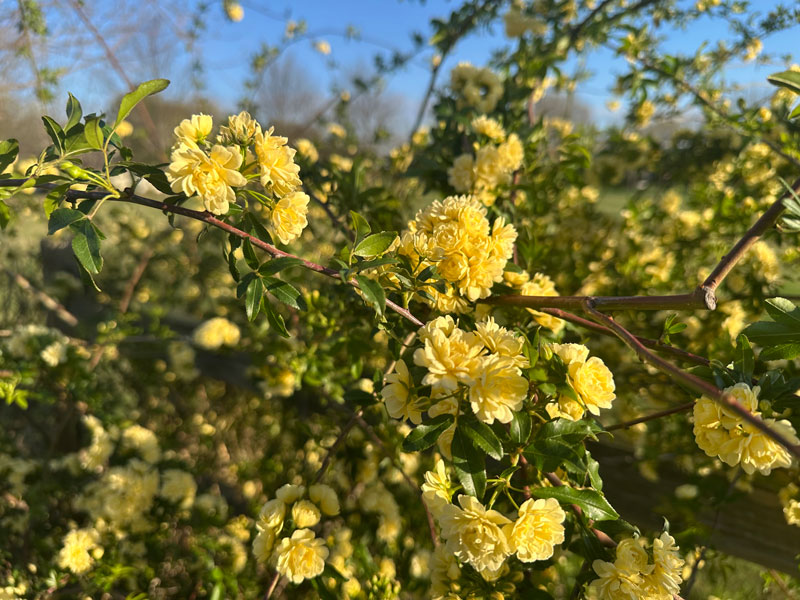
Lady Banksia grows like a horse. It sends out new shoots that look like CB antennae. I’ve found that the best way of dealing with them is to use lopping shears to cut them off at the ground and let the normal new growth take over. You can see one of them shooting out the top of the one whole-plant photo here with my story. You just have to keep them removed.
That’s it for my story on Lady Banksia roses. I’m surely glad we turned around yesterday so I could get you these photos. I haven’t written about this fine beauty for many years.
Hats off to that rude guy who honked us off the road as we tried to turn onto a side street so I could get these photos. Bet he’ll be embarrassed when he reads my story tonight. I’m sure he’s the gardening type.
Hope you enjoyed this. More importantly, I hope it gave you some things to think about.
Question: How did this plant survive all these years when other types of roses in the neighborhood nearby have died from RRD in recent years? (We drive this road often. I’ve watched them go down.) One of the reasons, of course, is that it’s a Lady Banksia. But the other is spacing. There’s a lot of air between it and the any other roses, now deceased. That’s one of the most critical findings of the researchers – we have to space our roses farther apart if we’re going to deal with RRD.