
Q&A – Ask Neil: March 26, 2026
(Please read these instructions carefully.)
Before you post your question, please look at recent issues to see if someone else has already asked it. You might find your answer there.
HOW TO SUBMIT YOUR QUESTION…
• Click here to post your question. (Please post your question only one time.)
• Please use this link only for posting questions – not for standard e-mails.
• High-resolution photos (1-2MB – not thumbnails) attached with your question help Neil give you the best possible answer. Please check your photo for clarity and exposure. If you do not see “All images clickable for larger views,” your images’ resolution was not sufficient for enlargement. That might also have made it difficult for Neil to give you an accurate answer.
• Neil chooses questions of greatest reader interest. Plant IDs rarely fit that description.
• Neil requires your first name or initials, also your city or county for an accurate answer. (Texas is a very large state.)
• One question per reader per week, please.
• Watch for Neil’s reply in the next issue of e-gardens.
Note: If you have submitted your question and did not see the pop-up window for attaching your photo, please click here.
QUESTION 1
WHAT IS THE BEST STARTER FERTILIZER FOR TOMATOES, PEPPERS?
Question: What is the best starter fertilizer for tomatoes and peppers? Ed F., Burkburnett, Wichita County.
Answer: I use a high-nitrogen, water-soluble fertilizer – the same one I use on my container plants. It’s instantly available for uptake by your new plants’ roots. I would continue using it weekly for the first month.
QUESTION 2
WHAT LOW SHRUB WOULD BE BETTER THAN BOXWOODS TO HIDE ROSES’ BARE STEMS?
Question: We have boxwoods bordering a bed of roses. The roses are failing, we believe because the soil is very shallow next to the concrete deck. What plant would do well there and still be tall enough to hide the roses’ bare stems? Paula M., Mt. Pleasant.
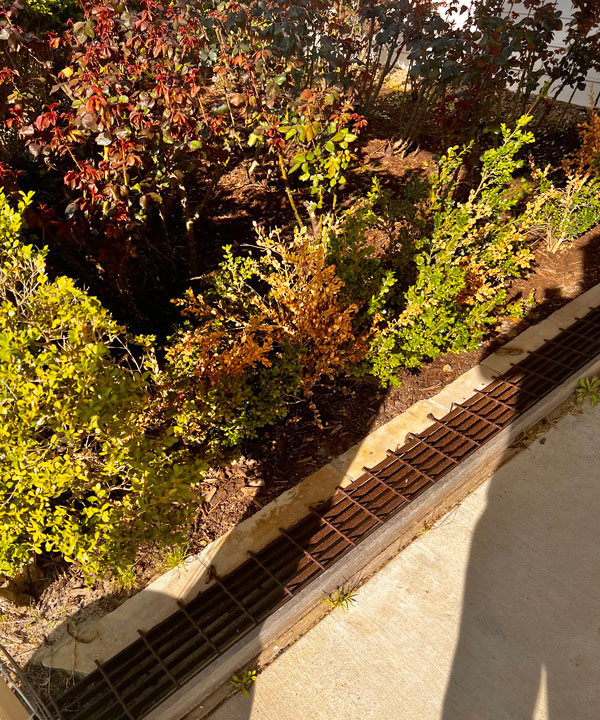
Answer: I’m going to come at my answer from a different angle. I wonder if the roses might have bare stems because of the shading caused by the shrubs (boxwoods). You might try a tall groundcover such as liriope (hoping it’s not too hot and sunny there) or perhaps a clumping perennial such as Shasta daisies, Gloriosa daisies, or even white Salvia greggii to contrast with the colors of your roses. From the standpoint of shrubs, the best of the very low shrubs would be dwarf Chinese hollies, but I really do think they would be too large. Purple wintercreeper euonymus could be pruned as a tuft along the wall, but you wouldn’t want it running beneath the roses. I really don’t think you want a full-fledged shrub growing there.
Note: Please double check your roses to be sure you don’t have Rose Rosette Disease (RRD) involved with them. It’s a virus for which we have no control, and it causes them to decline in vigor. That could also account for loss of lower leaves. I can’t tell by looking from this distance. Here is what I leave archived on RRD on my website.
QUESTION 3
WHAT IS THIS WHITE GROWTH ON MY PLANT?
Question: I have this white growth on my plant. I washed it with soap and water, but it just comes back. What should I do? Linda H., Georgetown.
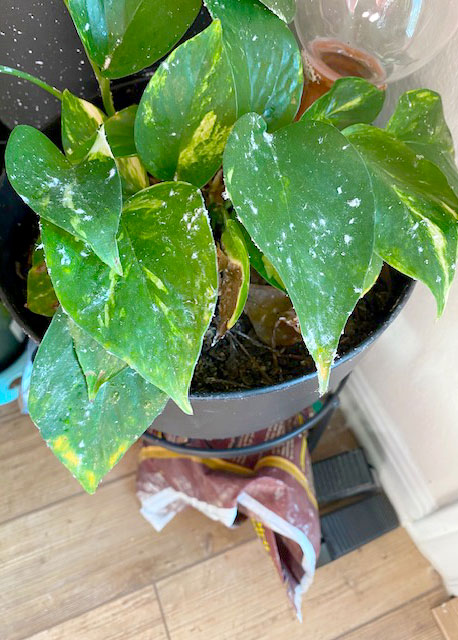
Answer: Your plant is devil’s ivy (Epipremnum aureum). I have grown it all my life and I have never seen mealy bugs or powdery mildew on its leaves, but those are the two top candidates visually.
At first, I ruled out mealy bugs because they are normally 3-dimensional. They are raised up from the leaf surfaces and are fuzzy. They also hide in the leaf axils (where leaves attach to the stems). Initially I didn’t see evidence of those things until I did the final cropping of your photo. I need to ask that you examine the leaves more closely. If you find any masses that could be pressed, mealy bugs exude a fluid when compressed with a toothpick. If that is the case, wipe all the white spots off with a Q-Tip or soft rag dipped in rubbing alcohol. It should be a fairly easy task to control them. Repeat in 7-10 days if any reappears.
I rule out powdery mildew because that looks like a dusting of flour when it shows up on a plant’s leaves (think zinnias or old varieties of crape myrtles). It rarely appears on leaves with thickened, glossy surfaces, although it’s common on Gold Spot euonymus. But this doesn’t look right for powdery mildew.
So, what else is left in case it isn’t mealy bugs? Mineral deposits, either from water droplets left over when you water or mist your plant or a natural phenomenon known as “guttation.”
Let’s try wiping the plants with a mixture of distilled water and vinegar. That would redissolve any mineral salts and allow you to wipe them away with the soft rag. See if they return right away. If not, that was probably the cause, and you should avoid misting the plant. It can tolerate the humidity in your area.
Watch the plant early in the morning to see if beads of water have been forced out of the leaves overnight. That’s guttation, and it happens when humidity is high and soils are wet. I really don’t think that’s the cause because of where you are and how dry we have been, but you can certainly watch it.
I currently have about 250 devil’s ivy plants growing in my greenhouse and 7 in our house. I’ve not encountered mealy bugs or any of the other problems I’ve outlined. Hopefully I’ve given you enough to get you started.
QUESTION 4
WHAT HAS HAPPENED TO OUR 4-YEAR-OLD RED OAK?
Question: We have a 4-year-old red oak that began losing bark late last year. It looks like there are some holes similar to sapsucker or woodpecker damage. Is that what caused this? What can we do? Steve B., Brock, Parker County.
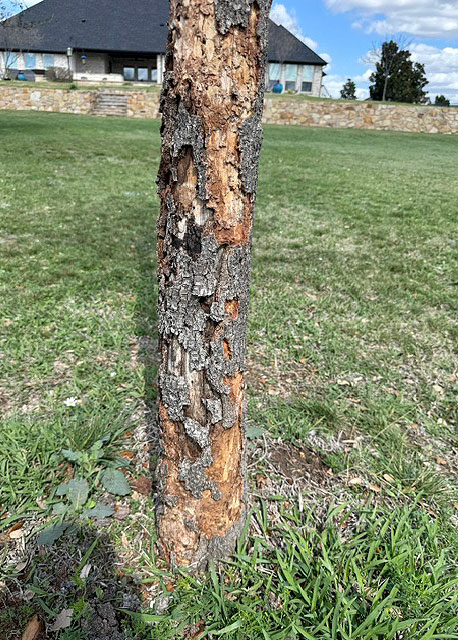
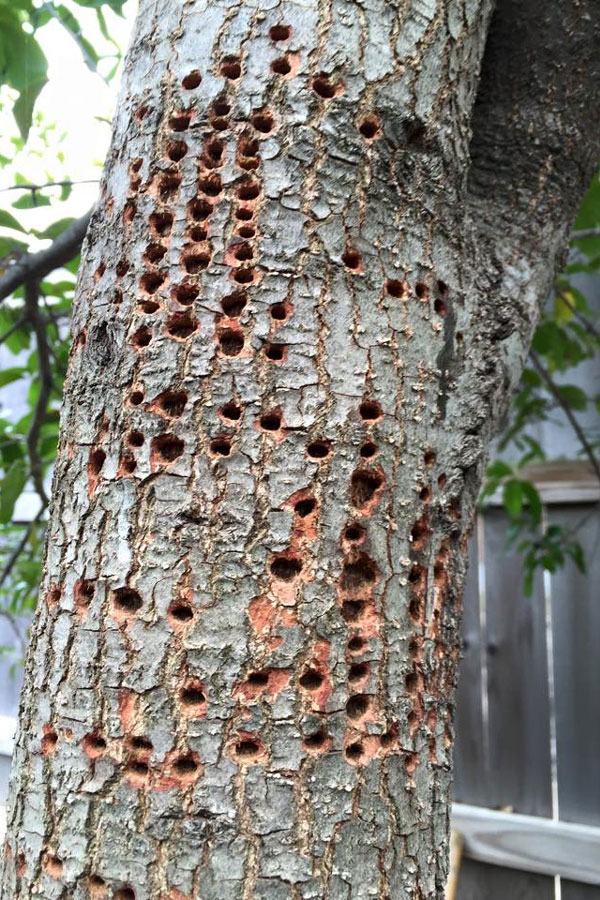
Answer: I don’t see the holes you’re describing. I’ll post a photo of what woodpecker damage would look like (holes regularly spaced in a distinct row). I just don’t see those.
Since this happened in the third year of your tree’s life in your landscape, I’m very suspicious that it’s due to sunscald of the trunk. You may have seen others’ posts with similar problems with red oaks, red maples, and Chinese pistachios. Trees that were protected by one another’s shade when grown side-by-side in the nursery are suddenly thrown into full sun in our landscapes. This damage happens in years 1 and 2, but it usually doesn’t show up until years 3 and 4. Bark on the south and southwest sides of the trunk starts to split and separate from the trunk. In doing so it exposes the internal wood of the trunk to drying conditions. That side of the top growth starts to decline, and the entire tree may be lost very quickly.
By the time people realize it, there is nothing that can be done to save the affected tree. The answer comes in prevention. Newly planted trees of types with thin bark should be protected with trunk wrap specifically designed for that purpose. I prefer the paper tree wrap you’ve seen me write about here, but there are plastic products that work, too. It’s a shame that nurseries rarely sell them or at least instruct customers to use them.
QUESTION 5
DO CACTUSES GROW NEW PADS FROM THEIR FRUIT?
Question: Do cactuses do this? A plant on our place is growing new pads from its fruit. This is new to me. Glenn C., Antlers, Oklahoma.
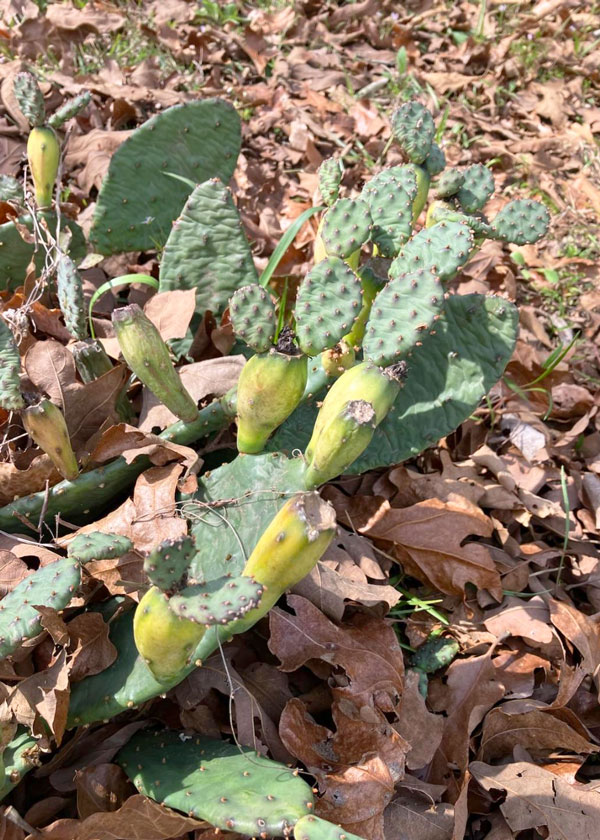
Answer: I haven’t seen it, either, but apparently the Cactus and Succulent Society people have. In fact, I’ve seen something very similar in daylilies. It’s called proliferation, and it’s where a reproductive part of the plant (the flower stalk in daylilies or the fruit in your prickly pear Opuntia) gives rise to a vegetative shoot. There are several possible causes ranging from environmental challenges of drought or temperature to injury from insects or other causes. It can actually be used as a means of vegetative propagation for that particular plant.
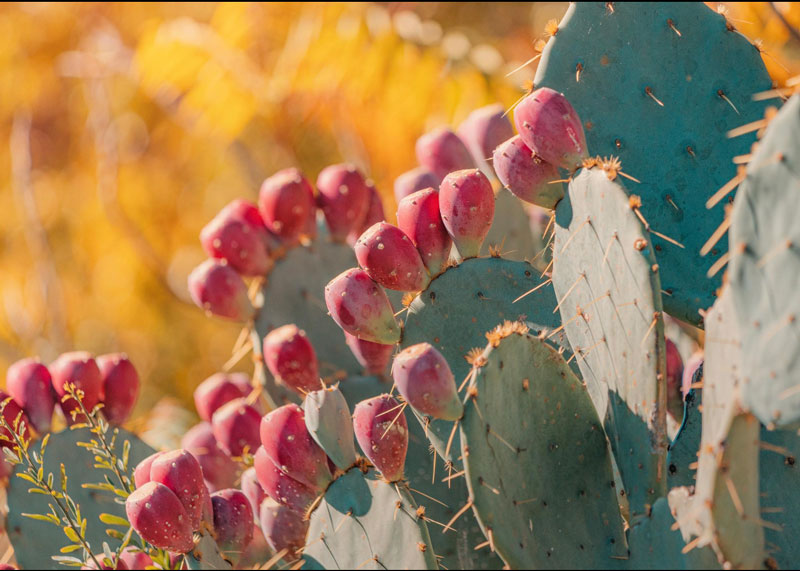
In my research for your answer I actually came across an example from the Texas Hill Country where pads came from fruit. Then the pads grew and bloomed again, set fruit, and started the process over again. It’s an interesting phenomenon.
QUESTION 6
WHERE CAN I FIND ITALIAN JASMINE?
Question: I’m having trouble locating the Italian jasmine (Jasminum humile) you recommended, despite checking with most of your local sponsors. Could you suggest a reliable source for this shrub and confirm that it is well suited for this part of Texas? Don M., Aledo.
Answer: Thank you for trying my sponsors. I’m very grateful. One of them reached out to me before I even saw your note here.
I may have done a disservice to both you and my advertiser, because it looks like the wholesale growers are not producing this plant currently. I will vouch for it 100 percent. I’ve grown it all my life. It’s an heirloom plant that was common in Texas landscapes in the 50s and 60s. I bought the ones I’ve had in our landscape in the 70s, 80s, and 90s. But I’ve seen it less and less often. The plantings in DFW (your general area) I used to observe were hurt by the February 2021 cold spell, but so were many other dependable species that we are already replanting.
You have the correct species name for Italian jasmine. Using both that name and the common name, I did find several consumer sources online, but they’re for small plants at outlandish prices. If I wanted one plant, I’d be able to justify it, but not for a landscape project.
Note: Italian jasmine is not to be confused with primrose jasmine (Jasminum mesnyi). Primrose jasmine is taller and more sprawling (not as mannerly), and not as winter hardy. Its flowers are larger and more showy, but that’s it only stronger selling point over Italian jasmine.
Sadly, for now Italian jasmine goes onto the list of other plants that need much wider production:
Italian jasmine (Jasminum humile)
Berries Jubilee holly (Ilex cornuta ‘Berries Jubilee’)
Dazzler holly (Ilex cornuta ‘Dazzler’)
First Lady yaupon holly (Ilex vomitoria ‘First Lady’)
Glendora White crape myrtle (Lagerstroemia indica ‘Glendora White’)
Other crape myrtle cultivars that are difficult to find but well worth the search include: Arapaho, Kiowa, Sarah’s Favorite White, and the various members of the “Petite” series.