
Q&A – Ask Neil: April 9, 2026
(Please read these instructions carefully.)
Before you post your question, please look at recent issues to see if someone else has already asked it. You might find your answer there.
HOW TO SUBMIT YOUR QUESTION…
• Click here to post your question. (Please post your question only one time.)
• Please use this link only for posting questions – not for standard e-mails.
• High-resolution photos (1-2MB – not thumbnails) attached with your question help Neil give you the best possible answer. Please check your photo for clarity and exposure. If you do not see “All images clickable for larger views,” your images’ resolution was not sufficient for enlargement. That might also have made it difficult for Neil to give you an accurate answer.
• Neil chooses questions of greatest reader interest. Plant IDs rarely fit that description.
• Neil requires your first name or initials, also your city or county for an accurate answer. (Texas is a very large state.)
• One question per reader per week, please.
• Watch for Neil’s reply in the next issue of e-gardens.
Note: If you have submitted your question and did not see the pop-up window for attaching your photo, please click here.
QUESTION 1
IS THIS FREEZE DAMAGE ON LITTLE ANN MAGNOLIA?
Question: Could our last freeze have caused this damage to our Little Ann magnolia tree? It only got down to 30F. A few days before, I noticed a different smell in our garage and outside and wondered if someone had done an insecticide spraying. This photo was taken March 22. Janice A., Canton.
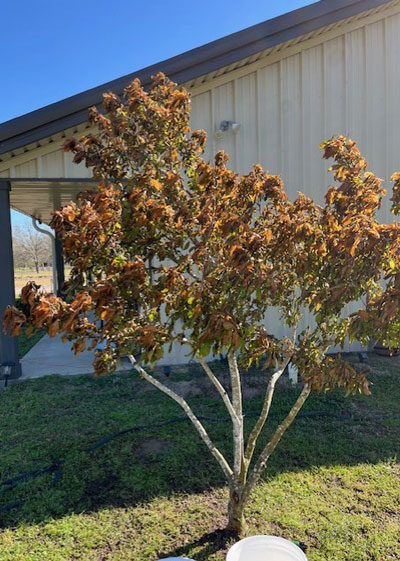
Answer: ‘Ann’ magnolias are hybrids from the ‘Little Girl’ series. As you were expecting, it has deep, rich, purple-red blooms just before the leaves emerge. 30F could kill the flowers and buds, but I must confess that the mysterious smell also has me concerned. Your photo came to me April 2, so a good bit of time had passed before I saw it. If it was freeze injury, the plant should be putting out its spring leaves by now. That would tell us there was no herbicide involved. I would not be concerned about an insecticide. You’re going to be a better judge than I can from this point forward, especially since you know if anyone had reason or access to be spraying around it.
QUESTION 2
DO COMMERCIAL MOSQUITO REPELLENT SPRAYS HURT BEES AND HUMMINGBIRDS?
Question: I am considering a commercial application via spray/mist of mosquito repellent around my house April through October. They apply to all plants including flowering plants. Will these commercial sprays harm bees and hummingbirds? M A C, Tarrant County.
Answer: I did a quick survey of several major agricultural universities. They all agree that these use insecticides that will also harm butterflies and bees as well as beneficial predators. They have a less direct, but still negative impact on hummingbirds.
The universities concur that these are treating only the “symptoms” (the mosquitoes) and not the real cause – standing water where they can breed.
You need to search for sources of standing water such as gutters, tipped flowerpots, drains, buckets and cans. Empty them so they cannot refill.
If you have standing water that cannot be emptied, use mosquito dunks.
Thin shrubs to allow better airflow. Utilize spot treatments to shrubs rather than whole-area sprays. Time applications to avoid periods of pollinator activity.
Protect yourself with DEET insect repellent.
QUESTION 3
HOW CAN I TRIM THIS SHRUB TO MAKE IT LOOK BETTER?
Question: A dead tree was removed to the left of this shrub about a year ago. It made it look so lopsided. I thought it might fill in, but it has not. Do you have any suggestions of how I could make it look better and when I should do it? Lisa L., Dallas.
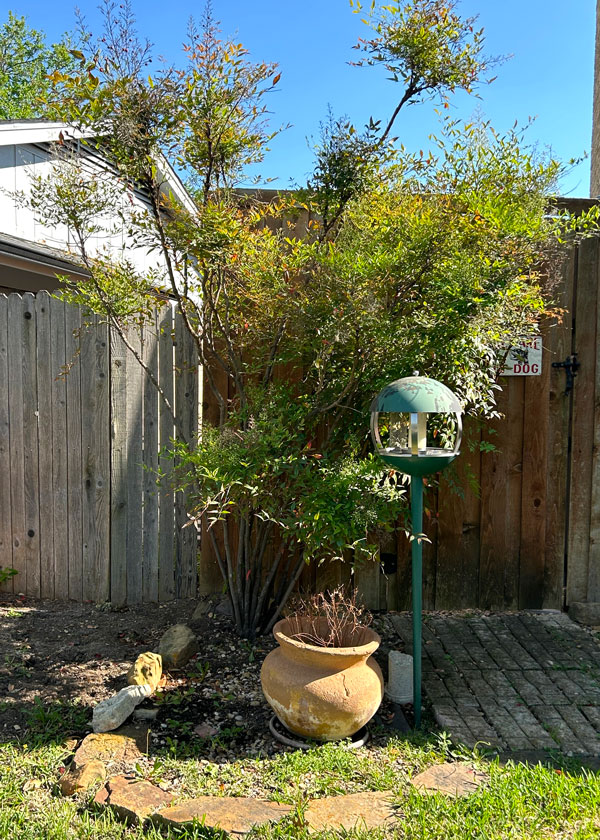
Answer: Oh, my goodness! I know exactly what to do. There is one answer and only one answer. It must be followed precisely, or the results will be dreadful.
You have a nandina, also sometimes (rarely) called “heavenly bamboo.” Yours is about as tall as you will ever see. There is only one way to prune them correctly! Any cane (stalk) that you cut must be cut to within 1-in. of the ground. You must never leave any stubs more than 1-in. from the soil surface. The worst thing you can have is a nandina stem with side branches. Look around you as you drive and you will see where others have made that mistake.
Speaking to your plant, I can count 12 or 14 stems that extend far beyond your bird feeder. Trust me on this! Those are the ones that need to be cut to the ground with lopping shears. Leave only the stems that come up to the height of your bird feeder. Do not prune them at all.
Do this pruning immediately. New growth is happening quickly, and you need to take advantage of it. Apply a high-nitrogen lawn-type fertilizer around the base of your plant and water it heavily. Within a month you will see new sprouts coming up from the bases of the cut stumps and soon your plant will be bushy and full from the ground up to the bird feeder.
Every winter from now going forward, remove the tallest 30 to 40 percent of the canes. Those canes that you leave as you prune now will probably need to be pruned next winter. Doing this annually will keep your plant full and compact.
I do this to my 100 nandinas each and every winter. I’ll guarantee the results!
QUESTION 4
WILL MY VERBENA COME BACK?
Question: The freeze we had in February affected half of my Homestead Purple verbena but not the other half a few feet away. The damaged area isn’t dead, but it’s not leafing out very well. Will it come back? Pamela B., Prosper.
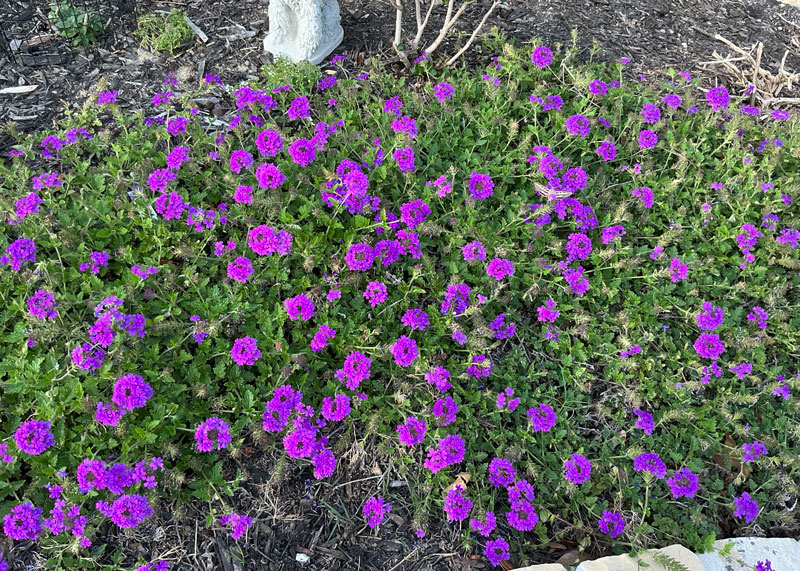
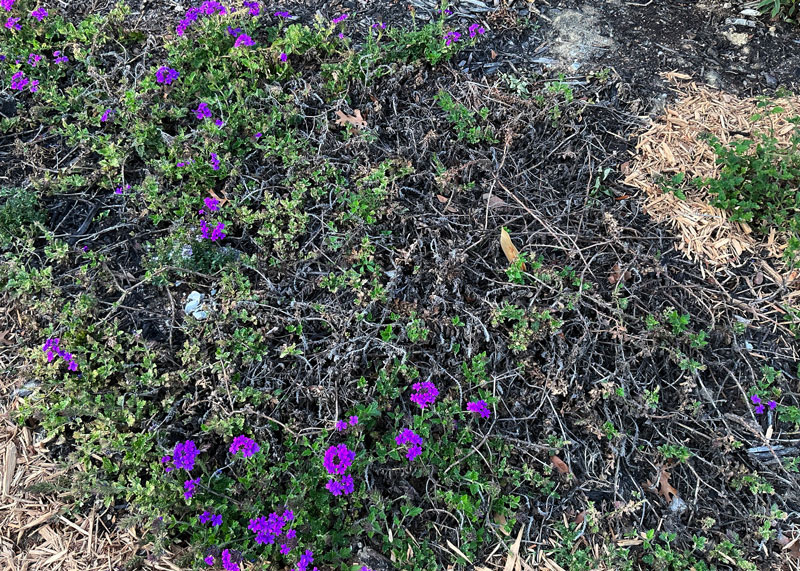
Images clickable for larger views.
Answer: It looks questionable. We’ve had great growing conditions. I’d suggest giving it a high-nitrogen, water-soluble fertilizer and two more weeks. If it doesn’t come back after that you probably should replant that area, either with something else or with transplants you make yourself or with fresh plants from the nursery. Homestead Purple is an old favorite that’s widely sold.
Yes. Love your hummingbird moth. Nice catch with the camera!
QUESTION 5
WHERE DO I START IN TREE-TRAINING THESE PLANTS?
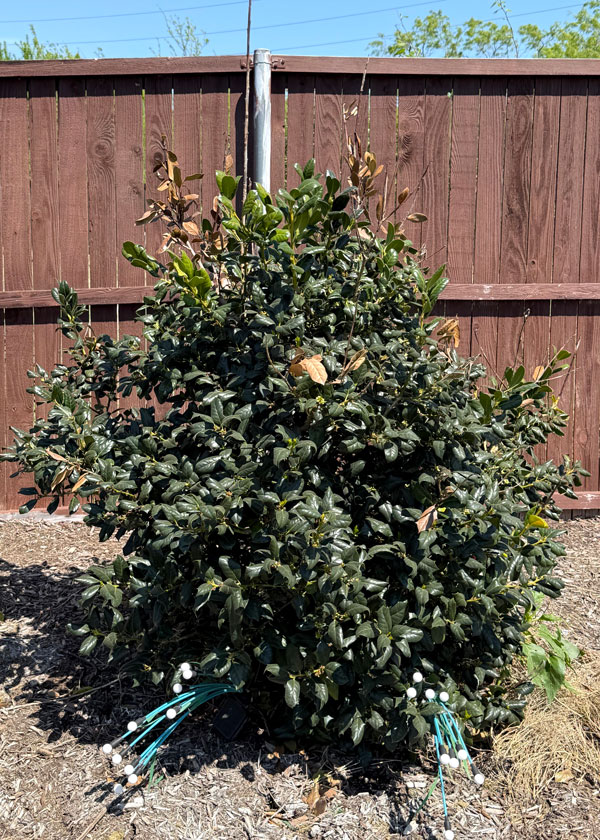
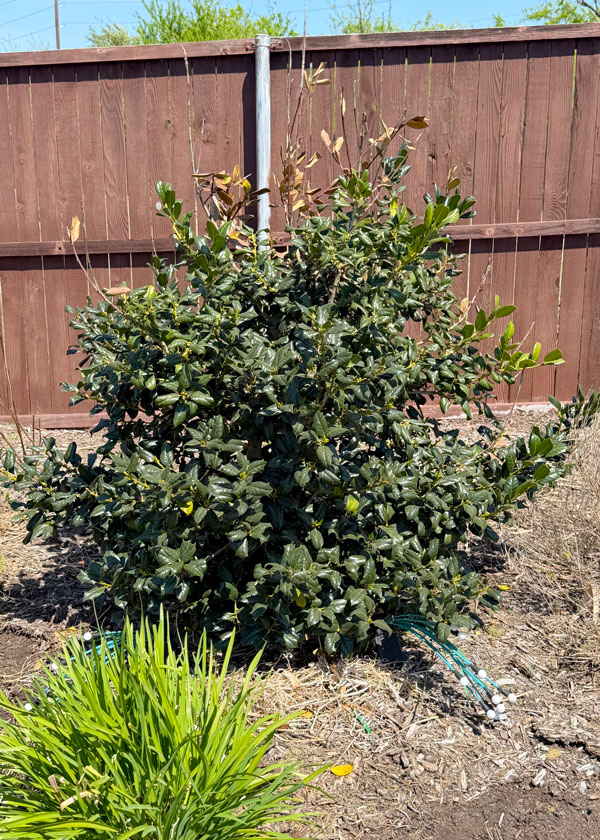
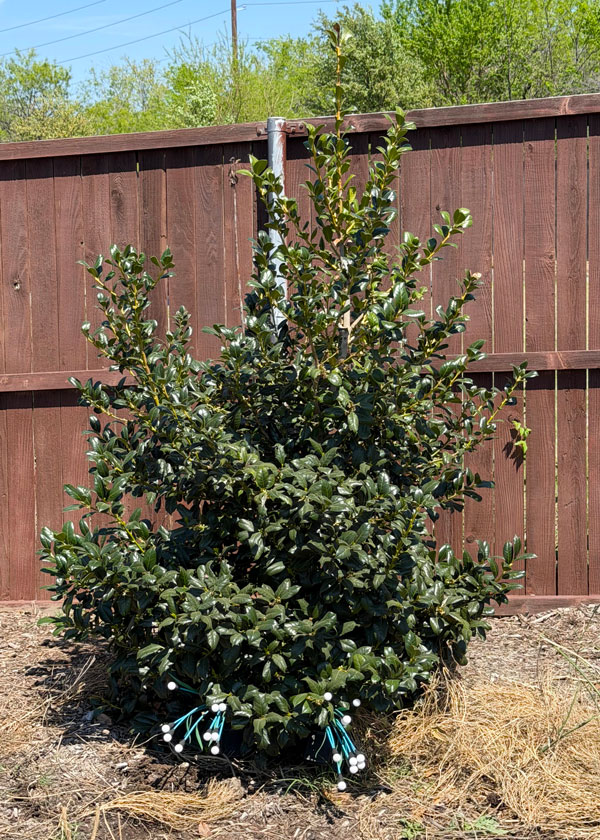
Question: I’m tree-training my Texas mountain laurels. One has no central leader. The longest limbs flop. Should I chop them and start over? Also, my Nellie R. Stevens hollies are ragged and the central leaders were damaged by the frost. Where do I begin? Jan H., The Colony.
Images clickable for larger views.
Answer: In both cases, it’s usually easiest for home gardeners to buy medium-sized or large container-grown plants and to select from plants that already have fairly straight trunks. You want the plants to develop full leaf canopies before you start removing lower branches. If the main trunk has twists and crooks, there’s nothing that can be done later to make it grow straight.
I didn’t receive a photo of the Texas mountain laurel. All I can do is give a generic reply that I’d plant it, probably remove any floppy stem, and let it fill in on its own. You’re very far north to depend on it. I’m 15 miles from you and my 30-year-old plant froze and died in extreme cold one winter.
As for your hollies, I would trim off the dead twigs and do a loose job of rounding their tops. Apply a high-nitrogen, lawn-type fertilizer to stimulate new growth soon. I’ve grown Nellie R. Stevens hollies in my Collin County landscape for 48 winters and I’ve never had any freeze injury – not one leaf. This looks more like drought damage to the new growth. Be sure to keep them moist at all times.
QUESTION 6
IS THERE A BROADCAST TREATMENT FOR BAGWORMS ON JUNIPERS?
Question: I live on a few acres. Each year there is some level of bagworms on our redcedar junipers. The trees are 15-20 ft. tall. I can’t treat hundreds of trees. What can I broadcast to control them on the trees close to the house? Bill P., Caddo Mills, Hunt County.
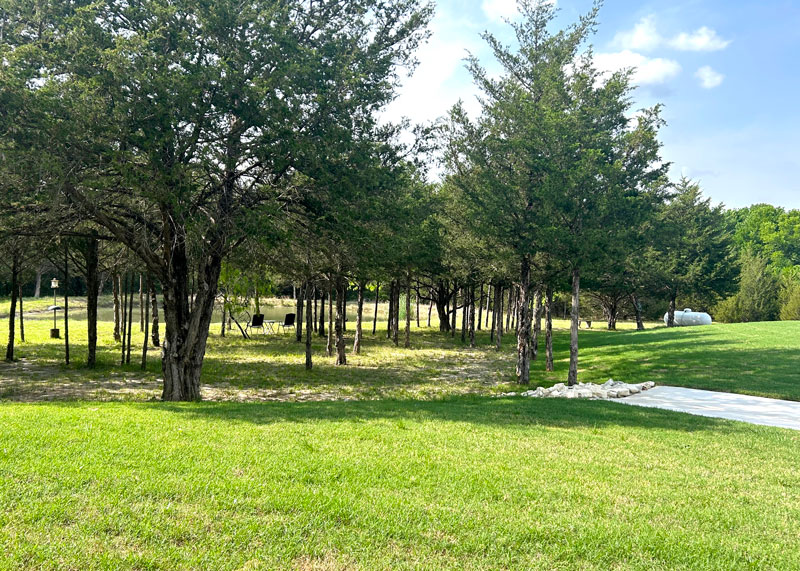
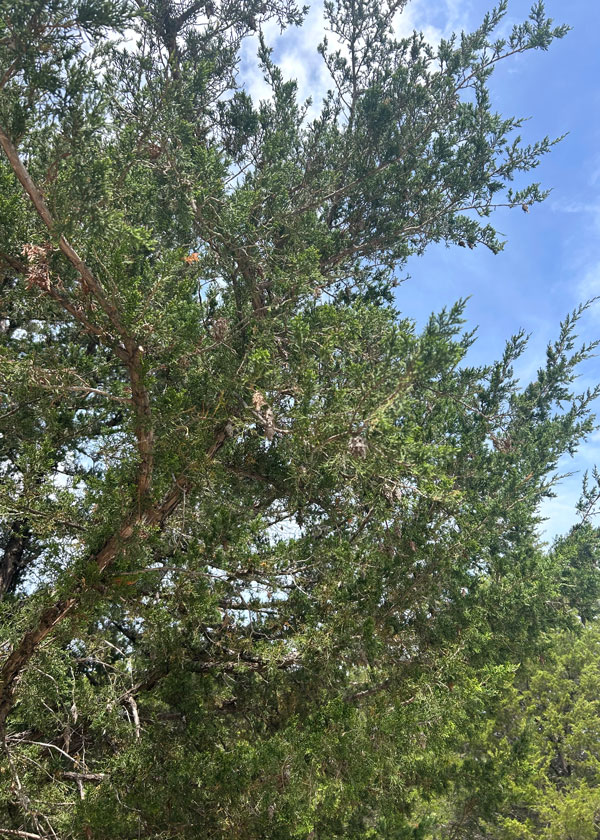
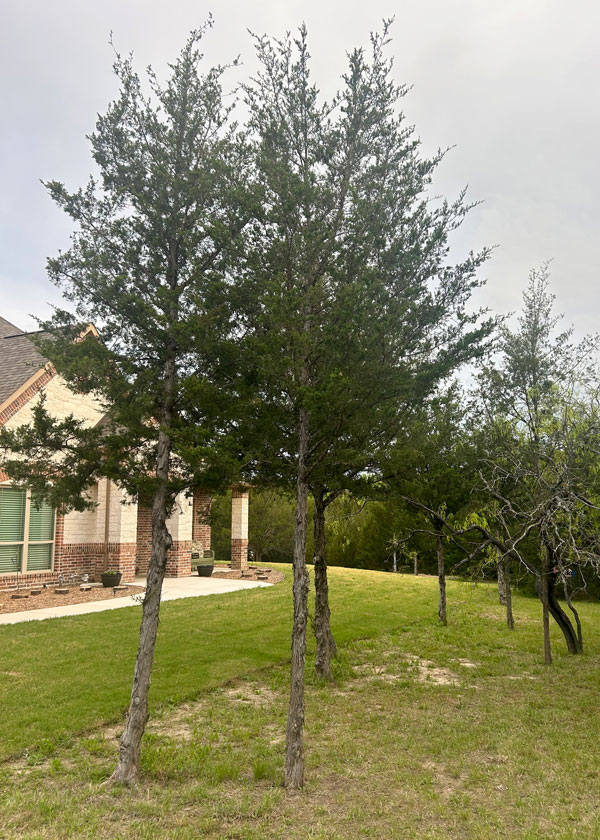
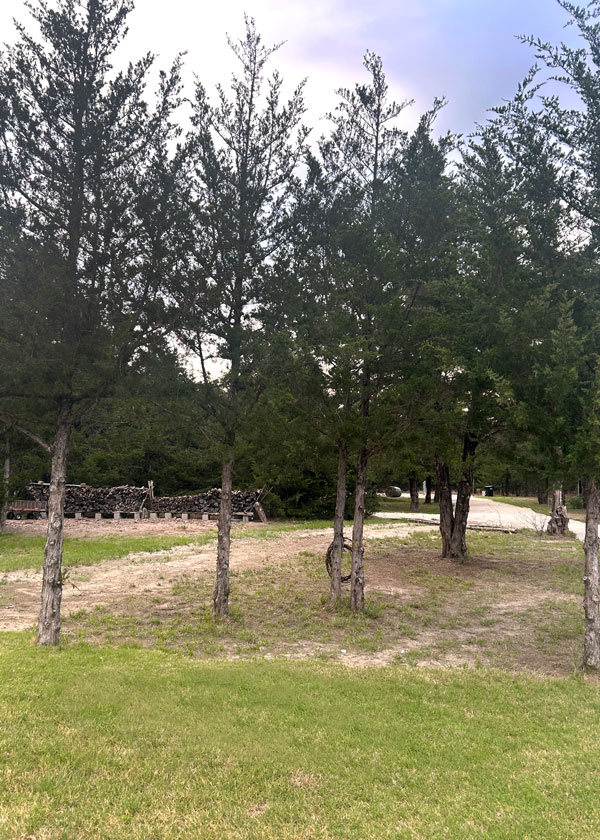
Answer: We have lived on 11 acres for 48 years. We have scores of eastern redcedars just as you do. I believe I have only sprayed one tree one year. For some reason, the bagworms ganged up on it that year.
All of which is to say, don’t panic. They will survive a certain level of attack. The treatment you would apply to the ground would be a systemic insecticide and it would be prohibitively expensive in that quantity. I really would suggest spraying with Sevin or Malathion (or almost any other insecticide) when you first see the larvae starting to feed. I would guess that would be late May or early June in your area. They will be very small (bags the size of pencil erasers) at that point. Spraying with a strong hose-end sprayer would be quick and easy. Anything you would apply to the ground would be far more expensive and a lot more work.
QUESTION 7
WHAT DO I DO WITH OUR CHINESE PISTACHIO?
Question: Four years ago, we received two trees from the TXU Energy/Oncor free tree program. One was Chinese pistachio that was about 3 ft. tall. It has grown very tall, but it has several oddities as you can see. It gets good circulation and light. Please advise. Cheryl L., Smith County.
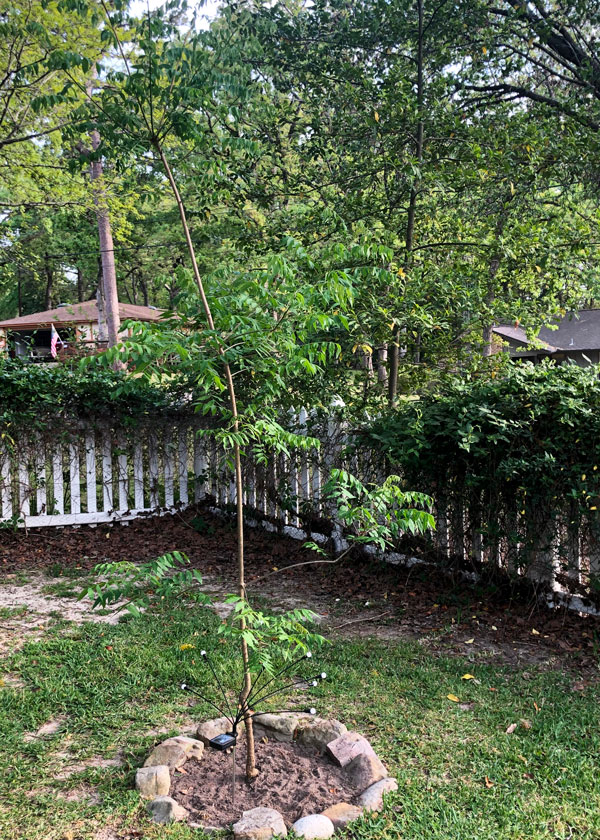
Answer: Even under the best growing conditions, Chinese pistachios are “gangly puppies” when they’re young. That’s how I’ve always described their lanky spaces between their clusters of branches. They eventually do fill in, however, to make lovely mature trees 40-50 ft. tall and wide. That assumes they have ample space in which to grow.
I worry about your tree not getting enough light. It looks like there is a great deal of competition from the opposite side. That’s probably going to cause it to lean away from that darkness. As the long, supple trunk develops, it may become very bowed. All the pruning you might do won’t be able to correct it.
If I’m wrong – if it has 40 to 50 ft. in which to grow, just let it develop. It may look odd for a season or two, but it should catch up. But if it’s crowded, you’ll just have to let it blend into the overall canopy. Best I can see, that’s what’s going to happen.
Another, perhaps better idea might be to transplant it next winter during the dormant season to a spot that has full sunlight year round.