
Q&A – Ask Neil: April 16, 2026
(Please read these instructions carefully.)
Before you post your question, please look at recent issues to see if someone else has already asked it. You might find your answer there.
HOW TO SUBMIT YOUR QUESTION…
• Click here to post your question. (Please post your question only one time.)
• Please use this link only for posting questions – not for standard e-mails.
• High-resolution photos (1-2MB – not thumbnails) attached with your question help Neil give you the best possible answer. Please check your photo for clarity and exposure. If you do not see “All images clickable for larger views,” your images’ resolution was not sufficient for enlargement. That might also have made it difficult for Neil to give you an accurate answer.
• Neil chooses questions of greatest reader interest. Plant IDs rarely fit that description.
• Neil requires your first name or initials, also your city or county for an accurate answer. (Texas is a very large state.)
• One question per reader per week, please.
• Watch for Neil’s reply in the next issue of e-gardens.
Note: If you have submitted your question and did not see the pop-up window for attaching your photo, please click here.
QUESTION 1
HOW CAN I ELIMINATE ST. AUGUSTINE GRASS FROM MY BERMUDA LAWN?
Question: How can I eliminate St. Augustine grass that is in my bermudagrass lawn? Walt M., Cleburne.
Answer: When MSMA was taken off the consumer market at the end of 2010 it left a giant hole in our homeowner weed control program. It had been the go-to product for eliminating both dallisgrass and invading and unwanted St. Augustine. It is still available for use on golf courses, sod farms, and highway rights-of-way. People tell me they still buy it from Canadian sources, but obviously I can’t recommend that, and I see lawn care companies that seem to be able to rid lawns of dallisgrass. They do have access to other products that will accomplish that with a couple of applications. Your other option is to spot-treat with a glyphosate-only herbicide in a tank sprayer, but that’s going to kill both grasses. If you have much St. Augustine, you won’t like the results. If it’s primarily at the edge of your lawn where the neighbor’s St. Augustine is coming into your bermuda, you might want to use a flat-bladed spade (see photo in story about turfgrass plugs, this issue) to cut a slit at the property line, then pull the St. Augustine runners. (Yeah – it’s a really boring job.) Eliminating one unwanted perennial grass within another perennial grass (bermuda) is a real problem since we lost our best tool.
QUESTION 2
HOW CAN I RETRAIN MY CRAPE MYRTLES?
Question: I moved into a new house 8 months ago. It looks like I have two crape myrtles that have been topped in the past few years. Should I remove the main trunks and allow the 4-5 secondary stems to become the main ones? Jack K., Brazos County.
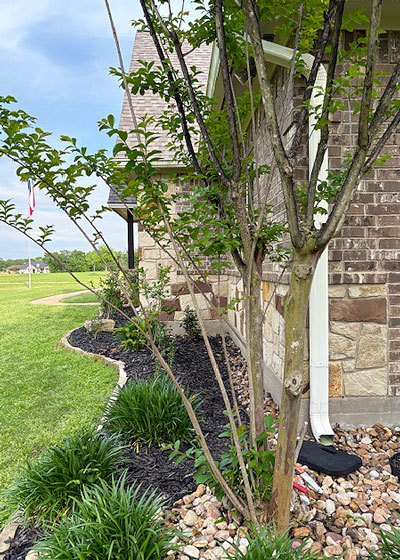
Answer: You are right on track, You will never be able to eliminate the ugly scars of prior years’ topping no matter how many years you struggle and train. Cutting the butchered stems completely to the ground and using new shoots as the new trunks is the right way to go, and your plant is already on its way. However, do not try to use sprouts that are emerging from the old trunks several inches above the soil line. It looks like there may be a few of those. And choose new trunks that are evenly spaced around the plant’s base. It looks like most of the new shoots are toward the front as things stand now.
This page from our Crape Myrtle Trails of McKinney website gives complete details of how to accomplish it. Scroll down about halfway. I wrote all this text, so there’s no need for me to write it again here.
QUESTION 3
WHAT SHOULD WE DO WITH OUR ZOYSIA LAWN?
Question: Our relatively new zoysia lawn is suffering. Parts of it appear to be dying. We’ve fertilized it and put down broadleafed and pre-emergent weedkillers, and we have kept it watered. The new growth looks anemic and light green with lots of grassy weeds. What should we do? Stephane R., Richardson.
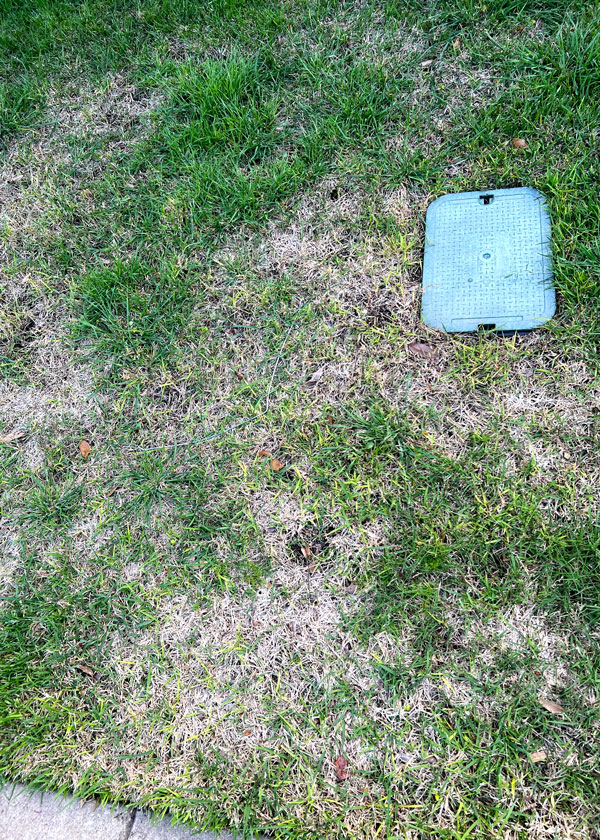
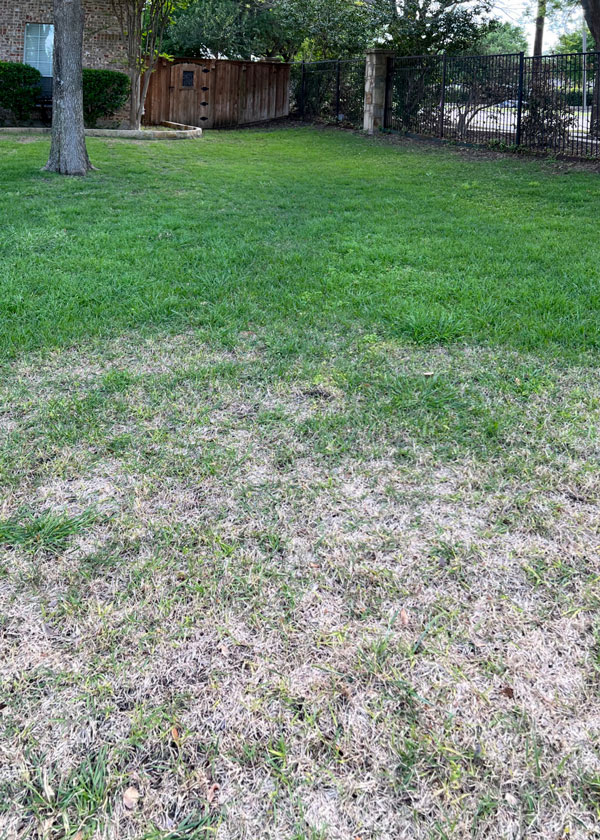
Images clickable for larger views.
Answer: I can’t tell for sure from the distance from which your photos were taken. However, the yellowing certainly points to Take All Root Rot (TARR) or take all patch. We commonly think of it as a disease impacting St. Augustine lawns in early spring (mid-March through mid- or late May). However, it also attacks bermudagrass and zoysia lawns as well.
Areas that are impacted by TARR fail to green up normally. The grass is pale green, even yellowed. Fertilizing it does not help, nor does applying iron. Infected roots are shortened and black from the fungus, and the grass can be pulled loose from the soil easily, similar to what you would find with damage of white grub worms – except you will not find grub worms in the soil in this case.
You should begin your treatment program by having the presence of the fungus confirmed. The Texas A&M Plant Disease Diagnostic Laboratory certainly can culture it for you. Collecting and mailing instructions are available on their website. This page from the Williamson County Extension Office has that information as well as a lot of other useful facts on TARR.
This web page from the University of Arkansas is also quite useful. It goes into more detail, so you may find even more helpful information here.
QUESTION 4
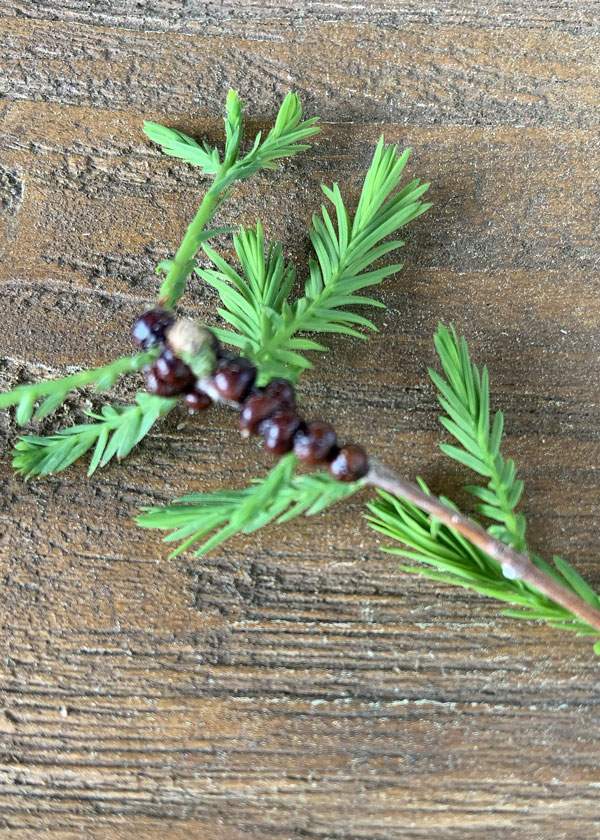
IS THIS LECANIUM SCALE ON MY BALD CYPRESS? WHAT CAN I DO?
Question: I have a 7-year-old bald cypress tree that might have Lecanium scale. I had the identical scale on a red oak 2 years ago and scraped them off by hand, but I can’t do that with this tree (too large). Is there a systemic insecticide that will work? I have another cypress nearby that is not infected. Juli L., Sulphur Springs.
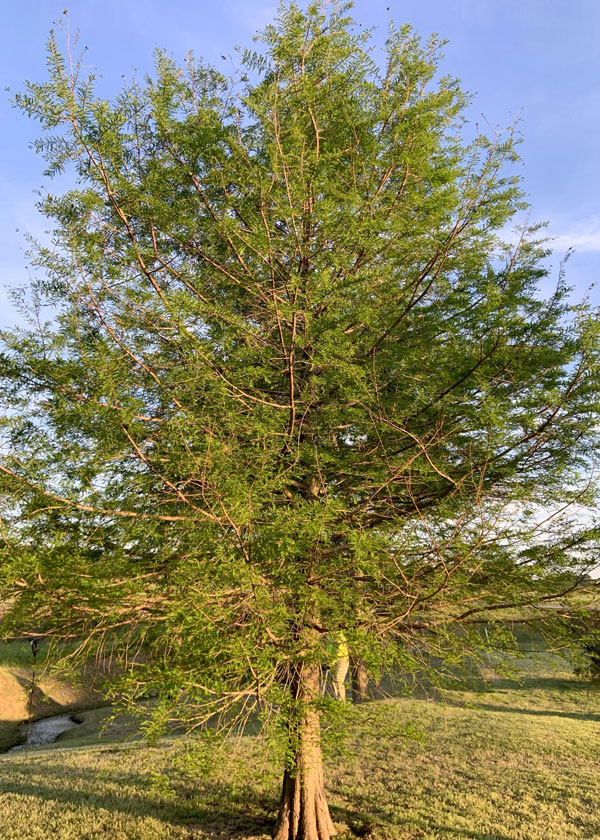
Images clickable for larger views.
Answer: I believe you’re correct on the ID. (Thanks for the head start.) Most of the Lecanium scale reports I find from the various agricultural universities concentrate on oaks, but they do mention that the pests will move to other species.
Their prime damage is from sucking of plant sap from the stem tissues and subsequent depositing of sticky honeydew residues in which honeydew fungus can grow. Dormant oil spray applied in late winter is mentioned, but systemic insecticides such as Imidacloprid are given higher marks if applied prior to feeding in early spring. Certified arborists may also be able to inject insecticides directly into the trees’ trunks for year-long control.
QUESTION 5
IS THIS CHLOROSIS IN MY CHINESE FRINGE FLOWER, AND IS IT WORTH SAVING?
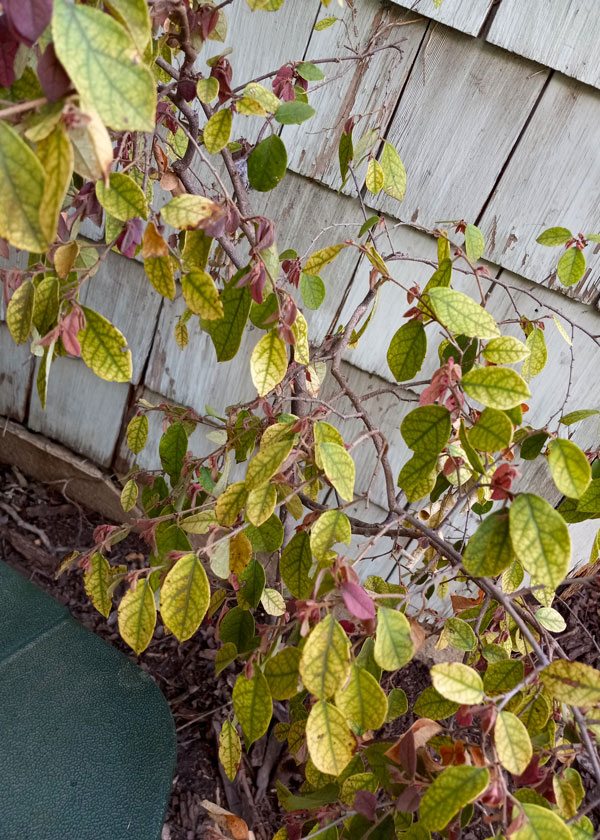
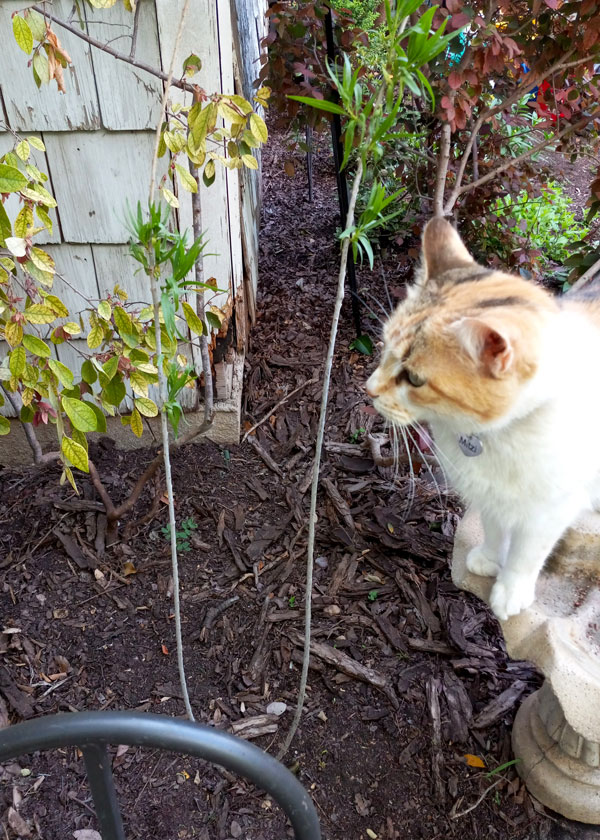
Question: My neighbor gave me four fringe flowers when she redid her landscape. Two yellowed and died. One is making it and looks normal. Should I try to save this one? I hate to give up. Our soil measures very alkaline. Vicky S., Austin.
Images clickable for larger views.
Answer: Let’s set the stage for success with fringe flowers (Loropetalum). Think of the conditions you would give azaleas if you wanted them to thrive in a Texas landscape.
• They would need morning sun until 9 or 10AM. Then light to medium shade the balance of the day.
• They would need uniform moisture – never soggy for prolonged periods, and certainly never dry to the point of wilting. Your plant looks dry, both as judged by looking at its leaves and by looking at its soil itself. It looks wilted, and the soil looks like it needs to be watered.
• But most of all, fringe flowers need a planting mix that is highly acidic, just as do azaleas and camellias. The soils up and down I35, from Dallas through Waco and Austin to San Antonio, are extremely alkaline. To grow fringe flowers successfully near I-35 and westward, you would need to plant them into beds 18 inches deep (part above ground and part below) filled with equal portions of sphagnum peat moss and finely ground pine bark mulch and sphagnum peat moss (sold by the cubic foot in bales, not bagged).
The yellowing you are seeing is iron deficiency brought on by lack of iron in the foliage. That happens when soils are very alkaline. Frankly, it’s not worth all the expense it will take to prepare the planting bed to try to save one or two plants. I would do that only if you want to try new, vigorous plants. And personally, fringe flowers are on my own “never again” list for the alkaline black clay soils in which I garden. I’ll leave them for my friends in the Piney Woods of East and Southeast Texas.
QUESTION 6
WHY ARE MY IRIS LOOKING SO HEALTHY BUT NOT BLOOMING?
Question: My iris plants look really healthy, but they are not blooming. Why would that be? Sally (Sarah C.) A. Granbury.
Answer: The question I always ask in return is, “How long has it been since they were divided and replanted?” If it’s been more than 3 or 4 years, they’re probably crowded to the point of reducing their own vigor and stopping production of flowers.
The other thing that often happens is that trees overhead grow larger and cast more shade onto the iris in a garden. Iris need full or nearly full sunlight to bloom to their full potential.
If either of these has happened in your landscape, plan to dig, divide, and replant your iris into new locations this fall (late September or early October). You could also do so this spring with some of them if you have a bed ready and can replant them immediately. That would give those plants longer to get reestablished.
QUESTION 7
I HAVE QUESTIONS ABOUT POA ANNUA.
Question: I have been fighting Poa annua for several years. I have used a number of pre-emergent weedkillers on it, and nothing seems to help. Do winter grasses truly die in the summer, or do they come back and spread more seeds the next year? Mike S., Royse City.
Answer: Poa annua has developed a resistance to pre-emergent herbicides just as you have noticed. I have mentioned that several times here. It’s been noted by southern ag universities and growers over the past couple of decades. Our consumer pre-emergent products all work on similar chemistry so there is limited help in switching from type to type. I do see reports that Dimension seems to give somewhat better results, but even there your best bet is always to maintain your turf at the best density possible to crowd out as much of the weed invasion as you can. If you have seed sources in beds, driveways, ditches, and vacant lots adjacent to your lawn, do whatever you can to lessen the load of annual bluegrass seeds that migrate into your lawn for next year.
Note that all the cool-season weed grasses (also including rescuegrass, ryegrass, and others) germinate in the fall, establish themselves over the winter, then flourish in the spring, culminating in blooming and setting seed for the next growing season. Almost all die with the return of hot weather. All the pre-emergent products available to consumers continue to work well on the other cool-season weed grasses. It’s primarily Poa annua that has built up this resistance.