
Q&A – Ask Neil: April 30, 2026
(Please read these instructions carefully.)
Before you post your question, please look at recent issues to see if someone else has already asked it. You might find your answer there.
HOW TO SUBMIT YOUR QUESTION…
• Click here to post your question. (Please post your question only one time.)
• Please use this link only for posting questions – not for standard e-mails.
• High-resolution photos (1-2MB – not thumbnails) attached with your question help Neil give you the best possible answer. Please check your photo for clarity and exposure. If you do not see “All images clickable for larger views,” your images’ resolution was not sufficient for enlargement. That might also have made it difficult for Neil to give you an accurate answer.
• Neil chooses questions of greatest reader interest. Plant IDs rarely fit that description.
• Neil requires your first name or initials, also your city or county for an accurate answer. (Texas is a very large state.)
• One question per reader per week, please.
• Watch for Neil’s reply in the next issue of e-gardens.
Note: If you have submitted your question and did not see the pop-up window for attaching your photo, please click here.
QUESTION 1
WILL MY LITTLE LIME HYDRANGEA BLOOM THIS YEAR?
Question: I purchased a healthy Little Lime hydrangea, but it has no buds. Some of the other types of hydrangeas have had flowers. Will mine bloom this year? Mary W., Allen.
Answer: I would need more information to be able to answer. How long have you had it? If it’s relatively new it may still be getting established. If it got too dry at the end of last summer that may have caused it to stall out. If you have it in the native clay soils of Collin County it may not be happy. (Hydrangeas prefer highly organic, consistently moist soils.) Ditto if it’s growing in a hot, sunny location. They do best in morning sun with shade in the hottest part of the afternoon.
Without a photo to see its general setting, size, and vigor, my best suggestion is that you be patient with it. That variety has certainly won some nice awards. Hopefully it will kick in this year or next.
QUESTION 2
HOW CAN I CONTROL WOOD SORREL?
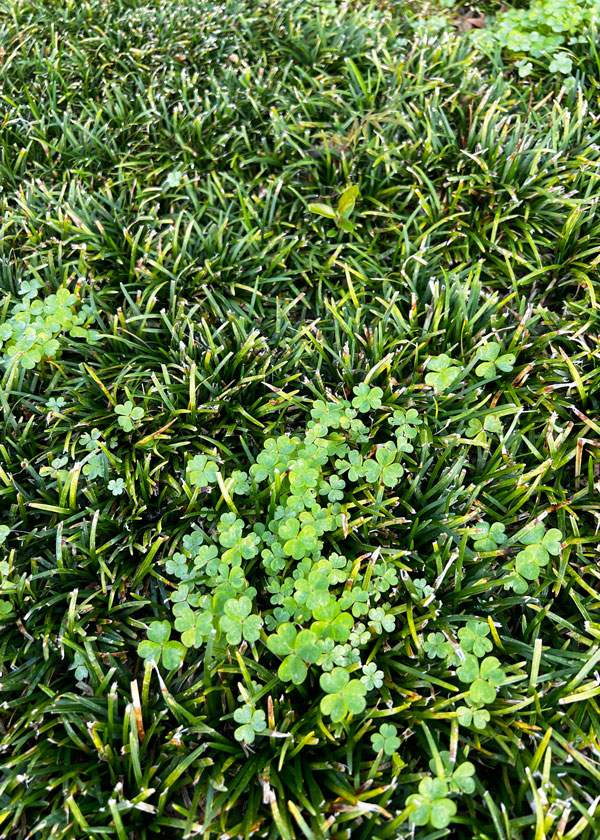
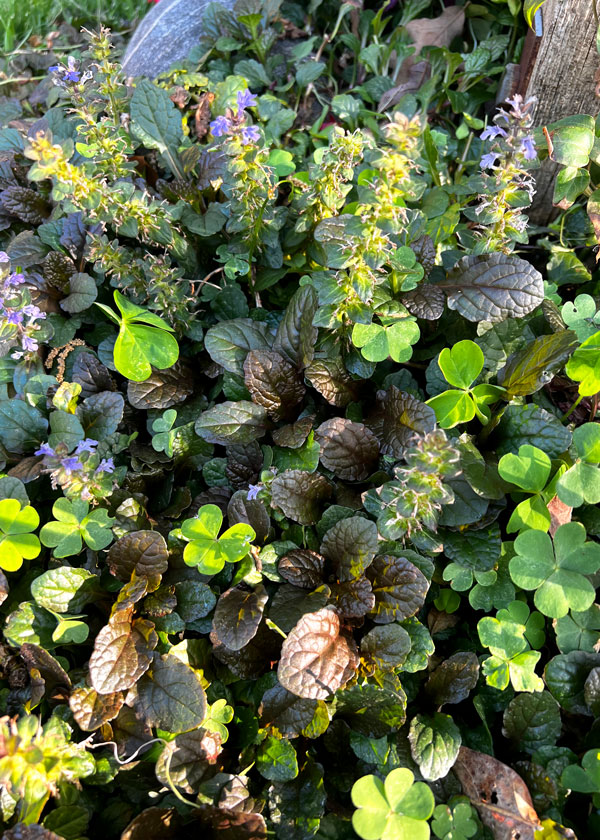
Question: How can I control wood sorrel when it is growing among other plants that are sensitive to herbicides? Mark R., Keller
Images clickable for larger views.
Answer: Indeed! You do have wood sorrel, or oxalis. It is acknowledged as being one of the most difficult of our lawn weeds to control even in turfgrass. When it grows among broadleafed plants like mondograss and ajuga it doubles the trouble.
I do not have what I would consider the perfect solution for you, but I do have two options. You could try a small (1-in.) disposable foam rubber paintbrush dipped into a tray of broadleafed weedkiller (containing 2,4-D). Squeeze the excess herbicide out of the brush and then swab the brush across the oxalis leaves. Your goal obviously will be to avoid having drips fall onto the leaves of the two groundcovers. That may be virtually impossible but come as close as you can. You might even be able to lay towels across the groundcovers’ foliage just before you treat to catch any of the fallout.
That would probably be my first method to try. But if that’s not possible for any reason, you might be able to find a small atomizer sprayer that would be precise enough to let you spray directly onto the leaves of the oxalis without drift getting onto the groundcovers. I just don’t picture such a sprayer, but you might be able to adjust the pressure on a tank sprayer down enough to accomplish it. Again, protecting the groundcover with towels would be a good idea.
Either way, or even with hand pulling, it’s going to be a challenge. The small oxalis fruits explode when they’re mature sending seeds 5-6 ft. in all directions. Keep after it! Good luck!
QUESTION 3
IS THIS A GOOD TIME TO ADD POTASSIUM TO A ZOYSIA LAWN?
Question: Is this a good time to add potassium to a zoysia lawn? Jan M., Nacogdoches.
Answer: Yes. Potassium (third number of the fertilizer analysis) is important for summer and winter hardiness. Potassium (K) often shows up as “deficient” in tests run on the sandy soils of the Piney Woods. Prime times for application would be May and again in September. Use a 3-1-2 ratio fertilizer such as 12-4-8, 15-5-10, or 18-6-12. If potash is specifically called for, add or substitute 0-0-20.
QUESTION 4
SHOULD I REMOVE THE TWO BOTTOM BRANCHES OF MY CHINESE PISTACHIO?
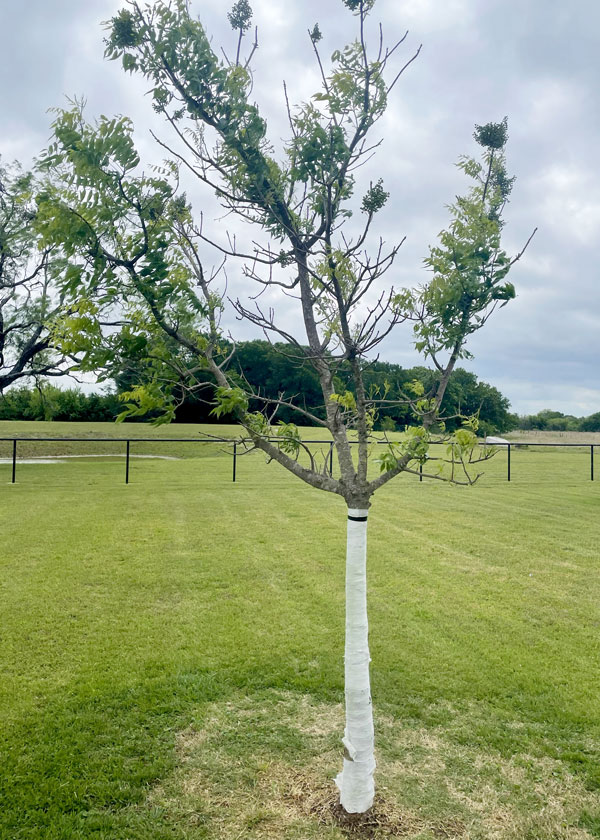
Question: My Chinese pistachio has been in the ground for 3 years. It is 10 ft. tall. The two lowest limbs are 4-1/2 ft. from the ground. Should I remove them to keep the tree’s limbs higher off the ground in the future? Dennis R., Blooming Grove, Navarro County.
Images clickable for larger views.
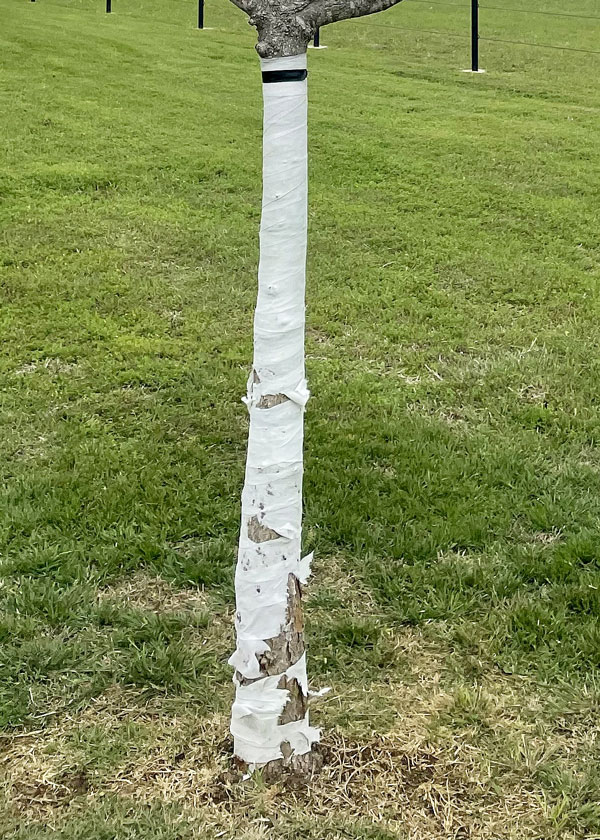
Answer: I definitely would not. Your tree needs any help the branches can give. I’m concerned about why it has not leafed out any more fully. It’s time to remove the wrap to see what is going on with the trunk. Good for you for having wrapped it. I’m concerned that I’m seeing the bark splitting where the wrap has deteriorated near the ground line. I hope it isn’t separating from the rest of the trunk. If I were on site with you as we unwrapped it I’d ask if the trunk was wrapped from the first days it was planted or if it was exposed to sun for any period of time. You’re going to know within the next few months if it’s going to recover and start growing. Dead twigs and branches can be trimmed out in the meanwhile.
Back to your original question, assuming the tree starts growing well this season, it will be just fine to leave all four major limbs. They are evenly spaced and they have strong branch angles. One branch seems to have only a few leaves. Monitor it this summer. If all the leaves die and drop you may end up needing to remove it flush with the trunk. That will still be fine. For the time being, however, let’s just see how the tree progresses.
Keep the tree properly watered as we head into summer. If you think re-wrapping it would be of any help, you could do so until it forms a better canopy, but see what’s happening in the trunk before you do. It’s obvious that you’ve tried really hard with your entire landscape. Your place looks really nice.
QUESTION 5
WHY ARE TWIGS FALLING FROM MY RED OAK?
Question: I have a red oak that lost clusters of leaves several days this month. I picked them up, and then there were more on the ground. What causes this? David Y., Rowlett.
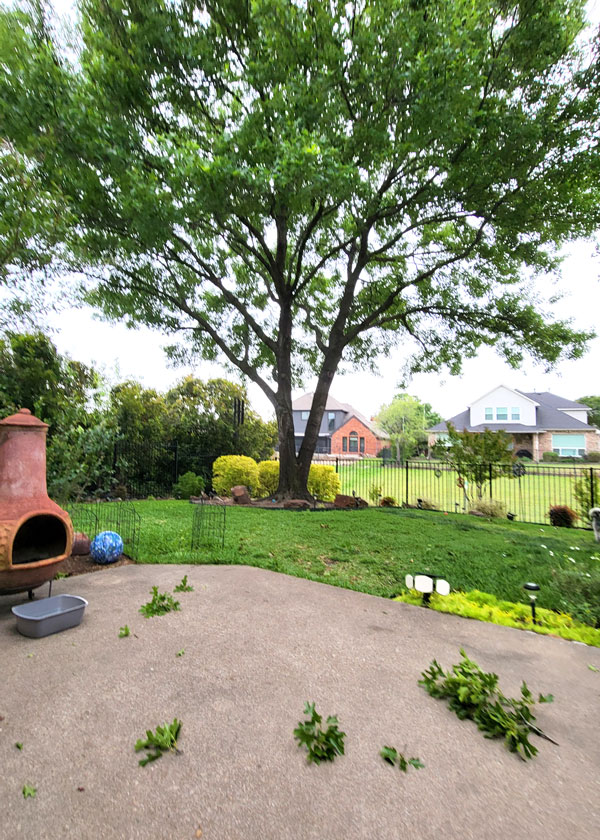
Answer: Squirrels will do this. They’re notorious for their chewing habits. They will gnaw into mature limbs and bark to keep their teeth sharpened, and in the spring, they will cut into tender new growth like this. If you see squirrels actively climbing through the tree, they’re probably to blame.
Grackles, blue jays, and other large birds are also known to snap off twigs and drop them to the ground. In our landscape, Shumard red oaks and cedar elms are their favorites.
The good news is that all of this is essentially harmless. It happens primarily in the spring. The tree will quickly replace those shoots with new growth and it will only go on for a short time. You can’t do much about it anyway, so you might as well spend your time worrying about something else. But at least you know that you’re not alone.
QUESTION 6
HOW CAN WE REVIVE OUR CAMELLIA?
Question: We have a struggling camellia. We use an acidifying 6-2-4 fertilizer, and we added compost 2 years ago when we planted it. Nothing seems to help. Do you have any ideas on how we can revive it? Amy M., Richardson.
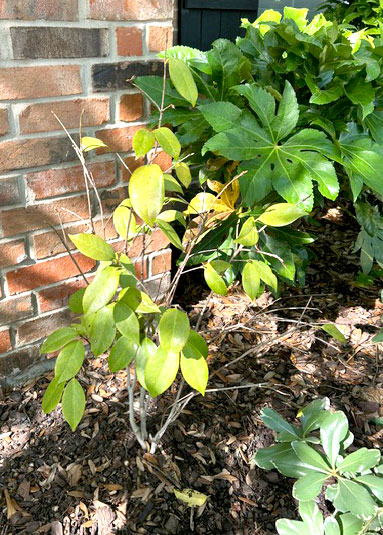
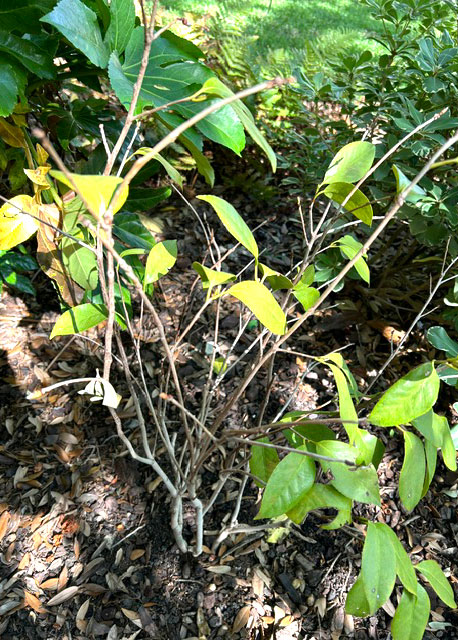
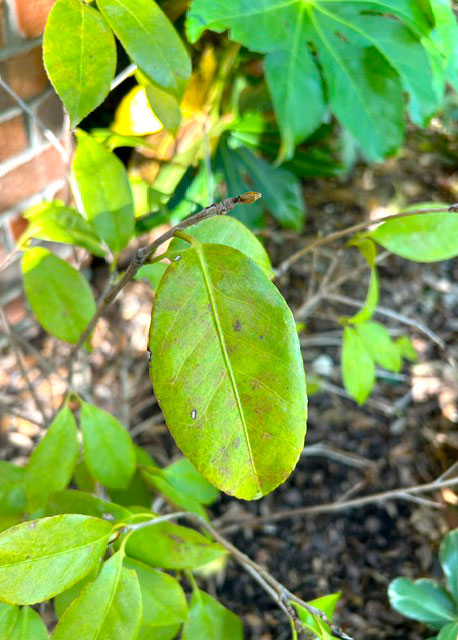
Images clickable for larger views.
Answer: It’s going to be difficult to turn this plant around. In fact, it’s difficult to grow camellias in Richardson in the first place. Soils are too alkaline and winters are too cold. You would need to replace the soil entirely with a mix of equal amounts of sphagnum peat moss and finely ground pine bark mulch. Compost isn’t nearly acidic enough.
As for the winters, you would want to grow selections of Camellia sasanqua since they bloom earlier (before the coldest parts of the winter). They’re one Hardiness Zone more durable to cold, but even they have a hard time with extreme North Central Texas winters. People who specialize in Camellia japonica selections (the larger, showier types) often grow them in large pots so they can be brought into a greenhouse over the coldest parts of the winter.
All of which explains why you seldom see camellias in beautiful bloom in the Metroplex. You have to get into the Piney Woods of East Texas.
QUESTION 7
WHAT IS THIS DAMAGE IN THE CENTER OF THE REMOVED BRANCH OF MY CEDAR ELM?
Question: I removed a lower branch off my cedar elm. The tree is 1-in. in diameter, and I noticed this damage in the center of the branch. The wood is soft, while the surrounding area is hard. The tree has grown well and appears to be healthy. Should I be concerned? Claudia E., Rockwall.
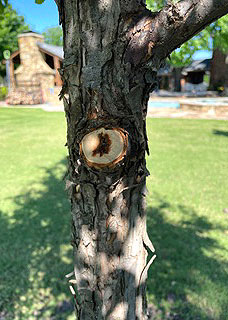
Answer: That’s probably just a small, deteriorated area that will quickly heal as new bark forms across the open wound. It should be no cause for concern. The fact that the tree is growing vigorously is your key that it’s going to be fine.