
Q&A – Ask Neil: May 7, 2026
(Please read these instructions carefully.)
Before you post your question, please look at recent issues to see if someone else has already asked it. You might find your answer there.
HOW TO SUBMIT YOUR QUESTION…
• Click here to post your question. (Please post your question only one time.)
• Please use this link only for posting questions – not for standard e-mails.
• High-resolution photos (1-2MB – not thumbnails) attached with your question help Neil give you the best possible answer. Please check your photo for clarity and exposure. If you do not see “All images clickable for larger views,” your images’ resolution was not sufficient for enlargement. That might also have made it difficult for Neil to give you an accurate answer.
• Neil chooses questions of greatest reader interest. Plant IDs rarely fit that description.
• Neil requires your first name or initials, also your city or county for an accurate answer. (Texas is a very large state.)
• One question per reader per week, please.
• Watch for Neil’s reply in the next issue of e-gardens.
Note: If you have submitted your question and did not see the pop-up window for attaching your photo, please click here.
QUESTION 1
WHAT CAN I DO TO CONCEAL THE ROOTS?
Question: I have a beautiful magnolia tree in my front yard, but the roots are exposed up to my sidewalk. Is there anything I can do about it? Can I create a flowerbed and cover the roots with soil? Lee Ann R., Burleson.
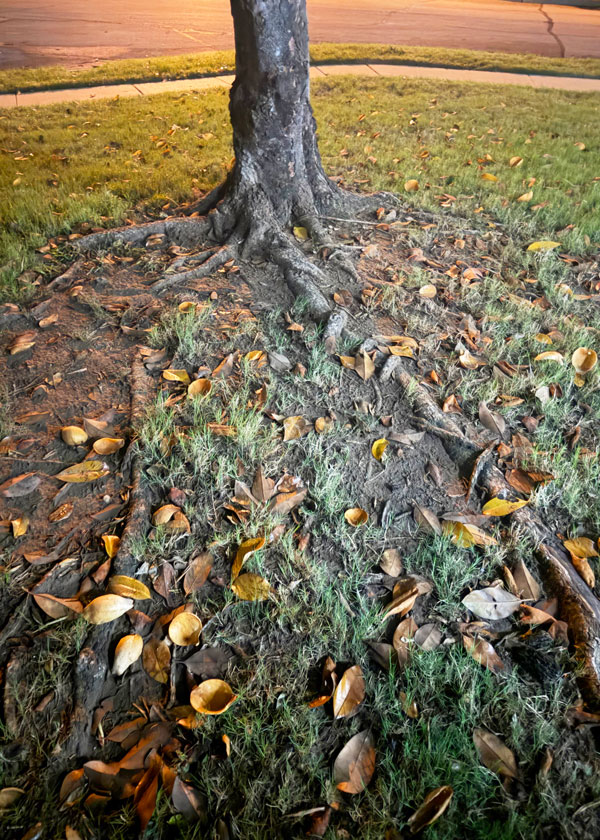
Answer: What you are seeing is absolutely normal. 90 percent of any tree’s roots will be in the top foot of soil. That’s where rainfall hits, and nature has provided surface roots so that trees can get moisture after rains. Sure, trees have tap roots, but they’re not the main source of water. Their function is to anchor their trees.
If you were to put a layer of soil over the roots, they would just grow larger and push their way through it. You would end up in 3-5 years wanting to do it again.
The bigger worry is that in doing all that, you run the risk of killing critical roots by putting them too deep in the soil. They will literally suffocate.
Your solution, since your turfgrass is thinning anyway, is to create a bed at this current grade level and plant a shade-tolerant groundcover such as regular mondograss, English ivy, purple wintercreeper, or liriope. Of that batch, I prefer and have used primarily mondograss. It does not have any runners so I can easily blow leaves and other debris out of it. It has a fine, grass-like texture, and it thrives in the shade. You can plant it at any season. I have probably ¼-acre of mondograss beneath our pecans and oaks.
QUESTION 2
WHAT IS THIS ON RUELLIA, AND HOW DO I GET RID OF IT?
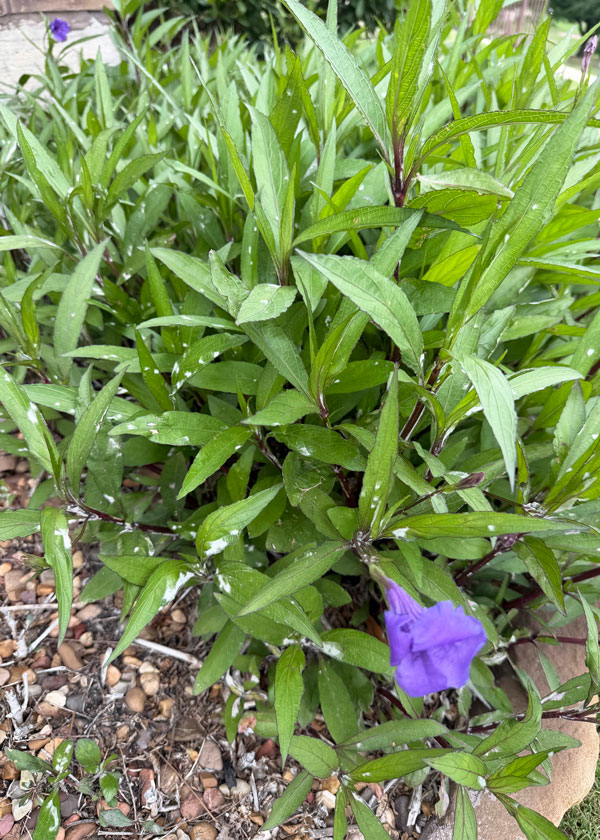
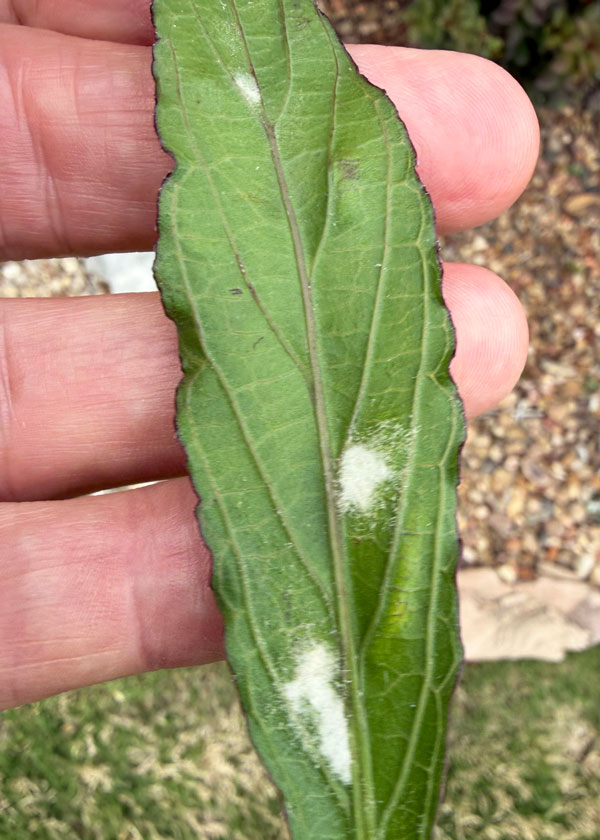
Question: My ruellia plants have a white scale on them. It isn’t a web, nor does it scrape off. Should I try drenching it, or what other suggestions do you have? Jim D., Parker County.
Images clickable for larger views.
Answer: Do you remember our old friend Rose Rosette Virus? It’s caused by a wind-driven, microscopic mite that carries the virus and attacks healthy roses without our ever knowing it’s around.
Well, welcome to another eriophyid mite. This is a gall mite that feeds of the leaves of ruellias and causes the plants to produce these fuzzy white patches as a response to the feeding. The extremely tiny mites live inside that impervious material. You don’t see them, and you can’t get products to them to kill them.
Here is what the University of Florida has to say about the whole sordid affair. It explains it all, so there’s no need for me to repeat it.
QUESTION 3
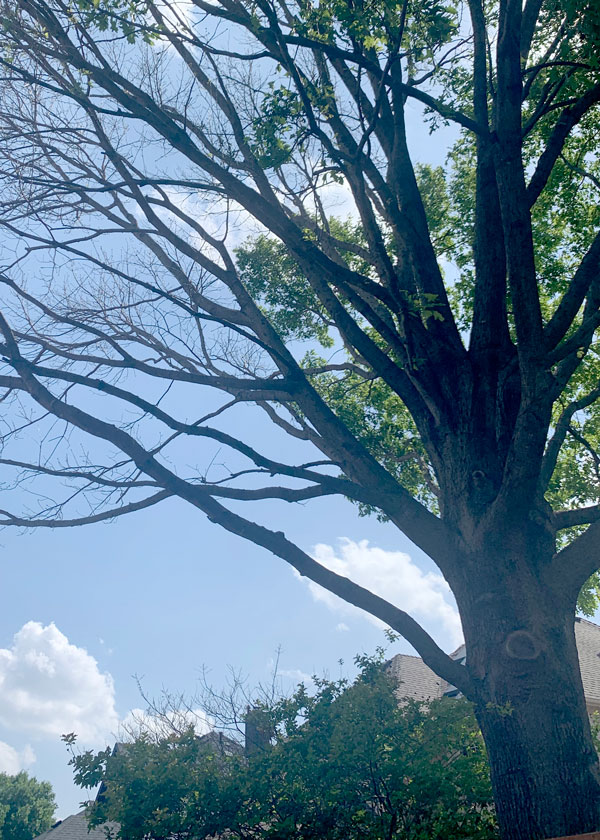
WHY IS ONE SIDE OF MY RED OAK NOT LEAFING OUT?
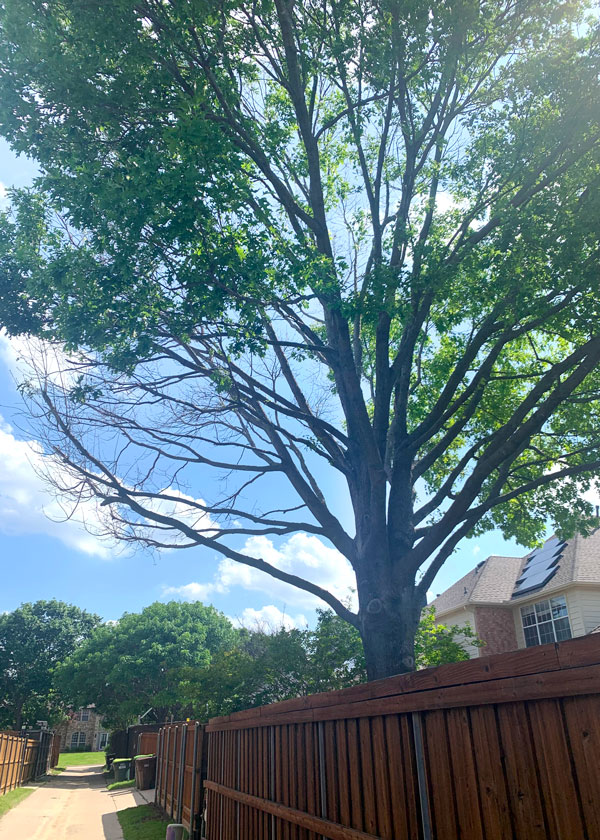
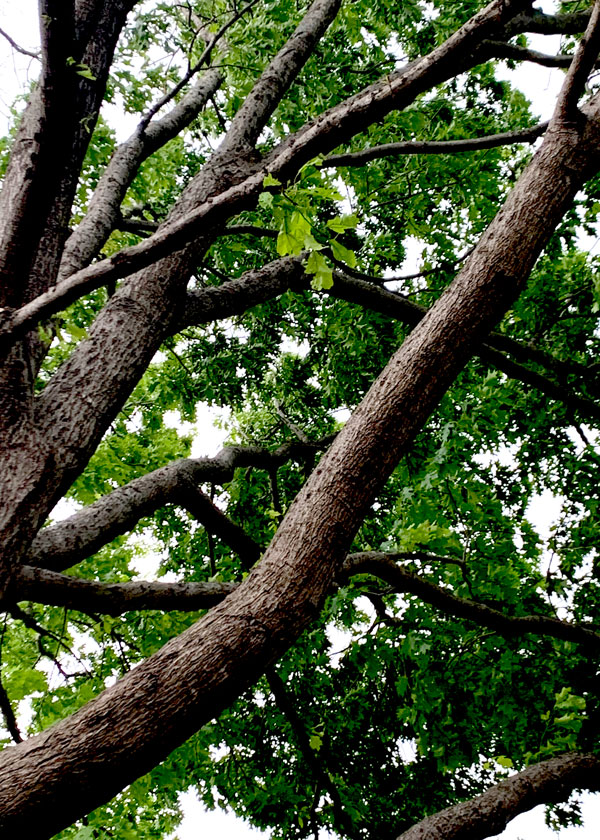
Question: Can you determine why one side (southeast) of my red oak has not leafed out this spring? It was heavily trimmed in the fall. Could it be in shock? I don’t see any difference in the bark. It was healthy until this spring. Kathie H., Plano.
Images clickable for larger views.
Answer: I have brightened your photos in an attempt to see the trunk wood better. If the tree was completely normal before the pruning, then it should have had no impact.
I actually did the photo brightening after I composed my reply (a mistake). I can see evidence of deterioration of the trunk on the dieback side. It’s so dark, however, that I can’t tell what might have happened. It could have been a stub of a branch that didn’t heal properly. Something is wrong fairly far up. You need to have a certified arborist out to look as soon as possible. If you have one who works with your trees already, get them on the schedule. If not, our advertiser here in e-gardens has specialists who work with oaks all the time.
With that said, here is what I had already written. I might as well leave it for you to see…
All I can do is speculate with some thoughts. The angle between the two major branches is very narrow. That’s normally not a good thing because it can cause pinching of debris as the major branches grow larger.
I also wonder about the root system on the alley side of the tree. Could anything have been done to a major root there that would have hurt the tree? That might even involve a weedkiller or gas leak near the fence. Examine the trunk closely on the fence side to be sure there is no damage in that area.
QUESTION 4
WHY WOULD HALF MY MEXICAN PETUNIAS (DWARF) BE FINE AND THE OTHER HALF SICKLY?
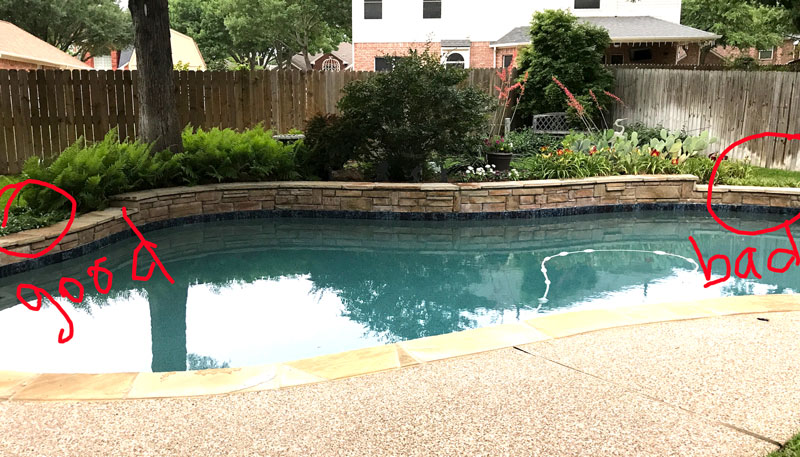
Question: What’s wrong with my Mexican petunias (Ruellias)? One side is great, the other side is not. Help! Wendy J., Tarrant County.
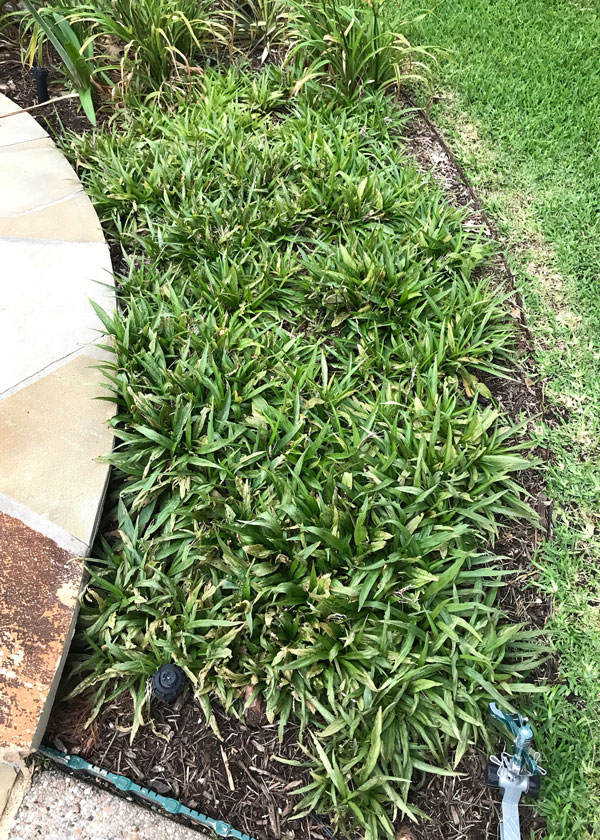
Answer: In an entire career, I don’t think I’ve ever had two ruellia questions on the same day. Your Katie’s dwarf Mexican petunia is a winner. Let’s try to get the one half doing better.
Things I notice…
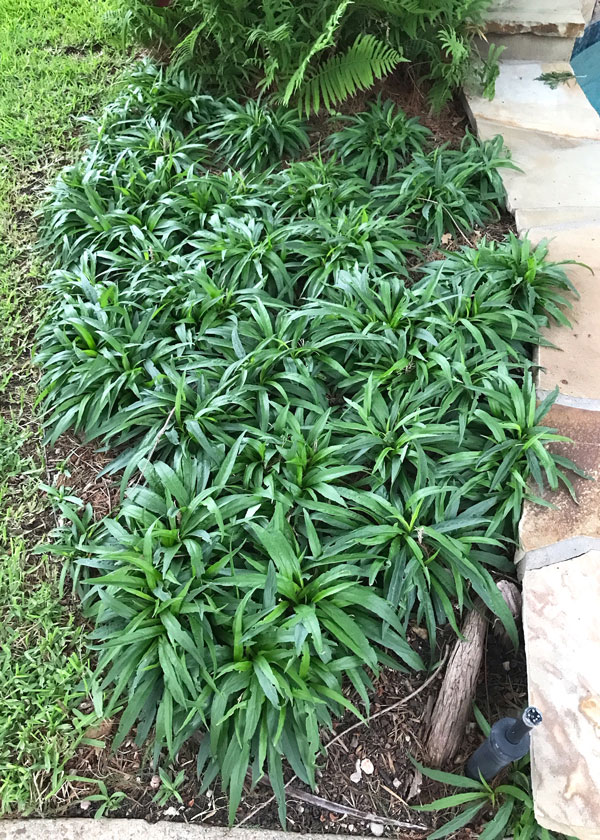
It’s not just the Mexican petunias in the bed that are struggling. The liriope (I believe) seems to be burned as well. By comparison, you have ferns with the other ruellias in the second bed. Ferns would need more shade to look that happy. Is that bed getting more shade?
Looking at the sprinkler heads that are watering the two beds, it looks like the “happy” bed’s head stands farther above it. The other bed’s head seems lower. Perhaps it is blocked as it waters those plants. That entire bed, ruellias, liriope, and all, looks like it’s been dry.
I don’t believe insects or diseases are involved. They wouldn’t impact these unrelated plants, nor would they hit the entire planting in that one bed. I think this has to be environmental. It could be bed preparation that has worn out. It could be reflected heat or drought. Maybe weedkiller drift or runoff into the bed.
And again, I composed my reply to you before I edited the photos. In fact, I missed your horizontal photo entirely. Now that I’ve seen it – wow! One end of the bed is a shade garden with shade and ferns. The other is a xeriscape garden with red yuccas and opuntias. (And daylilies, not liriope.) I’m sure the preparation for the two beds must have been different, and the exposure to sun certainly is. Katie’s dwarf thrives in the sun. That’s where I have mine growing. But the difference in the water needs of the two ends of that bed would be significant. You might consider using the weak plants in another bed somewhere else in your yard and replacing them with something that would hold up better alongside the other plants.
QUESTION 5
WHY DOES THIS JAPANESE MAPLE CONTINUE TO DO WELL?
Question: This Japanese maple (assuming it to be ‘Bloodgood’) has been at a local garden center for several years. It continues to do well. It receives sun until 2-3 p.m., southern winds, and reflective heat from the parking lot. Why do you think it has done so well? Soil? Heath T., Whitesboro, Grayson County.
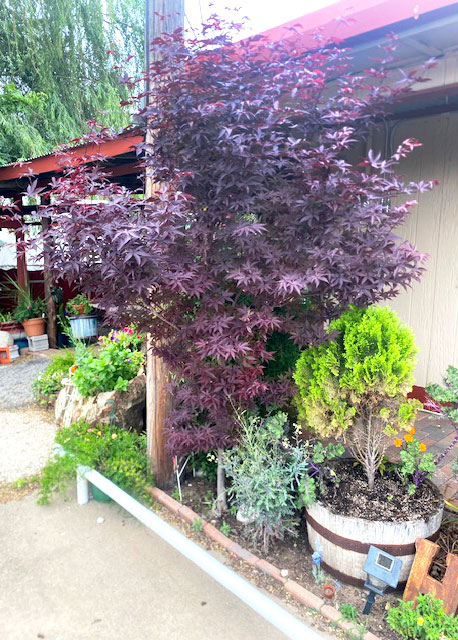
Answer: It could be the soil. Grayson County has both Blackland alkaline clay and the red sandy clay loam that Japanese maples love. Nurseries also know how to care for their plants perfectly, plus it’s tucked right up in a corner.
Note that your photos were probably taken this spring (judging by the ornamental cabbage/kale bolting to flower in your photo). We’re seeing the maple at its very best now. We also need to watch the angle of the sun as the summer progresses. It may get sun until early afternoon now, but it could be a different story by mid-June. That’s fairly common. Finally, those shoots at the top of the plant will really tell the story. If they start to scorch and burn 6 or 7 weeks from now, we’ll have our proof that it really needs a bit more protection.
(Finally, to address the unasked question, it looks like their arborvitae has spider mites moving up from its bottom.)
QUESTION 6
WHY ARE MY POST OAKS LOSING PATCHES OF BARK?
Question: My post oaks are experiencing bark loss. The trunks look as spotted as a Dalmatian. Could squirrels be causing this? The canopies of leaves look healthy. I see no evidence of pests or diseases. Linda J., Irving.
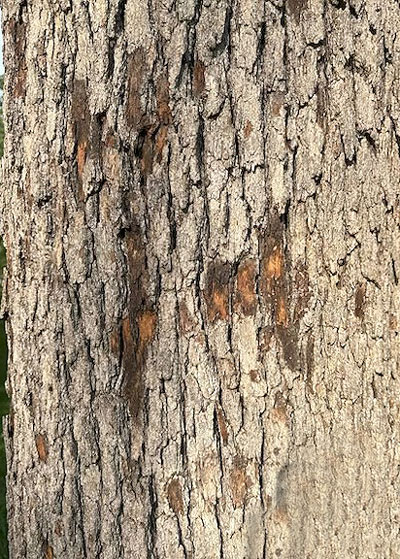
Answer: I think first of Hypoxylon canker, a fungus that attacks post oaks that have been under stress such as the biblical drought of 2011. But I don’t think this is quite that extreme.
I also don’t see any signs of woodpecker holes that would suggest they’ve been aggressive with the tree. They could have been knocking pieces loose. I guess squirrels could do this, but it’s not their normal type of work.
Bark is a dead tissue. As a trunk or branch grows larger, the bark cannot expand. It pops and sloughs off. New bark forms directly beneath it, and that may very well be what is happening here. Again, however, the plates of bark don’t look quite right for that.
If you are seeing a lot of this up and down your street, you might talk with a few neighbors. It might be a good idea to invest in a certified arborist to examine your trees just to make sure there isn’t a specific problem that needs to be addressed. You could also watch things for a couple of weeks and see if the trees don’t start producing new bark over these “wounds” right away.
Hope that helps.
QUESTION 7
WHY IS ONE LITTLE GEM MAGNOLIA LOOKING SO DIFFERENT?
Question: I have two Little Gem magnolias growing side by side. They were planted at the same time. One has lost most of its leaves, but the other has not. Do you have any idea why this would have happened? Will the weaker tree survive? Mohammed K., Prosper.
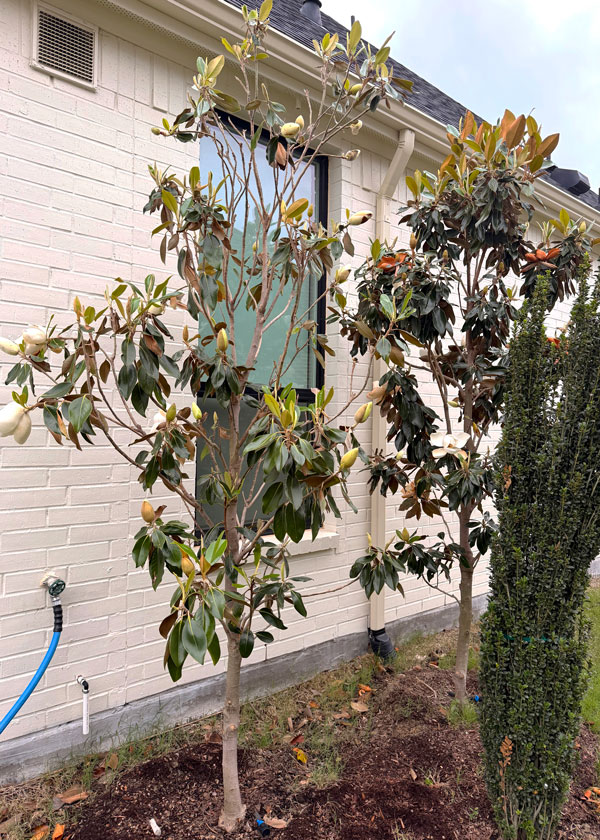
Answer: The only thing that would have caused this is that the one weaker tree got too dry one or more times before or after planting. It is not related to any insect or disease problem. (I just like to get that stated and out of the way.) All it takes is one such event and a magnolia will take a couple of years to recover. Nitrogen fertilizer and abundant water are your best solutions.
And, another answer to an unasked question is, “Yes, these trees are far too close to your house and its foundation.” Little Gem magnolias grow to be 25-35 ft. tall and 20-25 ft. wide. They should be at least 10 ft. out from the house. (Please forgive me. I just couldn’t stop myself.)