
Q&A – Ask Neil: May 14, 2026
(Please read these instructions carefully.)
Before you post your question, please look at recent issues to see if someone else has already asked it. You might find your answer there.
HOW TO SUBMIT YOUR QUESTION…
• Click here to post your question. (Please post your question only one time.)
• Please use this link only for posting questions – not for standard e-mails.
• High-resolution photos (1-2MB – not thumbnails) attached with your question help Neil give you the best possible answer. Please check your photo for clarity and exposure. If you do not see “All images clickable for larger views,” your images’ resolution was not sufficient for enlargement. That might also have made it difficult for Neil to give you an accurate answer.
• Neil chooses questions of greatest reader interest. Plant IDs rarely fit that description.
• Neil requires your first name or initials, also your city or county for an accurate answer. (Texas is a very large state.)
• One question per reader per week, please.
• Watch for Neil’s reply in the next issue of e-gardens.
Note: If you have submitted your question and did not see the pop-up window for attaching your photo, please click here.
QUESTION 1
CAN I REMOVE TWO TRUNKS WITH EXTREME ANGLES FROM MY HOSKIN SHADOW YAUPON HOLLY?
Question: My Hoskin Shadow is in a prominent location and has two extreme trunk angles. They are really obvious and I would like to remove them, but I’m concerned it will leave large holes in the canopy and disfigure the trunk area. Your thoughts? Don M., Aledo.
Answer: Oh, what I would have given for a photo or two. I have two Hoskin Shadow yaupons myself, and they do have very prominent branching. Mine, however, are not distracting.
My thought would be that if you do not do something you’re going to be unhappy with the plant for many years, perhaps forever. You might as well give it a go. Trim them where you want a new shoot to emerge. Leave some green growth in place on the plant to act as a nurse to keep the plant going. This would have been better if you could have done it before the surge of spring growth, but it should still work. Just be patient. Follow the pruning with a feeding of high-nitrogen lawn-type fertilizer and a deep soaking.
QUESTION 2
HOW CAN I ELIMINATE CAROLINA SNAILSEED VINE FROM MY FLOWERBEDS?
Question: Carolina snailseed showed up in our flowerbeds a few years ago. I thought it was nice, so I decided to keep it. My wife told me I’d be sorry and that I ought to remove it. Turns out she was right. How can I get rid of it now? Jim V., Fort Worth.
Answer: It’s perennial, meaning it comes back from that tenacious root system that fills the top of the soil. If you have access to the ground with a small nursery spade, dig the roots out. Don’t leave any small pieces or they will resprout. If it’s growing up into shrubs you may have to cut it off at the ground line and paint the new leaves with a brush killer applied with a foam rubber paint brush. Keep the herbicide off any desirable green foliage to avoid damage. You might be able to apply the same weedkiller to the freshy cut stems each time that you cut them off. Eventually you can make headway.
I’ve had good luck using weed-blocking landscape fabric applied like shingles to the surface of the soil to keep it from getting a fresh start with new growth. I overlap the pieces by 3-4 in. so the vine can’t sneak its way up through the fabric. I conceal the fabric with 1 in. of bark mulch. The vine is usually gone after 12-24 months. In the meantime, trim off all clusters of berries before they turn red. Birds quickly devour them when they’re ripe. They “plant” them and feed them all in one action and your problems start all over again.
QUESTION 3
HOW WOULD EPIMEDIUM BE AS A GROUNDCOVER HERE?
Question: I need a groundcover for this large bed in our front yard. I ran across a plant called Epimedium that interests me for its textures and colors. How would it be? Sharon H., Fort Worth.
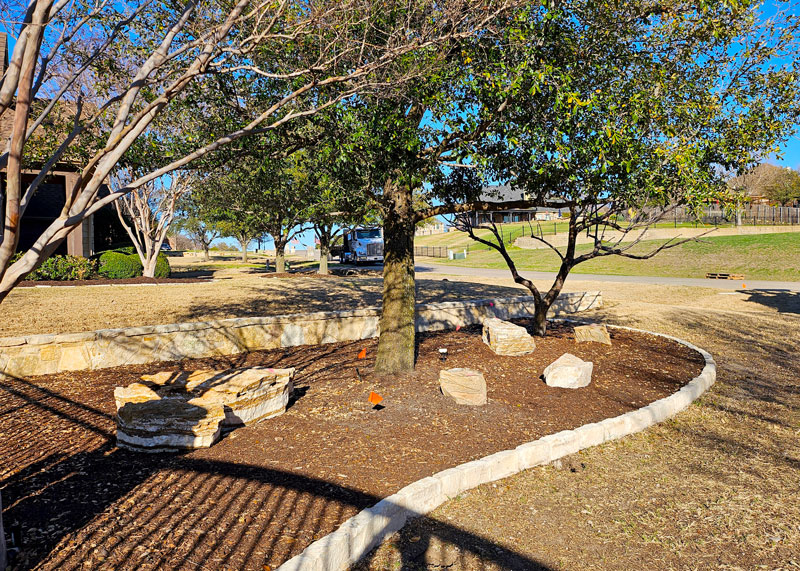
Answer: As you said, you have a large bed. I don’t believe it’s a good match. The various cultivars grow from 6 to 24 in. tall, and they come in a big variety of leaf and flower textures and colors. I would think you’d want something more uniform. They also bloom primarily in the spring and into the summer. That’s going to leave you a lot of “down” time.
You would be better off using just one variety of Epimedium as a clump along with other shade-loving perennials, shrubs, and groundcovers. Or you could just use a simple groundcover for the majority or all of the bed. I’ve used a bunch of regular mondograss (Ophiopogon) in this kind of planting, also its larger-leafed sister Liriope. English ivy is great for the shade, and purple wintercreeper and Asian jasmine would also do well here.
QUESTION 4
IS THIS POISON IVY?
Question: After reading your story on poison ivy I came across this vine in my yard. I thought it was poison ivy, but a chat box identified it as passionflower. I don’t think poison ivy has this kind of tendrils. What is this? Joe B., Llano.
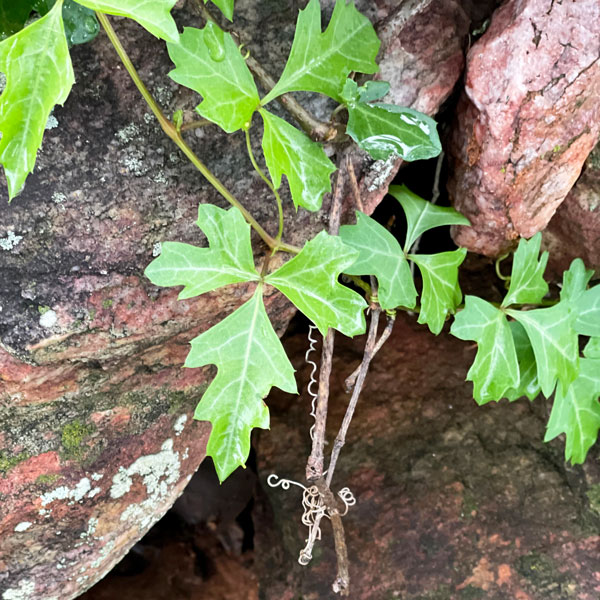
Answer: It is neither of those two. You have a pretty native vine called ivy treebine (Cissus trifoliata). I first saw it growing in the limestone slopes of the Hill Country as I worked alongside my dad as he did herbicide research for Texas A&M in Kerr, Real, and Uvalde Counties. I grew it in my landscape back in College Station and enjoyed it. However, it can overwhelm shrubs and fences, so you don’t see it used very often. No, it’s not poison ivy. It’s a relative of grapes.
QUESTION 5
WHAT FLOWERING SHRUB WILL GROW IN SHADE BENEATH MY CRAPE MYRTLE?
Question: What can I plant beneath a large crape myrtle that would be fairly tall and bloom? I was thinking of a hydrangea, but I see that they require full sun and this is 95 percent shade. Any ideas? Carol K., Arlington.
Answer: Flowering shrubs (except crape myrtles) will be in bloom for 2-4 weeks per year. You could try your hydrangeas. That suggestion for “sun” for them must have been written for some other part of the country. In Texas they do better with shade.
However, I’d suggest you use either leatherleaf mahonia for its bright yellow late winter flowers and steel blue clusters of fruit in spring, or even better, dwarf Burford hollies for their evergreen leaves (nice around the deciduous crape myrtle) that are covered with bright red berries from November until April. Both of those plants are great in the shade.
QUESTION 6
CAN I PRUNE THE LOWEST LIMB ON MY MAGNOLIA NOW?
Question: Is it OK to trim the lowest limb on my magnolia tree now, or should I wait until a different time of the year? If I need to wait, when is the best time? Lisa L., Garland.
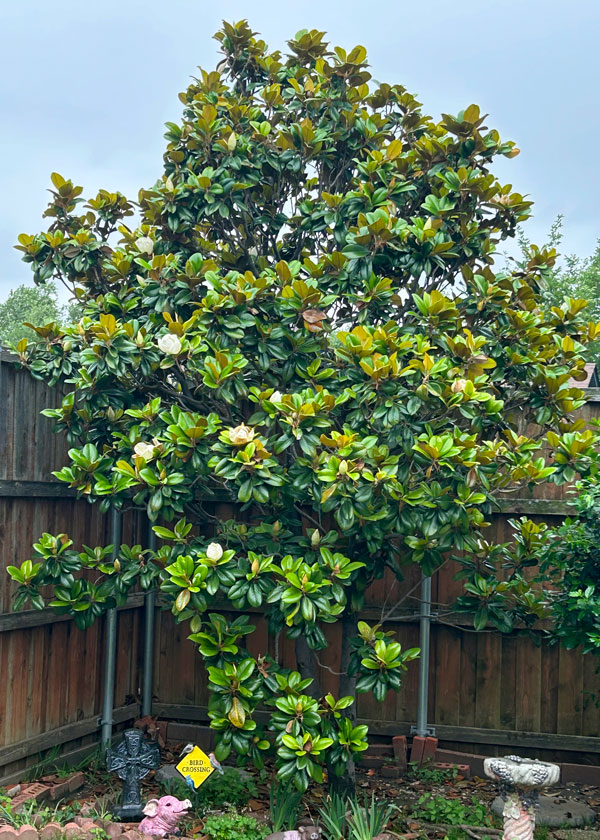
Answer: That kind of pruning to that branch can be done at any time – including now. Make the cut flush with the trunk. Do not leave a stub.
QUESTION 7
HOW CAN I GET GRASS TO GROW BENEATH MY OAK TREES?
Question: The HOA has ruled the lack of grass beneath my oak trees must be remedied or I will be fined. What do you recommend since summer is approaching along with water rationing? Elle K., Collin County.
Answer: It’s been my long-held opinion that HOAs need to take a basic course in agronomy. They typically demand that two shade trees be planted in every front yard. Some are barely large enough for one tree. Oaks are high on their approved list (as well they should be).
At the same time, they demand that turfgrass must be maintained over the entire front yard.
What HOAs fail to realize is that our most shade-tolerant lawngrass is St. Augustine, and it must have 6 hours of direct sunlight daily to survive. There is no negotiating.
The Houston Astros discovered back in the 1960s that grasses must have their minimum sunlight requirements met or they will thin and die. The groundskeepers couldn’t get grass to grow in the portions of the Astrodome where they had to install shade to reduce glare for the outfielders. Astroturf was the outcome.
News must travel slowly to HOAS. They do not seem to have figured this sunlight thing out in 2026, almost 60 years later.
When shade becomes excessive, and HOAs require that homeowners repeatedly buy new sod every year to fulfil their impossible rules, it leads to very hard feelings and thousands of wasted dollars.
The best solution, as you’ve perhaps seen me write here before, is to design a handsome landscape using shade-tolerant low shrubs and groundcovers. It can be beautiful and functional, and done once and done properly, it can be a showstopper for the neighborhood.
I’m not a loud or demanding sort of person, but the facts are the facts. We do not have a miracle grass! If grass fails because of too little sunlight, there is no other solution.
I do not live in an area with an HOA. We have lived in our current rural home for 48 years. Our landscape has evolved from bermuda turf to St. Augustine and finally to 100 percent groundcover and shade-loving shrubs. It can be done!
You are welcome to quote me.
QUESTION 8
WHAT CAN I DO FOR FUNGUS ON MY PEAR TREE?
Question: My pear tree has fungus that looks like what gets on cedar trees in the spring. What can I do? Ken, Crockett.
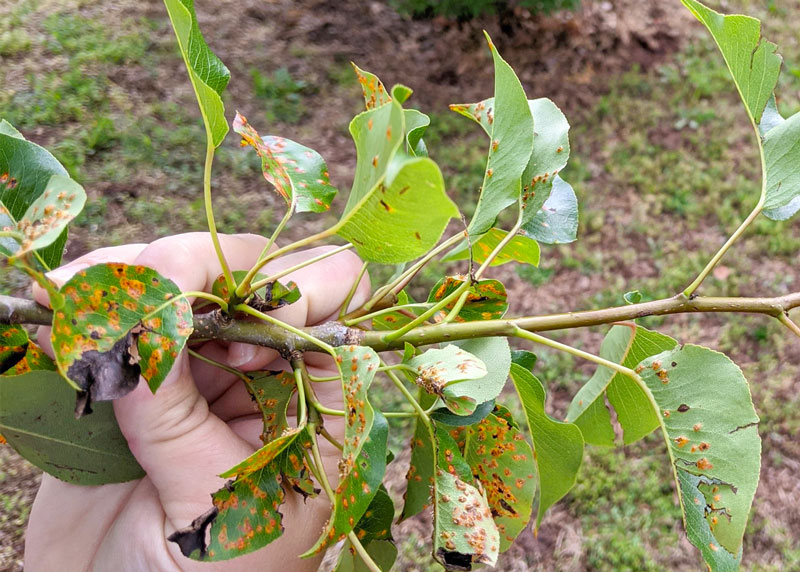
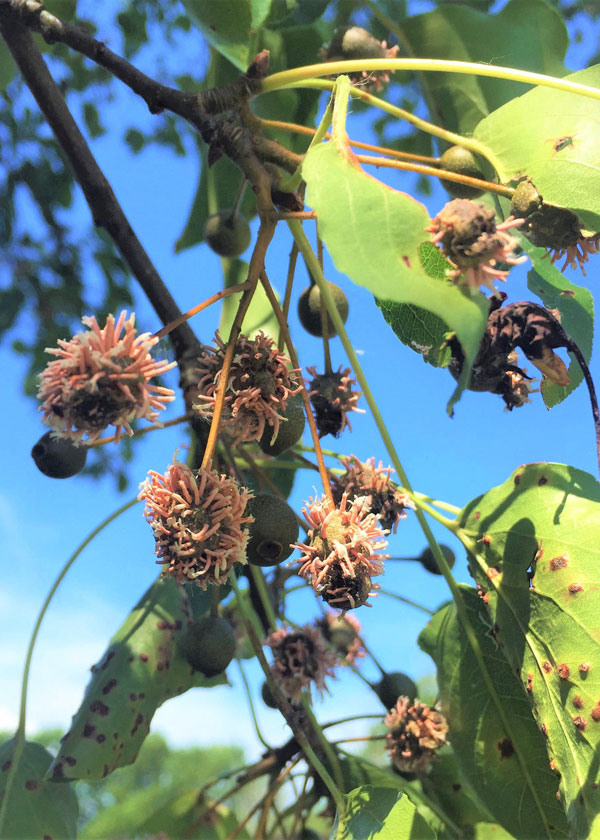
Answer: Ken called my radio program Saturday morning. I told him this sounds like the cedar-pear rust that is comparable to cedar-apple rust that we commonly see when we try to grow apples near native stands of eastern redcedars or other junipers.
Perhaps it is more common than I had known, but I didn’t get calls or notes on this one until a few years ago and then I had a barrage of them. I told Ken I wanted to do a little online searching to find him a good write-up on the disease. Oklahoma State University has the best one. As I feared, dealing with it is a bit complicated. I’m just going to let the OSU folks give all the details. They also have excellent photos.