
Q&A – Ask Neil: June 25, 2026
(Please read these instructions carefully.)
Before you post your question, please look at recent issues to see if someone else has already asked it. You might find your answer there.
HOW TO SUBMIT YOUR QUESTION…
• Click here to post your question. (Please post your question only one time.)
• Please use this link only for posting questions – not for standard e-mails.
• High-resolution photos (1-2MB – not thumbnails) attached with your question help Neil give you the best possible answer. Please check your photo for clarity and exposure. If you do not see “All images clickable for larger views,” your images’ resolution was not sufficient for enlargement. That might also have made it difficult for Neil to give you an accurate answer.
• Neil chooses questions of greatest reader interest. Plant IDs rarely fit that description.
• Neil requires your first name or initials, also your city or county for an accurate answer. (Texas is a very large state.)
• One question per reader per week, please.
• Watch for Neil’s reply in the next issue of e-gardens.
Note: If you have submitted your question and did not see the pop-up window for attaching your photo, please click here.
QUESTION 1
HOW ARE ALFALFA PELLETS AS A FERTILIZER?
Question: Scale of 1-5, with 5 being “excellent,” how would you rate alfalfa pellets as a lawn fertilizer compared to granular? Same question for perennials. M A C, Tarrant County.
Answer: Like other organic fertilizers, alfalfa pellets have a low nutrient analysis in the range of 3-1-2. Remember, that’s actual percentage of nitrogen, phosphorus, and potassium, not the ratio of the three major nutrients. From that standpoint, they’re going to give modest results in terms of stimulating growth and flower and fruit production. On the other hand, they are a source of organic matter, and they won’t burn plants’ roots, plus they will provide their nutrients for a long period of time.
You asked my own personal opinion. I do not use them, nor do I recommend them as a prime means of feeding plants. Nutrients go into plants’ roots in water solution by osmosis. Plants don’t differentiate between organic and inorganic origins, so I prefer to use inorganic fertilizers that have a higher analysis. I choose types that are very high nitrogen (or all-nitrogen), with 30 to 40 percent of that nitrogen in slow-release form. That gives my plants quick and sustained feeding and enough nutrients to keep them growing for many weeks. I use organic sources such as compost and rotted manure to improve the soil structure more than I do for the nutrients they contain. My score would be a “1,” maybe “1.5”
QUESTION 2
WHAT CAN YOU TELL ME ABOUT A GOLDEN RAINTREE CALLED ‘SEPTEMBER?’
Question: (Summarized from a lengthy e-mail.) I am growing a variety of golden raintree called ‘September’ because it blooms in early fall. I’m a beekeeper and I need flowering plants at that season. I understand it came from a college campus in another state. I got a bunch from a man in Sherman and am growing them now. I have 25 and hope to sell them for $10 each. I’m planning on growing many more. Any comments? James B., Pilot Point.
Answer: Be very careful. That selection was made back around 1960 on the campus of Indiana University where winters are very cold. My degrees are from Ohio State (also very cold), and regular golden raintrees (Koelreuteria paniculata) did well on the OSU campus. They are the types that bloom earlier in the season. By September trees were getting ready to shut down for fall in that climate.
If you saw the note at the end of my story last week on golden raintrees, you saw the information about southern golden raintrees, also called Chinese flametrees (K. bipinnata). It does well in South Texas where it blooms in August and September. It has been tried in North Texas where you are, but it is not reliably winter hardy.
There is discussion online that the cultivar ‘September’ is probably a hybrid of the two species. It is noted that it never caught on well in the nursery trade due to its poor shape – that its sole selling point was its late blooming time. And, a second late bloomer called ‘Rose Lantern’ that was introduced about the same time may also be an offspring of Chinese flametree, therefore not reliably winter hardy. Be very careful before you start selling them.
QUESTION 3
WILL CEDAR OIL AND CEDAR MULCH GET RID OF CHIGGERS?
Question: We are having a horrible time with chiggers in our landscape and in the St. Augustine in the front yard. Will cedar oil and cedar mulch get rid of them? RuthAnn H., Plano.
Answer: It’s very rare for chiggers to be a problem in St. Augustine. They’re usually confined to bermuda and other types of turfgrass. Double check to be sure you haven’t stepped out into a vacant lot, a park, or a playground somewhere else. It takes 12-36 hours for them to make their presence fully known. By then you might have been any of a dozen other places.
As for using the cedar oil and cedar mulch, they probably will help, but I prefer to apply DEET repellent to my feet and legs, shoes, socks, and pants. It’s a lot easier and more dependable just to do that each time I want to go outdoors than it is to apply mulch and keep reactivating it with the garden rake. I can treat my own clothes and body more easily than I can treat every last place I might want to walk and work. You also keep mosquitoes away with DEET, and that can be a life-saving benefit.
QUESTION 4
WHAT IS THIS, AND HOW CAN I ELIMINATE IT FROM MY BERMUDA TURF?
Question: I’m seeing this all over my bermuda lawn. I’ve used 2,4-D, but it keeps coming back. What will destroy it? CHIA LIAO, Little Elm.

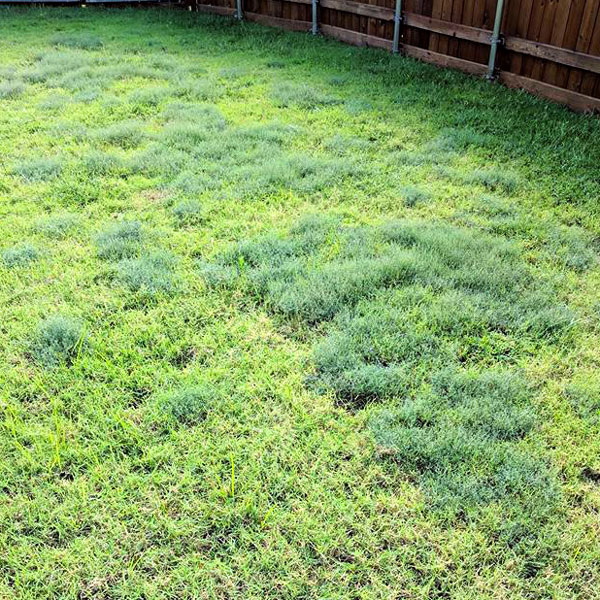
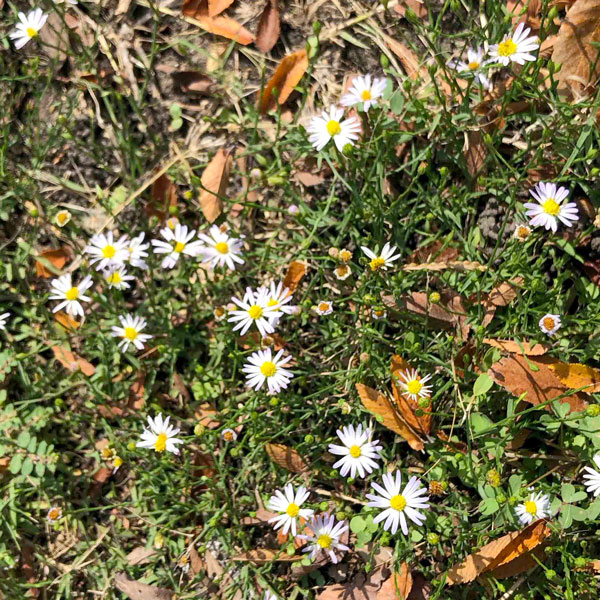
Answer: I’m pretty sure what you have is the lush summer growth of roadside aster. I’m going to give you a photo a reader posted 9 years ago. It looks similar to yours. That’s what he had, and it was roadside aster. I’ll also give you a fall photo to show you how it blooms starting in September and October.You may remember seeing those blooms in your lawn last year. If so, that confirms what you have this time. The plants make quite a transition from the lush summer foliage to the wiry fall blooms. Some folks refer to it as a “pretty wildflower,” but two weeks later, when it has finished blooming, they realize what a noxious pest it is. The 2,4-D broadleafed weedkiller spray you have used is the right thing. You say, “It keeps coming back.” If you are killing it with the spray, keep after it. You’re either seeing subsequent seedlings or you’re not getting good coverage with the herbicide. Don’t let it bloom and go to seed.
QUESTION 5
CAN I USE TIMED-RELEASE FERTILIZER IN ADDITION TO WATER-SOLUBLE PLANT FOOD FOR MY CONTAINERS?
Question: When you suggest water-soluble fertilizers for potted plants, can we also add timed-release granules in between? What would the timing be between feedings? Cindy P., San Antonio.
Answer: I do both. I start out the season with a timed-release product and I use the water-soluble plant foods every other time that I water my pots. The two schedules run concurrently.
Remember, too, that timed-release products often release their nutrients more quickly in Texas’ hot weather. If it says it will feed over a 90-day period, you’d better figure it will last for 45-60 days when it’s hot.
QUESTION 6
WILL MY CRAPE MYRTLES EVER RECOVER FROM THE COLD?
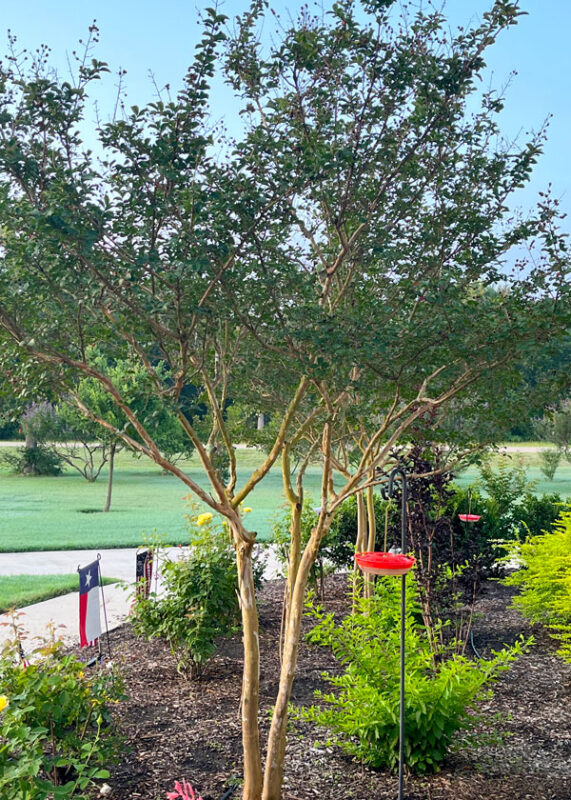
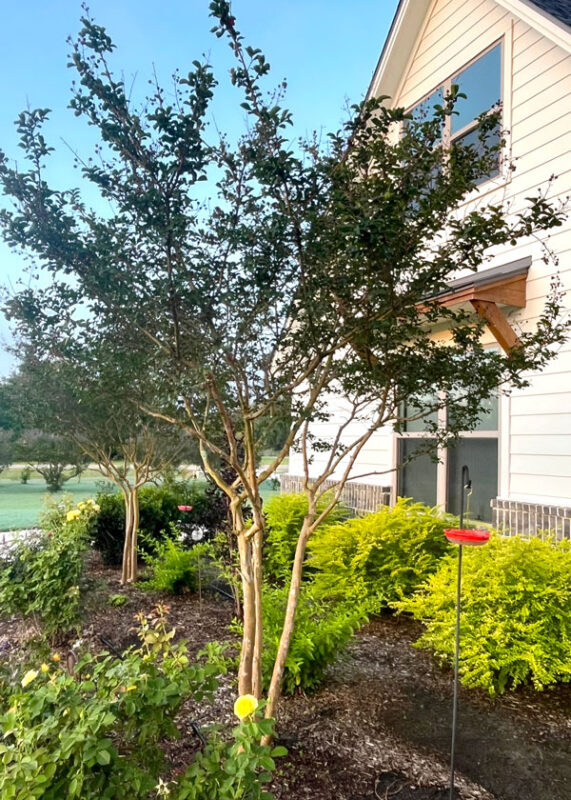
Question: My poor crape myrtles have not been the same after the freezes. I’m not sure of the variety, but they’re a dark purple. I’ve put a fertilizer on them, and they get great water. Is there hope? (The one that is blooming is a volunteer.) Kim M., Grimes County.
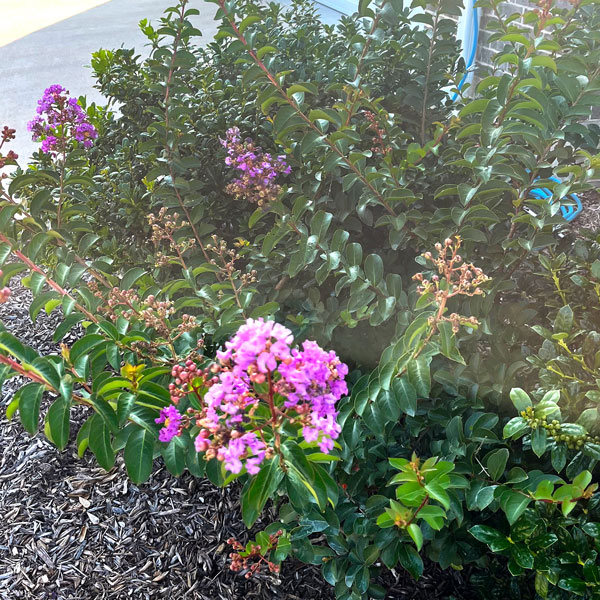
Images clickable for larger views.
Answer: I live much farther north than you do, and I’m sadly familiar with freeze damage to varieties like Tuscarora (rose-red), Natchez (white), and Muskogee (pale lavender-pink). They die back intermittently and new shoots come up around the bases of the plants. I’m just not seeing that here. Your plants just look like they need a high-nitrogen fertilizer to promote some vigorous growth. Crape myrtles bloom on new growth, so that’s what is called for anyway. I would suggest buying a water-soluble plant food that you might normally use for Boston ferns or other foliar houseplants and feeding them with it as a soil drench. At the same time, apply an all-nitrogen lawn food with a deep soaking. Do those two things one time and see if you don’t get a flush of new growth. You still have ample time for that new growth to produce a good round of blooms yet this summer.
QUESTION 7
WHAT IS WRONG WITH MY DESERT WILLOW’S TRUNK?
Question: I am concerned about my desert willow. What is causing the defect in the trunk? Otherwise, the tree seems healthy. Is there anything I should do for it? Deena B., Denton.
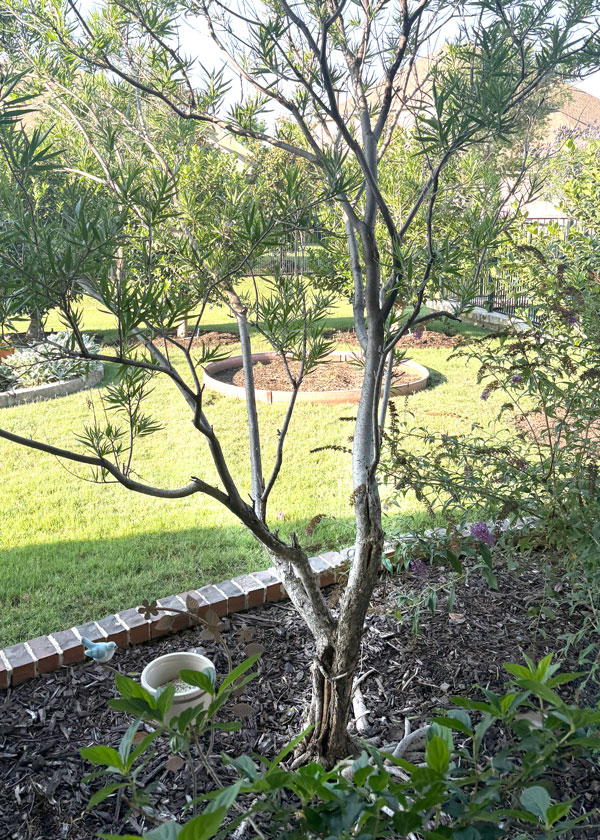
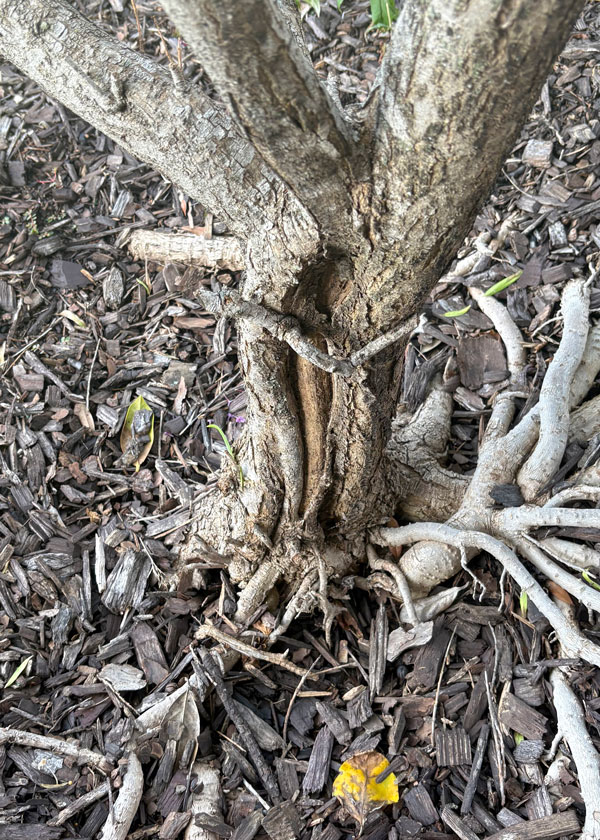
Images clickable for larger views.
Answer: Look up and down the trunks and stems of your plant. Where branches have been removed there are stubs left behind. The plant cannot heal properly across those stubs and decay will set it. (See story on that topic this issue.) That’s what has happened where this decaying area has appeared. It looks like there might have been two such stubs left in place. Anytime you do any trimming on any shrub or tree, you want to make the cuts essentially flush with the remaining trunks or branches. Just leave a tiny section of the branch collar, but no conspicuous stub.
Hopefully your plant will be able to heal properly.
QUESTION 8
HOW CAN I FIX A SINKHOLE IN MY ST. AUGUSTINE?
Question: I have a sinkhole that keeps reappearing in my St. Augustine lawn. I keep filling it and it comes back. It’s beside the sidewalk, which now has a crack. What can I do to stop the hole from developing again? Daryl, Allen.
Answer: Daryl called my KLIF radio program Saturday. I told him that of the 450,000 calls and questions I’ve taken, I’d never had that one. However, I’ve seen it happen. I thought it probably was from something going wrong beneath the sidewalk and that he would need to use a masonry blade on a saw to cut the concrete out, then examine what is going on beneath the walk. But I told him I wanted to talk with a builder friend that I knew would be able to guide us.
I called Tom Wright of McKinney. Tom has done a lot of remodeling for us at our home and my office in McKinney. When I presented the facts to him, he said instantly, “He has a water leak beneath the walk. He needs to get a leak detection company out to find it.”
After we visited a bit more Tom also suggested that if this was near the front sidewalk by the curb, it might be the city’s water line that had developed a leak, in which case the first call should be to their people. Homeowners are not supposed to make any repairs to the city water supply lines.
In any event, there is a nick or a break in a water line. Soil is being washed out, perhaps very slowly, and it is draining downhill to another location where the eroding soil is perhaps going into a storm sewer or spreading out across the lawn. You need to have the leak detection people find the source of the leak, then have them or a plumber repair it. Once the soil dries out, you’ll be able to fill the holes with topsoil and get back to normal.