
Q&A – Ask Neil: May 28, 2026
(Please read these instructions carefully.)
Before you post your question, please look at recent issues to see if someone else has already asked it. You might find your answer there.
HOW TO SUBMIT YOUR QUESTION…
• Click here to post your question. (Please post your question only one time.)
• Please use this link only for posting questions – not for standard e-mails.
• High-resolution photos (1-2MB – not thumbnails) attached with your question help Neil give you the best possible answer. Please check your photo for clarity and exposure. If you do not see “All images clickable for larger views,” your images’ resolution was not sufficient for enlargement. That might also have made it difficult for Neil to give you an accurate answer.
• Neil chooses questions of greatest reader interest. Plant IDs rarely fit that description.
• Neil requires your first name or initials, also your city or county for an accurate answer. (Texas is a very large state.)
• One question per reader per week, please.
• Watch for Neil’s reply in the next issue of e-gardens.
Note: If you have submitted your question and did not see the pop-up window for attaching your photo, please click here.
QUESTION 1
WHAT IS HAPPENING TO MY SUNSHINE LIGUSTRUMS?
Question: My Sunshine ligustrums have brown areas on their leaves. It looks like they have little black bugs on them. I had this problem last year, and when I sprayed with Malathion I lost several of the plants. What is causing this, and what can I do? Karen L., Tioga, Cooke County.
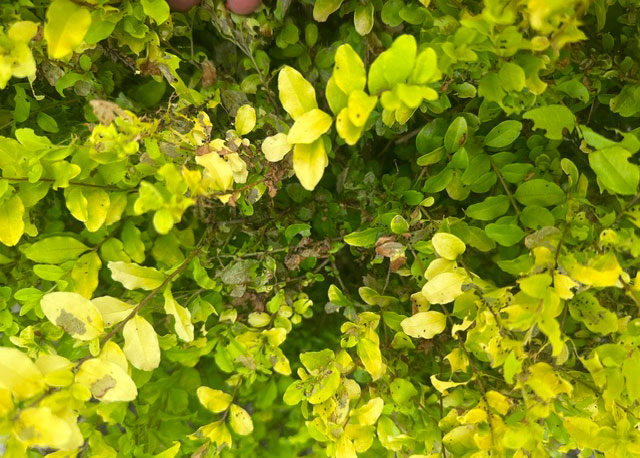
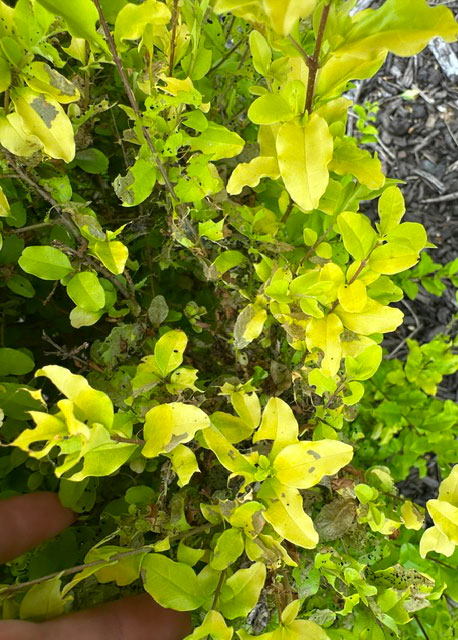
Images clickable able for larger views.
Answer: I do not see any insects, but I do see damage that looks like it might have been caused by chewing and perhaps skeletonizing insects. For that reason, I might suggest Sevin as a remedy if you see new damage. Malathion can damage tender new foliage of some plants. Normally I would not have expected it to bother any of the ligustrums, but Sunshine ligustrums are odd little beings. Their yellow leaves are pretty vulnerable.
QUESTION 2
HOW ABOUT SUMMER PHLOX? WHY DON’T NURSERIES CARRY IT?
Question: Beebalm looks good as an old-fashioned plant (as per your last issue), but for me, nothing beats old-fashioned summer phlox. I rarely see it offered for sale anywhere. I got some from my mother. I wish you would feature it sometime, and I wish nurseries would carry it. Sandra S., Bell.
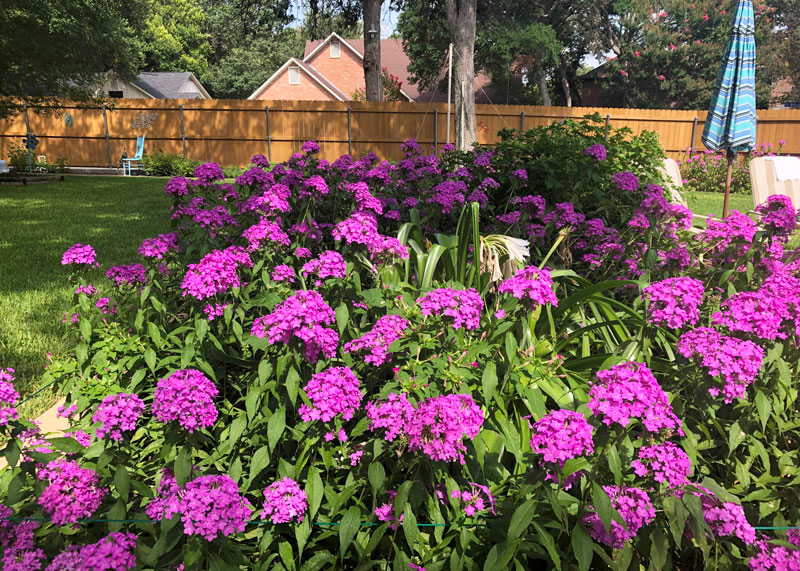
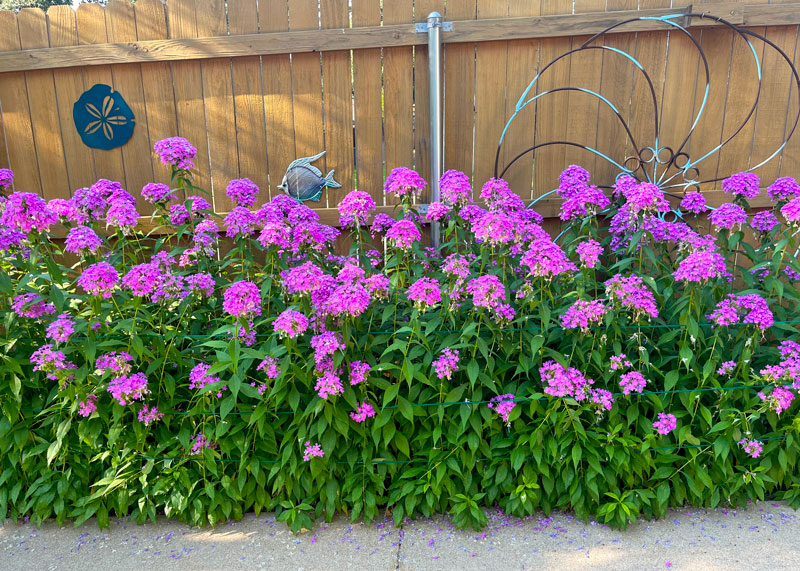
Images clickable for larger views.
Answer: Your planting is gorgeous. And I agree with you. The old-fashioned passalong type deserves wider promotion and sales. Northern hybrid types don’t fare as well in our climate.
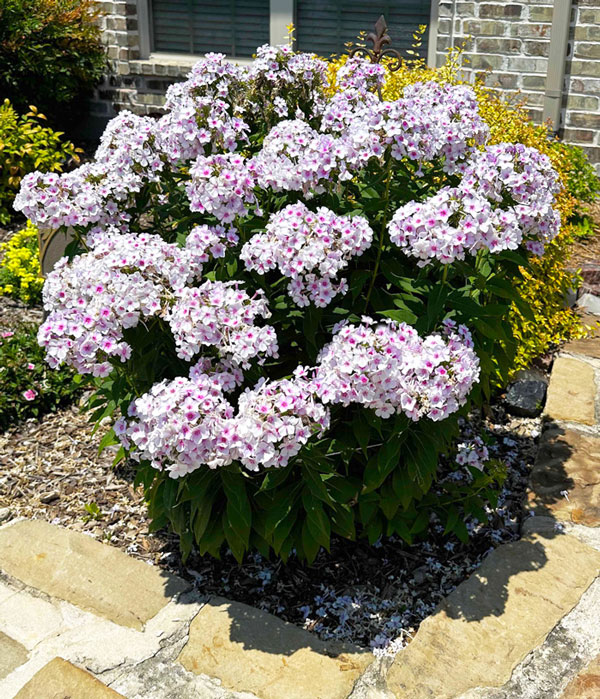
We have featured the fine one that our friend Greg Grant found and introduced. He named it ‘John Fanick’ in honor of one of San Antonio’s finest nurserymen. Here’s the story we ran three years ago next month. You’ll find this plant in hundreds of Texas nurseries.
QUESTION 3
WHY DO I FAIL REPEATEDLY WITH GARDENIAS?
Question: I have tried several times to plant a gardenia on the patio, but they always die. Something comes up on the undersides of the leaves and then the plant dies. How can I succeed? Ann L., Forney.
Answer: I suspect you’re seeing white flies and their egg masses. They would leave a sticky honeydew residue, and that would then lead to growth of black sooty mold on the leaves.
If that sounds familiar, find an insecticide recommended for the white flies and spray on 5- to 7-day intervals. (Their eggs keep hatching.) If the leaves are coated with sooty mold you may prefer to use two soft sponges and a bucket of warm, soapy water. Soak the sponges, then wring them almost dry. Putting one sponge in either hand, gently pull the sponges toward you to wipe off the eggs and sooty mold. Keep that cycle going until you get rid of the pests.
QUESTION 4
HOW CAN I GET RID OF THIS PLANT?
Question: How can I get rid of this plant? It’s taking over my pool pump pad and driveway. Digging it up is useless. Phyllis S., Dallas.
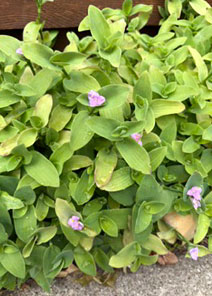
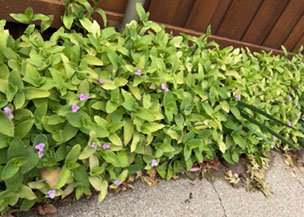
Answer: This is one of the dayflowers (related to wandering Jew). It looks like it’s growing all on its own and not mixed in with desirable plants, so I’m going to suggest applying a glyphosate herbicide very carefully to the leaves. The spray will try to bead up and roll off, so include one drop of liquid dishwashing detergent to help it hold onto the surface of the leaves. You will probably need to repeat the treatment in 10 days. You could also try a broadleafed weedkiller containing 2,4-D. Again, apply it very carefully to avoid drift onto desirable plants nearby.
QUESTION 5
WHAT CAN I PLANT THAT DEER WILL NOT EAT?
Question: What can I plant that deer will not eat? Millie McWilliams, Weatherford.
Answer: This is a giant problem for gardeners across Texas, notably through the Hill Country and surrounding areas. The best list I’ve found was compiled by Bexar County Master Gardener and retired Texas Certified Nursery Professional Forrest Appleton several years ago. Here is a link to his information as it was originally presented by my friend Dr. Jerry Parsons in his Plant Answers pages.
QUESTION 6
WHAT SHOULD I DO WITH ALL THESE SMALL SPROUTS?
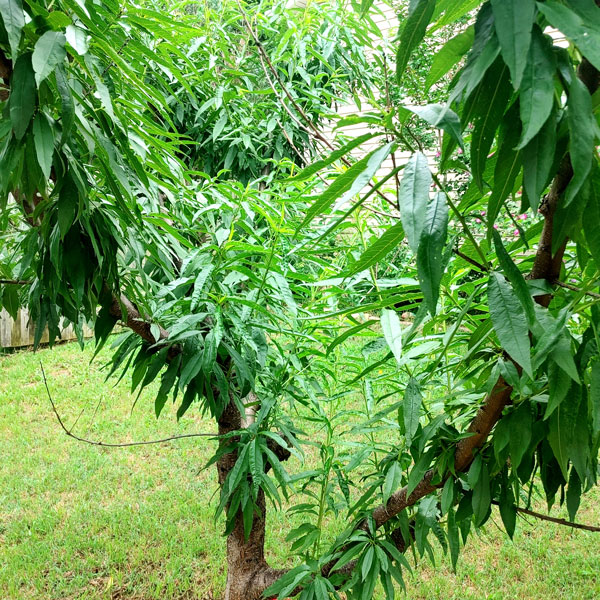
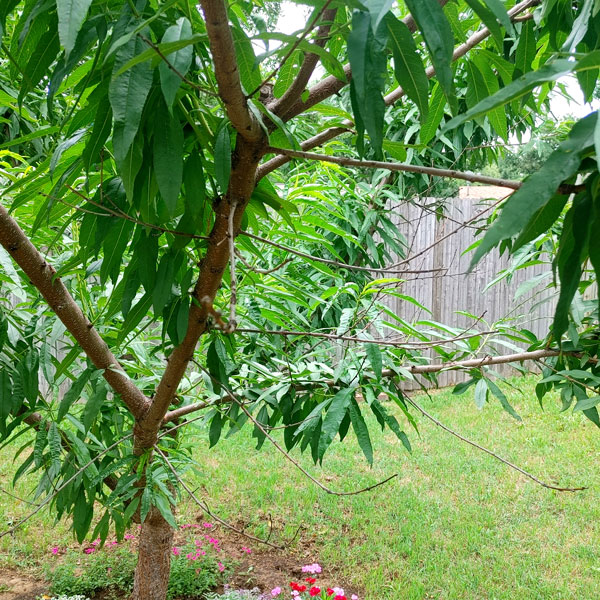
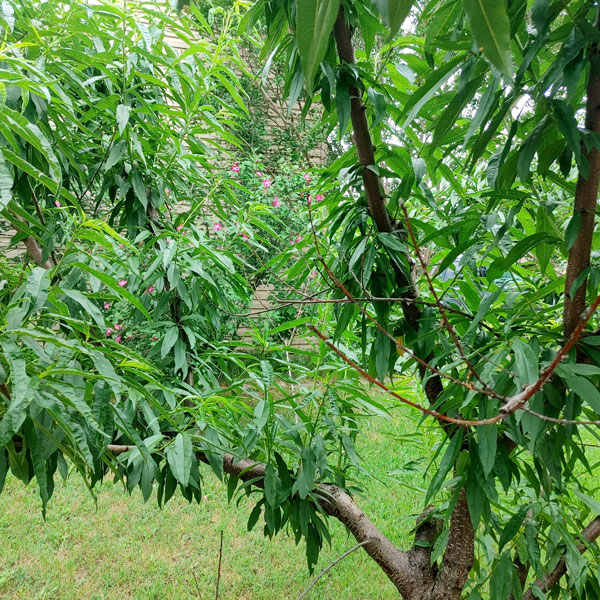
Question: My peach tree is sending out all these small sprouts on its bigger limbs. Do I need to leave them? Also, there are small, dead limbs. Should I leave them or prune them off? Danny S., Tarrant County.
Images clickable for larger views.
Answer: They certainly look vigorous. However, you don’t want them. The shoots will congest the interior of the tree. Most – probably all – should be removed. While you’re at it, you can also remove the dead twigs.
Before you start pruning, however, look closely at the trunk and the ends of the large branches. Is there something wrong with them? Do you see any signs of sap oozing out of holes that would indicate borers or bacterial infection?
You may remember “apical dominance” from high school biology classes. To put it in overly simple terms, trees’ tip growth sends hormones down to lower buds that they need to remain dormant as long as the outer buds are growing actively. When there is a problem with the growing tips you see this kind of secondary bud and twig growth.
QUESTION 7
DO I NEED TO BE CONCERNED ABOUT MY LIVE OAKS?
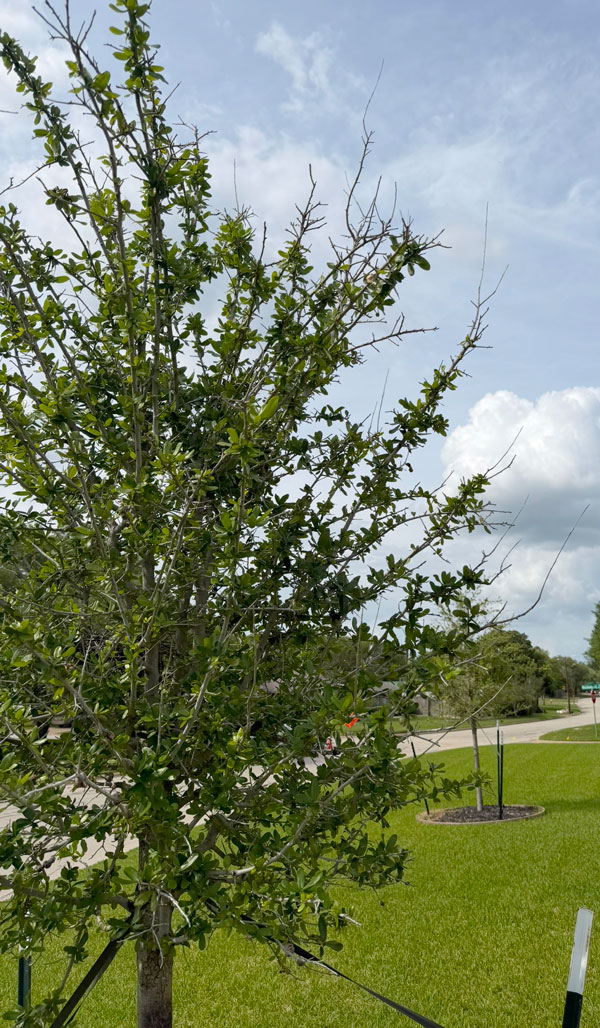
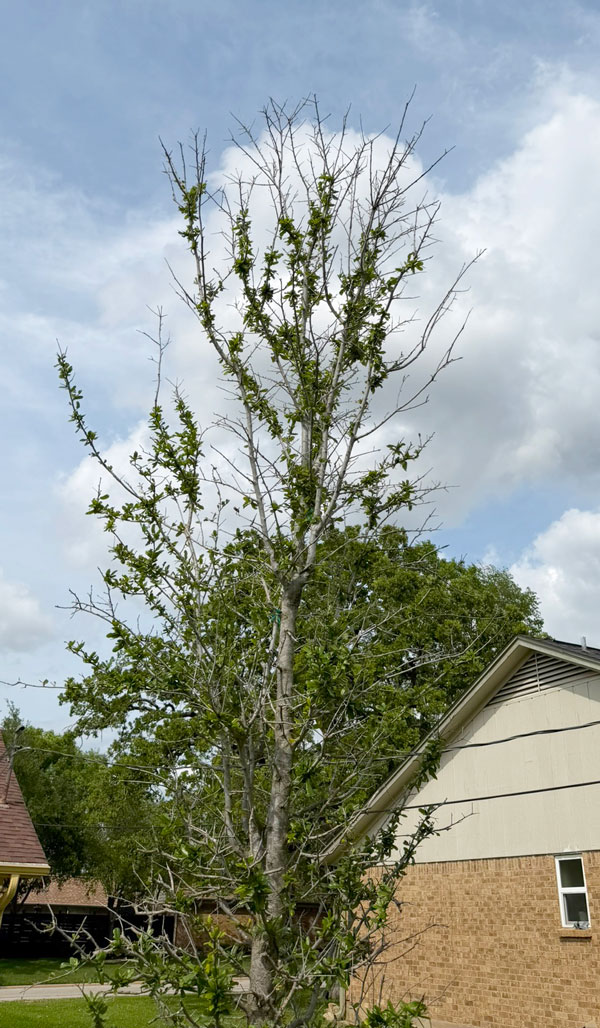
Question: I have three 3-year-old live oak trees. Two have limb tips with no leaves. Do I need to trim the bare ends? Should I be concerned about the trees? Bobby L., Brazos County.
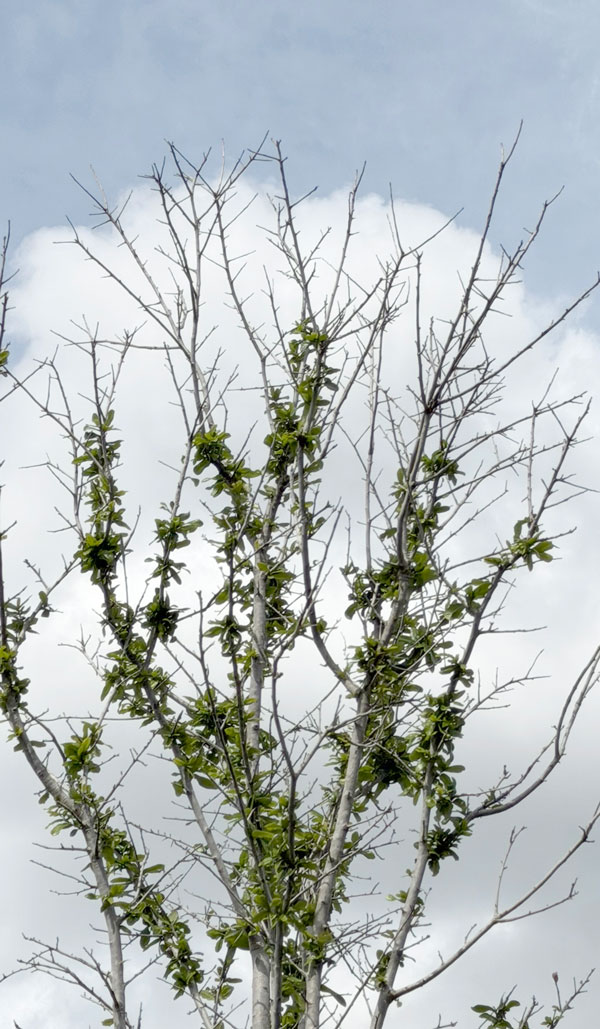
Images clickable for larger views.
Answer: If these trees have been in these locations for 3 years, they’re probably going to take hold and start growing soon. Be sure there is no sun scald or other damage to the trunks. Apply a high-nitrogen fertilizer and water them deeply. Keep them moist all summer. If you trim off the dead twigs, it will be easier to monitor if there is any further dieback.
As for the cause of this, my guess would be that the affected trees may have gotten too dry a time or two in their first year. That happens fairly often with new oaks and other species.