
Q&A – Ask Neil: July 16, 2026
(Please read these instructions carefully.)
Before you post your question, please look at recent issues to see if someone else has already asked it. You might find your answer there.
HOW TO SUBMIT YOUR QUESTION…
• Click here to post your question. (Please post your question only one time.)
• Please use this link only for posting questions – not for standard e-mails.
• High-resolution photos (1-2MB – not thumbnails) attached with your question help Neil give you the best possible answer. Please check your photo for clarity and exposure. If you do not see “All images clickable for larger views,” your images’ resolution was not sufficient for enlargement. That might also have made it difficult for Neil to give you an accurate answer.
• Neil chooses questions of greatest reader interest. Plant IDs rarely fit that description.
• Neil requires your first name or initials, also your city or county for an accurate answer. (Texas is a very large state.)
• One question per reader per week, please.
• Watch for Neil’s reply in the next issue of e-gardens.
Note: If you have submitted your question and did not see the pop-up window for attaching your photo, please click here.
QUESTION 1
WHAT IS WRONG WITH MY JAPANESE MAPLE?
Question: What is going on with my Japanese maple? There were spots earlier in the season, but now I’ve lost a complete limb and I’m hoping I’m not going to lose the entire tree. Another Japanese maple also has limb damage. What can I do? Nancy S., South Arlington.
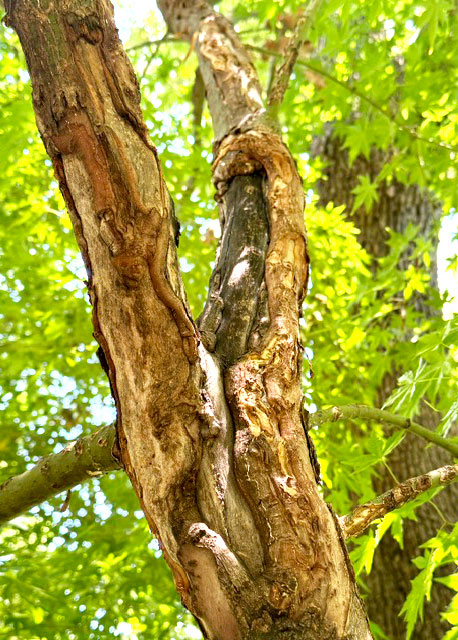
Answer: This problem has been evolving for several years, perhaps more than 5 as judged by the amount of decay and its extent into the core of the branches and up and down the affected areas. I don’t see any freshly exposed wood that would pinpoint the cause. I think this is the result of an injury (or injuries) from some time back.
I can imagine two possible causes based on 50 years of growing Japanese maples and other trees that have exhibited this kind of damage in our woods and landscape.
If a branch is broken or trimmed off and if a stub of that branch is left in place, the tree will not heal properly. New bark will try to form to seal off the wound on the healthy part of the remaining trunk or limb, but when that roll of new bark gets to the stub it cannot cover it. The stub is left to decay on its own. Often that starts happening even before the roll of new bark begins to approach. That decay will spread into the internal tissues of the tree, and it will spread both up and down in the trunk or limb. Unfortunately, your photo cuts off before I can see healthy tissue, so I’ll have to let you make that analysis.
I have also seen many instances in which squirrels busy themselves in tearing bark away from the trunks and limbs of maples, pecans, and other trees. They are constantly doing so in an effort to keep their teeth sharpened since their teeth grow continuously (much as human fingernails do). It’s quite possible one or more squirrels were involved several years back. Perhaps you can remember.
What can you do now? Perhaps not much other than to prune out the worst damage. That would include weak or dead branches, and it might also include reshaping the tree to allow it to regrow in an attractive form. Watch to be sure neither of the above issues recurs. And I certainly won’t be offended if you call for the help of a certified arborist to examine the tree more closely. Our advertiser here in e-gardens (Arborilogical Services) has a dozen of them on staff and one or more serves your part of the Metroplex. You could start by contacting them. Perhaps they will see something I’ve missed. If you have a certified arborist you already use, have them take a look. I hope that helps.
QUESTION 2
WHAT ARE YOUR RECOMMENDATIONS FOR PRE-EMERGENT WEEDKILLERS?
Question: I missed applying pre-emergent weedkiller granules to prevent grassburs in my bermuda lawn this year. What kind do you recommend, and should I buy it now so I can have it for next year? Dustin H., Sweetwater.
Answer: You should not have to buy your pre-emergent granules now and store them until next year. Either in Sweetwater or in Abilene you should have no trouble at all in finding them at the right time.
Dimension is available at many independent retail garden centers and local hardware stores and feed stores.
Halts is available at national chain stores.
Balan has been a recommendation since it was introduced more than 50 years ago, but even though it’s still effective, many turf experts have switched to one of the other products mentioned.
You can choose any of the three products. They act somewhat similarly to prevent germination of crabgrass and grassburs.
All can be used on any type of turfgrass as long as it has gone through its first winter. All can be used on ground where trees and shrubs share the same soil.
Your first application should be made 2 weeks prior to the average date of your last killing freeze for your area, so for Nolan County you would want to apply one of those March 10-20.
All are effective for about 100 days.
That means you would need a second “booster shot” application 90 days (3 months) later. That would put you June 10-20 for the entire growing season.
You do not have to use the same pre-emergent for the second round that you used for the first. You can “mix or match.”
You will want another application…
There is another category of annual grassy weeds called “cool-season” grasses, including rescue grass, ryegrass, and annual bluegrass. These germinate in the fall, establish over the winter, and plague our lawns in the early spring.
We must apply any of those same pre-emergent weedkillers to prevent them, and the timing is the first two weeks of September. Prevention of annual bluegrass (Poa annua) is sporadic with any of these products, but for the other weeds you should have good results.
Here is your kicker…
Many, perhaps most, stores that sell pre-emergent herbicides in February and March sell out of them and do not offer them for the second and third applications.
Perhaps they can order them in for you, but you may find it easier just to buy your supply in late winter and keep them in a dry place until you need them in June and September.
QUESTION 3
ARE CRAPE MYRTLE SCALE AND APHIDS MORE OF A PROBLEM WHEN THE PLANTS ARE GROWING RAPIDLY?
Question: I see all these people with crape myrtle bark scale and aphid problems. I have a bunch of crape myrtles, and it seems like when they get fertilized it causes those problems. When they aren’t in a fast growth phase I don’t have those problems. Comments? James B., Pilot Point.
Answer: Crape myrtle aphids have been with us for decades. As for the bark scale, I was probably one of the first 10 people in America to witness them. A store manager of the Richardson Calloway’s called me in to look at a sample his customer had brought in. No one, including Texas A&M entomologists, had ever seen the insect before. That was 2004, and I’ve been watching them ever since. The only really bad year that I have seen area-wide was 2007. That was a very wet spring, and we had not yet experienced a build-up of the predatory black lady bugs that feed on crape myrtle bark scales.
I agree with you very slightly. Crape myrtle bark scale seems to be more of a problem when the spring and early summer weather is cool and wet, but the twice-stabbed lady bug now does an admirable job of keeping populations better in check. Plus, we can apply a soil drench of Imidacloprid around the drip line of our crape myrtles in mid-May and avoid the scale and aphid problem before either ever shows up.
Crape myrtles bloom two, three, and even four times per summer if they’re kept properly watered and fertilized. I would not recommend keeping them dry just to avoid the possibility of scale insects on their trunks and aphids on their leaves.
QUESTION 4
HOW DO I STOP THE SEEDINGS FROM MY TEXAS MOUNTAIN LAURELS?
Question: How can I stop the hundreds of seedling Texas mountain laurels that sprout beneath the mother plants? I keep clipping them down, but they keep growing everywhere. Rhonda P., Fair Oaks Ranch, Comal County.
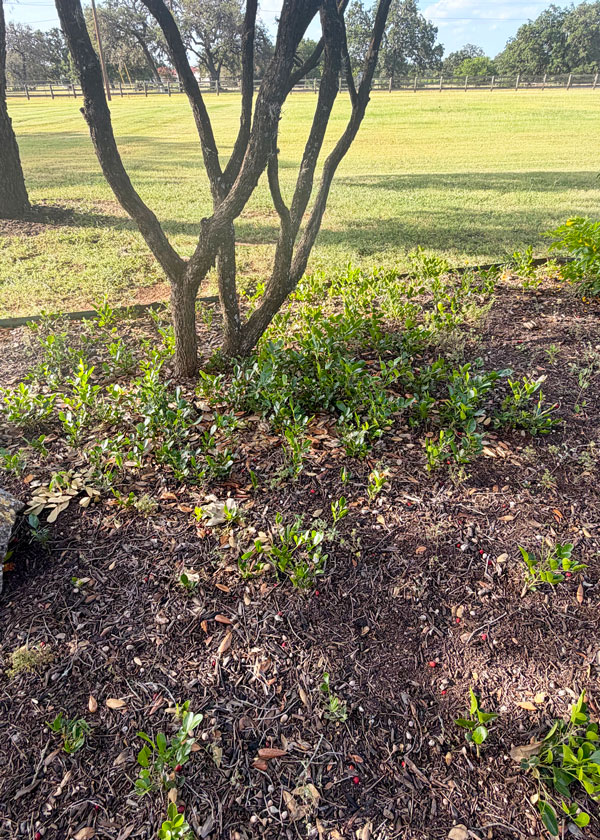
Answer: Put a layer of mulch beneath the mother mountain laurel. As the seeds sprout, their roots will initially be in the mulch. Run a sharpened hoe through the mulch mainly to disturb it. In doing so you’ll be turning the mountain laurel seedlings upside down and exposing their young root systems. They’ll die out quickly. Also, I can see many of the red seeds on the ground just waiting their turn to germinate as their hard seed coats break down. For the time being you could blow those or rake them to get them picked up.
QUESTION 5
WHAT IS THIS WEB IN MY HOLLY?
Question: I spotted this web in my holly bushes. Do I need to be concerned? Charles T., Wylie.
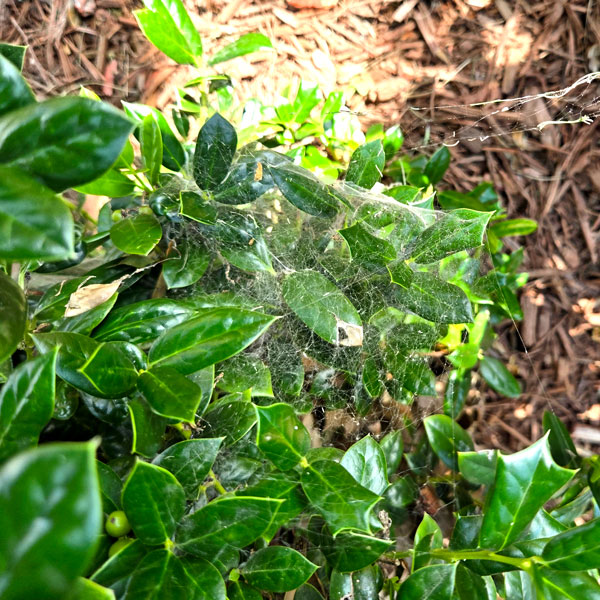
Answer: Absolutely no cause for concern. This is the web of some type of garden spider that has set up shop. I could go out into my own landscape right now and take photos of several just like this in my hollies. I just leave them alone to do their work at catching small insects. If I’m going to be doing a photo shoot or if Lynn and I have something planned that will involve polite society, I’ll take a small stick and merely “comb” them out of the shrubs. Otherwise, they’re your friends. No call to action.
QUESTION 6
HOW CAN I KEEP MY BUR OAKS’ ACORNS FROM HITTING THE NEIGHBOR’S ROOF?
Question: I planted my two bur oak trees 29 years ago. Their branches now extend over the neighbor’s house and the large acorns dropping onto their roof 24 hours a day (and night) have become an issue. Is there anything I can do to reduce the acorn impacts without major pruning or harming the trees? Andrew B., Highland Village, Denton County.
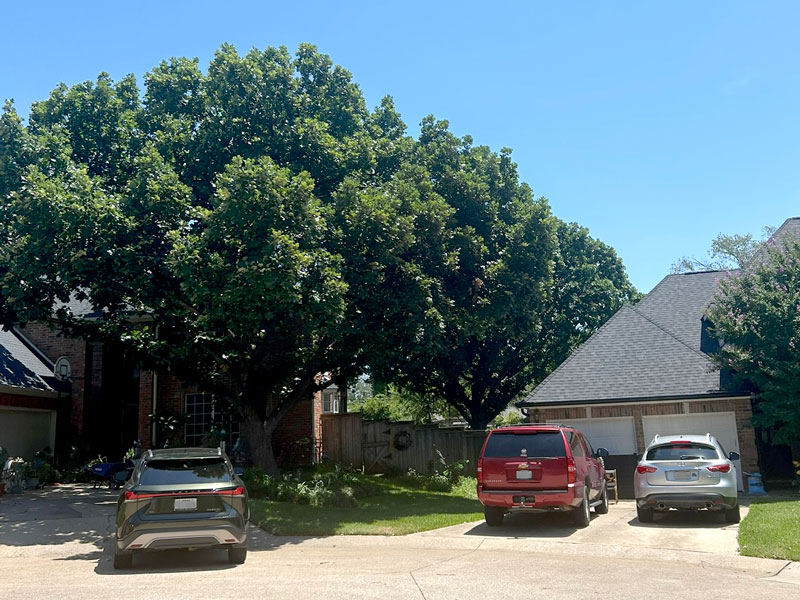
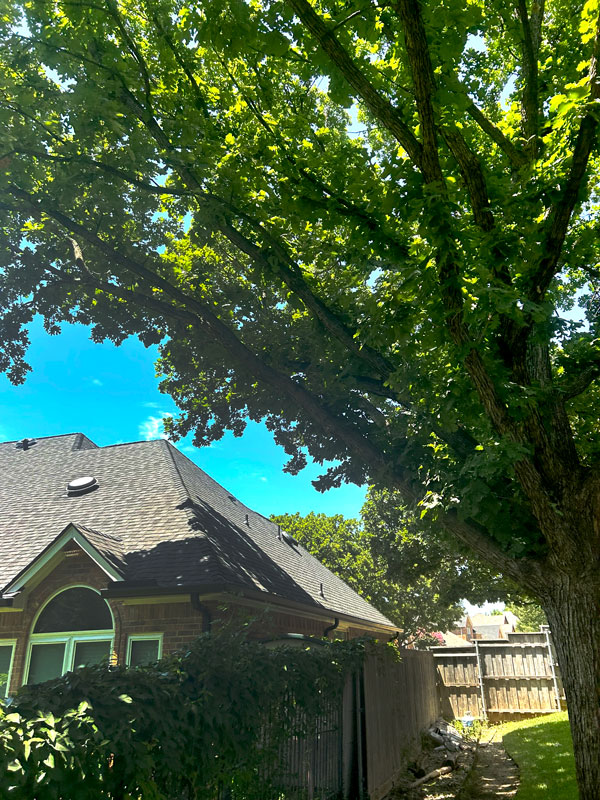
Answer: From all 8 of your photos, I’ve chosen these two. I believe they best show the situation.
Unfortunately, there is no “magic spray” that will suddenly render the trees fruitless.
The tree closer to the street doesn’t appear to be as much of a problem, but the one against your back fence leans way over their roof. Pruning to remove one or two major branches may be one solution to much of the acorn drop onto their roof. You could certainly talk to a certified arborist and to your neighbor to see if the loss of that amount of shade would be a downside to them. Their roof is quite dark, and the shading has to help with their cooling bills.
Beyond that, I’m going to reach deep into the idea bag to try to help. A certified arborist might be able to rig up some type of a tree netting that could be draped beneath the tree temporarily during the acorn season. Of course, that’s also going to coincide with leaf drop so you’re going to have to be able to release it and let the accumulation fall to the ground on your side. It’s going to take some innovation and ongoing attention, but if they can keep foul balls and hockey pucks where they are not wanted, surely you can keep bur oak acorns on your property, too.
The other idea that crossed my mind would be to hire the use of a pecan shaker. These are machines that are used to vibrate pecan trees near harvest time so that a majority of the crop falls at once for immediate harvest. A pecan expert could offer better advice, but here’s one example. You would probably have to shake your oaks a branch or two at a time.
QUESTION 7
WHY IS OUR BALD CYPRESS TREE’S CANOPY NOT AS FULL AS IN PAST YEARS?
Question: Why is our 25-year-old bald cypress tree’s canopy not as full as in past years? The decline actually started about 5 years ago. James S., Arlington.
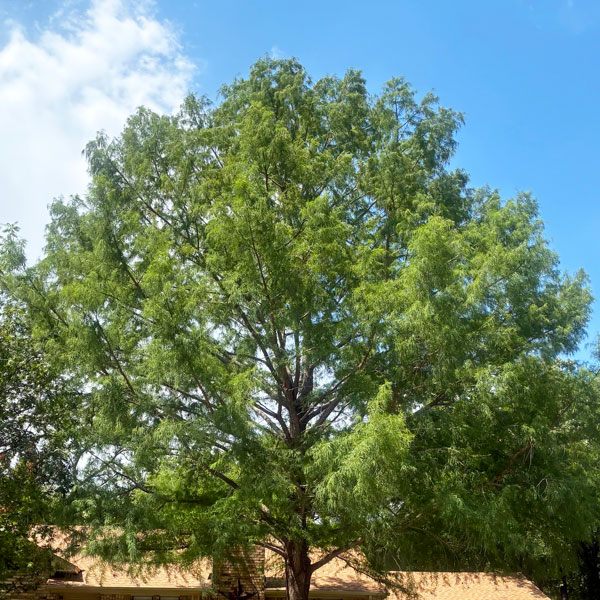
Answer: The first thing I look for with bald cypress trees anywhere near or west of I-35 is yellowing. It can be brought on by iron deficiency in alkaline black clay soil underlaid with white rock subsoil, or it can be due to nothing more complicated than a shortage of water.
Your tree has outstanding needle color, so it’s not iron deficiency. Actually, there are many people within 25 miles of you who wish their bald cypresses looked as good as your tree.
However, if you’ve noticed a thinning of its canopy, I’d check the depth of the soil where it’s growing. Perhaps it has hit a shelf of rock that has limited its root room. It may be suffering the equivalent of being root bound.
Check, too, to be sure it doesn’t have any surface roots, perhaps even knees, that have crossed over one another causing girdling effects.
Is the tree watered by a sprinkler system? If so, has anything about that system changed in a way that would be causing it not to get as much water as before? Actually, it will need considerably more water than before since it has continued to grow. Water and nitrogen are the two things that will cause any tree, bald cypress or otherwise, to put on new leaf growth.
If none of that helps, I’m going to suggest you contact a certified arborist to check the tree on site. Perhaps they will see something that I’m missing.