
Q&A – Ask Neil: July 9, 2026
(Please read these instructions carefully.)
Before you post your question, please look at recent issues to see if someone else has already asked it. You might find your answer there.
HOW TO SUBMIT YOUR QUESTION…
• Click here to post your question. (Please post your question only one time.)
• Please use this link only for posting questions – not for standard e-mails.
• High-resolution photos (1-2MB – not thumbnails) attached with your question help Neil give you the best possible answer. Please check your photo for clarity and exposure. If you do not see “All images clickable for larger views,” your images’ resolution was not sufficient for enlargement. That might also have made it difficult for Neil to give you an accurate answer.
• Neil chooses questions of greatest reader interest. Plant IDs rarely fit that description.
• Neil requires your first name or initials, also your city or county for an accurate answer. (Texas is a very large state.)
• One question per reader per week, please.
• Watch for Neil’s reply in the next issue of e-gardens.
Note: If you have submitted your question and did not see the pop-up window for attaching your photo, please click here.
QUESTION 1
WHAT CAN BE DONE TO CONTROL DALLISGRASS?
Question: Is there anything that can be done to control dallisgrass? Carol V., McKinney.
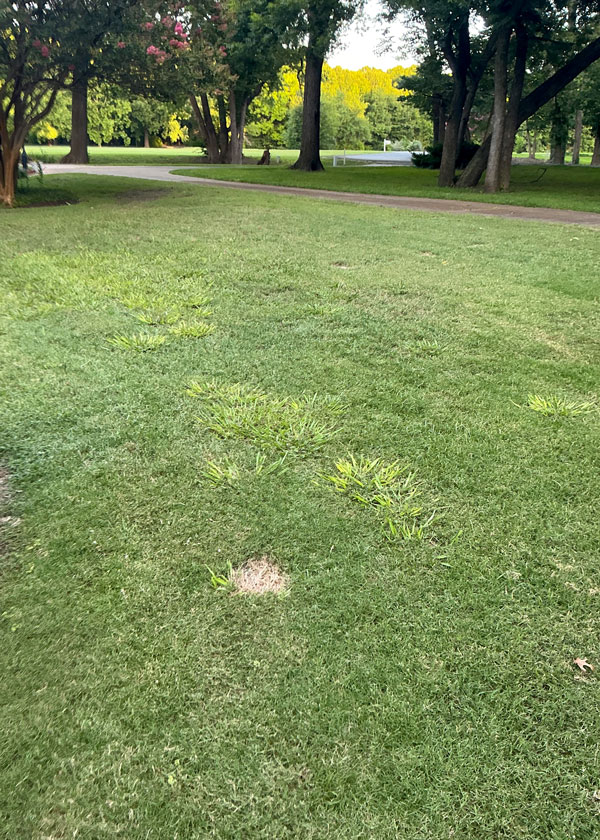
Answer: It looks like you found some way to kill that one clump. That may be one of the options I now must give home gardeners since MSMA went off the consumer product shelf 12-14 years ago. You can use a straight glyphosate product (no other active ingredient mixed with it) according to label directions. It will kill dallisgrass and all other grasses without contaminating the soil. You can plant new plugs right into the dead areas if you wish or wait for the adjacent grass to regrow over the areas. If you decide to use plugs, dig them out of your own lawn rather than buying sod that might be some other cultivar of bermudagrass. It could be a mismatch that would become very obvious as it grew and developed.
A reader gave me a very good suggestion several years ago. Cut the bottom out of a 1-gal. milk carton. Take the lid off and place the carton down over the clump of dalligrass. Insert the nozzle of your 2-gal. sprayer into the jug as you spray and you will contain any drift that might otherwise kill adjacent grass. That almost looks like what you have done with that one clump.
Option 2 that I can give you is to dig the clumps out of thoroughly wet soil with a sharpshooter spade. Again, it will leave you with a dead spot, but if you’re very patient you can get rid of all the dallisgrass roots.
Now the information I can only provide without recommending. MSMA is still available. It is labeled for use on golf courses, sod farms, and in highway rights-of-way. I just saw it offered for sale online and I didn’t see restrictions posted. Lawn care services seem to be able to eliminate the awful weed, so I would suggest that you visit with them. So, there are options.
QUESTION 2
WHAT HAPPENED TO MY AZALEAS?
Question: What happened to my azaleas? They are on the north side of my house and get plenty of sun and shade. They are 3 years old and have been beautiful. They were full of flowers earlier in the year. They have started losing all their green leaves. Richard M., Lamar.
Answer: I’m starting at a disadvantage. Actually, several. I wish I had a photo. Plants losing leaves usually suggests that they have gotten too dry. But I don’t know if you’re in Lamar County (Paris area where azaleas are common), or the unicorporated town of Lamar near Rockport (where I’m guessing azaleas are far less common). I’ll go with the former.
Also, the word “plenty” worries me a bit. Azaleas in Lamar County would do best with morning sun until 11 or noon, then moderate shade during the afternoon. I don’t know what you consider to be “plenty.”
If the first leaves to turn yellow and drop were the oldest ones at the bottoms of the branches, that would be planting mix that got too dry for some period of time. But it should have been associated with wilting prior to the leaf drop. Once they were watered or once you got rainfall the leaf drop should have stopped within a week or two.
Check the leaves, too, for signs of lace bugs. They will turn the leaves tan with black specks on the backs of the leaves. I don’t think they are the culprits, however, because they normally don’t cause leaf drop.
Unfortunately, without more clues and a good photo or two I can’t get any closer. I’m sorry.
QUESTION 3
WHAT IS HAPPENING TO MY LAWN?
Question: I don’t know what is going on with my lawn. I fertilize and apply pre-emergent per your recommendations. I’ve had the irrigation checked. I do have a large tree to the north of the spots, but I don’t think it prevents adequate sun in these areas. Jan H., The Colony.
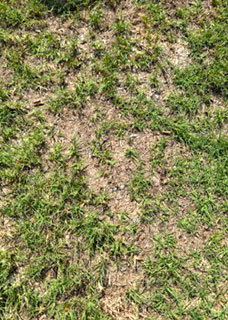
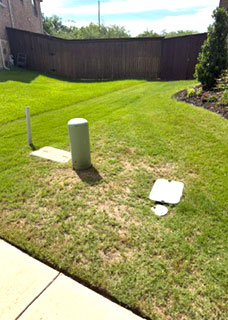
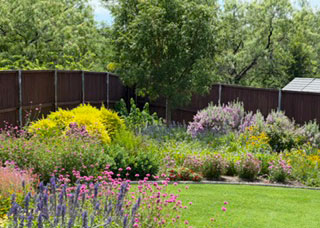
Answer: Your photos are thumbnails of 100KB and less in size. Unfortunately, when I click to enlarge them, they pixilate immediately and all detail is lost. I believe I’m looking at bermudagrass, but when I click into the closeup trying to see it better, it becomes a blur. Let me scatter-shoot as best I can.
You have a lovely landscape, as judged by your color plantings and the otherwise attractive turf.
The browning areas do not look like they’ve been caused by shade. They could be caused by cottony blight, the disease that shows up in low, wet areas when we over-feed bermudagrass in hot weather. You may have seen my other writings about it here in past years in July and August. It is not uncommon. If you feel that could be the cause, find the source of the excess moisture and be careful not to overdo the feeding of the lawn. A turf fungicide would also benefit the immediate situation, but you’ll want to correct the growing conditions to keep it from coming back.
Or the browning areas could be due to accumulations of undecomposed organic matter on top of the soil and beneath the bermuda runners. That is known as “thatch,” and it forms when we mow infrequently, leave long grass clippings on the lawn without using a mulching mower or bagging them, and when we use fast-release nitrogen as our fertilizer. Thatch compacts into an impenetrable layer of organic matter that water, nutrients, and grass roots have a difficult time penetrating. Grass thins out and eventually dies in patches like your photo might show. You can slide a flat trowel under thatch, then pick it up in a sheet and hold it like a piece of ill-tasting pizza (don’t taste it!). It’s that fibrous. If thatch is your problem, break through it with a spading fork (you have small areas and do not need any kind of rental equipment or gimmicky tools) and get air and water through to the soil.
One of your photos seems to show two mowing heights. I’m unsure why you would be doing that. Raising the height does not help turf survive summer’s heat. Determine the optimum mowing height for the type of bermuda you have, then mow at that height on 5- to 7-day intervals through the summer.
Sorry for the lengthy reply, but without being able to see things any better I needed to cover all bases.
QUESTION 4
WHY DO BOXWOODS IN THIS LOCATION KEEP DYING?
Question: I have planted 8 Baby Gem boxwoods, and all have grown well except the ones I have in this one location. We have replaced it three times. I have amended the soil around it but it still looks bad. Could it be blight? Ann L., Coppell, Dallas County.


Images clickable for larger views.
Answer: If a disease were involved it would not continue to attack new (I assume), healthy plants set in as replacements. Plus, it would eventually spread to the adjacent boxwoods. Since you have specifically ruled that out, I’m going to say no to diseases (and insects).
My experience leads me to some kind of environmental difference, either in the bed preparation or in the watering that plants in that location have been receiving. I do not see any sprinkler heads showing in the bed, but if you are using an automatic system, figure a way to see how much water is being delivered to each plant each time they are watered. It might involve placing identically sized cans or cups in identical locations in front of each plant. If you are using drip irrigation, pull back the mulch so you can watch the drippers. Before you turn the system on, check the moisture level of the soil in the proximity of each plant.
My thought it that this plant (all three of them) has not gotten enough water time after time. Either your irrigation has been shorting it or it has a damaged head or emitter.
Remember, too, that your older boxwoods have better root systems since they are established. As I pointed out last week, we must water new plants by hand for their first couple of years because sprinkler irrigation and drip irrigation won’t get the soil wet deep enough to soak their entire original root balls where all their roots are still growing. That may be the reason your new plants keep dying.
In looking at your photos, it appears to my eye that the fronts of the bed, as judged by the color of the mulch, aren’t as moist as the backs of the bed.
That’s where I would focus my attention at this point.
QUESTION 5
HOW CAN I CONTROL APHIDS ON MY CRAPE MYRTLES?
Question: I have alternated between Sevin and neem oil every 3 days and my crape myrtles are still covered with aphids. I do my best to hit the undersides of the leaves. Could they have built up a fightin’ Texas Aggie immunity? Jack K., Bryan.
Answer: I would probably not have used Sevin. In fact, be sure you have aphids and not crape myrtle bark scale. Both cause drips of sticky honeydew to coat leaf and stem tissues in summer. That, in turn, allows black sooty mold fungus to grow in the sticky substrate. Many gardeners end up being as upset with the black mold as they are with the honeydew.
But back to the original identification. Aphids will be clustered all over new growth. They’re BB-sized yellow-green insects with pear-shaped bodies and they will reproduce prolifically.
Crape myrtle bark scales look like cigarette ashes stuck to the twigs, branches and sometimes leaves of crape myrtles. They are basically immobile when we see them, but they exude a pink fluid when pressed with a thumbnail or small stick.
All that said, both insects can be prevented with a mid-May soil drench of Imidacloprid applied around the drip line of each crape myrtle plant. The systemic insecticide will be taken into the plant, and it will kill the young insects as they start feeding and before they start exuding the honeydew.
If you have existing aphids, the Imidacloprid insecticide would work as a spray to reduce their populations, but it is not highly effective on a mature population of bark scales at this time of year. You may have to resort to scrubbing the trunk with warm, soapy water using large sponges to clean things up.
In both cases there are predatory insects, especially lady bugs that will do heroic work in reducing populations of the pests, although too often they show up after much of the discoloration has been done.
QUESTION 6
SHOULD WE PRUNE OUR JAPANESE MAPLE?
Question: I gave my daughter a dwarf Japanese maple last year because I have no shade in my yard. It is doing really well. So well, we’re now wondering if we should prune it or leave it alone. If we prune it, when and how? Pamela B., Frisco.


Images clickable for larger views.
Answer: Congratulations on saving the life of a Japanese maple. It is doing famously well! Just beautifully. I’m not sure which cultivar you have, but it appears to be one of the dwarf types that may not grow to be more than 6 or 8 ft. tall. If that’s the case, be in no hurry to do any trimming. If and when it comes time to trim it, you would start with the lowest branch. You’ll be able to tell better in January when it’s bare. At that point you could (but don’t have to) remove the lowest branch flush with the trunk. Step back and see how it looks. Then you could decide if you wanted to remove the second lowest branch. Or perhaps you’d decide to wait a year to do so. Or perhaps you do no pruning at all for several years. But in any event, winter would be the time at which you can best determine which branches could be removed. Once you remove lower branches you can never get a tree to produce branches down there again.
QUESTION 7
WHY IS OUR ASIAN JASMINE THINNING OUT?
Question: Our Asian jasmine is thinning out in several places on the southwest side of our house. What might be causing this, and how can I fix it? We also have Asian jasmine on the southeast side of the house, and it is healthy. David Y., Rowlett.

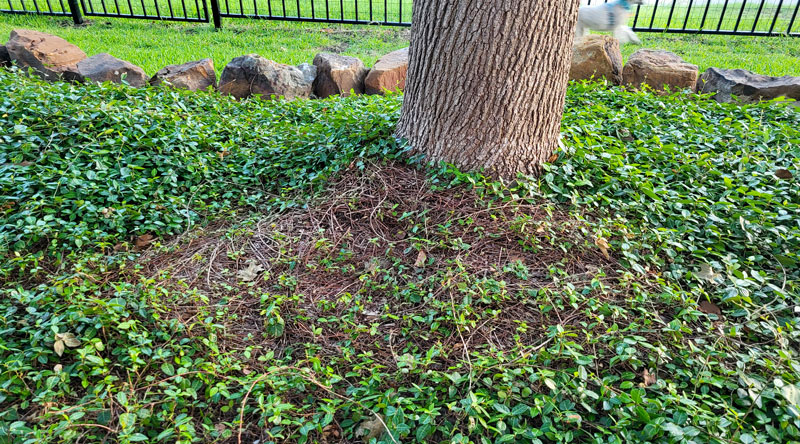
Answer: I’m going out on a limb with this answer. I see a clue in one of your photos. Is there any chance that your buddy might be wearing a path to the fence along that straight line? And, as long as I’m on thin ice, to take a further chance, would it be possible that you have a male dog who might be relieving himself against that tree’s trunk in the other photo?
Unless there is a very shallow pipe or drain tile that has been put in place in that straight line, and unless tree roots are surfacing beneath the jasmine close to the tree’s trunk, I have nothing else to add. I have never seen an insect or disease bother Asian jasmine, and certainly not in a straight line. It is tolerant of sun and shade, so that wouldn’t bother it. It is, however, damaged by cold in extreme winters, but not in straight lines or right behind trees.
As I said, I have pretty much nothing much more to add.
QUESTION 8
HOW CAN I SAVE MY CACTI AND SUCCULENTS?
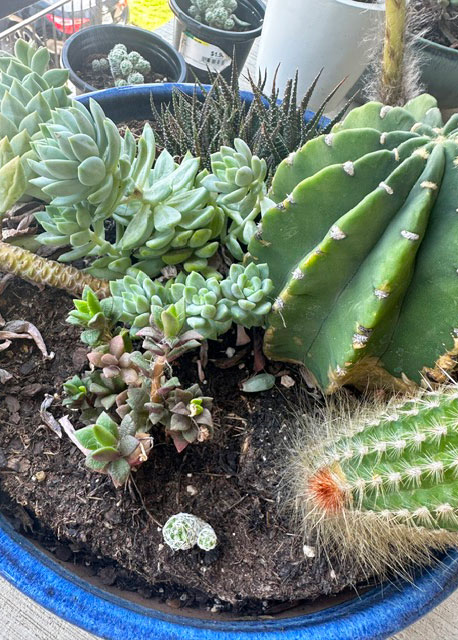
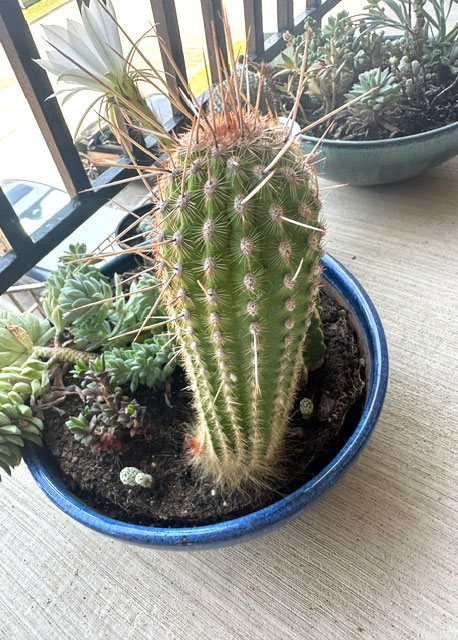
Question: These cacti and succulents are very special to me. They were my father’s plants. I lost him recently, and I want to keep them thriving in his memory. Please help me. Sadie S., Fort Worth.

Images clickable for larger views.
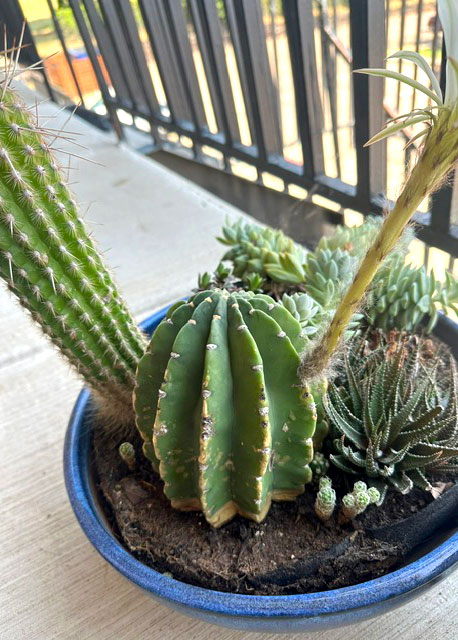

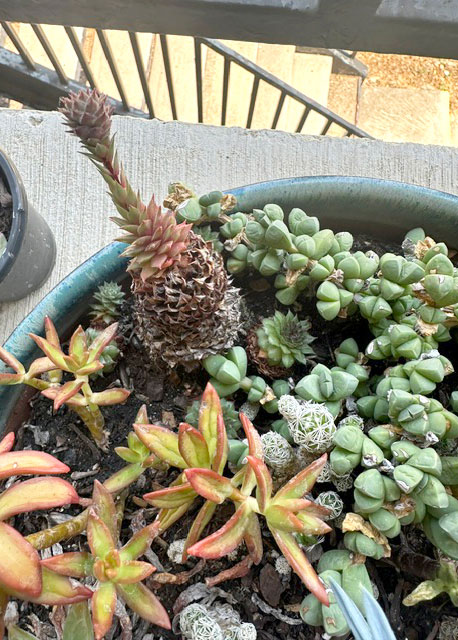
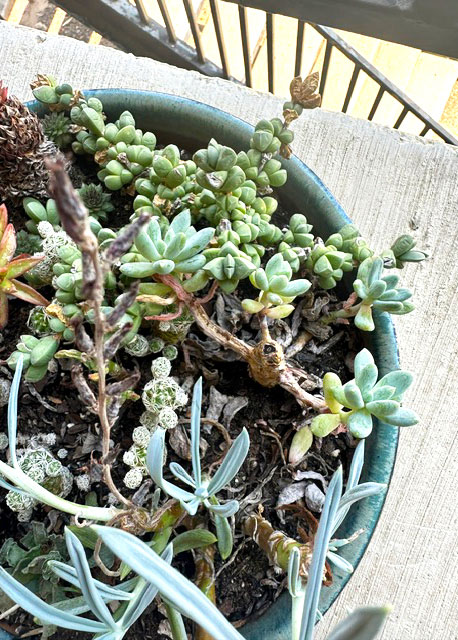
Answer: Sadie called my program on WBAP Sunday morning and after having to wait through a newscast she described her situation with me. It sounded like the plants might have been exposed to freezing weather this past winter, so I was concerned about whether they were even going to be alive once I could see them. I asked that she take photos for me, and she sent many excellent ones.
It’s obvious her father really enjoyed growing cacti and succulents (as I do). I’ve spent 90 minutes looking carefully at each of the photos, trying to identify all the plants. Some are difficult to pinpoint because of the scores of hybrids that have been created by enthusiasts. Haworthias number into the many hundreds, for example, as do the sedums and echeverias. There is an entire category of this last pair of hybrids marked as “Sedeverias.” They are bi-generic crosses between the genera, and the results have been stunning. See them in this link I came across. https://succulentalley.com/sedeveria/
If these were my plants from my own father, I would find a source of new and clean 3-in. to 6-in. terra cotta pots with drain holes. That’s the plain old-fashioned clay pots. Marshall Pottery in Marshall, Texas, used to turn them out by the millions, just to give you one example. I believe our advertiser Calloway’s handles them most of the time. You can grow succulent plants in plastic pots (most growers do), but your margin of error in preventing over-watering is better in clay pots.
As for the potting soil I use, I mix my own. I want it to be extremely lightweight. I start with 40 percent sphagnum peat moss (finely screened to remove small sticks and other debris); 20 percent well-rotted compost, also finely screened through ¼-inch hardware cloth; 20 percent expanded shale; 10 percent fine aquarium gravel, and 10 percent washed brick sand.
I would use a dull paring knife (so I wouldn’t cut my fingers and thumb) to lift the plants out individually with as much root system intact as possible and replant them into the moistened potting soil.
Water them gently, then place them into a nursery flat to hold them upright and place them in a bright spot out of direct sunlight to reestablish and start growing individually.
I’ve had planters that combined many different species of succulents, and I always found that a few dominated while a few struggled. I decided a long time ago it was better to grow the different types individually and then set their pots side by side in any display I wanted to create. That has always served me well. Some of the types are very picky about surviving in our climate (too hot), and I treat all of mine as if they were tropical (can’t handle freezing weather).
I encourage you to attend the next show and sale of the Fort Worth Cactus and Succulent Society https://fwcss.org in the Moncrief Garden Center, Fort Worth Botanic Gardens, September 26, 8am-5pm https://fwcss.org/future-event/. The Fort Worth group is very active, and they can give you expert advice beyond what I have given you.