
Q&A – Ask Neil: July 30, 2026
(Please read these instructions carefully.)
Before you post your question, please look at recent issues to see if someone else has already asked it. You might find your answer there.
HOW TO SUBMIT YOUR QUESTION…
• Click here to post your question. (Please post your question only one time.)
• Please use this link only for posting questions – not for standard e-mails.
• High-resolution photos (1-2MB – not thumbnails) attached with your question help Neil give you the best possible answer. Please check your photo for clarity and exposure. If you do not see “All images clickable for larger views,” your images’ resolution was not sufficient for enlargement. That might also have made it difficult for Neil to give you an accurate answer.
• Neil chooses questions of greatest reader interest. Plant IDs rarely fit that description.
• Neil requires your first name or initials, also your city or county for an accurate answer. (Texas is a very large state.)
• One question per reader per week, please.
• Watch for Neil’s reply in the next issue of e-gardens.
Note: If you have submitted your question and did not see the pop-up window for attaching your photo, please click here.
QUESTION 1
WHAT COULD BE USED HERE TO ALLOW DOGS ACCESS WHEN THEY GO OUTSIDE?
Question: My friend has a very tiny backyard. She also has two large dogs. What could she plant where nothing grows? They need to go outside to use the bathroom and it’s so muddy and shaded. Mondograss? Granite gravel? Linda B., Mansfield.
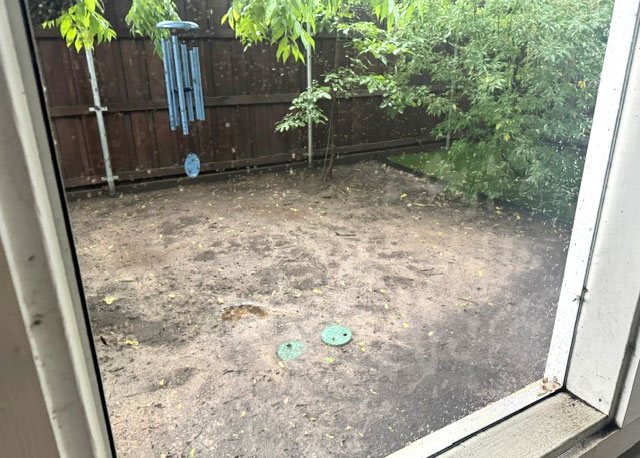
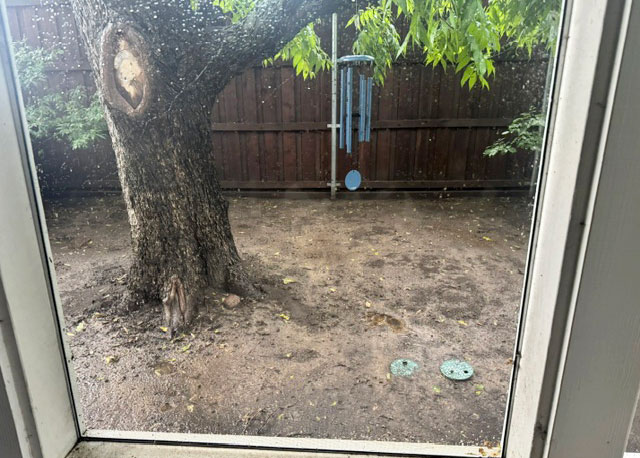
Images clickable for larger views.
Answer: That’s a huge challenge. The ground is bare because of all the shade, I assume. However, two large dogs on such a small plot would also trample any plant – even mondograss. Her best bet would be a medium-sized, rounded gravel (marble-sized to something slightly smaller than ping pong balls). I would not use granite. Its corners are too sharp. She would want a large type of pea gravel. It needs to be something she could wash with a hard stream of water. If they’re female dogs she could plant a few shade-tolerant hollies such as dwarf Burfords in an irregular cluster just to break up the sharp lines of the plot, but they should be planted out of 10-gal. or larger pots, so the dogs don’t destroy them. I would be concerned that male dogs might mark the shrubs as their own territory and in doing so burn the leaves.
QUESTION 2
CAN A ROOT BARRIER BE USED TO STOP ROOTS OF A 25-YEAR-OLD OAK TREE?
Question: To resolve a foundation issue, an engineer has recommended installation of a deep trench with a root barrier between our house and the tree. The tree is approximately 15 ft. from the house. Can this be done so that the tree will survive? Bob G., Keller.
Answer: I’ll answer without seeing the tree and the setting. Generically speaking, yes, it can. The trench should be as far from the trunk of the tree as possible to leave as many roots as you can. It would be far better to wait until October or November to do the trenching to let the tree get past its time of greatest demand for water (heat of the summer). You may want to thin the top growth of the tree somewhat to reduce the demand for water following the root pruning. And, perhaps most importantly, you probably should have a certified arborist working alongside the foundation people to be sure the tree has a professional “advocate” in the process. Our sponsors here in e-gardens (Arborilogical Services of DFW) do serve your area.
QUESTION 3
HOW CAN I SAVE MY JAPANESE MAPLE?
Question: Something (probably a squirrel or rabbit) is gnawing the bark on my Japanese maple. The chewed-away area is approximately 5×2 in. What can I do to stop whatever is doing the damage and to help the tree recover? Nancy W., Flower Mound.
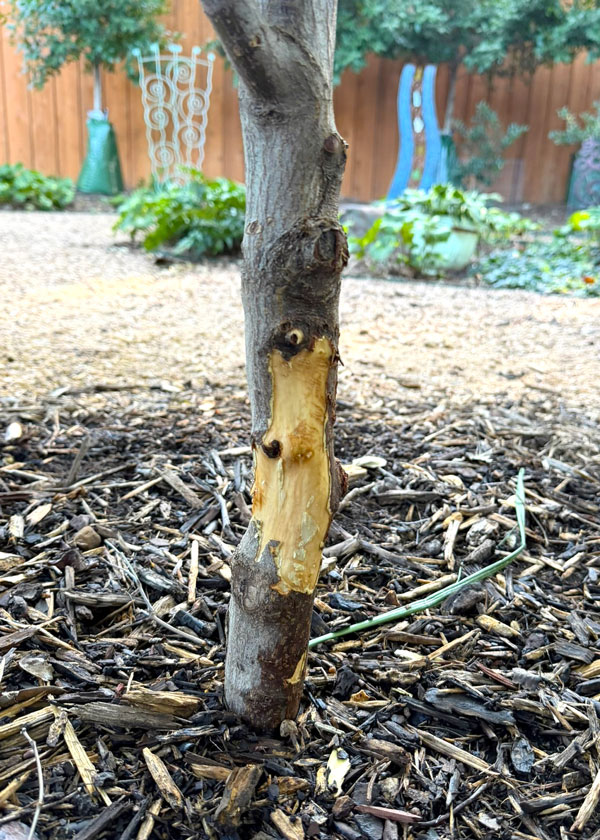
Answer: I doubt if it would be squirrels working that close to the ground, although the damage looks like something they would do. Rabbits are a possibility, and as much as I hate to suggest them, rats are also capable of doing this. They damage many trees each year. Whatever is doing it has been there recently. The damage is fresh, and you can see the pieces of bark on the ground.
The tree is going to have to make its own recovery. You can help it by preventing any further gnawing. The best way to do that is to make the entire process unattractive to the rodent. It might be use of the gooey product called Tree Tanglefoot applied to the trunk, but it definitely should involve a wrapping with either galvanized sheet metal or heavy chicken wire or hardware cloth. You don’t want anything that would eventually girdle the trunk. It needs to be left in place for a year or two so the animal doesn’t come back.
QUESTION 4
DID THIS WASP MAKE THE HOLE IN THE TRUNK OF MY CRAPE MYRTLE?
Question: A few days ago, I saw this wasp buzzing around a hole in the bark of my Muskogee crape myrtle. Did it make the hole? I haven’t seen any more wasps, and the hole isn’t enlarging. It does not look like the regular bark peeling that crape myrtles do. Miriam D., Garland.
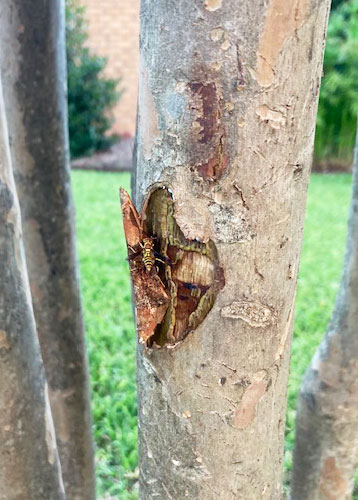
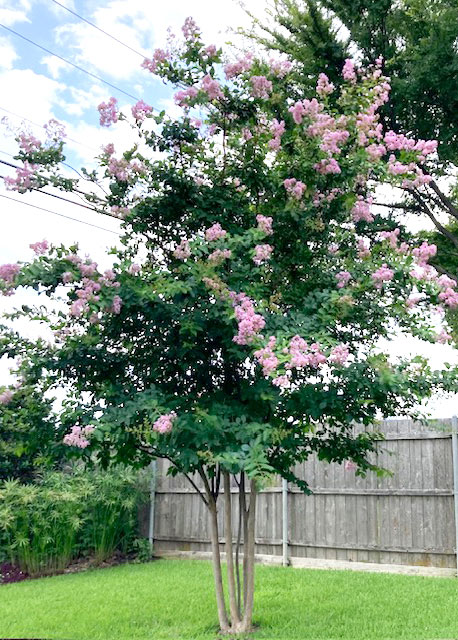
Images clickable for larger views.
Answer: I don’t believe this wasp had anything to do with the hole. There probably was a small twig that died leaving a stub in its place. That stub may very well have decayed leaving the hole where it (the stub) once was. I’ve seen this happen before.
Notice that the wood around the hole is gray and the peeling bark appears to be very dry. This is old damage.
Back to the wasp: It’s a beneficial insect. Unless it’s threatening to your family and guests I would just leave it alone and pretend to be its friend. There’s plenty of space on this earth for us all to exist.
QUESTION 5
WHAT CAUSES GARDENIA BUDS TO TURN BROWN?
Question: My gardenia’s buds brown right before opening up, then they fall off. What gives? Greg A., Rowlett.

Answer: Since the bud is browning from its base upward, that pretty well rules out disease and insect issues. My first thoughts were toward environmental fluctuations such as sudden temperature rises or letting the plant get too dry between waterings. Gardenias do better where temperatures are slightly cooler and conditions a bit more humid than Rowlett and Rockwall County in the summer. Try to keep your plant evenly moist at all times. Mulching might help. Hopefully it’s not getting afternoon sun.
QUESTION 6
WHAT ARE GOOD REPLACEMENT TREES FOR POST OAKS?
Question: What are your top 3 replacement recommendations for a post oak? We live in a post oak neighborhood, and they’ve been dying out. We need a tree that will blend in. Multiple arborists (including your sponsor) haven’t been able to save them.
Answer: You may have heard me refer to post oaks on my radio program as being “members of the Flat Earth Society.” They sail along very well, and then they suddenly die almost without warning. It’s as if they’ve sailed off the edge of the earth. Unlike almost any other species you will see, they have no in-between phase. They’re healthy one year and dead a year later. They also have shorter life expectancies than most other oak species. I would guess that to be 75 years. Many other oaks can live to be 150 to 250 years old, live oaks to 500 or 1,000 years.
Post oaks also have very little tolerance of human intervention. When we start building homes in their native environment, we can count on losing a certain percentage of them within 1-3 years. Grade changes and utility lines are their biggest enemies, followed closely by soil compaction.
If you had the folks from Arborilogical Services on the task, you had the best. There comes a time in the life of a post oak that “all the king’s horses and all the king’s arborists” can’t put a post oak together again.
To your question: Bur oaks. Best by far. Their leaves are much larger, but about the same shape. Both trees are large and rounded. Bur oaks blend in well and they’re very durable trees. They would be my only choice personally.
However, if you wanted a couple of other species you could include in your landscape, cedar elms commonly grow mixed in with post oaks. And Shumard red oaks look good with any trees.
QUESTION 7
HOW CAN I ELIMINATE OLEANDER APHIDS ON MY MILKWEED PLANTS?
Question: I am raising milkweed plants as a food crop for monarch butterflies, but they are covered with what I have found out are oleander aphids. What can I do to control the aphids without harming the monarchs? I’ve been using Neem oil, and I’ve been washing them off with my mister tuned to a spray. Pamela, College Station.
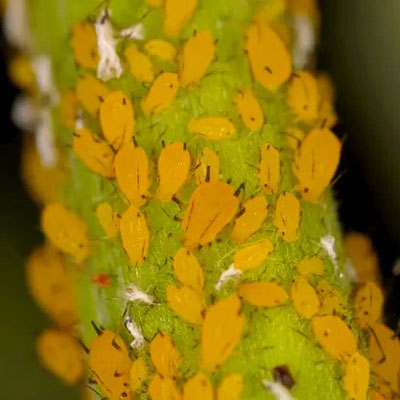
Pamela called my statewide radio program Saturday morning. I told her I had always had good luck with this type of aphid and with other aphids just hitting them with a hard blast of water, and that I would suggest trying that with another nozzle that might be more forceful – ramping it up to just below where it would do harm to the milkweed plants. However, I also told her I would do some more homework to see if I found anything different.
Answer: The various university entomology sites that I researched said basically the same thing I had for starters. A brisk stream of water is the ideal starting point.
However, they had several additional tips that made good sense.
• Avoid over-feeding and over-watering your milkweed plants. You want steady, healthy growth, but if you apply too much water and fertilizer, you will get soft and succulent new growth and that, in turn, will attract aphids.
• Pinch or nip off heavily infested growing tips and leaves.
• Mash the aphids whenever possible, then rinse them off with water.
• Where practical, dip cotton swabs in rubbing alcohol and daub the aphids off the plants. (That seems tedious to me.)
• Encourage beneficial insects, notably ladybugs.
• Avoid using systemic insecticides at all costs when you’re counting on your milkweed plants to be a food source for monarchs. In fact, try not to use any insecticide.