
Q&A – Ask Neil: August 6, 2026
(Please read these instructions carefully.)
Before you post your question, please look at recent issues to see if someone else has already asked it. You might find your answer there.
HOW TO SUBMIT YOUR QUESTION…
• Click here to post your question. (Please post your question only one time.)
• Please use this link only for posting questions – not for standard e-mails.
• High-resolution photos (1-2MB – not thumbnails) attached with your question help Neil give you the best possible answer. Please check your photo for clarity and exposure. If you do not see “All images clickable for larger views,” your images’ resolution was not sufficient for enlargement. That might also have made it difficult for Neil to give you an accurate answer.
• Neil chooses questions of greatest reader interest. Plant IDs rarely fit that description.
• Neil requires your first name or initials, also your city or county for an accurate answer. (Texas is a very large state.)
• One question per reader per week, please.
• Watch for Neil’s reply in the next issue of e-gardens.
Note: If you have submitted your question and did not see the pop-up window for attaching your photo, please click here.
QUESTION 1
WHAT CAN BE DONE FOR SPIDER MITES ON TOMATOES?
Question: Help! My tomatoes are being destroyed again by spider mites. Year after year I try all the pesticides labeled for them plus all the other remedies, but nothing stops them. Do they remain in the soil? I do crop rotation, and I add new amendments each season. Is there anything else I can be doing to avoid them? Dorothy C., Sherman.
Answer: Tough question. I’ll do my best to help. Here are our challenges:
• Spider mites are not insects (with 6 legs – spider mites have 8 legs, same as ticks and spiders), so conventional insecticides may or may not help with them.
• We lost our consumer miticide Kelthane more than a decade ago. No home-gardener product was brought into the market to replace it.
• Spider mites do most of their damage on the undersides of plants’ leaves, so it is difficult to get any type of spray to reach them.
• They feed on a large percentage of native and landscape plants in Texas, so there is always a ready population at hand.
• They thrive in hot, dry conditions, so their populations increase rapidly in late spring and early summer, just when many people’s tomatoes start setting fruit.
• Their first impact is usually to plants’ lower leaves, then it progresses upward. It is easy for them to get out of hand before gardeners realize it.
• Eggs hatch rapidly, so populations can continue to rebuild after treatment.
• Broad-spectrum insecticides often kill their natural predators, so populations of mites may actrually increase with their use.
All of that said, here are my suggestions…
• Plant your transplants early so most of your crop can be finished by the end of June. Know the average date of the last killing freeze for your county and plant somewhere around that date.
• Keep your plants healthy and vigorous by regular watering and feeding. Spider mites are more damaging to plants that have been neglected. Mulch well and keep weeds away from the tomatoes.
• Learn to recognize early signs of their presence. Look for pale yellow stippling of the lower leaves. When you see it, examine the backs of the leaves carefully. You may see the mites with the unaided eye, but a simple hand lens should definitely show them if they are present. Or you can thump the leaf over a sheet of white paper.
• Insecticidal soap is recommended by many university websites. Apply it in early morning or late evening to avoid damage to the plants’ leaves on sunny hot days.
• Check the leaves every 5 days for signs of living mites. If they keep coming back switch to one of the general-purpose insecticides for a one-time spray, then check again 5-7 days later.
• Above all, try tomatoes in a fall garden in Texas. Spider mites won’t be a factor since temperatures will be falling. Planting time in Grayson County would be July 1, so that’s a project for next year.
QUESTION 2
WHAT IS WRONG WITH MY LANTANAS?
Question: My Chapel Hill lantanas appear really sick. The leaves are turning white on both sides. I think it’s powdery mildew and I’ve cut them back as well as sprayed with an insecticide just in case. Do I need to cut them back even more? Michael G., Mansfield.
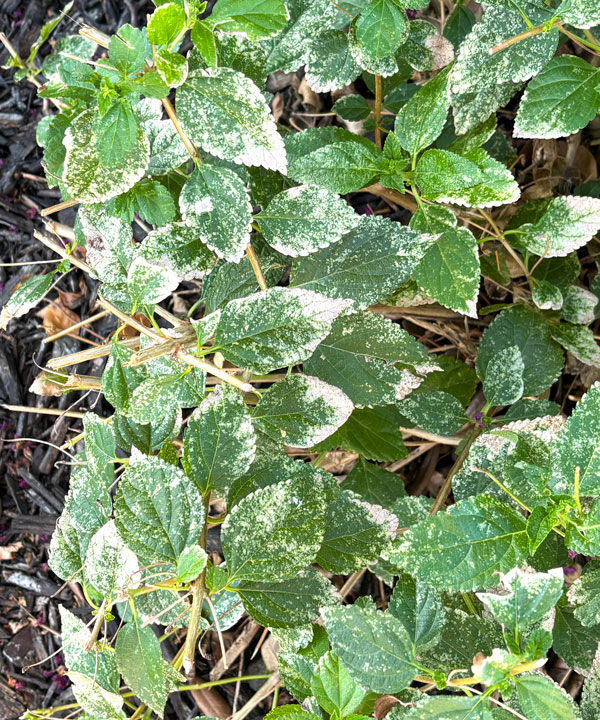
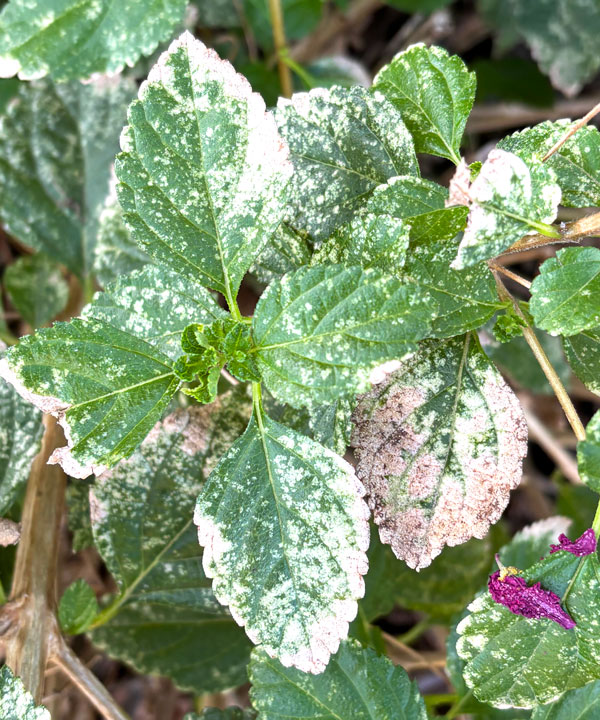
Images clickable for larger views.
Answer: This is the work of lace bugs. The BB-sized adult insects have cellophane-like wings making them difficult to find in many cases. They leave black beads of excrement behind as their gifts. Your plants can rebound very quickly. Trim them lightly to remove the damage, then apply a high-nitrogen, water-soluble plant food to stimulate new growth. Water them deeply and stand back. Good things should quickly ensue.
QUESTION 3
WHY DID MY SANTA ROSA PLUM HAVE VERY FEW FRUIT?
Question: My Santa Rosa plum was covered with blossoms, but very few fruit developed. I saw only a few bees around the tree, and now it is overgrown with water sprouts. Should I trim those off or wait until fall? Are the sprouts a result of lack of fruit? Karen C., Hurst.
Answer: There are more questions in there than you probably realized. As you are aware, you must have bees to pollinate fruit crops. And ideally, you’ll want a second variety of plum that blooms at the same time to ensure good cross-pollination.
However, Santa Rosa plums are not on any A&M recommended list for Texas. You will want to plant Methley (self-pollinating), as well as an excellent variety for cross pollination), Morris, or Ozark Premier.
As for the water sprouts, those may indicate that your tree is in distress. They typically show up when the top of a tree of any species is struggling, whether because of freeze dieback, insect damage, or other serious injury. In the case of plums and peaches they often suggest that peach tree borers have hit the base of the tree and that the top of the tree (above the graft) is about to be lost. When that is happening, you will usually see accumulations of sap coming out of the base where the borers have chewed their tunnels. By then it’s usually too late to correct the problem. In fact, it’s tough to prevent peach tree borers from getting into peaches and plums in the first place.
All that, of course, is just an assumption since I have no photo on which to base my suggestions. I hope it’s of help.
QUESTION 4
WHY WOULD TWO CRAPE MYRTLES BE REACTING DIFFERENTLY?
Question: Why would my two crape myrtles be behaving differently? One is thriving and the other not so much. I’m watering them on the weekends with a soaker hose. The one is not doing as well. Any suggestions? Nixie R., Ellis County.
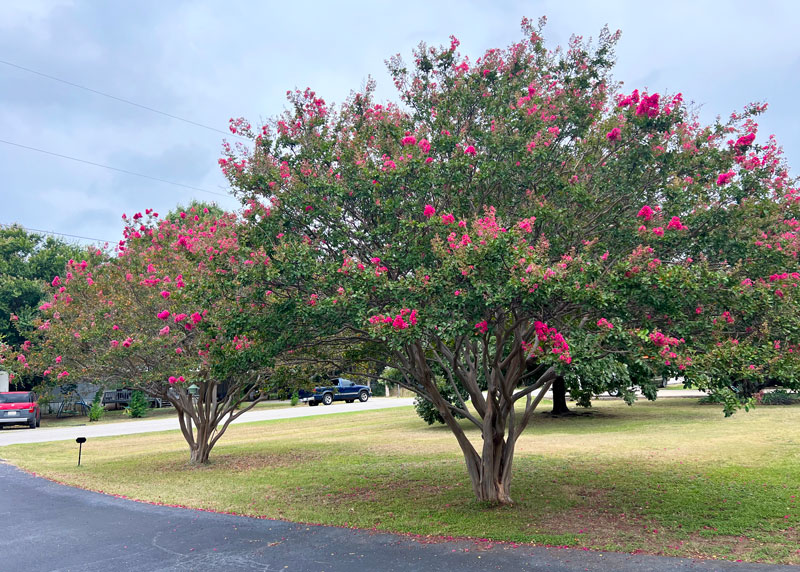
Answer: They are both lovely plants and obviously of the same variety. That was my first concern before I saw your photo – that perhaps you had two different varieties.
Are you sure the plant closer to the road is getting as much water and fertilizer? I’m using the grass as an additional clue. It mirrors the look of the crape myrtle: not as green and not as full as the grass around the more vigorous crape myrtle. Maybe you’re not running the water as long as you are for the larger, more vigorous plant. Set a timer to see.
Do something else just as a comparison. You wouldn’t even need to send the samples off to a lab for this one. Dig a couple of soil samples from the drip line of each tree. Perhaps there is more gravel in the soil beneath the front tree. Maybe it’s planted in soil that was pushed up when the ditch was created decades ago. You may need to compensate for any difference in soil by watering and feeding more often, less at each time.
It looks like there are browned leaves on the left side of the canopy of the tree in question. If so, that might point to that tree’s having gotten too dry earlier this summer. It could also suggest weedkiller injury, a small gas leak, or some other totally random problem.
As I warned you, lots of questions, and maybe one vital clue that could get you to a good answer.
QUESTION 5
WHY ARE MY HYDRANGEA BLOOMS GREEN?
Question: My hydrangea blooms are green. They’re in their second year in this bed. I’d like them to return to blue. What do I need to do next year? Could they be turned pink? Margaret H., Plano.
Answer: Mophead hydrangeas (what we typically grow for blue or pink floral heads in our landscapes) turn green as they age. Your plants’ blooms have passed their prime. They will change from green to tan and eventually crisp.
They will produce blue heads in acidic conditions such as they would find in the East Texas Piney Woods (but not in Plano in the Blackland Prairie). It is extremely challenging to acidify the highly alkaline soils and with the highly alkaline irrigation water of the Metroplex. You’d be hard pressed to make enough difference to keep hydrangeas blooming blue.
Pink flower heads are produced in alkaline conditions. They’re more achievable in your setting. Grow hydrangeas in highly organic soil (no native Blackland soil), with a little sun in early morning, then shade the rest of the day. Keep them constantly moist, never allowing their large leaves to wilt.
QUESTION 6
WHAT GRASS IS BEST FOR VERY SHADED AREAS?
Question: I called you two weeks ago on the radio and asked about mowing height difference and soil in my yard. I was going to submit to photos, but I don’t see an option, so I will just ask the question: what grass do you suggest for a very shaded area? Dustin, Sweetwater.
Answer: There is an option for submitting photos. See the instructions at the top of this page.
As for the best turfgrass for shade, it’s St. Augustine. However, even it must have 6 hours of direct sunlight daily during the growing season to survive. If you have less than that you’ll have to opt, instead, for a shade-tolerant groundcover like mondograss (“monkeygrass”), liriope, English ivy, or purple wintercreeper. I very much prefer regular mondograss. It grows well in the shade, plus it does not have runners to snag fallen leaves.
Dwarf mondograss would seem to be a good option, but it is far too slow growing, too expensive, and also too susceptible to crown rot fungal problems in wet weather. Stick with regular mondograss planted in tennisball-sized clumps spaced 10 in. apart. That can be expensive if you have a large area to cover, but you can often find someone who wants to eliminate part of a bed. It transplants easily. Fall is a great time to do so.