
Q&A – Ask Neil: August 20, 2026
(Please read these instructions carefully.)
Before you post your question, please look at recent issues to see if someone else has already asked it. You might find your answer there.
HOW TO SUBMIT YOUR QUESTION…
• Click here to post your question. (Please post your question only one time.)
• Please use this link only for posting questions – not for standard e-mails.
• High-resolution photos (1-2MB – not thumbnails) attached with your question help Neil give you the best possible answer. Please check your photo for clarity and exposure. If you do not see “All images clickable for larger views,” your images’ resolution was not sufficient for enlargement. That might also have made it difficult for Neil to give you an accurate answer.
• Neil chooses questions of greatest reader interest. Plant IDs rarely fit that description.
• Neil requires your first name or initials, also your city or county for an accurate answer. (Texas is a very large state.)
• One question per reader per week, please.
• Watch for Neil’s reply in the next issue of e-gardens.
Note: If you have submitted your question and did not see the pop-up window for attaching your photo, please click here.
QUESTION 1
IS IT UNUSUAL FOR THIS ORANGE FLOWER TO GROW SO TALL?
Question: I had one of these orange flowers in a smaller pot and it didn’t do well. This one came up on its own in this large pot and it has grown so tall. What is it, and is this usual? Lisa L., Dallas.
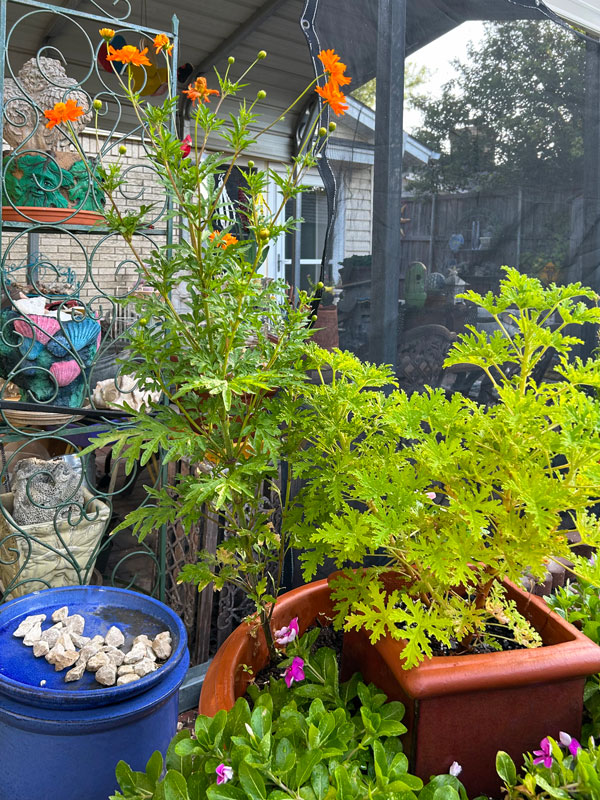
Answer: This is orange cosmos, Cosmos sulphureus, and yes, it grows tall when it’s given full sun, good soil, and ample moisture. It also reseeds itself freely. It’s a pretty plant if you have space for it (usually in ground beds).
QUESTION 2
MY JAPANESE MAPLE WILTED AND SHRIVELED.
Question: My Japanese maple is 4 years old. It has been a delight in the corner of my yard with azaleas near its feet. It leafed out beautifully in the spring, then one week in April I noticed the leaves wilting and shriveled. The bed gets plenty of water. Selah H., Arlington.
Answer: I posted your note verbatim. Without a photo, I have no clues. Just an apparently dead tree. I guess I would check the trunk to see if it is offering to put out any new growth. Sometimes grafts will fail and the tops will die. In those cases, the root systems will push out new shoots from below. Hopefully your tree receives no sunlight. Although they will tolerate sun farther east in the Piney Woods, Japanese maples in the Metroplex climate need total shade. It’s apparently made it through the three previous years, so perhaps it suddenly grew tall enough that its leaves were exposed to direct sunlight (above a fence or wall or beyond the shade of an adjacent tree). Without more on which to build an answer (especially a couple of photos), I’m out of gas.
QUESTION 3
WHAT IS THE DIFFERENCE BETWEEN “DROUGHT-TOLERANT” AND “DROUGHT-RESISTANT?”
Question: What is the difference, in terms of watering needs, between “drought-tolerant” and “drought-resistant” plants? During this hot, dry summer, do I need to be watering “tolerant” plants? “Resistant” plants? Plants involved: autumn sage, Esperanza, Turk’s cap, rock rose pavonia. MAC, Tarrant County.
Answer: When I hear those terms, my mind translates them into exactly the same meaning. “Half a foot.” “Six inches.”
Practically speaking, I translate it to mean that if I want them to grow and bloom nicely, I’d better water them. If I’m just willing to watch them survive to prove that they can make it through some really tough times and still come out looking ragged and rugged, they’ll do that. I can take my choice, but if I’m going to spend time and money planting them, I’m not going to pinch pennies by cutting back on the water unless is there is a water shortage. I can do my part in conservation by avoiding the water-hogging plants, and you have none on your list.
QUESTION 4
WHAT IS THIS WHITE STREAKING ON MY MEXICAN PETUNIAS?
Question: This is the second year my Mexican petunias have gotten this white affliction. I’ve tried cutting them down. I saturated them with Neem oil throughout the spring. Nothing else in my garden is affected. They bloomed beautifully for years before. Kathy L., Southlake.
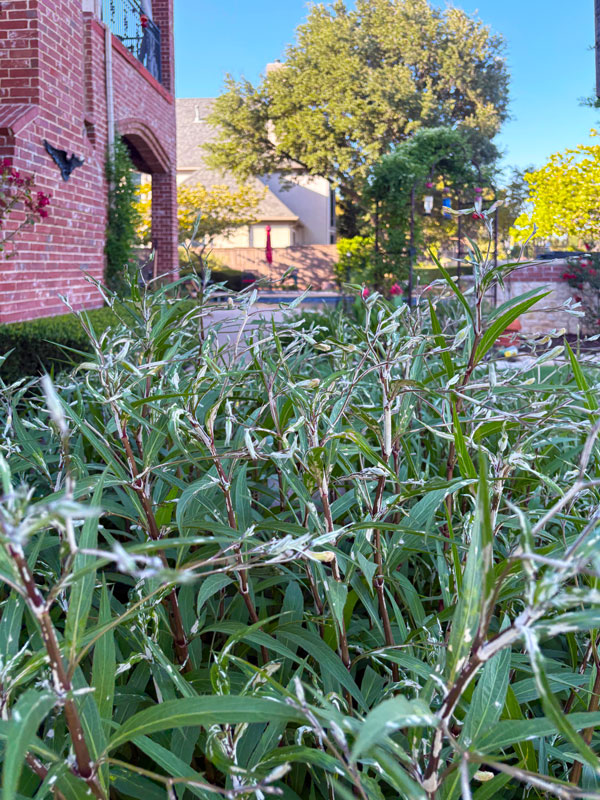
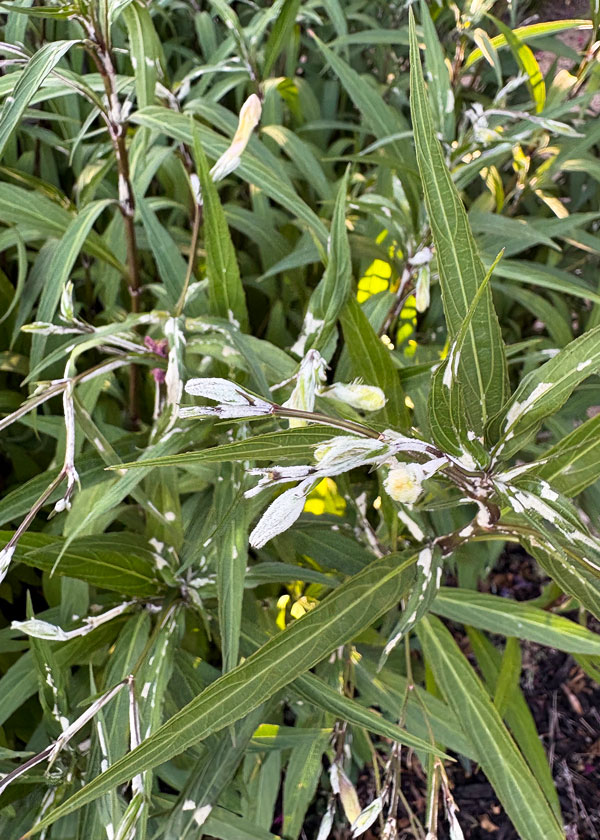
Image clickable for larger view.
Answer: This is a growth distortion called Ruellia erineum caused by the eriophyid mite Acalitus ruelliae. The galls appear to be fungal, but they are plant tissues that result from the mites’ feeding activities. This mite feeds exclusively on plants in the genus Ruellia.
There’s not a lot written at the consumer level from university research on this problem. What little I found mirrored what you have done. Cut the plants to the ground. Ruellias come back vigorously. Discard all cut tissues in black plastic trash bags that you send to the landfill. I didn’t see the suggestion that you remove all debris from beneath the plants, but that has to be another place these pests could be surviving. It can’t hurt to keep the bed clean.
Neem oil will offer help but be sure to spray both top and bottom leaf surfaces and all the stem surfaces as you spray. These mites feed in those areas. Keep pruning out and discarding any new populations that recur next year.
I spent 40 minutes researching your answer. I hope some part of it will be an improvement to where you are now. Other than its invasive nature, I like this plant, too.
QUESTION 5
WHAT HAS HAPPENED TO MY LACEBARK ELM?
Question: We have a lacebark elm. It was planted 6 years ago when it was less than 1 in. in diameter. Now it is 6 in. in diameter. Recently, within less than 2 weeks, all its leaves turned brown. I have tried watering it, Insect, Disease, and Mite Killer and a Nematode drench. Help! Is it too late? John Z., Godley.
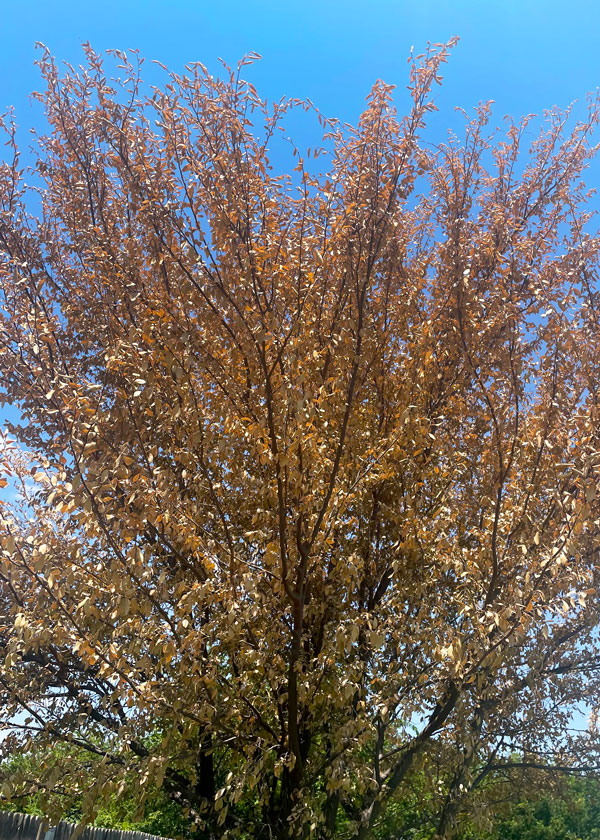
Answer: The problem is at the opposite end of the tree from what is shown in your photo. Unless you’ve mis-applied a weedkiller, your tree has succumbed to the soil-borne fungus cotton root rot. Lacebark elms are notoriously susceptible to the disease, as are several other tree species such as maples, apples, and pears. The fungus can rest dormant in the soil for 10 or 15 years, then suddenly spring forth and kill even a mature tree almost overnight, just as you described. Unfortunately, there is nothing you can do to prevent or cure it other than to plant a resistant species. Cedar elms, by comparison, are highly resistant, along with live oaks, bur oaks, Chinquapin oaks, and Shumard red oaks, pecans, and magnolias. Crape myrtles and hollies are as well if you’re ever looking for a shorter species.