
Q&A – Ask Neil: August 27, 2026
(Please read these instructions carefully.)
Before you post your question, please look at recent issues to see if someone else has already asked it. You might find your answer there.
HOW TO SUBMIT YOUR QUESTION…
• Click here to post your question. (Please post your question only one time.)
• Please use this link only for posting questions – not for standard e-mails.
• High-resolution photos (1-2MB – not thumbnails) attached with your question help Neil give you the best possible answer. Please check your photo for clarity and exposure. If you do not see “All images clickable for larger views,” your images’ resolution was not sufficient for enlargement. That might also have made it difficult for Neil to give you an accurate answer.
• Neil chooses questions of greatest reader interest. Plant IDs rarely fit that description.
• Neil requires your first name or initials, also your city or county for an accurate answer. (Texas is a very large state.)
• One question per reader per week, please.
• Watch for Neil’s reply in the next issue of e-gardens.
Note: If you have submitted your question and did not see the pop-up window for attaching your photo, please click here.
QUESTION 1
CAN DIMENSION OR GALLERY BE APPLIED WITHIN DRIP LINE OF A MATURE TREE?
Question: Can Dimension or Gallery pre-emergent herbicides be applied within the drip line/root zone of a 50-year-old American elm tree? Tom H., Rowlett.
Answer: Great job of asking before you make an application. You do realize that that doesn’t happen as often as it should?
You will be completely fine in using either of those products according to label directions within the drip lines of your elm tree. They only impact germinating seeds as they attempt to sprout. Go for it!
QUESTION 2
HOW IS THE NATIVE PURPLE VERBENA WILDFLOWER STARTED?
Question: I really like the native purple verbena Texas wildflower. I’ve tried to transplant them without luck. If they can’t be transplanted, how can I buy seeds and start them? Raeford C., Woodway.
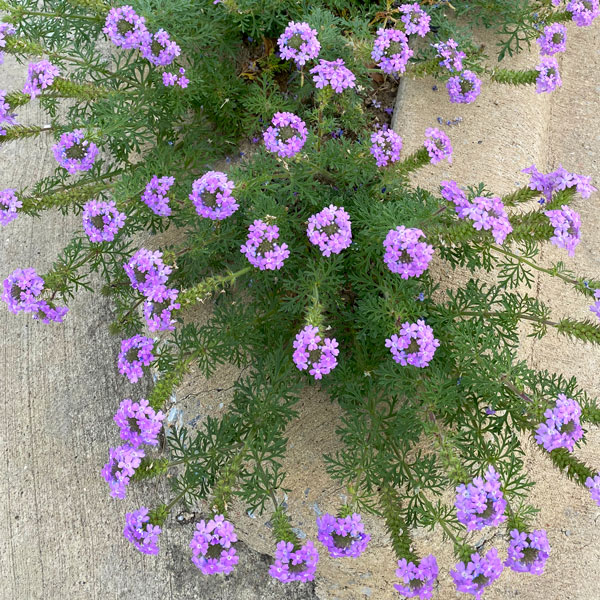
Answer: It is a lovely short-lived perennial that might also be considered to be a reseeding annual, especially from your area (Waco) northward. It is better to start it from seed than by trying to transplant it.
You need to look for the plant called “prairie verbena,” Glandularia bipinnatifida. At one point it went by the scientific name of Verbena bipinnatifida and you may still see it listed that way occasionally. I would avoid using that name in searches, however, and I would not look for “wild verbenas” or any other general term that might get you a random type of mixture.
I’ve admired this plant for decades. It seems to survive drought, really poor soil, intense sun, and most other types of abuse and still keep flowering. It makes a wonderful carpet of blooms 8 or 10 in. tall as the plants spread to 15 or 20 in. wide. Its dark green, highly incised leaves are the perfect backdrop. It is many times more durable than our common garden verbenas.
I looked for sources and came up with these. I know there are others.
• High Country Gardens
https://www.highcountrygardens.com/search?q=Glandularia+bipinnatifida&options%5Bprefix%5D=last
• American Meadows
https://www.americanmeadows.com/products/dakota-mock-vervain-wildflower-seeds
• Native Flora Seeds
https://nativefloraseeds.org/products/prairie-verbena
If you are trying to plant acreage there are sources that will sell larger quantities.
QUESTION 3
WHAT IS WRONG WITH MY NECHES CRAPE MYRTLE?
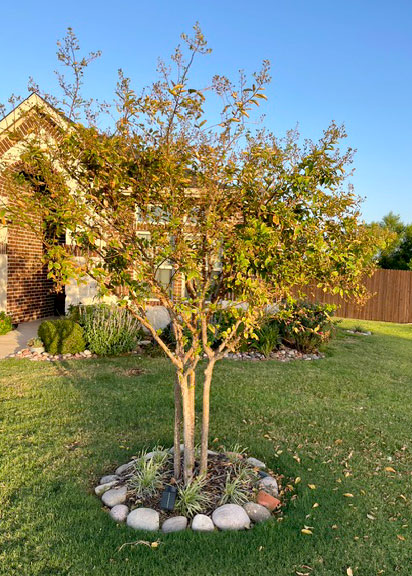
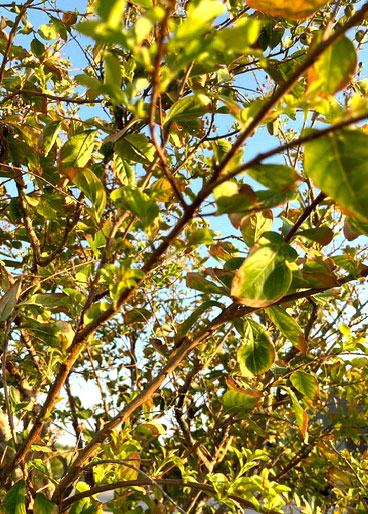
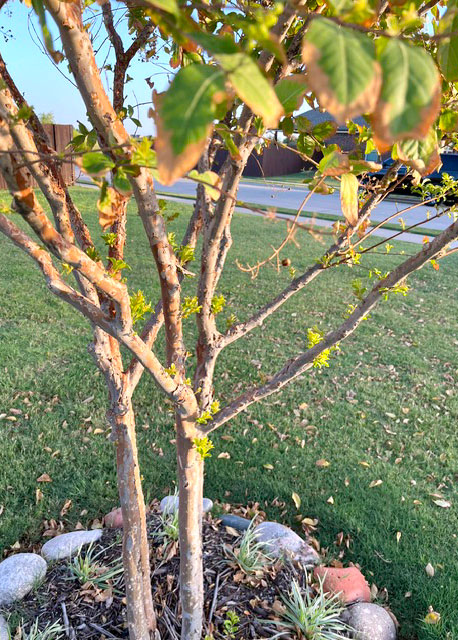
Question: My Neches crepemyrtle has been planted for 6-7 years from a 10-gal. container. It has a beautiful show all at once, but not much the remainder of the summer. The foliage is normally not great, but this year most of the leaves were pushed off. Brad L., Denton.
Images clickable for larger views.
Answer: I’m unfamiliar with a crape myrtle variety called “Neches.” I suspect you may be referring to Natchez, the very popular white variety, but these leaves don’t look like Natchez leaves. They’re more like the leaves of the old-fashioned types of Lagerstroemia indica – smaller and more rounded. Natchez leaves are elongated and more pointed. (See photos in Question 7 below.)
Your plant’s trunks, especially after that many years, don’t look like trunks of Natchez, either. They normally lose bark to reveal a lovely cinnamon secondary bark.
Putting that aside, however, the marginal browning of your plant’s leaves suggests moisture stress. It could be from the plant’s having gotten too dry, although I do notice that your lawn and the rest of the landscape look like they’ve been kept properly watered. Excessive fertilizer could cause it. So could trunk damage due to freeze injury of the past several winters, but I don’t see the obvious symptoms.
I’m coming up dry on ideas. My best suggestion would be that you apply a high-nitrogen lawn-type fertilizer to it next April and again in early June followed by deep and frequent soakings in spring and through the summer. See if you can’t promote some vigorous growth that could, in turn, support additional rounds of blooms.
One final thought: Check your water source to be sure it’s not high in sodium. Denton isn’t known for having that trouble, at least not in my memory, but maybe you have an unusual situation where you have water that could be leading to leaf scorch during hot weather. Whoever is supplying your water would know that. It’s a reach, but worth asking.
QUESTION 4
HOW DO WE FIND SOMEONE TO DESIGN A DROUGHT-TOLERANT LANDSCAPE?
Question: My front yard (beds) are a mess. I want to create a beautiful and drought-tolerant environment. How do we find someone who specializes in that? Squirrels and rabbits ate everything we planted a couple of years ago. Alice A., Carrollton.
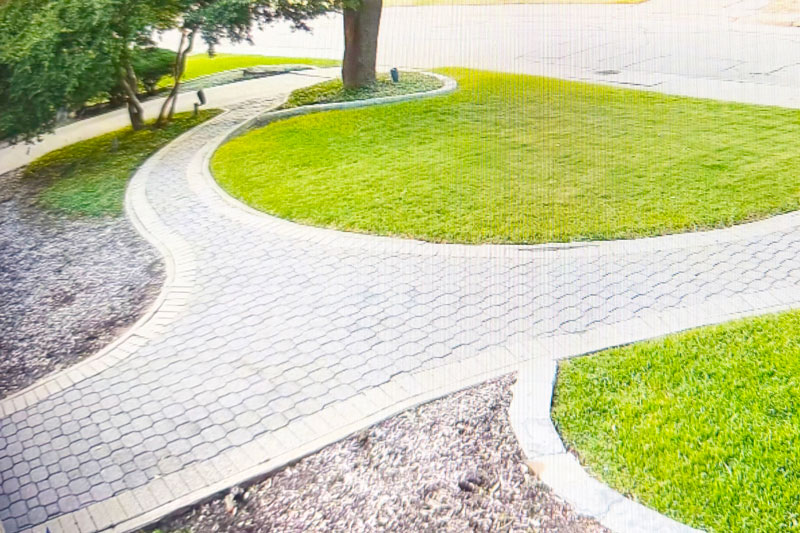
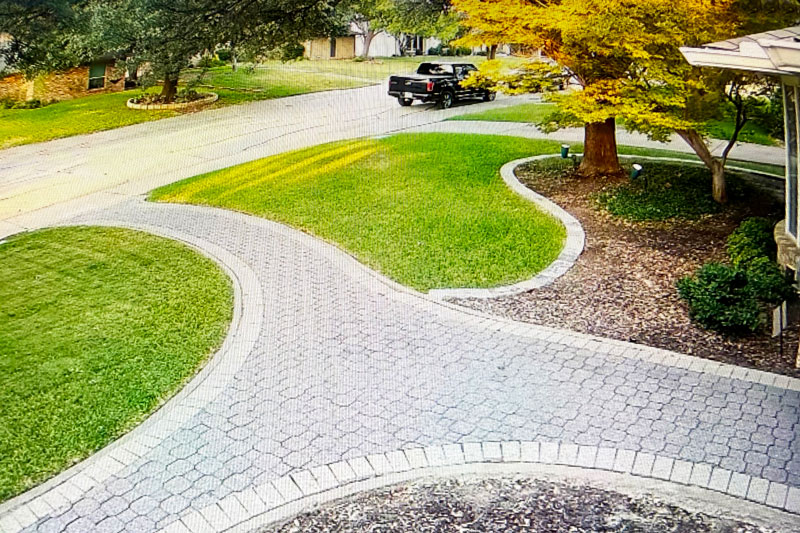
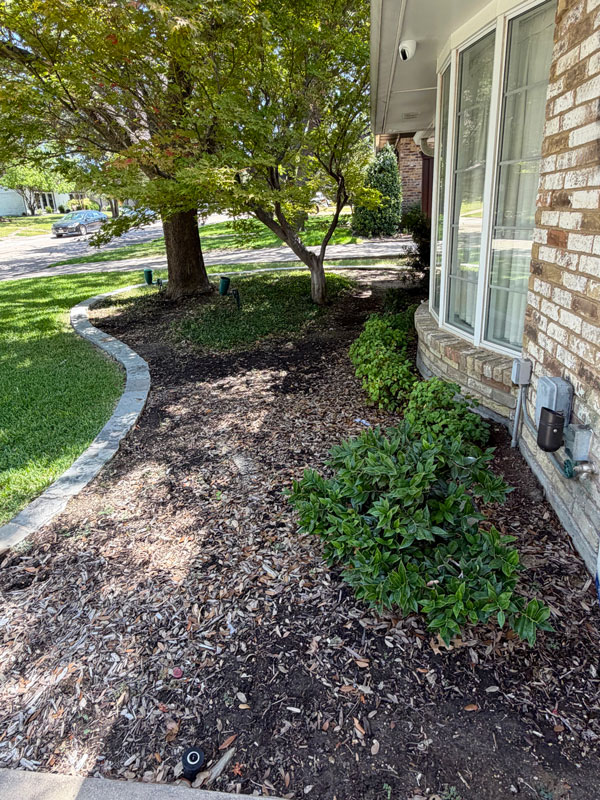
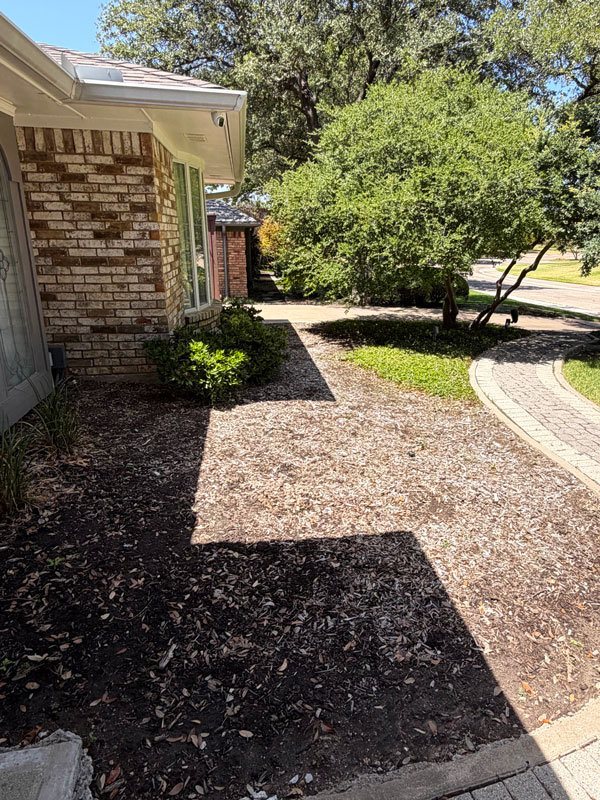
Answer: First things first: the framework of your landscape is beautiful. Your gracefully curved beds are some of the prettiest I’ve seen in a long, long time. If I were to move into your house, I would capitalize on them and use water-conscious plants that are not necessarily xeriphytes (dry-land plants). The rest of the landscape is lush and lovely, and there’s no reason that you should have to depart from that look, especially since you have a good bit of shade.
If you want to find a landscape contractor in your neighborhood who does work that would please you, my suggestion is that you drive around and knock on a couple of doors or leave notes at houses where the landscapes are especially appealing. People are flattered that someone else thinks their gardens are attractive, and they’ll usually happily share contact information if they’ve had help in getting the work done. Retail nurseries that also sell wholesale also can guide you to their customers who do outstanding design and installations.
However you do it, keep it simple. I would stay with a limited number of types of plants – say 4 or 5 types.
I rarely give landscaping suggestions in the Q&A section of e-gardens, and I know you didn’t ask for my ideas, but you’ve done such a nice job of laying it out that I couldn’t help myself. Here are thoughts that came to mind.
I like your use of Carissa hollies in the shade. Dwarf Chinese hollies are also among my favorites, and they could work on the opposite side (Photo 4) in a large naturally shaped cluster. I could see them where the shadow extends out from the house to the right (I think) of the door, but far enough from the door that they wouldn’t encroach on folks as they came up the walk. Let them fill in that shaded area that extends out from the house along the walk but only use 5 of them and space them far enough apart that they can grow unencumbered for the first many years. You could shear them as needed to keep them from getting too tall.
I’d put a dwarf Burford holly in the far corner, and I’d buy a large specimen for immediate impact. Any taller variety would get too large there.
If you wanted color, a tree-form Catawba crape myrtle (medium purple) would be pretty out in the sun near the walk – still referring to your Photo 4.
I think I’m seeing red yuccas beneath the windows. I’d use them somewhere else. They get too large when they bloom, plus they’re so informal with their floral spikes waving around at 4 ft. tall. I also fear the red might not look the best against the brick. I love the plant, but in a different setting.
That leaves us a large open space in Photo 4. If it were my landscape, I’d invest in 3 very large, simple and attractive pots and I would put annual color in them. You could change it out easily as the seasons changed. You could have a matching pot of equal size on the left side of your entry as shown in Photo 2.
As for groundcovers, I’ve had good luck with purple wintercreeper euonymus in full sun and mondograss in shade or morning sun, afternoon shade. This is in a rural setting complete with squirrels and rabbits. If you felt the need to have something growing beneath the windows you could always use giant liriope.
Another option for covering part of the space might be tennis ball-sized river rock. It’s attractive, and it gives you a no-maintenance cover that provides nice contrast with either of the groundcovers I mentioned.
So, that’s my start. Your landscape contractor will have different and likely better ideas. You’re already off to a great beginning. Have fun!
QUESTION 5
WHY IS MY HIBISCUS DROPPING ITS BUDS?
Question: Why are my hibiscus buds falling off without opening? I water every day due to the extreme heat. Several friends have had the same experience. Cindy P., San Antonio.
Answer: Hibiscus and their many relatives are notorious for aborting flower buds. It happens with tropical hibiscus that we grow in pots because they become rootbound and we can’t get enough water into their systems in hot summer weather. Along a similar line, roses-of-Sharon will set many buds in late spring’s rainy weather, and then, as it turns hot and dry, many of those buds will be shed without opening.
If your plants are in pots it might help to move them into a spot that gets a little shade in the afternoon (but full sun the morning). Otherwise, all you can do is to keep watering and hope for cooler weather soon.
QUESTION 6
IS THE POSSIBLE TO OVER-WATER NEW LIVE OAKS?
Question: I have 2 live oak trees that were planted 3 months ago. I water them every day with a hose and bubbler for 9 min., 5 gal. per min. An additional 20 gal. are put on by my irrigation system 4 days per week. Bobby L., Brazos Co.
Answer: You gave me every fact I need except the size of the container (or root ball) from which they were planted. That’s 45 gal. of water daily, plus 20 more gal. every other day (approximately). That’s a lot of water unless these were planted out of very large containers (100 gal. or so in size).
I use simpler math in giving my recommendations. At temperatures like we’ve been having, I suggest you give an amount of water equal to the size of the container from which the tree (any species) was planted, and that you do so every other day for the first two years. Do so with a water breaker or a water bubbler. So, a 10-gal. tree would get 10 gal. A 20-gal. tree would get 20 gal. And so forth. When temperatures drop to 95 degrees for a high, extend it out to every third day. At 90 degrees, every fourth day.
QUESTION 7
WHY THE DIFFERENCE IN LEAF SIZE?
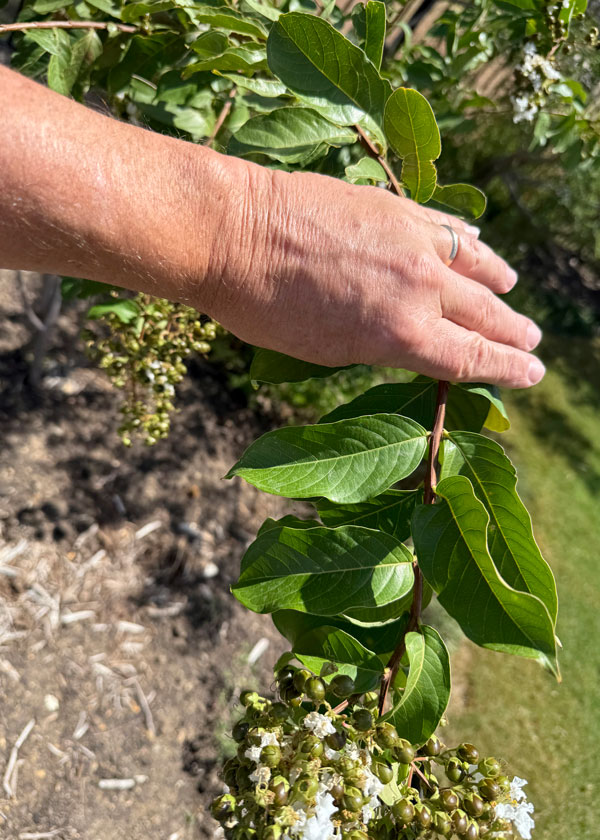
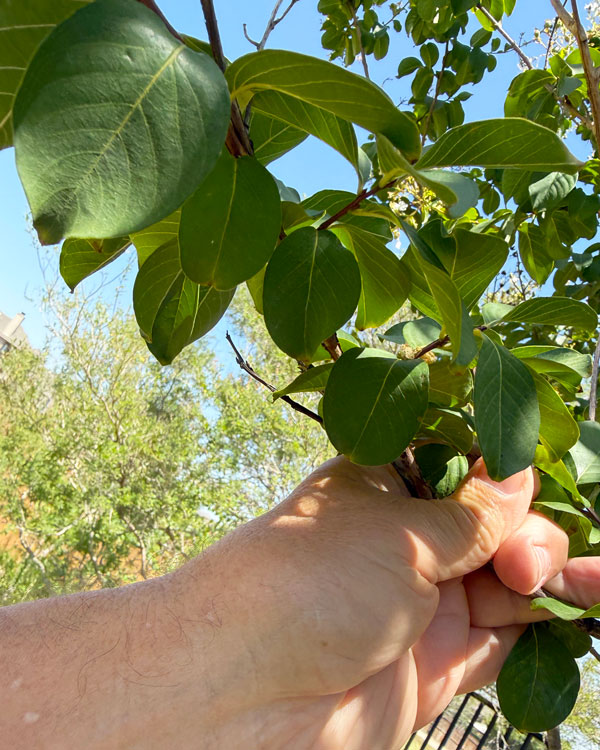
Question: I have 4 Natchez crape myrtles. They are all in the same general area. Two are 10 ft. tall and the other two are 6 ft. tall. My concern is their leaf sizes. Is the difference due to nutrients? Phillip D., Midlothian.
Images clickable for larger views.
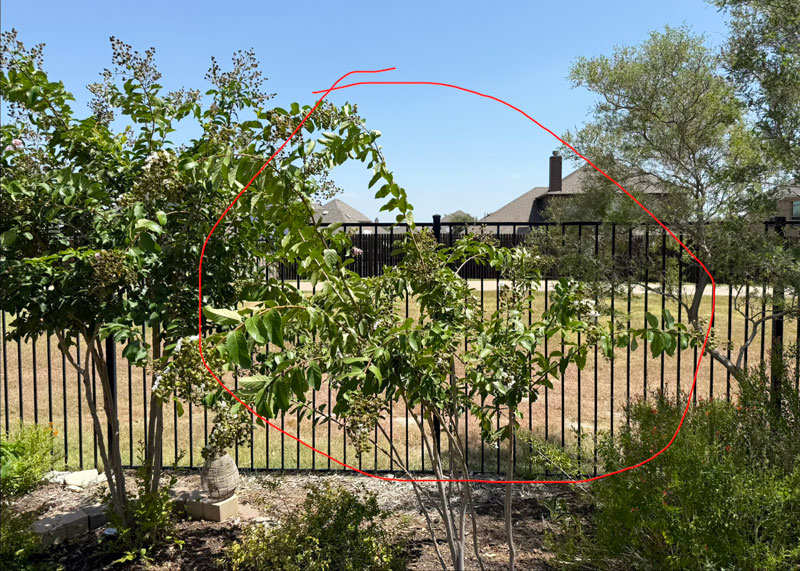
Answer: The photo showing your fingers and wedding band is the typical shape of Natchez leaves. It’s common for young plants to produce larger leaves when they have enough nitrogen and water. The photo showing your hand grasping the small twig and the smaller, more rounded leaves is probably from a plant that didn’t get as much nitrogen or water.