
Q&A – Ask Neil: September 24, 2026
(Please read these instructions carefully.)
Before you post your question, please look at recent issues to see if someone else has already asked it. You might find your answer there.
HOW TO SUBMIT YOUR QUESTION…
• Click here to post your question. (Please post your question only one time.)
• Please use this link only for posting questions – not for standard e-mails.
• High-resolution photos (1-2MB – not thumbnails) attached with your question help Neil give you the best possible answer. Please check your photo for clarity and exposure. If you do not see “All images clickable for larger views,” your images’ resolution was not sufficient for enlargement. That might also have made it difficult for Neil to give you an accurate answer.
• Neil chooses questions of greatest reader interest. Plant IDs rarely fit that description.
• Neil requires your first name or initials, also your city or county for an accurate answer. (Texas is a very large state.)
• One question per reader per week, please.
• Watch for Neil’s reply in the next issue of e-gardens.
Note: If you have submitted your question and did not see the pop-up window for attaching your photo, please click here.
QUESTION 1
WHAT IS WRONG WITH MY ST. AUGUSTINE?
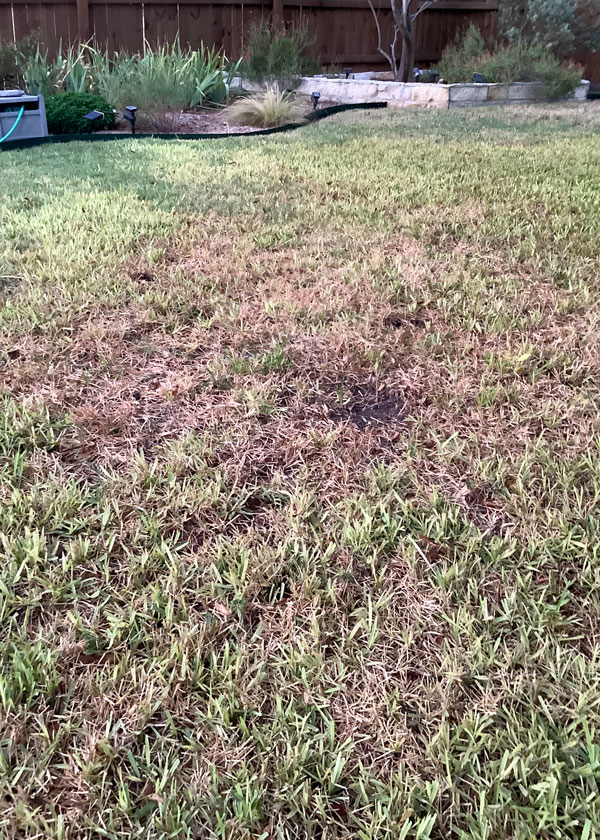
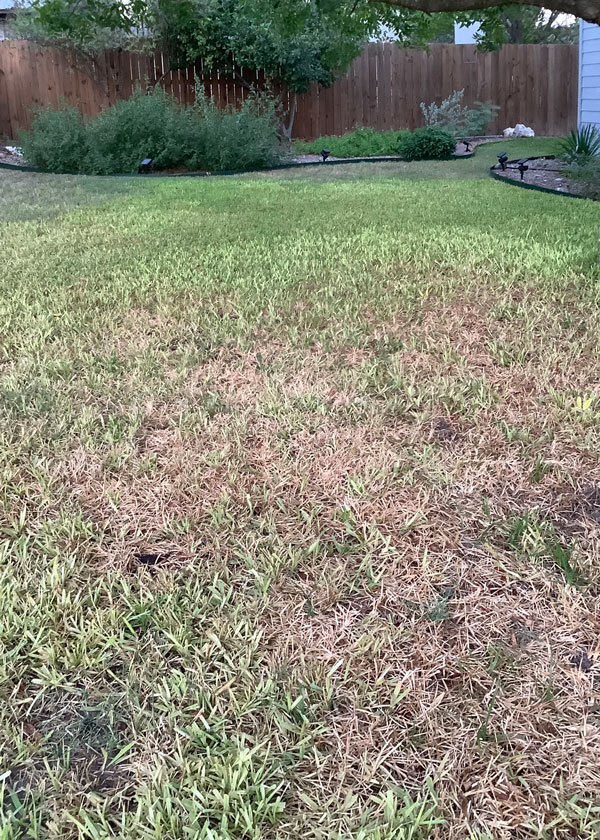
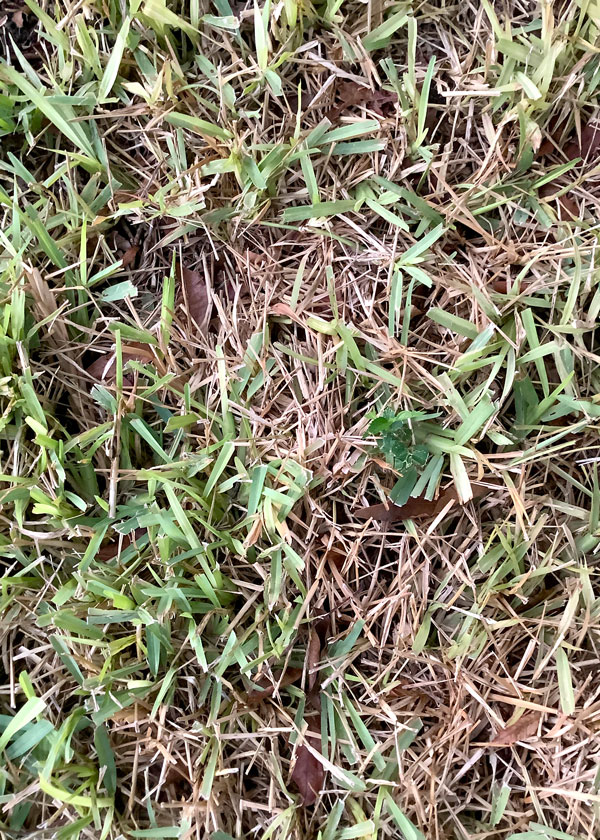
Question: What is going on with my St. Augustine? I thought it might be chinch bugs, but I don’t find any anywhere. I am finding ants everywhere. Carol N., Clifton.
Images clickable for larger views.
Answer: I can see why you might suspect chinch bugs. What I noticed early in examining your three photos was how dark green the bermudagrass is. That suggests to me that you might have fertilized your lawn sometime in the past 4-6 weeks.
If that’s the case, the St. Augustine may have suffered from gray leaf spot. It shows up in the hottest weather of summer, and it is accelerated by applications of nitrogen. Our lawns look yellow, so we apply nitrogen, and the fungus gets worse.
However, I would have expected much more visible symptoms on your close-up photo. (Thanks for the high resolution that I could zoom in on.) I do see some of the characteristic diamond-shaped brown lesions on the leaf blades in the top third of the close-up photo.
If you did have chinch bugs, I would have expected more of a “patchy” look to the lawn, with more distinctive dead and live areas. This grass is all mixed together. That might suggest a late-season outbreak of take all root rot. Pull on some of the runners that are still green. See if their roots are still firm, or if they pull up easily. If the latter, TARR could be the culprit. For either it or the gray leaf spot you could apply Azoxystrobin turf fungicide. I honestly can’t tell what the prime cause of the problem might have been.
It looks like an armadillo might have been digging in the middle, so there might be some white grub worms in the soil. If you wanted to dig a test area 1 sq. ft. in size and 5 in., deep you could get a better idea. You would have to see 5 or 6 white grubs per square foot to do this kind of damage, and it’s very early in the fall for it to be showing up already. But they may be your cause. If so, there are several good turf insecticides labeled for their control. If you find that kind of population you should apply one of those followed by a deep soaking.
I’m sorry not to have a clear answer for you. Hopefully I’ve given you a few trails to try. Perhaps together we can solve this.
Oh, and I don’t think the ants are doing anything more than just hanging out in a cool place. They are not the cause of your troubles.
QUESTION 2
WHAT HAPPENED TO OUR AUCUBA?
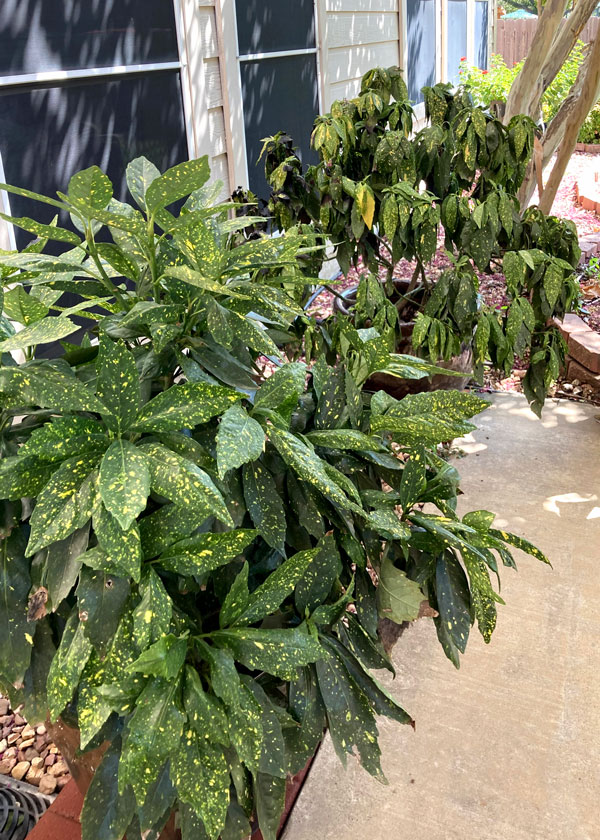
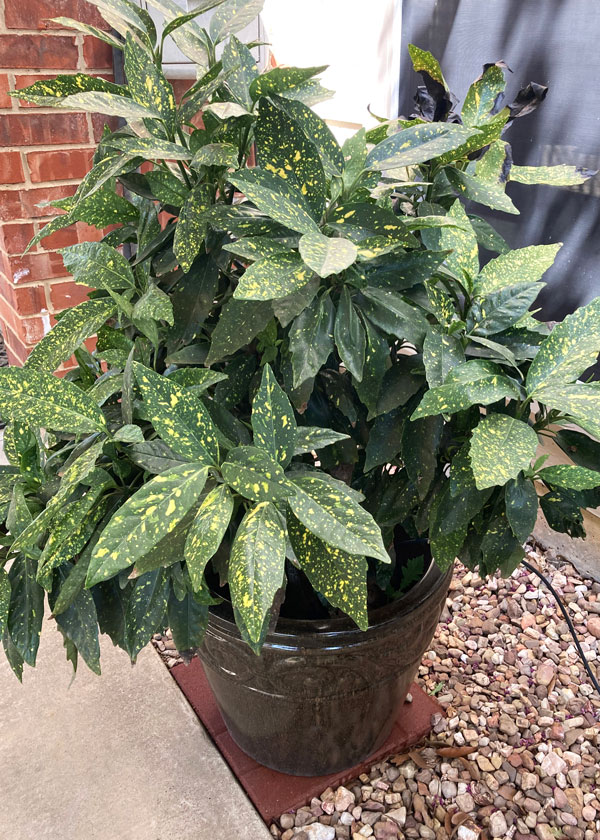
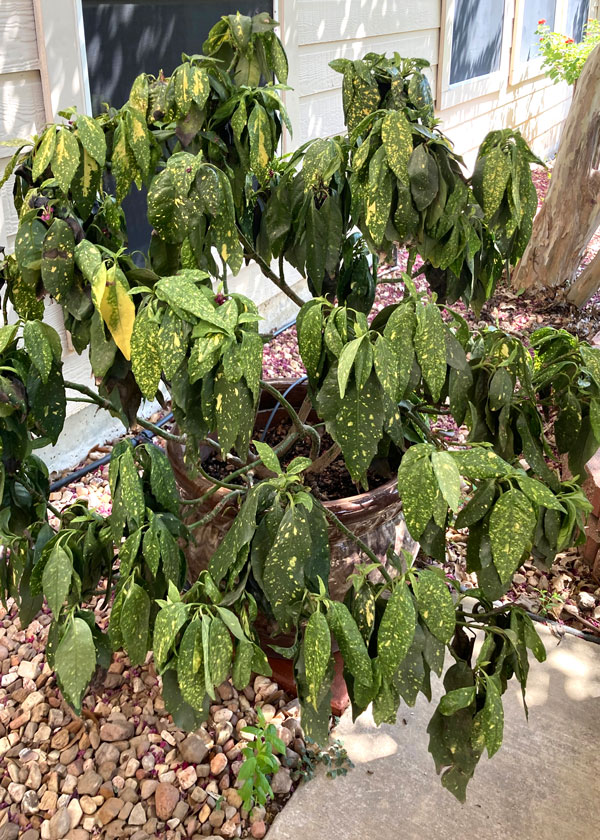
Question: We lost one of our aucuba plants this year. They were planted the same time about 10 years ago, receive equal water, sunlight, fertilizer, etc. For some reason one died. It looked as if the entire plant was stressed and then died. Any idea? Bob G., Keller.
Images clickable for larger views.
Answer: No insect or disease would cause this damage. If it had been in too much sun (they don’t tolerate very much), the exposed portions would have been turned coal black. I don’t see that.
The only thing that would cause an aucuba to look the way your plant looks would be to have gotten too dry one or more times. Regarding your “equal treatment” statement, aucubas, like all other plants and animals (including humans) will vary from one to the next even in the same set of circumstances. One plant certainly can dry out slightly faster than the one next to it. It could be something as simple as maybe it’s more rootbound.
QUESTION 3
WHAT IS DIGGING UP OUR ST. AUGUSTINE LAWN?
Question: For the past several weeks something has been digging up my lawn, mostly the St. Augustine. We’ve never had this problem before. What would cause this? Carol S., University Park.
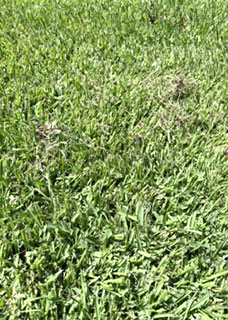
Answer: We live in a rural area with woods all around us. Armadillos and possums do this kind of digging. Raccoons will, too, but not as often. The damage doesn’t look severe. I’d suggest just clipping the loose grass off, filling the small holes with topsoil, and letting the grass fill back in. If you do see one of the animals (all night feeders), buy or borrow a humane trap of the appropriate size. Capture it and then release it in a sanctuary somewhere where it won’t bother farmers or gardeners. We just caught and released a possum last week. I have a description of capturing armadillos in the FAQ pages of my website.
QUESTION 4
SHOULD WE WAIT FOR WETTER WEATHER FOR THE FALL FEEDING?
Question: You mentioned fall fertilizing, but is it smart to do that right now in this drought? Should we wait until there is some rainfall? Phil K., Lewisville.
Answer: No. Water before you apply it. Wait a few days, then fertilize and water deeply. That will get the nutrients into the soil and therefore into the plants while there’s still time for them to be beneficial.
I’d be concerned about applying fertilizer much later. The first freeze in North Central Texas is less than 2 months away. I’ve experienced killing frost in my gardens in Collin County (fairly near you) as early as the last week of October. I don’t want to wait any longer to apply fertilizer, either in North Texas or, for that matter, along the Gulf Coast.
QUESTION 5
DO WE NEED AN ARBORIST OR JUST A “TREE GUY” TO TRIM OUR PECANS?
Question: We have 16 very large, old pecan trees. This year they are loaded with pecans, so much so the branches are breaking. We need to have them trimmed. Do we have to get an arborist or just a regular tree trimmer? (The nuts aren’t any good – it’s been too dry.) Please help: arborist or tree guy? Carran M., Cayuga.
Answer: If you crafted a loose layman’s definition of an “arborist,” it would be a “tree guy,” that is, a person who works with trees. The terms are almost interchangeable.
In that regard, I’m a “tree guy.” But I’m not a certified arborist. That’s something entirely different. I don’t have all the training on safe tree climbing, proper removal of branches, and techniques of lowering large branches to the ground. I also don’t have the insurance for me, you, any employees I might hire to help me, not to mention property damage should anything come out wrong in the process.
A certified arborist should have those things. But don’t be afraid to ask, if only for your own protection. Ask for referrals – ask for names of other people for whom they’ve done work. Talk to your local nursery owners. They’ll know the good ones. Your local office of the Texas AgriLife Extension Service probably can give you two or three names. If you can’t find a certified arborist who serves your area, look for a well experienced arborist who comes with a file folder of good recommendations.
Remember than an unskilled person with a chain saw can ruin 40 or 50 years’ worth of growth in less than an hour. Don’t take any chances.
QUESTION 6
CAN I TRIM THESE HOLLIES BACK BY 1-2 FT.?
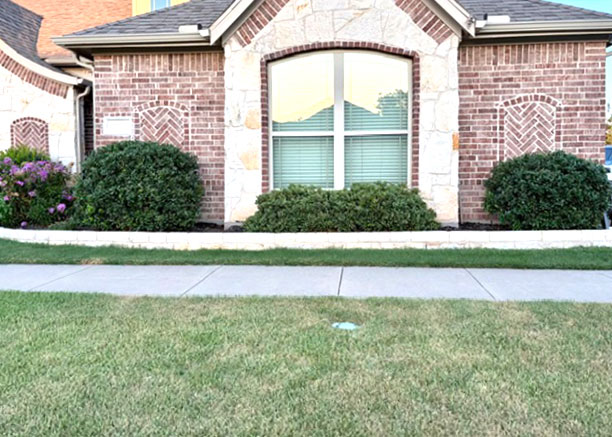
Question: These hollies have grown too tall. I’d like to trim them down 1-2 ft. What is the best way to do that? Karla B., Anna.

Images clickable for larger views.
Answer: They’re going to look very naked when you finish, so wait until late winter (early February), so you can take advantage of next year’s new growth to fill in the gaps.
I wish I could zoom in enough to tell which hollies you have. It looks like the taller ones could be dwarf Burfords and the shorter ones might be dwarf yaupons. I’ll answer accordingly.
If I were doing it, I’d do a rough cut with my power pruning shears 6-8 in. down so I could get a better idea of the branching. Then I would follow up with lopping shears to remove the large stem stubble. Try to maintain a fairly normal growth habit. Tidy up the last little twigs with a really good pair of bypass shears.
QUESTION 7
WHAT IS WRONG WITH MY PLUMBAGO?
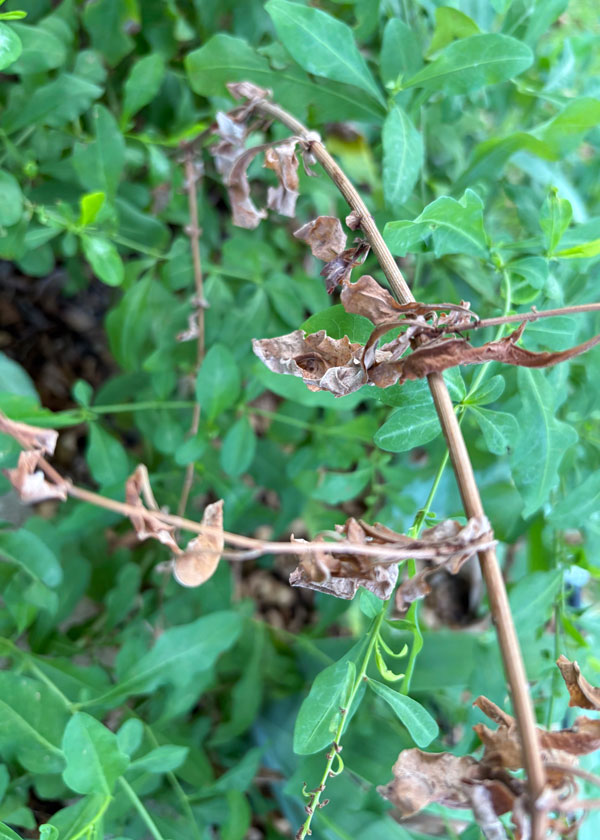
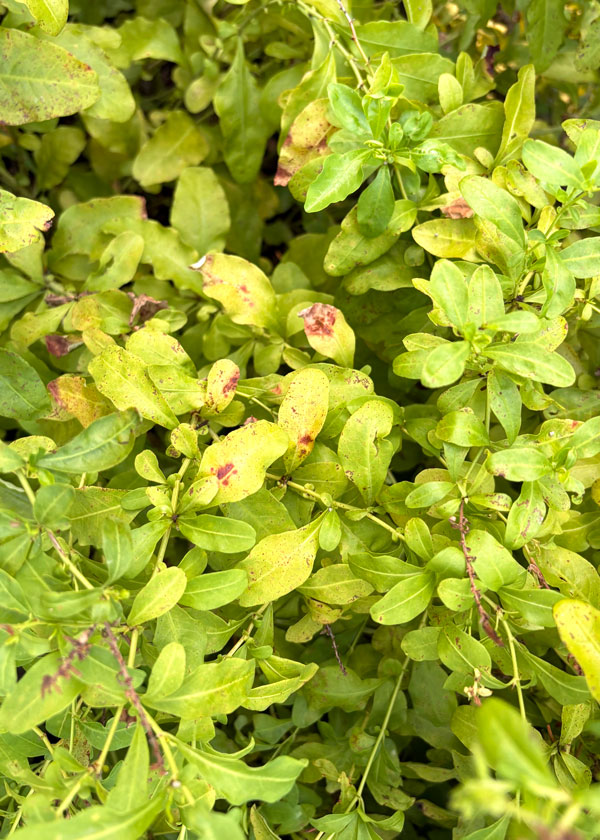
Question: What is wrong with my plumbago? I have a long hedge of it. Most looks healthy, but each year I have a few areas that develop this problem. Some of it gets afternoon shade. One quarter gets full sun. The planting gets a small amount of water applied by a soaker hose one time per week. Marty G., New Braunfels.
Images clickable for larger views.
Answer: The photo showing yellowed foliage and what might be assumed to be a fungal leaf spot looks like it has been in a lot of sun without enough water. Your own wordings of using “a soaker hose one time per week” and a “small amount of water” would seem to be the main cause of the problem.
You have enough time this season to try a quick remedy: soak the plants deeply. Wait a day, then apply a water-soluble, high-nitrogen fertilizer to see if you can get a quick pick-up in foliar color and vigor before it turns cool. Take photos at the same time mid-afternoon “before” and a couple of weeks “after” the feeding for comparison. Reason for keeping the same time of day is the big changes in color of sunlight later in the evenings.
As for the broken twig, I suspect that’s all that is. Something has cracked that stem and left it to dry. You can trace it back to see. Trim it out and you should be fine.